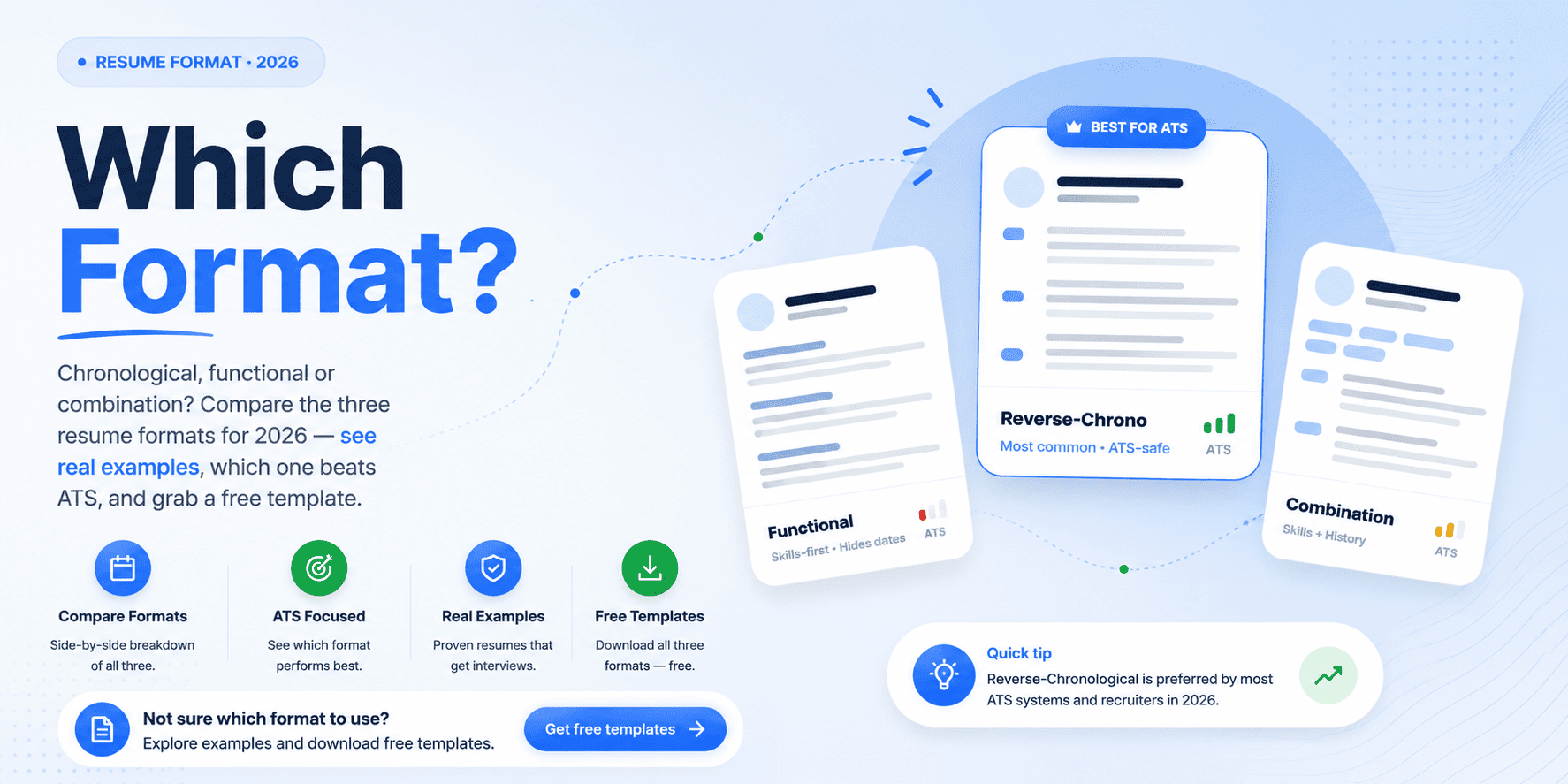
Your resume format decides whether anyone reads your resume at all. In 2026, up to three in four resumes are filtered out before a person sees them, and recruiters skim the survivors in about seven seconds. So the layout you choose is not a cosmetic choice. It is the gatekeeper.
The problem is that the advice online keeps conflicting. Some sources swear by one structure, while others push another. This guide cuts through the noise. You will see the three main resume format types, real examples of each, and a clear pick for your exact situation.
Want a headstart? Start as Seeker on CloudColleague. Use our platform’s CV builder and aaply for jobs from day 1.
The 3 Resume Format Types in 2026
There are only three resume format types worth knowing, and each answers a different question. A chronological resume answers “where have you worked”. A functional resume answers “what can you do”. A hybrid resume answers both at once.
Understanding that difference makes your choice simple. So let us look at each one, with an example you can copy.
Reverse-Chronological Resume Format
This is the default, and for good reason. It lists your work history from most recent to oldest, which is exactly what recruiters expect and what applicant tracking systems read most reliably. Therefore it suits anyone with a steady employment history.
Here is the structure at a glance:
JORDAN LEE
Sydney, NSW | jordan.lee@email.com | linkedin.com/in/jordanlee
PROFESSIONAL SUMMARY
Operations coordinator with 6 years in logistics and a record of cutting costs.
EXPERIENCE
Operations Coordinator, Bright Logistics (2022 to Present)
– Reduced delivery costs by 18% by renegotiating carrier contracts.
– Led a team of 8 across two warehouses.
Logistics Assistant, Coastline Freight (2019 to 2022)
– Improved order accuracy from 91% to 99% in 12 months.
SKILLS
Supply chain planning, inventory control, Excel, stakeholder communication
EDUCATION
Diploma of Logistics, TAFE NSW
Functional Resume Format
The functional resume format puts skills first and pushes dates to the bottom. In theory, that helps people with gaps. In practice, it carries real risk in 2026.
Here is the catch. Many applicant tracking systems struggle to parse this layout, and recruiters often assume a skills-first page is hiding something. As a result, most career experts now recommend it only in narrow cases. Use it with caution, if at all.
JORDAN LEE
Sydney, NSW | jordan.lee@email.com
KEY SKILLS
Project Coordination: Ran 12 cross-team projects to deadline.
Client Communication: Managed 40+ client accounts.
Process Improvement: Cut reporting time by 30%.
WORK HISTORY
Bright Logistics, 2022 to Present
Coastline Freight, 2019 to 2022
Hybrid (Combination) Resume Format
The hybrid resume format is the fastest-growing choice in 2026, and it is easy to see why. It opens with a skills summary, like a functional resume, then backs it up with a chronological work history. Consequently, it satisfies both the software and the human reader.
This format works especially well for career changers, freelancers, and remote or hybrid job seekers. It proves what you can do, then shows where you proved it.
JORDAN LEE
Sydney, NSW | jordan.lee@email.com | linkedin.com/in/jordanlee
SUMMARY OF SKILLS
– Operations: cut delivery costs 18% across two sites.
– Leadership: managed a team of 8.
– Analysis: built dashboards that sped up reporting 30%.
PROFESSIONAL EXPERIENCE
Operations Coordinator, Bright Logistics (2022 to Present)
Logistics Assistant, Coastline Freight (2019 to 2022)
EDUCATION
Diploma of Logistics, TAFE NSW
Read Next: Resume Writing: How to Write a Resume That Gets Interviews in 2026
Chronological vs Functional vs Hybrid
Still unsure which resume format fits? This table makes the trade-offs clear at a glance.
| Format | Best for | ATS-friendly | Answers |
| Reverse-chronological | Steady work history | Very strong | Where you worked |
| Functional | Heavy gaps, use with caution | Weak | What you can do |
| Hybrid | Career change, freelancers | Strong | Both |
In short, reverse-chronological wins for most people, hybrid wins for career pivots, and functional stays on the bench unless you have a specific reason. See our guide on Functional Resume vs Chronological Resume: Which Should You Use in 2026?.
Which Resume Format Is Best for You?
The best resume format depends on your story, not on a single rule. So match the layout to your situation.
Resume Format for Career Changers
Choose the hybrid format. Lead with transferable skills so a recruiter sees your value before they notice the change of field. Then let your chronological history reassure them.
Read Next: Best Resume Builder for Career Changers in 2026: Tested and Ranked.
Resume Format With No Experience
A hybrid or simple skills-first layout works best. Lean on study, projects, internships, and volunteering, and quantify whatever you can. As a result, the page fills with proof rather than gaps.
Read Next: Best Resume Format for Freshers With No Experience in 2026
Resume Format for Senior Professionals
Stick with reverse-chronological. It showcases career progression clearly, and a second page is acceptable once you pass roughly ten years of relevant experience.
Read Next: How to Write a Resume for a Senior-Level Role in 2026: The Australian Guide
What Makes a Resume Format ATS-Friendly?
Even the best-looking resume fails if the software cannot read it. Fortunately, the rules are simple.
Use standard section headings, such as Summary, Experience, and Skills. Avoid tables, columns, and graphics in the body, because they scramble during parsing. Save the file as a Word .docx or a selectable PDF, and pick a clean, common font. For the deeper parsing detail, see our resume writing guide.
Not sure your layout passes? Upload your resume to CloudColleague for a free format check in seconds.
One Page or Two? Resume Length in 2026
Length still matters, so keep it tight. Use one page if you have under ten years of experience. Two pages is fine for senior professionals with a long, relevant track record. However, never go beyond two pages.
Above all, cut anything that does not support the job you want. Focus on recent, relevant roles, because filler dilutes your strongest evidence.
Best Resume Format in Australia
Australian employers have clear preferences, and following them helps. Most expect a reverse-chronological resume format with no photo and no personal details like age or marital status. The Australian HR Institute consistently recommends leaving these off to reduce bias risk.
Industry norms also vary. For example, creative fields such as marketing and design welcome a hybrid layout, while government and banking roles tend to prefer a straightforward chronological structure. When in doubt, clarity beats creativity.
Get Your Resume Format Checked and Matched to Jobs
A strong resume format only counts once it reaches the right roles. This is the step most people skip, and it is where momentum is won.
CloudColleague closes that gap. You can upload your resume for free, confirm your format parses cleanly, and instantly see live Australian jobs that match your skills. Then you apply in a few clicks instead of scrolling for hours. You can also switch on match alerts, so new roles come to you. For a full walkthrough, read how to use CloudColleague to find jobs.
Ready to put your resume to work? Create your free CloudColleague profile and start applying today.
Choosing The Right Resume
Choosing the right resume format is one of the highest-impact decisions in your job search. For most candidates, reverse-chronological is the safe winner. For career changers and freelancers, hybrid pulls ahead. Functional, meanwhile, stays risky in an ATS-driven market.
So make your choice, grab the free templates, and put your resume to work. Login into your CloudColleague account, browse jobs, freelance tasks and start applying from day one.
Frequently Asked Questions
For most people, the reverse-chronological resume format is best, because recruiters expect it and applicant tracking systems read it cleanly. If you are changing careers or have gaps, choose the hybrid format instead.
Not really. Many systems struggle to parse a skills-first layout, and recruiters often distrust it. Use a hybrid format if you want skills up top without the risk.
Keep it to one page if you have under ten years of experience. Two pages is acceptable for senior professionals with extensive relevant experience. Never exceed two pages.
Most prefer a reverse-chronological format with no photo and no personal details. Creative roles may welcome a hybrid layout, while government and banking roles usually expect a chronological one.
You can download three ATS-ready templates here, then upload your finished resume to CloudColleague to check it and match it to live jobs.