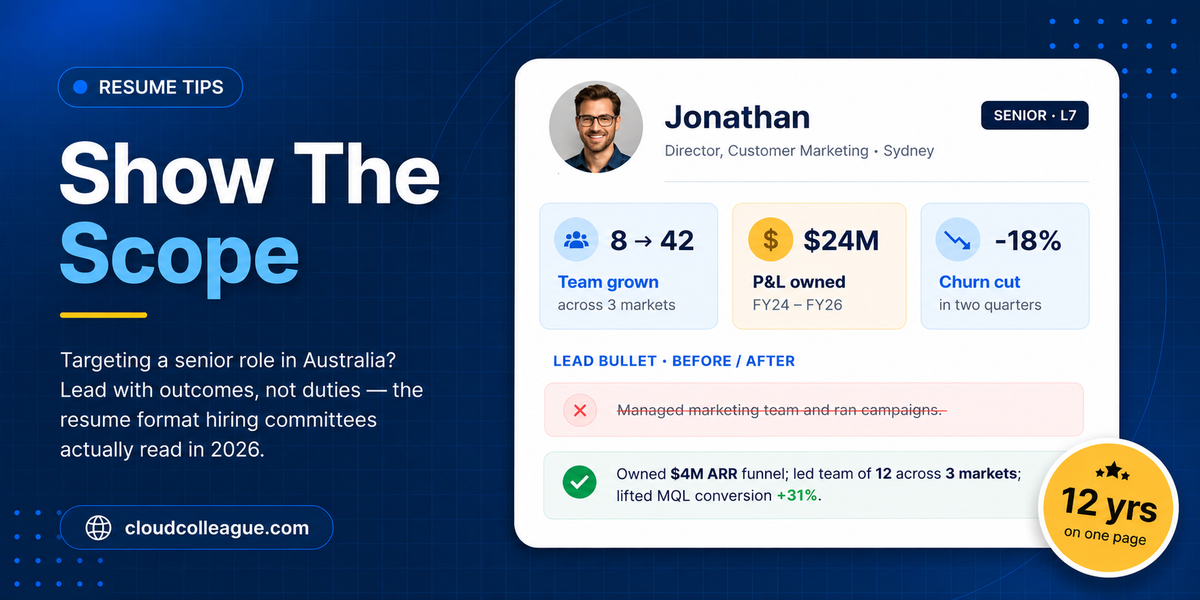
How to write a resume for a senior-level role requires a fundamentally different approach from every resume you have written before.
A mid-career resume answers one question: what have you done? A senior-level resume answers a different question entirely: who are you as a leader, what have you built, what scale have you operated at, and why is this role the logical next chapter of a career with a visible arc?
The document is a strategic narrative, not a job history. The recruiter, executive search partner, or board committee member reading it is not checking whether you have held relevant positions. They are evaluating whether the pattern of your career leads credibly to the role they are filling.
In this guide, we show you how to write a senior-level resume that works for Australian hiring processes in 2026, from ATS-screened portals at major employers to executive search briefings to board committee review.
Looking for senior and director-level roles in Australia? CloudColleague lists verified management and leadership roles from 18,000+ Australian employers. Browse AI-matched senior roles right now. Browse senior roles on CloudColleague.
The Fundamental Difference: Strategic Narrative vs Job History
The most important concept in senior resume writing is one that most candidates never explicitly learn: the shift from job history document to strategic narrative document.
A mid-career resume is primarily a record. It documents roles held, responsibilities carried, and achievements delivered. The recruiter reads it to confirm relevant experience.
A senior-level resume is primarily an argument. It makes a case for a specific kind of leadership capability, built over a career with a visible arc of increasing responsibility, scope, and strategic impact. The person reading a senior resume is evaluating whether this candidate’s career trajectory leads credibly to the role being considered.
Read Next: How to Write a Resume After a 2-Year Employment Gap in 2026?
Three elements make up the strategic narrative of a strong senior resume.
The leadership thread: A consistent pattern of leadership behaviour across roles and organisations, visible across the career history. Not just “managed teams” but a specific, recurring leadership capability: building capability in others, turning around underperforming operations, scaling organisations through growth, leading through complexity. The thread should be nameable in a sentence.
The scale progression: Evidence that scope and complexity have grown consistently over time. From team leader to functional head to divisional executive. From AUD $10M budget to AUD $100M to AUD $500M. From single site to multi-site to multi-national. The progression does not need to be linear, but it needs to be visible.
The domain authority: Deep, named expertise in a specific field that makes the candidate the credible choice for this particular role. Not “broad business experience” but “18 years of end-to-end supply chain leadership in FMCG and resources.” Domain authority is the claim that a generalist cannot make.
Every section of a senior resume should serve at least one of these three narrative elements. Content that does not serve the narrative should be removed, regardless of how significant it felt at the time. The resume writing guide can help you through the process.
Format and Length: What Australian Senior Hiring Expects
Australian senior hiring has specific format expectations that differ meaningfully from both fresh graduate norms and US executive conventions.
Length: Two to three pages is the Australian standard for senior professionals with ten or more years of relevant experience. The one-page rule applies to graduates and early career candidates. The two-page ceiling applies to mid-career professionals. For senior roles, three pages is acceptable and sometimes necessary when the additional content is substantive: board directorships, significant publications, media appearances, extensive governance credentials, or multiple major executive roles that each require context and achievement bullets to be meaningful.
Format: Chronological format works for most senior candidates whose career progression tells the narrative clearly. The hybrid format (leading with a skills or achievement summary before the chronological history) is appropriate only if the most recent role title does not reflect the actual level of responsibility held. A candidate whose formal title was Senior Manager but whose scope was effectively that of a General Manager should consider a brief achievement summary before the chronological history to establish the correct level before the reader encounters the title.
Design: Clean, professional, and conservative. At senior level, design-forward templates signal the wrong kind of creativity. Black text, standard professional fonts (Calibri, Arial, or Garamond), clear section headings, and consistent margins throughout. No sidebar columns, no icons, no progress bars, no colour blocks. These elements reduce ATS compatibility and signal junior rather than executive sensibility.
File format: PDF exported from Word or Google Docs for direct applications. For executive search firms who may want to edit and present your document to clients, have a clean Word version available on request.
The Executive Summary: Your Most Important Section
At senior level, the professional summary becomes an executive summary. It is the paragraph that determines whether the reader continues or files. Getting it right is more important than any other element of the document.
A strong senior executive summary has four components working together in three to five sentences.
Leadership identity: Who you are as a leader in one or two precise descriptors. Transformational. Operationally disciplined. Commercially driven. Governance-focused. These are specific claims, not generic aspirations.
Domain: The specific function, industry, or intersection where you hold demonstrable deep expertise.
Scale: The size of organisations, teams, or financial responsibility you have operated at. Named in specific numbers.
Signature value: The one thing that makes you the credible choice for the next step. The outcome you reliably deliver. The problem you are particularly equipped to solve.
Strong Executive Summary Example
“Operations executive with 18 years of end-to-end supply chain and manufacturing leadership across ASX-listed FMCG and resources companies. Built and led cross-functional teams of up to 450 people across five sites in Australia and New Zealand. Delivered AUD $120M in procurement savings over a six-year period through supplier renegotiation and process automation. Track record of leading major transformation programmes while maintaining operational continuity and staff engagement above industry benchmarks.”
This summary names the domain (supply chain and manufacturing), the scale (450 people, five sites, AUD $120M), and the signature value (transformation with continuity). The reader knows exactly who this candidate is before reading a single achievement bullet.
Weak Executive Summary to Avoid
“Experienced operations executive with a strong track record in supply chain management. Proven ability to lead teams and deliver results in fast-paced environments. Seeking a senior operations role in a dynamic organisation.”
This summary could describe almost anyone at almost any experience level. No scale, no specificity, no signature value, and the phrase “dynamic organisation” tells the reader nothing about who you are or what you deliver. At senior level, vagueness is not modesty. It is invisibility.
How to Write Senior-Level Work History?
The work history section of a senior resume requires a different structure from mid-career resumes in three specific ways.
Lead Each Role With Organisational Context
At senior level, the organisation context matters because the reader may not know your employer. A hiring committee reviewing an executive resume needs to calibrate the significance of your role immediately without researching the company separately.
After your role title, employer, and dates, add a brief context line:
“[Organisation name] is an ASX-200 listed financial services group with AUD $4.1B in annual revenue and 6,500 employees across Australia, New Zealand, and Southeast Asia.”
This one sentence, which most candidates omit entirely, allows the reader to immediately understand the scale and complexity of your leadership context. It is one of the highest-return additions to a senior resume.
State P&L Responsibility Specifically
At senior level, P&L responsibility is the most important financial signal on a resume. It tells the reader the scale of commercial accountability you have directly owned. Most senior candidates either omit P&L responsibility entirely or state it vaguely. Both approaches are missed opportunities.
Strong P&L statements:
- “P&L accountability for the Australian business unit: AUD $340M revenue, AUD $28M EBITDA, and a workforce of 1,200 across twelve locations.”
- “Full P&L responsibility for a portfolio of three product lines generating AUD $85M in combined annual revenue.”
- “Capital program accountability: AUD $180M over three years, delivered AUD $12M under budget.”
Weak P&L statements to avoid:
- “Managed significant budgets across the business.”
- “Accountable for substantial revenue lines.”
- “Oversaw large capital programmes.”
Every senior candidate claims significant budgets. The specific AUD figure is what distinguishes the claim. Provide it for every role where you held direct financial accountability.
Three to Four Achievement Bullets Per Role, Not Eight
Senior resumes should have three to four high-impact, tightly written achievement bullets per role. Not a comprehensive list of responsibilities. At senior level, responsibility is assumed. Specific, quantified, strategic achievement is what differentiates.
Each bullet should answer three questions in a single sentence: what did you do, at what scale or complexity, and with what specific measurable outcome?
Strong achievement bullet: “Led the integration of two acquired businesses totalling AUD $85M combined revenue, completing full integration six months ahead of schedule and AUD $4M under the approved budget while achieving 94% staff retention across both organisations.”
Weak achievement bullet: “Responsible for leading integration activities across the organisation following two significant acquisitions.”
The strong version has a specific financial scale (AUD $85M), a timeline comparison (six months ahead of schedule), a financial outcome (AUD $4M under budget), and a people outcome (94% retention). The weak version has none of these.
How Far Back to Go?
Roles from more than fifteen years ago should be summarised rather than detailed. List the employer, role title, and dates in a brief “Earlier Career” section without bullet points: “General Manager, [Company], 2005 to 2009. Regional Operations Manager, [Company], 2001 to 2005.”
This approach acknowledges the experience without consuming space that earlier career details rarely justify. The reader’s focus belongs on the last ten to twelve years, where evidence of current capability lives.
Senior resume updated. Now find director and senior management roles in Australia. Browse AI-matched leadership roles from verified Australian employers on CloudColleague. Start as a Seeker on CloudCollague.
The Sections That Matter More at Senior Level
Board Directorships and Governance Roles
In Australian senior hiring, board directorships, advisory board memberships, and significant committee roles carry meaningful weight, particularly for candidates who are board-ready or actively pursuing NED roles alongside executive positions.
Create a dedicated “Board and Governance” section after your work history if you hold any of these positions. Include the organisation name, your specific role (Non-Executive Director, Chair of the Audit and Risk Committee, Advisory Board Member), and the dates.
For candidates who do not yet hold formal board roles but are targeting board-readiness, the AICD (Australian Institute of Company Directors) Company Directors Course leading to GAICD designation is the standard credential in Australia. It belongs in your Education and Qualifications section and signals board-level accountability readiness to nomination committees.
Professional Memberships and Fellowships
At senior level, professional memberships and industry roles signal domain authority and community standing in ways that mid-career credentials do not.
A fellowship of a professional body (FCPA, FCA, FAIM, FIAA, FCA) is a significant credential in Australian executive hiring. List these clearly with the credential designation, the issuing body, and the year of fellowship if relevant. Active committee or board roles within professional associations, particularly leadership positions, are worth listing separately as governance experience.
If you are a member rather than a fellow of a relevant body, list the membership in your qualifications section rather than creating a separate section for it.
Education at Senior Level
At fifteen or more years into a career, education moves to the bottom of the resume and is stated briefly. Qualification, institution, and year only. No WAM, no relevant coursework list.
An MBA, executive master’s, or AICD Company Directors Course remains meaningful at senior level and should be listed. An undergraduate degree from more than twenty years ago is listed by name only. Honorary degrees and fellowships from universities belong in this section.
The AICD CDC leading to GAICD or FAICD designation is the most widely recognised governance credential in Australia and should be listed prominently in your qualifications section.
ATS at Senior Level: When It Matters and When It Does Not?
A common belief among senior professionals is that ATS is irrelevant to their job search because senior roles go through executive search firms rather than online portals. This belief is partially correct and increasingly incomplete in 2026.
When ATS does not apply: Major executive search firms including Spencer Stuart, Korn Ferry, Egon Zehnder, Hays Executive, and Robert Half Executive read resumes directly, bypassing ATS. For roles sourced and placed through these firms, formatting and narrative quality matter significantly more than keyword density. These firms are evaluating strategic narrative and leadership evidence, not ATS score.
When ATS does apply: Many ASX-listed companies and major government employers run senior roles, including director and general manager level positions, through their own career portals, which are ATS-screened. If you are applying directly to a company’s careers page, your resume will pass through ATS screening before a human reads it. This applies more frequently than most senior candidates realise.
The practical solution: Maintain two versions of your senior resume.
The first is a clean, ATS-safe PDF exported from Word. Single-column layout, standard section headings (Experience, Education, Board Roles), no tables or text boxes. This version is used for direct applications through employer portals.
The second is a more richly formatted Word document that may include design elements and more sophisticated layout. This version is shared with executive search firms who may present it to clients in a customised format.
Both versions should contain identical content. The difference is presentation only.
LinkedIn for Senior Professionals: Complementing Rather Than Copying Your Resume
For senior professionals, LinkedIn is frequently the first document that executive search firms and board nomination committees review. Your LinkedIn profile must be complete, current, and professionally positioned regardless of whether you are actively searching. A neglected or incomplete LinkedIn profile signals that you are either not taking your career seriously or not aware of how senior hiring works in 2026.
Your LinkedIn About section should function as an extended executive summary. More narrative in voice and more personal in tone than your formal resume summary, but covering the same domain, scale, and signature value. Write it in first person. It should read as you speaking directly, not as a formal document.
LinkedIn recommendations from chairs, board members, CEOs, or other senior executives carry significant weight in senior hiring contexts. Three to five specific, well-written recommendations from senior stakeholders are worth considerably more than twenty generic skill endorsements. If you do not have senior-level recommendations, asking two or three former boards, chairs, or chief executives for a brief LinkedIn recommendation is a worthwhile investment before you begin a senior search.
Your LinkedIn headline should state your domain and level explicitly. “Chief Operating Officer | Supply Chain and Operations | ASX-listed Resources and FMCG | GAICD” is more useful than “Experienced Operations Leader.” The headline is what appears in search results when executive search consultants are sourcing candidates.
Ensure your LinkedIn employment dates and role titles match your resume exactly. Inconsistencies between LinkedIn and resume are the most common discovery in senior candidate screening and create questions that a confident, consistent profile would have prevented.
Integrate and make your Job search faster with AI models. Read our guide : Best AI Tools for Job Search
What Australian Senior Professionals Specifically Need to Know
Australian senior hiring moves more slowly than most candidates expect, and this is a feature of the market rather than a sign that something is wrong. Executive search processes at major Australian employers typically take three to six months from first contact to offer. Board appointments can take six to twelve months.
The Australian executive search ecosystem is smaller and more relationship-driven than comparable markets. The major firms active in Australian executive search include Hays Executive, and Robert Half Executive. Being known to two or three firms before you are actively searching is the most effective senior career development strategy.
CloudColleague lists director, general manager, and senior management roles from verified Australian employers across every industry. For senior professionals who want to explore opportunities outside the traditional search channel, maintaining an active CloudColleague profile with a complete, skills-based description surfaces.
The AICD Company Directors Course (CDC), leading to the GAICD or FAICD designation, is the most recognised governance qualification in Australia. Completing it signals board-readiness and is expected by most nomination committees for NED candidates.
Australian senior salaries for director and general manager level roles typically range from AUD $200,000 to $500,000 in total package depending on sector, organisation size, complexity, and role scope. Hays Executive and Robert Half Executive publish annual senior salary guides specific to the Australian market that provide the most reliable benchmarking data for this level.
Senior resume polished and ready. Find director and management-level roles in Australia. Create a free verified profile on CloudColleague and get AI-matched to senior roles from 18,000+ verified Australian employers.Get started free on CloudColleague
Hiring at director or management level? Post a senior role on CloudColleague in under five minutes. Smart matching surfaces pre-vetted senior professionals across every Australian industry.Start hiring on CloudColleague
Frequently Asked Questions
For how to write a resume for a senior-level role, two to three pages is standard in Australia. Two pages suits most senior professionals, while three pages is acceptable when covering executive leadership, board roles, governance work, or major achievements. Every section should add clear value and evidence of leadership impact.
No. Roles older than 15 years should usually be condensed into a short “Earlier Career” section with titles, employers, and dates only. Detailed bullet points should focus on the last 10–12 years, where your current leadership capability and strategic impact are most relevant.
Yes, if applying directly through company or government career portals. Executive recruiters often review resumes manually, but ATS systems are still common for direct applications. A clean, single-column layout with clear headings is usually the safest format.
State it clearly and specifically. Include revenue, budget, or EBITDA responsibility in AUD early in each role description. Specific figures demonstrate scale and credibility far more effectively than vague claims about managing “large budgets.”
Yes. Board and advisory roles carry significant weight in Australian senior hiring. Create a dedicated “Board and Governance” section including organisation names, roles, and dates. Governance credentials like GAICD should also be listed prominently.