You’ve tailored your resume. You’ve applied to 40 jobs. And you’ve heard almost nothing back. So you do what everyone tells you to do , you run your resume through an ATS checker. The score comes back: 62%. You tweak a few keywords, rerun it: 78%. You feel better. And you apply again. Still silent. Here’s the uncomfortable truth nobody talks about: a higher ATS score does not equal more interviews. The tool you use to optimise matters , and so does understanding what it actually measures.
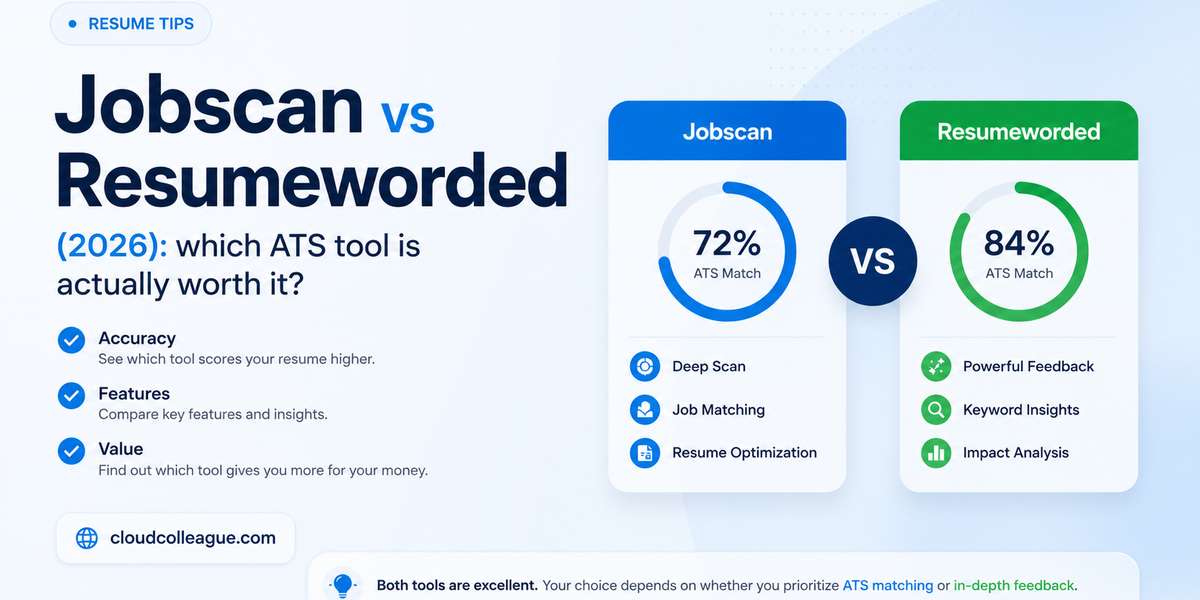
We tested both Jobscan and Resumeworded on the same resume, against the same job descriptions, over three weeks. This is our honest breakdown of what each tool does well, where each one falls short, and which one deserves a place in your job search in 2026.
Quick verdict: which tool should you use?
If you’re short on time, here’s the bottom line:
| Your situation | Best tool |
| Applying to Fortune 500s and large corporations | Jobscan |
| Applying to startups, tech companies, and mid-size firms | Resumeworded |
| Want detailed writing feedback on your bullet points | Resumeworded |
| Need a job tracker alongside your ATS scanner | Jobscan |
| On a tight budget (need a solid free plan) | Resumeworded |
| Want LinkedIn profile optimisation too | Resumeworded |
Still want the full picture? Keep reading , the nuance matters.
What is Jobscan? (and who it’s built for)
Jobscan launched in 2014 and built its reputation specifically around Applicant Tracking Systems. Its core function is simple: you paste in a job description, upload your resume, and it returns a match score showing how well your resume aligns with the keywords the ATS is likely scanning for.
Jobscan’s database covers over 100 ATS platforms , including Workday, Taleo, Greenhouse, and iCIMS , and adjusts its scoring based on which system a company is known to use. That makes it genuinely useful if you’re targeting large enterprises that run applications through legacy ATS platforms.
It also includes a job tracker, a LinkedIn optimiser, a cover letter scanner, and a recruiter search tool in its paid tier.
Best suited for: job seekers targeting large corporations, government roles, or any company known to use a traditional ATS.
What is Resumeworded? (and who it’s built for)
Resumeworded launched in 2018 with a different angle: it’s less about raw keyword matching and more about resume quality signals. Its “Score My Resume” feature grades your resume like a recruiter would , flagging weak bullet points, passive language, missing metrics, and formatting issues that ATS tools miss entirely.
It also has a “Targeted Resume” feature that works similarly to Jobscan’s keyword matching, and a LinkedIn Review tool that scores your LinkedIn profile against industry benchmarks.
Where Resumeworded stands out is in its actionable feedback. Rather than telling you “add the word ‘Python’,” it says “this bullet point doesn’t show impact , try starting with a stronger action verb and quantifying the result.”
Best suited for: job seekers targeting startups, tech companies, and roles where human recruiters read resumes carefully , and anyone who wants to improve their actual writing, not just their keyword score.
Jobscan vs Resumeworded: head-to-head comparison
Both tools scan your resume against a job description and return a match score, but they measure different things.
Jobscan focuses almost entirely on keyword frequency and placement. It checks whether specific terms from the job description appear in your resume, flags exact matches versus close matches, and accounts for the specific ATS system the company uses. For large employers using Workday or Taleo, this is genuinely useful , those older systems do rely heavily on keyword density.
Resumeworded’s Targeted Resume feature does keyword matching too, but it layers in contextual relevance. It’s less likely to reward you for stuffing in a term once , it wants to see the keyword used in a meaningful way inside an achievement statement.
In our testing, Jobscan caught more raw keyword gaps on a corporate job description. Resumeworded gave us more useful guidance on how to naturally include those keywords without the resume reading like a list of terms.
Winner for pure keyword matching: Jobscan
Winner for contextual keyword guidance: Resumeworded
Pricing and free plan limits on Jobscan vs ResumeWorded
| Jobscan | Resumeworded | |
| Free plan | 5 scans/month | 5 resume reviews + LinkedIn |
| Paid monthly | $49.95/month | $29/month |
| Paid quarterly | $29.98/month | $19/month |
| Annual | $19.99/month | $9/month |
Jobscan is significantly more expensive at every pricing tier. At $49.95 per month billed monthly, it’s hard to justify unless you’re doing a high-volume, enterprise-focused job search.
Resumeworded at $29/month gives you unlimited scans and the full feedback suite , a much better value for most job seekers.
Both free plans are limited but workable for someone testing the waters with a single application. If you’re actively applying to multiple roles per week, you’ll need a paid plan on either platform.
Winner: Resumeworded , by a significant margin on price.
Resume feedback quality
This is where the gap between the two tools is most pronounced.
Jobscan tells you what keywords are missing. That’s it. It won’t tell you that your bullet points are passive, that your summary is generic, or that your metrics are vague. It’s a keyword gap detector, not a resume coach.
Resumeworded goes deeper. Its line-by-line feedback flags issues like:
- Bullet points starting with weak verbs (“Responsible for”, “Helped with”)
- Missing quantifiable results (“increased sales” vs “increased sales by 34% over 6 months”)
- Sections that are too long or structured incorrectly
- Skills that are listed but not evidenced in the experience section
For anyone who wants their resume to actually read well to a human recruiter , not just score well against a machine , Resumeworded’s feedback is far more valuable.
Winner: Resumeworded , it’s not close.
Ease of use and interface
Jobscan’s interface is functional but dated. The dashboard can feel cluttered, especially once you’ve saved multiple job scans. The match report is detailed but dense.
Resumeworded has a cleaner, more modern UI. The scoring dashboard is intuitive, and the line-by-line feedback is easy to act on. The experience feels closer to getting feedback from a real reviewer than reading a data export.
Winner: Resumeworded for usability; Jobscan for data depth.
LinkedIn profile grading
Both tools offer LinkedIn profile analysis. Resumeworded’s LinkedIn Review is the stronger product , it scores your headline, about section, experience entries, and skills section individually, and benchmarks you against professionals in your target industry.
Jobscan’s LinkedIn optimiser is more keyword-focused, checking your profile against a target job description the same way it scans a resume. Useful for a specific role, less useful for general profile strength.
Winner: Resumeworded for general profile improvement; Jobscan for role-specific targeting.
Job tracker and extras
Jobscan includes a Kanban-style job tracker that lets you manage applications, add notes, and track where you are in each process. If you’re applying to 30+ roles and need to stay organised, this is genuinely useful.
Resumeworded doesn’t have a native job tracker. You’d need a separate tool for application management.
Winner: Jobscan for job tracking.
Resume optimised? Now find the actual job.
CloudColleague lists thousands of verified Australian roles across tech, admin, health, creative, and trades , AI-matched to your profile.
→Browse jobs matched to your skills
What do real users say?
We pulled recent sentiment from r/resumes and r/jobs , the most honest place to find unfiltered opinions on these tools.
On Jobscan: the general consensus is that it’s useful for targeting specific job descriptions at big companies, but many users note that a high Jobscan score doesn’t guarantee interviews. Obsessing over the match score can actually make resumes read unnaturally , stuffed with keywords rather than written for a human.
On Resumeworded: users consistently praise the quality of the line-by-line feedback, particularly for early-career job seekers who don’t know what strong resume writing looks like. The common criticism is the price jump between the free and paid tiers.
A recurring theme across both tools: they’re most useful as a starting point for identifying gaps , not as a substitute for applying to the right jobs in the first place.
Our honest verdict
After three weeks of testing both tools across multiple industries and job levels, here’s where we land.
Jobscan wins if you are applying to large corporations that use legacy ATS platforms like Workday or Taleo. Its keyword matching is precise, its ATS database is the best in the industry, and its job tracker is a genuine productivity tool for high-volume applicants.
Resumeworded wins in almost every other situation. It’s better value, it gives more actionable feedback, its interface is more pleasant to use, and its LinkedIn review tool is stronger. For the majority of job seekers , especially those applying to tech companies, startups, or any role where a human reads the resume carefully , Resumeworded is the more useful tool.
If budget isn’t a concern and you want both a keyword scanner and a writing coach, there’s a case for using both. Use Jobscan to identify keyword gaps for a specific job description, then Resumeworded to ensure those keywords land naturally inside strong achievement statements.
But here’s what neither tool solves: finding the right roles to apply to in the first place.
When your resume is ready , where do you actually apply?
Both Jobscan and Resumeworded help you optimize the document. Neither helps you find roles that genuinely fit your skills, location, and career stage , and that’s the other half of the equation most job seekers overlook.
CloudColleague is an Australian hiring platform built for exactly this. It surfaces roles based on your actual profile using AI matching , not just the keywords you’ve searched. With 18,000+ Australian businesses on the platform across every major industry, you can find full-time permanent roles, contract work, and short-term tasks you can bid on today.
Once your resume is polished and your ATS score is where you want it, the next step is getting it in front of the right employers.
Your resume is ready. Here’s where to use it.
Create a free verified profile on CloudColleague, get AI-matched to Australian jobs that fit your experience, and apply directly , no middlemen.
→Create your free profile
Are you a business looking to hire?
Post a job or task in under 5 minutes. Smart matching surfaces pre-vetted candidates. No agency markups.
→Start hiring on CloudColleague
Frequently asked questions
Jobscan has a free plan that includes 5 resume scans per month. After that, you’ll need a paid subscription starting at $49.95/month billed monthly, or around $19.99/month if you pay annually.
For most job seekers, yes , especially at the annual plan rate of around $9/month. The feedback quality on bullet points and resume structure is significantly better than most ATS tools at this price point. The free plan gives you 5 reviews per month , enough to test it before committing.
Jobscan has the edge on raw keyword matching, particularly for legacy enterprise ATS systems like Workday and Taleo. Resumeworded is more useful for contextual keyword guidance and overall writing quality.
Yes, and for high-stakes applications it’s worth doing. Use Jobscan first to identify missing keywords, then Resumeworded to make sure those keywords are incorporated in a natural, impactful way.
Resumeworded’s free plan offers the best value , 5 full resume reviews per month with line-by-line feedback. Jobscan’s free plan gives you 5 keyword scans. Both are worth testing before committing to a paid plan.
CloudColleague is one of Australia’s fastest-growing hiring platforms, with roles across tech, admin, health, creative, and trades. Create a free profile, get AI-matched to relevant jobs, and apply directly. Browse current listings here.