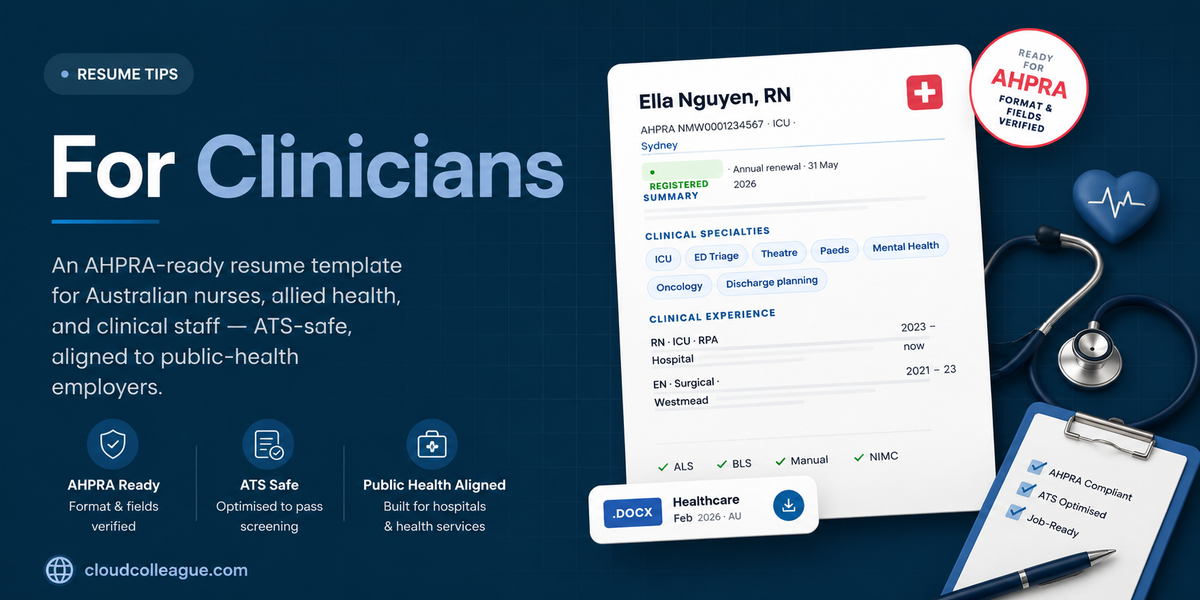
This resume template for healthcare roles is free, editable in Word and Google Docs, and built specifically for Australian clinical and healthcare support staff in 2026. No signup required. No account needed.
The most important thing to know before filling it in: Australian healthcare employers check your AHPRA registration before reading anything else on your resume. Your registration number, registration type, and expiry date should appear near the top of your resume, not buried in a certifications section at the bottom. The template is structured accordingly, with AHPRA registration first, mandatory training second, and clinical experience third, matching the sequence Australian health employers actually follow when assessing an application.
Download the Template: No Signup, No Account, No Cost
Google Docs version (recommended): [Open the Healthcare Resume Template in Google Docs] [GOOGLE DOCS TEMPLATE LINK]
To use: Click the link, then File > Make a Copy. This saves your own editable version to your Google Drive.
Microsoft Word version: [Download Healthcare Resume Template (.docx)] [WORD DOWNLOAD LINK]
To use: Download the file, open in Word, and save a copy with your name before editing.
Three steps to a submitted resume:
- Open the template and make a copy.
- Replace every placeholder using the section guidance below.
- Export as PDF and upload to the relevant employer portal or SEEK.
Template downloaded. Find healthcare and clinical roles across Australia right now. Browse AI-matched nursing, allied health, and healthcare administration roles on CloudColleague.Browse healthcare roles on CloudColleague
What Makes a Healthcare Resume Different in Australia?
Australian healthcare resumes have structural requirements that generic resume templates do not include. Most of these requirements relate to mandatory registration, credentialling, and compliance evidence that Australian health employers check at the shortlisting stage, before evaluating clinical experience or qualifications.
This template is structured around the sequence Australian health employers actually follow when reviewing an application.
For clinical roles (nursing, allied health, medicine, pharmacy): AHPRA registration appears first, followed by mandatory training currency, then professional memberships, then clinical experience, then formal qualifications and CPD.
For non-clinical healthcare roles (administration, management, health informatics, healthcare coordination): the structure follows a conventional format with professional summary leading, as AHPRA registration does not apply to these positions.
The specific structural guidance for each healthcare sub-sector is covered in detail below. Read the section that applies to your role type before filling in the template.
The AHPRA Registration Section: The Most Important Line on a Clinical Resume
AHPRA, the Australian Health Practitioner Regulation Agency, maintains the register of practitioners across 16 regulated health professions including nursing and midwifery, medicine, physiotherapy, occupational therapy, psychology, pharmacy, dental, optometry, and others.
For any role in an AHPRA-regulated profession, your registration details must appear in or immediately below your contact header. This is not optional and it is not a formatting preference. Australian public health services, private hospitals, and community health organisations verify AHPRA registration before shortlisting. A resume that places registration details in a certifications section at the bottom of the document creates an unnecessary friction point in a verification process that happens before your qualifications are ever assessed.
Format for AHPRA Registration on Your Resume
Place this directly below your contact details line:
AHPRA Registration: Registered Nurse | Registration No: [XXXXXXXXXX] | Full Registration | Expires: [MM/YYYY]
Or for other professions:
AHPRA Registration: Physiotherapist | Registration No: [XXXXXXXXXX] | General Registration | Expires: [MM/YYYY]
Include the following for each registration:
- Your AHPRA profession title exactly as it appears on your registration certificate.
- Your registration number.
- Your registration type: General, Specialist, Provisional, Limited, or Non-practising.
- Your registration expiry date.
- Any endorsements: Nurse Practitioner endorsement, Scheduled Medicines Endorsement for nurses, specialist registration for medical practitioners.
- Any conditions on your registration, only if applicable. If you have conditions, be prepared to explain them honestly and briefly in your cover letter or at interview.
For internationally qualified practitioners: Note your current AHPRA registration status clearly. If your registration assessment is in progress, write: “AHPRA Registration Assessment: In progress, expected [Month Year].” If you hold provisional registration while completing a bridging program, state this with the program name and expected completion date.
Verify that your name on the resume matches your AHPRA record exactly. Many internationally qualified practitioners use a shortened version of their name professionally. The name on your resume should match the name under which your AHPRA registration is held to avoid verification confusion.
The Mandatory Training Section
This section is specific to Australian healthcare resumes and is absent from every generic or US-focused healthcare template. Australian health employers require evidence of current mandatory training as a baseline for clinical employment. This section appears after your AHPRA registration and before your clinical experience.
List each item with its expiry date. Employers verify these during onboarding and increasingly at the shortlisting stage for clinical roles.
Standard mandatory training for Australian clinical roles:
- Basic Life Support (BLS) / CPR: [Expiry MM/YYYY]
- Manual Handling and Patient Handling: [Expiry MM/YYYY]
- Infection Prevention and Control: [Expiry MM/YYYY]
- Fire Safety and Emergency Evacuation: [Expiry MM/YYYY]
- Work Health and Safety Induction: [Current]
- Hand Hygiene Competency: [Current]
- Medication Administration: [Expiry MM/YYYY] (if applicable)
- Child Protection Awareness: [Expiry MM/YYYY] (where applicable to role)
- National Police Check: [Date obtained, within last 3 years]
- Working With Children Check: [Check number, Expiry MM/YYYY] (where applicable)
- NDIS Worker Screening Check: [Check number] (for roles involving NDIS participants)
For aged care roles, add:
- COVID-19 vaccination status: [Vaccinated, booster date]
- Dementia Care Training: [Provider, Year]
- Restraint and Restrictive Practices Training: [Provider, Year] (if applicable)
- Aged Care Quality Standards Awareness: [Year]
For theatre and perioperative roles, add:
- Advanced Life Support (ALS) or ACLS: [Expiry MM/YYYY]
- Surgical Count Procedures: [Current]
If any mandatory training is recently expired or upcoming for renewal, note it as “Renewal in progress, due [date]” rather than leaving it blank. Transparency about renewal timelines is preferred over omission.
The Template Structure by Healthcare Sub-Sector
Nursing and Midwifery
Resume structure:
Header with AHPRA registration | Mandatory Training | Professional Summary | Professional Memberships | Clinical Experience | Education and CPD | Skills
Professional Summary (3 sentences):
- Sentence 1: Your AHPRA registration type, years of experience, and primary clinical specialisation.
- Sentence 2: Your most significant clinical capability or achievement.
- Sentence 3: The specific ward type, hospital level, or clinical role you are targeting.
Strong example: “Registered Nurse with eight years of acute care experience across surgical and medical wards in metropolitan Melbourne health services. AHPRA registered with full general registration. Experienced in complex wound assessment and management, perioperative care, medication administration, and coordination of multidisciplinary care for patients with complex comorbidities. Targeting a Senior Registered Nurse or Nurse Unit Manager role in a tertiary metropolitan hospital environment.”
Clinical Experience bullet point guidance: Each clinical role should name the specific ward or unit type, not just the hospital. “Medical Ward B, 28-bed acute medical unit” is more useful to a hiring committee than “St Vincent’s Hospital Melbourne.” Include patient-to-nurse ratios where they demonstrate workload complexity. Name specific clinical procedures, equipment, or protocols you used. Include patient acuity level where it differentiates your experience from a less complex setting.
Strong clinical bullet example: “Managed a caseload of four to five high-acuity patients per shift on a 32-bed surgical oncology ward, including post-operative care for colorectal, upper GI, and hepatobiliary patients. Competent in epidural management, PCA monitoring, stoma care, drain management, and complex wound assessment.”
Weak clinical bullet example: “Provided nursing care to patients in the surgical ward and assisted the medical team.”
Professional Memberships: Include your Australian Nursing and Midwifery Federation (ANMF) membership and any specialty nursing organisations: Australian College of Critical Care Nurses (ACCCN), Australian College of Perioperative Nurses (ACORN), Australian College of Emergency Medicine Nursing (ACEN), or relevant state-based nursing colleges.
Allied Health: Physiotherapy, Occupational Therapy, Social Work, Psychology
Resume structure: Header with AHPRA registration (for AHPRA-regulated professions) | Mandatory Training | Professional Summary | Professional Memberships | Clinical and Practice Experience | Education and CPD | Skills
Professional membership bodies:
- Physiotherapy: Australian Physiotherapy Association (APA)
- Occupational Therapy: Occupational Therapy Australia (OTA)
- Social Work: Australian Association of Social Workers (AASW)
- Psychology: Australian Psychological Society (APS)
- Pharmacy: The Society of Hospital Pharmacists of Australia (SHPA) or Pharmaceutical Society of Australia (PSA)
Clinical experience guidance for allied health: Name your client population specifically. Include intervention types and outcome measures used. Volume (caseload size) signals competency as much as clinical setting.
Strong example (physiotherapy): “Delivered community-based physiotherapy to a caseload of 24 NDIS participants with acquired brain injuries and progressive neurological conditions, including in-home assessment and treatment planning. Used outcome measures including the Modified Barthel Index, Timed Up and Go, and Berg Balance Scale to track functional progress and inform NDIS plan reviews.”
Strong example (occupational therapy): “Completed functional assessments and home modification reports for 15 to 18 clients per week across community and residential aged care settings. Competent in assistive technology prescription, cognitive assessments using MMSE and ACE-III, and preparation of occupational therapy reports for NDIS plan reviews and ACAT assessments.”
For NDIS-funded allied health roles, include your NDIS Worker Screening Check number in the mandatory training section and reference your familiarity with NDIS funding categories, plan management, and service agreements in your skills section.
Healthcare Administration and Coordination
Resume structure: Professional Summary | Skills | Work Experience | Education | Certifications
Healthcare administration roles do not require AHPRA registration. The AHPRA section is omitted entirely. These roles require a different keyword set from clinical roles.
Key Australian healthcare administration keywords:
- Patient administration systems: Cerner, EPIC, HealthConnect, Trak, Webpas, Titanium.
- Medical records management, health information management.
- Medicare billing, MBS item numbers, DVA billing, private health insurance billing.
- Appointment scheduling, referral management, clinic coordination.
- Health Information Management (HIM) credentials: HIMAA membership, health information qualifications.
Professional Summary example: “Healthcare Administrator with six years of experience in outpatient clinic coordination and medical records management across public and private health settings in Brisbane. Experienced in Cerner and Webpas patient administration systems, Medicare and DVA billing, and high-volume appointment scheduling for specialist outpatient clinics. Targeting a Senior Patient Services Officer or Medical Reception Coordinator role in a tertiary or specialist outpatient environment.”
Aged Care
Resume structure: Header | Extended Mandatory Training Section | Professional Summary | Work Experience | Education | Skills
Aged care roles in Australia have additional mandatory requirements beyond standard clinical mandatory training. The sector is regulated under the Aged Care Quality Standards (ACQS) and the Aged Care Act 1997, and compliance documentation is scrutinised more thoroughly than in most other health settings.
Extended mandatory training for aged care: In addition to standard mandatory training, include:
- COVID-19 vaccination status and booster dates (mandatory for Australian aged care workers.
- Dementia Care Training: provider and year.
- Palliative Care Awareness: provider and year.
- Elder Abuse Awareness: provider and year.
- Restrictive Practices Training: provider and year (if applicable).
- Aged Care Quality Standards Awareness: year.
Work experience bullet guidance for aged care: Reference specific Aged Care Quality Standards where relevant: “Supported person-centred care planning in alignment with ACQS Standard 2, including regular goal-setting conversations with residents and family representatives.” This signals to aged care employers that you understand the regulatory framework.
Resume structured and ready. Find healthcare roles across Australia on CloudColleague. Browse nursing, allied health, aged care, and healthcare administration roles whether its job or tasks from verified Australian employers. Browse freelance tasks on CloudColleague.
Australian Healthcare Keywords for ATS Optimisation
Australian healthcare ATS systems, particularly PageUp and the portals used by NSW Health and Queensland Health, scan for clinical keywords that generic ATS guidance does not cover. Include those that reflect genuine experience.
Clinical Skills Keywords
- Medication administration, medication management, medication reconciliation.
- IV therapy, IV cannulation, venepuncture, phlebotomy.
- Wound assessment and management, wound care, complex wound management.
- Clinical documentation, nursing notes, SOAP notes, progress notes.
- Patient assessment, clinical observation, vital signs monitoring.
- Pressure injury prevention and management, skin integrity assessment.
- Falls prevention, falls risk assessment, falls management.
- Pain assessment, pain management, palliative care, end-of-life care.
- Infection prevention and control, standard precautions, transmission-based precautions.
- Manual handling and patient handling, hoist operation.
Australian Healthcare System Keywords
- ISBAR handover, clinical handover, bedside handover.
- Multidisciplinary team (MDT), care planning, case conferencing.
- Electronic Medical Record (EMR), Cerner, EPIC, HealthConnect, Webpas.
- Medicare, MBS item numbers, bulk billing, DVA.
- NDIS, National Disability Insurance Scheme, support coordination.
- My Aged Care, ACAT assessment, restorative care.
- Aged Care Quality Standards, ACQS, Aged Care Act.
- CPD, Continuing Professional Development, mandatory training currency.
- Clinical governance, incident reporting, open disclosure.
Applied and ready for the interview? Being prepare for the interview is your next step. Read our guide on : STAR Method Answer Template for Behavioral Interviews in 2026.
Australian Healthcare Employer Application Portals
Most Australian public health service roles are not advertised on SEEK. Knowing where to find and submit applications is as important as having the right resume format.
NSW Health: The primary portal for NSW Health roles is iworkfor.nsw.gov.au. This covers all Local Health Districts (LHDs) across New South Wales including Sydney LHD, Northern Sydney LHD, South Western Sydney LHD, and others. Single-column PDF and DOCX resumes upload correctly. Registration as a candidate on the portal is required before applying.
Queensland Health: SmartJobs (smartjobs.qld.gov.au) is the Queensland government jobs portal covering Queensland Health and Hospital and Health Services (HHSs) across the state. The portal uses PageUp. Single-column templates upload without issue.
SA Health: sahealth.sa.gov.au/careers uses a PageUp-based application portal. Single-column PDF and DOCX resumes are accepted. Alfred Health, Melbourne Health, Monash Health, Eastern Health, St Vincent’s Health (Victoria): Each major Victorian health service operates its own careers portal, most of which use PageUp. Check each employer’s specific careers page directly.
Ramsay Health Care and Healthscope: Australia’s two largest private hospital groups advertise roles through their own careers portals and on SEEK. Both accept standard PDF and DOCX resume formats.
SEEK: Many private hospital, community health, general practice, and allied health private practice roles are advertised on SEEK. Upload the PDF version of this template to your SEEK candidate profile and keep it current. The single-column layout parses correctly through SEEK’s internal processing.
CloudColleague: Lists healthcare, nursing, allied health, and healthcare administration roles from verified Australian employers across every state and territory. A complete CloudColleague seeker profile with clinical competency keywords surfaces you to employers actively searching for candidates with your specific clinical background.
What Australian Healthcare Candidates Specifically Need to Know
For an Australian healthcare resume, AHPRA verification usually happens before your application is fully assessed. Your resume name must exactly match your AHPRA registration details to avoid administrative delays during screening.
CPD compliance is also important. Most AHPRA-registered professions require ongoing CPD hours annually, so noting that your CPD requirements are current signals professionalism and regulatory compliance, especially for senior or specialist roles.
International healthcare professionals should clearly state their qualification country, AHPRA assessment pathway, and current registration status. Australian employers are familiar with bridging programs and provisional registration pathways, so transparency matters more than the registration stage itself.
Resume length expectations follow standard Australian conventions. One page suits graduates and junior clinicians, while two pages is standard for most experienced healthcare professionals. Senior clinical and management candidates may reasonably use two to three pages when governance, research, or leadership experience is relevant.
Do not include referee details directly on the resume. Australian healthcare employers usually request references later in the hiring process. Prepare at least two professional referees in advance, ideally including a recent clinical supervisor or line manager.
Resume complete. Find clinical and healthcare roles across every Australian state and territory. Create a free profile on CloudColleague and get AI-matched to verified Australian health employers hiring right now.Get started free on CloudColleague
Hiring healthcare professionals? Post a clinical or healthcare administration role on CloudColleague in under five minutes. Smart matching surfaces pre-vetted candidates across every Australian health sector.Start hiring on CloudColleague
Frequently Asked Questions on Resume Template for Healthcare Roles
For an Australian healthcare resume, place your AHPRA registration directly below your contact details and above the professional summary. Include your profession, registration number, registration type, and expiry date so recruiters can verify it immediately.
Include current clinical compliance items such as BLS, Manual Handling, Infection Control, WHS, Hand Hygiene, Police Check, and Working With Children Check. Add NDIS checks, ALS, or aged care training where relevant, and include expiry dates for all certifications.
Two pages is standard in Australia for experienced nurses and allied health professionals because employers expect detail about wards, procedures, patient types, and clinical competencies. One page is generally suitable only for graduates or candidates with limited experience.
NSW Health Jobs and Queensland Health SmartJobs both require online application forms alongside resume uploads. Have your AHPRA details, compliance documents, and PDF resume ready before applying.
Yes. Clearly state your qualification country, AHPRA pathway, and current registration status. Australian healthcare employers are familiar with international practitioner pathways, so clarity and accurate registration information matter most.