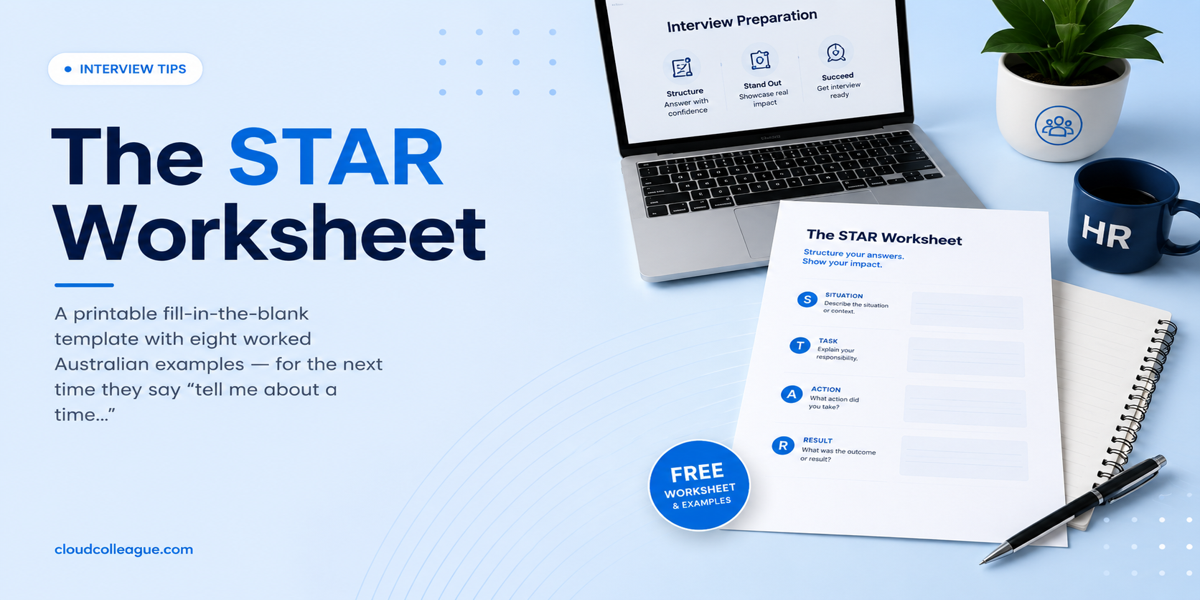
This STAR method answer template gives you everything you need to prepare for behavioral interviews in 2026: a free fill-in-the-blank worksheet for building eight core stories, the exact time distribution that makes STAR answers land (Action is 50% of the answer, not 20%), and eight complete Australian examples across the most common behavioral question categories.
The STAR method is used in approximately 73% of Australian employer interviews according to SHRM 2026 hiring data. It is the standard structure for behavioral questions at every career stage, every industry, and every employer type in Australia. Knowing the framework is not enough. This article gives you the specific template, the correct timing, and Australian-calibrated examples to practise with immediately.
Download the Free STAR Worksheet: Eight Story Frames, No Signup
[Open the STAR Method Worksheet in Google Docs] [STAR WORKSHEET LINK]
To use: Click the link, then File > Make a Copy. This saves your own editable version to your Google Drive. Fill in one story per frame before any significant interview.
The worksheet contains eight fill-in-the-blank frames covering the eight most common behavioral question categories. Preparing one strong story per category gives you a library that covers approximately 80% of behavioral questions asked in Australian interviews.
Preparing for interviews? Find Australian roles worth your preparation effort. Browse AI-matched jobs on CloudColleague from 18,000+ verified Australian employers right now.Browse open roles on CloudColleague
What the STAR Method Is? and Why It Works?
STAR stands for Situation, Task, Action, Result. It is the standard structure for answering behavioral interview questions, which typically begin with “Tell me about a time when…” or “Describe a situation where you…”
The framework works because it gives interviewers exactly what they need to evaluate a candidate fairly: a specific example from real experience rather than a hypothetical, a clear account of the candidate’s individual role rather than the team’s, and a measurable outcome rather than a general statement about how things went.
What most STAR guides do not tell you is how much time each component should take. The most common mistake candidates make is spending too much time on the Situation and Task, then rushing through the Action and Result. The interviewer is evaluating your Action above everything else. It is where they learn what you are actually capable of. It should take up approximately half your total answer.
The STAR Time Distribution: The Insight That Changes Your Answers
A complete STAR answer should take 60 to 90 seconds when delivered at a comfortable speaking pace. Here is how that time should be distributed across the four components.
Situation: 10 to 15 seconds. One to two sentences of context. Just enough for the interviewer to understand the setting and circumstances. No backstory, no explanation of the industry, no organisational chart. The minimum context needed to make the example intelligible.
Task: 10 to 15 seconds. One sentence stating your specific role or responsibility within the situation. What were you personally required to deliver, own, or resolve?
Action: 30 to 45 seconds. This is approximately 50% of your total answer. Describe specifically what you did, step by step. Not what the team did. Not what happened around you. What you specifically decided, said, built, delegated, negotiated, or delivered. Use “I” throughout this section, not “we.”
Result: 15 to 25 seconds. State the outcome in measurable terms wherever possible. What changed? What number improved? Or what was avoided? And what did the organisation gain or the team learn?
If your Action section is shorter than your Situation and Task sections combined, your answer is structured incorrectly. Restructure before you practise.
The STAR Worksheet: Eight Core Story Frames
The following eight categories cover the vast majority of behavioral questions asked in Australian corporate, government, healthcare, and technology interviews. Preparing one strong story per category before any significant interview gives you a library that can flex across multiple question types.
The worksheet available at the link above contains these eight frames in fill-in-the-blank format. Use the prompts below to fill in your own stories.
Frame 1: Achievement
Use for: “Tell me about your greatest professional achievement.” “What accomplishment are you most proud of?” “Describe a project you led successfully.”
- Situation: What was the context? What challenge or opportunity existed, and what was at stake?
- Task: What were you specifically responsible for delivering or achieving?
- Action: What did you do, step by step? What decisions did you make? What tools, approaches, or people did you use?
- Result: What was the measurable outcome? Include a number, percentage, dollar value, or time saving.
Frame 2: Leadership
Use for: “Tell me about a time you led a team.” “Describe your leadership style with an example.” “Tell me about a time you influenced others without formal authority.”
- Situation: What was the team context, its size, and the challenge you were navigating?
- Task: What was your leadership role and accountability?
- Action: How did you direct, motivate, communicate, and make decisions? What specific leadership choices did you make?
- Result: What did the team deliver? What individual development did you facilitate?
Frame 3: Conflict
Use for: “Tell me about a time you disagreed with a manager or colleague.” “Describe a conflict you navigated at work.” “Tell me about a time you had to give difficult feedback.”
- Situation: What was the nature of the disagreement and who was involved?
- Task: What was your role and what was at stake?
- Action: How did you approach the conversation? What did you say? What did you listen for? How did you resolve it?
- Result: What was the outcome for the relationship or the project? What did you learn?
Frame 4: Failure or Mistake
Use for: “Tell me about a time you failed.” “Describe a mistake you made and what you learned.” “Tell me about a time something did not go to plan.”
- Situation: What happened and why?
- Task: What were you responsible for?
- Action: What did you do when you realised the problem? How did you manage the consequences and communicate with stakeholders?
- Result: What was the immediate outcome? What did you learn? What did you do differently as a result?
Frame 5: Collaboration
Use for: “Tell me about a time you worked effectively in a team.” “Describe how you contribute to a group project.” “Tell me about a time you worked with someone very different from you.”
- Situation: What was the project and team context?
- Task: What was your specific contribution within the group effort?
- Action: How did you collaborate, communicate, and contribute your distinct value?
- Result: What did the project produce and what was your measurable individual contribution to that outcome?
Frame 6: Problem-Solving
Use for: “Tell me about a time you solved a complex problem.” “Describe how you approach difficult challenges.” “Tell me about a time you made a decision with incomplete information.”
- Situation: What was the problem, its complexity, and what was at stake?
- Task: What was your role in solving it?
- Action: How did you diagnose, analyse, prioritise, decide, and execute?
- Result: What did the solution produce and how was it measured?
Frame 7: Pressure and Prioritisation
Use for: “Tell me about a time you managed multiple competing priorities.” “Describe a time you worked under significant pressure.” “Tell me about a time you had to say no to a request.”
- Situation: What was the volume, complexity, or urgency of the competing demands?
- Task: What were you required to deliver and by when?
- Action: How did you assess priorities, communicate with stakeholders, and execute under pressure?
- Result: What did you deliver? What did you choose not to prioritise and how did you manage the consequences of that choice?
Frame 8: Change and Adaptability
Use for: “Tell me about a time you had to adapt quickly.” “Describe how you handle ambiguity.” “Tell me about a time the situation changed and you had to adjust.”
- Situation: What was the nature of the change or uncertainty?
- Task: What was expected of you in this changing context?
- Action: How did you respond, adapt, communicate, and continue to perform?
- Result: What was your outcome within or after the change?
Read Next : Prepare for Job Interview.
Eight Complete Australian STAR Examples
These worked examples use Australian employer contexts, Australian dollar figures, and Australian industry settings. Read through the examples in your target function and use the structure and language as a model for your own stories.
Example 1: Achievement (Project Manager, Infrastructure)
Question: “Tell me about your greatest professional achievement.”
Situation: “In my previous role as a project manager at a mid-size Australian engineering firm, we were awarded a government infrastructure contract significantly larger than anything we had managed before. The project involved AUD $12M in capital works across three regional sites with an 18-month fixed delivery timeline.”
Task: “I was appointed project lead with full accountability for scope, budget, timeline, and stakeholder management across the three sites and the government client.”
Action: “I began by rebuilding the project plan from scratch with the site teams rather than inheriting the tender assumptions. That exercise identified three scope items undercosted by approximately AUD $800K. I negotiated a variation order with the client before works commenced. I then implemented a weekly cross-site reporting cadence and a shared risk register that all three site teams contributed to daily. When the southern site hit a two-week weather delay, I reallocated resource from the northern site to absorb the impact rather than letting the delay compound across the program.”
Result: “We delivered seven days ahead of the contracted completion date and AUD $340K under the revised budget. The government client awarded us a preferred supplier agreement for the following three years. That project is the one I am most proud of because it required every project management capability I have developed to work simultaneously.”
Example 2: Failure (Marketing Coordinator, Financial Services)
Question: “Tell me about a time you made a mistake.”
Situation: “I was coordinating a product launch campaign for a new service line at a financial services company in Sydney. The campaign included a SEEK job posting for supporting roles, a LinkedIn paid campaign, and a client newsletter.”
Task: “I was responsible for scheduling all three assets to go live simultaneously on the launch date.”
Action: “I had set the LinkedIn and SEEK posts to schedule automatically but had entered the wrong time zone in the scheduler. Both posts went live at 3am AEST instead of 9am. By the time I arrived at work, the posts had been active for six hours with almost no engagement because they had run outside business hours. I immediately contacted both platforms to understand the options. LinkedIn allowed a repost at the correct time. SEEK did not have an equivalent option. I drafted a brief internal report for my manager explaining what had happened, what I had done to address it, and what I was changing in my process to prevent it recurring.”
Result: “The LinkedIn repost at 9am performed strongly, reaching 3,200 impressions on launch day. The SEEK post recovered normal visibility within 48 hours. My manager valued the fast, transparent communication. I now use a pre-launch scheduling checklist for every campaign that includes a time zone verification step and a test send confirmation the day before.”
Example 3: Leadership (Team Leader, Retail)
Question: “Tell me about a time you led a team through a difficult period.”
Situation: “I was a team leader in a retail environment when the store moved to a new rostering system that significantly changed existing shift arrangements. Several long-term casual staff had their preferred shifts removed. Team morale dropped noticeably in the first two weeks of the transition.”
Task: “As team leader, I was responsible for maintaining team performance during the transition and addressing the morale issues without the authority to override the rostering decisions made at a more senior level.”
Action: “I held brief one-on-one conversations with each affected team member to understand their specific concern rather than assuming I knew what was driving the dissatisfaction. Two team members were worried about income certainty. Two others were concerned about shift patterns conflicting with their study commitments. I worked with the store manager to introduce a shift swap system that gave staff more control over their schedules. I also advocated specifically for the two study-affected staff members to have their shifts protected where operationally feasible.”
Result: “Within three weeks, attendance was back to pre-transition levels and no staff resigned during the changeover, which had been a risk my manager flagged at the outset. I learned that when people express frustration about a change, the specific concern underneath is almost always different from what it initially appears to be.”
Example 4: Conflict (HR Coordinator, Professional Services)
Question: “Describe a time you had to deliver difficult feedback to a colleague.”
Situation: “I was working as an HR Coordinator at a professional services firm when I noticed that a senior analyst on a client project was consistently missing shared document deadlines, which was creating downstream pressure on the rest of the team.”
Task: “As the HR Coordinator with a supporting role on the project, I was not the analyst’s direct manager, but I had been asked by the project lead to address team dynamic concerns as they emerged.”
Action: “I requested a brief one-on-one conversation with the analyst and framed it as a check-in rather than a performance discussion. I asked open questions about how the project was going from her perspective before raising the specific pattern I had observed. When I named the deadline issue, I described the downstream impact on the team rather than characterising her behaviour as a problem. She disclosed that she had taken on a second major project simultaneously without it being visible to the team and was significantly overloaded. I took that information back to the project lead and recommended a workload review.”
Result: “The workload was redistributed within a week and the deadline pattern resolved immediately. The analyst thanked me afterwards for approaching the conversation without judgment. The project delivered on time. The experience reinforced for me how rarely performance issues are about attitude and how often they are about workload visibility.”
Example 5: Problem-Solving (Data Analyst, Healthcare)
Question: “Tell me about a time you solved a complex problem with limited information.”
Situation: “I was a data analyst at a regional health network in Queensland when the finance team flagged an unexplained 22% increase in agency nursing expenditure over a six-week period. No one could identify the cause from the existing reports.”
Task: “I was asked to investigate the expenditure spike and produce a report with findings and recommendations within five business days.”
Action: “I started by mapping the expenditure data against ward-level staffing records to see if the spike was concentrated in specific areas. It was: three wards accounted for 80% of the increase. I then cross-referenced those wards with leave records and found that two of the three had experienced overlapping permanent staff departures during the period. The third ward had a policy change that inadvertently created a mandatory minimum staffing level that triggered agency usage. I presented the findings with three separate recommendations: one for each ward based on the specific cause.”
Result: “The finance team accepted all three recommendations. The policy that triggered the third ward’s agency usage was amended within two weeks, producing an estimated AUD $180K in annualised savings. The other two wards had targeted recruitment processes initiated within four weeks.”
Example 6: Pressure and Prioritisation (Executive Assistant, Corporate)
Question: “Tell me about a time you had to manage multiple urgent competing demands.”
Situation: “I was an Executive Assistant supporting three senior partners at a law firm in Melbourne. On the morning of a major client pitch, one partner’s presentation file corrupted, a second partner had a flight to reschedule after a delay, and the third needed urgent document preparation for a matter that had escalated overnight.”
Task: “All three needs were urgent and all three partners needed assistance simultaneously. I had approximately four hours before the pitch and two hours before the flight.”
Action: “I triaged immediately. The corrupted presentation was the highest-stakes item because it had no workaround: I started rebuilding it from the partner’s notes and the previous version while simultaneously calling the airline to understand rebooking options and flagging the matter documents as a task I would address after the presentation was restored. I kept all three partners updated every 30 minutes with a status line so none of them were left wondering where their task stood.”
Result: “The presentation was rebuilt and reviewed with 45 minutes to spare. The flight was rebooked with a two-hour connection at no additional cost. The matter documents were completed by midday. All three partners provided positive feedback. I learned that communicating clearly and frequently under pressure is as important as the task execution itself.”
Example 7: Collaboration (Graduate Engineer, Construction)
Question: “Tell me about a time you worked with someone very different from you.”
Situation: “In my first year as a graduate civil engineer, I was assigned to a site team alongside a senior site foreman with 30 years of on-site construction experience. We had very different working styles and initially very different views on how the project should be managed.”
Task: “I was responsible for producing daily progress reports and flagging any engineering concerns. He was responsible for on-site execution. We needed to work together daily for six months.”
Action: “Rather than assuming our disagreements were personality conflicts, I started arriving at the site 30 minutes earlier than required to observe how he worked and ask questions about his approach. That time built enough mutual respect for him to tell me directly when my reports were missing information that mattered to his team. I adjusted the format of my daily reports based on his feedback and started including a visual summary alongside the data tables.”
Result: “By the third month, the foreman was voluntarily flagging potential engineering issues to me before they became problems. The site delivered without a single reportable safety incident, which the project director specifically noted in our performance reviews. I learned more about practical construction management in those six months than in my two years of academic study combined.”
Example 8: Change and Adaptability (Account Manager, Technology)
Question: “Tell me about a time you had to adapt quickly to a major change.”
Situation: “I was an account manager at a software company when our largest client, representing approximately 30% of my annual portfolio revenue, informed us with four weeks’ notice that they were switching to a competitor product due to a group-wide procurement decision above our key contact’s authority.”
Task: “I needed to manage the client exit professionally while simultaneously working to replace that revenue within the same financial year.”
Action: “I requested a formal exit conversation with the client to understand what had driven the decision and whether any elements of the relationship were salvageable for a future opportunity. I took detailed notes and shared the feedback internally with the product team. Simultaneously, I worked with my sales manager to identify four existing accounts with expansion potential and three prospective accounts that matched the profile of the departing client. I restructured my activity plan for the remaining eight months of the year to focus on those seven accounts.”
Result: “By the end of the financial year, I had replaced 80% of the lost revenue through two expanded existing accounts and one new win. The departing client returned the following year as a co-invest partner on a specific module rather than a full-license customer, which was a relationship I had maintained through the exit process. That year taught me that how you manage a loss determines your credibility with everyone watching.”
Stories prepared and confidence building. Find Australian roles worth the investment. Browse AI-matched jobs on CloudColleague. Apply to the right roles with the right preparation. Start as a Seeker on CloudColleague.
Australian-Specific STAR Guidance
Using “I” Confidently in Australian Interview Culture
Australian workplace culture has a strong egalitarian character, and many Australian candidates instinctively use “we” when describing their contributions because individual self-promotion feels uncomfortable. In a STAR answer, using “we” when you mean “I” is one of the most common and most damaging mistakes.
The interviewer is evaluating your individual capability, not your team’s. “We delivered the project on time and under budget” tells them nothing about what you specifically did or decided. “I rebuilt the project plan, identified AUD $800K in scope risk, and negotiated the variation order with the client” tells them precisely what you are capable of.
Practise replacing “we” with “I” in every STAR answer. This is not boasting. It is accuracy. The interviewer cannot assess your individual contribution if you do not name it clearly. You can acknowledge the team’s contribution in a final sentence after your Result: “The whole team executed well, but the specific decisions I made that changed the outcome were…” This approach names your individual role without erasing the collaborative context.
Australian Public Sector Selection Criteria: The STAR Variant
Australian government and public sector employers, including Commonwealth, state, and local government agencies, universities, and many public healthcare employers, typically require written selection criteria responses rather than traditional cover letters. These responses follow a similar structure to STAR but with specific differences.
Selection criteria responses are written (not spoken), typically 250 to 500 words per criterion, and evaluated against a formal competency framework. The structure used by most Australian federal and state government employers is sometimes called CARL or CCAR:
Context (equivalent to Situation plus Task): Where were you and what were you responsible for? Challenge: What made this situation particularly demanding, complex, or high-stakes? Actions: What specific steps did you take? (Use “I” throughout, same as STAR) Results: What were the measurable outcomes? Learnings: What did you take from the experience and how have you applied it?
The Learnings component is the key addition that differentiates selection criteria responses from STAR answers. Australian public sector employers specifically value candidates who demonstrate reflective practice: not just what you did but what you understood from it and how you applied that understanding subsequently.
Read Next: Top 20 Interview Questions and Answers (2026)
What Australian Job Seekers Specifically Need to Know
Behavioural interviews are the standard format across Australian corporate, government, healthcare, and professional services hiring. Approximately 73% of employers use them globally, and in Australia the proportion is similar. The STAR framework is specifically expected and taught in most Australian HR and recruitment departments. Arriving at a behavioural interview without prepared STAR stories is one of the most preventable interview mistakes.
Prepare your six to eight core stories before any significant interview and use the cross-mapping strategy. Your Story 3 (conflict) can also answer questions about leadership, communication, giving feedback, and managing difficult relationships. Your Story 1 (achievement) can also answer questions about project management, initiative, problem-solving, and working under pressure. One well-prepared, specific story covers multiple potential question categories. You do not need a separate answer for every possible question.
Australian employers in banking, professional services, and government frequently follow up STAR answers with probing questions. “What would you do differently?” “What did you learn from that?” “How have you applied that learning since?” Prepare a follow-up reflection sentence for each of your eight core stories so probing questions feel like a natural continuation rather than a challenge.
68% of first-round interviews in 2026 happen virtually according to SHRM data. For video-based STAR delivery, slow your pace slightly compared to in-person delivery. The absence of physical presence in a room makes conversational pacing feel faster to the interviewer than it does to the speaker. Pause briefly after your Result before asking whether the interviewer would like more detail.
CloudColleague
CloudColleague lists roles across every Australian industry. Using your eight STAR stories during preparation also gives you a clear view of which of your experiences best match specific role requirements in your CloudColleague job search. A story about managing a complex multi-site project is directly relevant to operations and project management roles. A story about conflict resolution and stakeholder communication is directly relevant to HR, consulting, and client-facing roles.
Stories prepared. Now find Australian roles worth applying to. Create a free verified profile on CloudColleague and get AI-matched to 18,000+ verified Australian employers hiring right now.Get started free on CloudColleague
Hiring and need candidates who can demonstrate results? Post a role on CloudColleague in under five minutes. Smart matching surfaces pre-vetted professionals across every Australian industry.Start hiring on CloudColleague
Frequently Asked Questions
A strong STAR method interview answer should last 60–90 seconds. Most of the response should focus on Action and Result, since those sections demonstrate your decision-making and impact. If your answers feel too long, shorten the background context and add more specific actions or measurable outcomes instead.
Yes. One well-prepared STAR story can answer several behavioural questions by shifting the emphasis. A leadership example, for instance, can also demonstrate teamwork, adaptability, pressure management, or problem-solving depending on which actions and results you highlight.
The biggest mistake is spending too much time explaining the Situation and not enough on Action and Result. Interviewers care most about what you specifically did and what outcome you achieved.
Choose a real example with a clear lesson and behaviour change. Focus on accountability, what you learned, and how your actions improved afterward. Australian interviewers usually assess self-awareness and growth more than the failure itself.
Yes. Australian public sector interviews commonly use structured behavioural questions based on STAR-style responses. Written selection criteria often follow similar frameworks such as CARL or CCAR, which add a learning component to the standard STAR structure.