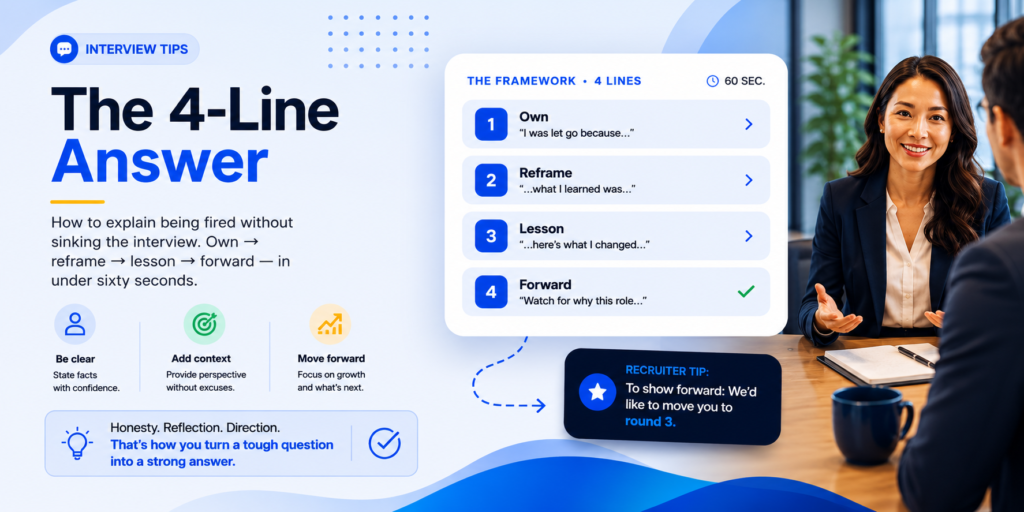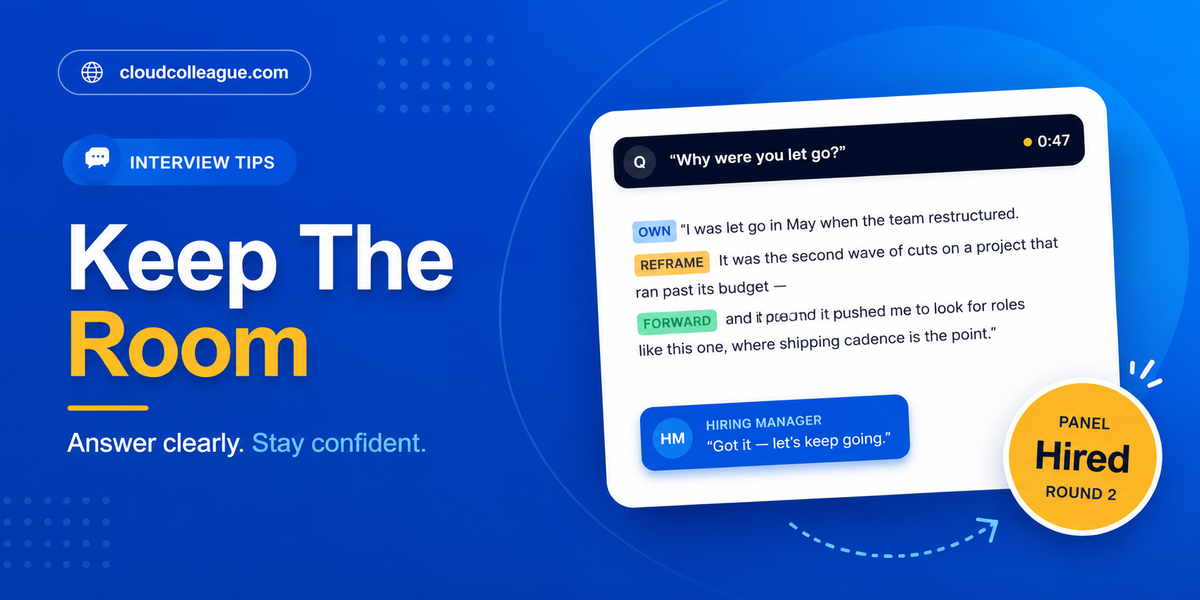
The question “Why were you fired?” is not the interview-ending question it feels like.
Research consistently shows that most hiring managers have experienced a termination in their own career or have successfully hired candidates who have. What ends the interview is not the termination itself. It is the way the question is handled in the room: the deflection, the visible discomfort, the bitterness, the inconsistency between what you say and what your reference says, or the over-explanation that keeps the conversation anchored to the worst moment of your career rather than moving through it to your value as a candidate.
This guide gives you word-for-word answers for every variant of this question, what to do when it catches you off guard, the application form version that most guides ignore, and how Australian reference checks actually work. It is also the companion to our broader article on explaining being fired in a job interview, which covers the strategic three-part answer framework in more depth.
Preparing for an interview after a termination? Make sure you are applying to Australian roles that are a genuine fit for your experience and working style. Browse AI-matched jobs on CloudColleague right now.Browse open roles on CloudColleague
The Many Ways This Question Gets Asked (And What Each Requires)
One of the most common reasons candidates are caught off guard by this question is that it does not always arrive in the form they prepared for. Interviewers ask about terminations in several different ways, and each phrasing requires a slightly different opening response.
“Why Were You Fired?” or “Why Were You Let Go?”
This is the most direct version. It requires the clearest, most direct answer. Do not hedge, do not deflect to a description of company circumstances without explaining your specific situation, and do not start with a lengthy preamble.
Acknowledge the termination directly, provide the briefest accurate reason in one sentence, and move immediately to what you learned. The directness of the question rewards an equally direct opening.
“I was let go from that role. The primary reason was [brief, honest category]. I want to give you the full picture on that, because it is genuinely relevant to how I have developed since.”
“Why Did You Leave Your Last Role?”
This is a softer phrasing that does not presuppose termination. However, if you were fired, you must answer honestly. Do not misrepresent a termination as a voluntary resignation or a mutual agreement.
This misrepresentation is one of the most common and most damaging errors candidates make. Reference checks, background checks, and conversations with shared professional contacts frequently surface this inconsistency. A discovered dishonesty at any stage of the hiring process is far more damaging than the original termination.
The honest version: “The role ended following a termination.” Then follow with your brief, prepared explanation. You do not need to use the word “fired” if the phrasing feels harsh in context. “The role ended,” “my employment was ended,” or “I was let go” are all accurate and professional alternatives.
“Can You Walk Me Through Your Work History?” or “I Noticed a Gap…”
This version is the one that most frequently catches candidates off guard because it does not announce itself as a termination question. When an interviewer is reviewing your work history chronologically and reaches the period of your termination, be ready.
Do not wait for a specific direct question that may not come. When the interviewer reaches that employer in your timeline, proactively and briefly acknowledge the departure rather than waiting to be asked directly.
“I was let go from that role, and I am happy to explain what happened” is the correct proactive approach. It signals transparency, removes the awkward moment where the interviewer has to ask why you left without you volunteering it, and positions you as someone who has processed the experience rather than someone who is hoping it will not be noticed.
“Have You Ever Been Terminated From a Position?”
This is the formal direct question that appears in structured interview formats, particularly in financial services, healthcare, and government roles in Australia. It is a yes or no question followed by a brief explanation.
“Yes, I was terminated from [company] approximately [timeframe] ago. The reason was [brief explanation] and I am happy to give you the full context on that.” Then deliver your prepared answer.
Never answer “no” when the correct answer is “yes.” In regulated industries in Australia, this question is often followed by a background check that confirms employment history. A false answer to a direct question is grounds for immediate withdrawal of an offer or termination of employment if discovered after hiring.
In a Panel Interview With Multiple Interviewers Present
Panel interviews add social complexity to an already charged question. Answering about a termination in front of three or four people simultaneously can feel exponentially more pressured than answering the same question one-on-one.
The strategy is identical to a one-on-one interview, but the delivery technique changes. Distribute your eye contact across the panel rather than fixing on the person who asked. Address your opening sentence to the questioner, then rotate your gaze across the group as you deliver the body of your answer. Keep your answer to exactly the same length as you would in a one-on-one interview. The panel format does not require or benefit from a longer, more detailed explanation.
Want to skip the interview and work on some freelance tasks? Browse freelance tasks on CloudColleague and earn from day one.
What to Do When the Question Catches You Off Guard?
Not every termination question announces itself. Sometimes it arrives earlier than you expected, mid-conversation after you thought the topic had moved on, or embedded in a routine work history review. The specific tactics for managing the surprise are different from the tactics for a question you saw coming.
Buy Yourself Three to Five Seconds With a Bridging Phrase
“That is a good question” buys you approximately two seconds. “I am glad you asked about that” buys you three. “Let me give you some context on that” buys you five and also signals that you have a considered answer ready rather than stalling for time.
These bridging phrases are not evasions. They are professional transitions that give you the moment to shift from whatever you were discussing to the prepared answer you have rehearsed. The key is that the bridging phrase is followed immediately by the direct opening of your prepared answer. A bridge that is not followed by a clear response within three seconds reads as a stall.
Keep Your Physical Composure
If the question catches you by surprise, the physical response is as revealing as the verbal one. A visible startle, a sudden shift in posture, a drop in eye contact, or a long silence before the bridging phrase can signal discomfort that undermines the confidence of the answer that follows.
Practise delivering your answer in conditions that simulate surprise. Ask a friend, family member, or mock interview partner to ask the termination question at a random point in a practice conversation rather than as an announced set-up. This builds the physical composure and the fluency of the bridging phrase and opening sentence under realistic surprise conditions.
The Pramp platform allows peer-to-peer mock interview practice with a real human on the other side. One session where you ask your partner to insert the termination question unexpectedly is more useful than twenty planned rehearsals.
Read Next: Interview Tips for Introverts: How to Present Confidently in 2026 (Australian Edition)
Word-for-Word Answers by Termination Type
These answers are the companion to the scenario-specific examples in our article on explaining being fired in a job interview. They provide additional options and more granular language choices for each situation.
Fired for Performance: Additional Answer Options
Short version (30 to 40 seconds):
“I was let go when my performance did not meet the expectations of the role. Looking back, I had moved into a position that required capabilities I was still developing, and I did not seek support early enough when I recognised the gap. Since then, I have [specific development action, for example: completed a data analysis certification, worked in a more structured role that built that skill, engaged a professional coach on that specific area]. I am a meaningfully stronger candidate for this type of role as a result.”
If pressed for more detail:
“The specific area was [general category without naming individuals, for example: managing upward communication, data accuracy under deadline pressure, client relationship management in a high-volume environment]. I take full responsibility for how I managed that period. What I learned was [specific, actionable lesson]. I have since [specific evidence of what changed].”
If there was a Performance Improvement Plan (PIP):
“I was placed on a performance improvement plan in [general area]. I worked through the process but did not meet the revised targets within the timeframe. The structured feedback from that process was genuinely useful. I have since [specific application of that feedback]. That experience directly informs how I approach [relevant skill] in this role.”
Made Redundant: Distinguishing It Clearly From Being Fired
Standard answer:
“My role was made redundant when [brief business reason: the company restructured its operations, the function was consolidated into another team, the project it supported was discontinued, the company moved the work offshore]. The decision was a business one, not a performance one. My manager was supportive and has agreed to provide a reference. I used the transition period to [specific productive activity] and have been specifically targeting roles where [specific fit with this role].”
Australian legal note for this scenario: Under the Fair Work Act, a genuine redundancy has a specific legal definition. Your role must have genuinely ceased to exist rather than you simply being replaced by another person. If your situation meets that definition, using “my role was made redundant” is both accurate and legally precise. This is materially different from being dismissed for performance or conduct, and using the correct language matters.
Dismissed for Poor Cultural or Role Fit
“I was let go after several months when it became clear that the role was not the right fit for either party. Looking back, I did not ask specific enough questions during the interview process about the management style and the level of autonomy in the role. Those turned out to be areas where expectations and reality were quite different. I have since been much more deliberate in how I evaluate roles before accepting them. I have spent time specifically researching this organisation and the way your team operates, and what I have found tells me this is a meaningfully better match for how I work most effectively.”
Dismissed for Misconduct or a Workplace Dispute
“I was dismissed following a workplace situation that I did not handle as professionally as I should have. I take responsibility for my role in how it escalated. It was a genuinely difficult experience that taught me a great deal about conflict resolution and the importance of addressing concerns through formal channels early rather than allowing them to build. I have since [specific development: coaching sessions, conflict resolution training, structured self-reflection]. I am specifically drawn to organisations where there is a clear and transparent culture around how disagreements are raised and resolved.”
Do not name the other person involved. Do not describe the specific nature of the incident. And do not apportion blame to your former employer. Focus entirely on your accountability and the specific ways in which you have grown.
Fired After a Short Tenure (Under Six Months)
“I was in the role for [X months] before my employment ended. [Brief reason in one sentence]. I recognise that a short tenure on its own raises a question, so I want to give you the full picture. [Two sentences of context and one sentence of specific growth]. I have been very deliberate about how I evaluate new roles since then. The research I have done on this organisation and this specific role tells me [one specific reason this is a better fit].”
Interview preparation underway. Make sure you are applying to Australian roles that are a genuine fit. Browse AI-matched jobs on CloudColleague from 18,000+ verified Australian employers. Start as a Seeker on CloudColleague
The Application Form Version of This Question
Most interview guides ignore this, and it creates significant anxiety for candidates who encounter it unprepared.
Many Australian job applications, particularly in healthcare, government, financial services, and other regulated industries, include a written question asking whether the applicant has been terminated. The form may have a checkbox, a dropdown, or a text field for explanation.
If there is a yes/no checkbox: Answer yes if you have been terminated. Answering no when yes is the correct answer is a misrepresentation that a reference check, background check, or employment verification may surface. A discovered false answer to a direct written question is typically more damaging than the original termination, particularly in regulated industries.
If there is a text field for explanation: Write one to two sentences using the same framework as your verbal answer. Keep it factual, brief, and forward-pointing. Example: “Terminated from [role] at [company] in [year] following a performance review. I have since [one specific development action]. Happy to discuss the full context at interview.”
If the form asks only for reason for leaving: “Employment concluded” or “Role ended” are factually accurate without being evasive for situations that do not require full detail at the application stage. These phrasings are honest without being unnecessarily detailed in a written field where brevity is appropriate.
Never leave this field blank if it directly asks whether you have been terminated. A blank answer to a direct question reads as evasion and is often treated as a failed disclosure check at the offer stage.
How Australian Reference Checks Actually Work?
This information directly addresses the most common fear that candidates with terminations carry into every interview, and it is information that no competing article on this topic provides.
Most candidates with terminations are significantly more anxious about reference checks than the actual risk warrants. Here is the Australian reality.
Most Australian organisations instruct their HR departments to confirm only dates of employment and job title when responding to a reference check request. The reason for departure is rarely disclosed in a formal HR reference check because of legal liability. Under Australian defamation law, providing a false or misleading reference that damages a former employee’s reputation creates genuine legal exposure for the employer. This practical constraint means that most formal reference responses from HR departments are limited to: “Yes, [name] worked here from [date] to [date] as a [title]. We can confirm employment details but are not in a position to provide further information.”
The meaningful risk is not the formal HR reference. The meaningful risk is a personal reference from a former manager or colleague who knew the circumstances and who provides their assessment outside the formal HR framework. Choose your references deliberately. Do not list your previous direct manager as a reference without first having a brief conversation with them about how they will characterise your departure. Ensure the references you provide are people who can speak positively and specifically about your work, not simply people who knew you.
This distinction changes how you think about your reference exposure. The formal HR channel is almost always safe. The personal reference channel requires deliberate management.
The Story Consistency Checklist
Before any interview where your termination may come up, run through this four-point consistency check. Inconsistencies between these sources are what create problems, not the termination itself.
Your resume dates: Confirm your employment end date for the relevant role is accurate and matches your actual last working day or the formal termination date. Do not manipulate dates to disguise tenure length.
Your LinkedIn profile: Confirm the end date on LinkedIn matches your resume exactly. Inconsistencies between LinkedIn and resume dates are the single most common discrepancy that surfaces in reference check conversations, because recruiters frequently check both.
Your verbal answer: Be consistent in how you describe the termination across every interview in the same process. If you are interviewed by multiple people from the same organisation at different stages, your account of the termination should be identical in substance across all of them.
Your references: Brief your references on the general shape of your answer before giving their contact details to a prospective employer. You do not need to script their response. You do need to ensure they are not going to describe the departure in terms that directly contradict what you have said. A brief, honest conversation with each reference removes this risk.
What Australian Job Seekers Specifically Need to Know
When answering Why were you fired, Australian workplace context matters. Under the Fair Work Act, a “genuine redundancy” has a specific legal meaning. If your role was genuinely removed during restructuring, using that wording is accurate and professionally protective. Saying “My role was made redundant during a restructure” is viewed very differently from saying you were simply “let go.”
Background checks in Australia are generally more detailed in industries like finance, healthcare, and government. These checks usually confirm employment dates and sometimes criminal history, but they rarely investigate separation details beyond standard HR verification.
Australian workplace culture also values direct, honest communication. Interviewers typically respond better to a calm, concise explanation than to vague or evasive answers. A straightforward response shows professionalism, self-awareness, and confidence, while overexplaining often creates unnecessary concern.
CloudColleague’s AI matching surfaces roles based on your skills and capability profile rather than your most recent employer relationship. For candidates who have experienced a termination, applying through a skills-based matching platform reduces the weight that a specific employment ending carries in the initial screening stage. Your skills and experience are evaluated on their merit rather than through the lens of your previous employer’s decision.
Interview answer prepared and confidence in place. Now find Australian roles worth applying to. Create a free verified profile on CloudColleague and get AI-matched to 18,000+ verified Australian employers hiring right now. Get started free on CloudColleague
Hiring and need to find the right candidate? Post a role on CloudColleague in under five minutes. Smart matching surfaces pre-vetted professionals across every Australian industry.Start hiring on CloudColleague
Frequently Asked Questions
You do not need to volunteer the information unless asked. However, if an interviewer asks why you left a role or whether you were terminated, answer honestly. In Australia, background and reference checks can reveal discrepancies, especially in regulated industries like healthcare, finance, and government. A brief, honest explanation is usually the safest approach.
Stick to your honest account and keep it calm and factual. Avoid sounding defensive or trying to predict what a former employer may say. In most Australian workplaces, formal HR references only confirm dates and job titles, so major conflicts rarely arise.
If the form asks directly about termination, answer truthfully and keep the explanation short. Mention the role ended, provide a brief reason, and note one positive change or improvement made since then. Never leave direct disclosure questions blank.
No. Most hiring managers care more about how you explain the situation than the fact it happened. Candidates who take ownership, stay professional, and demonstrate growth usually perform far better than those who avoid or blame others.
It depends on your situation. Some people apply immediately, while others benefit from taking a few weeks to update their resume, practise interview answers, and clarify career direction. The most important step is preparing a confident answer before interviewing.