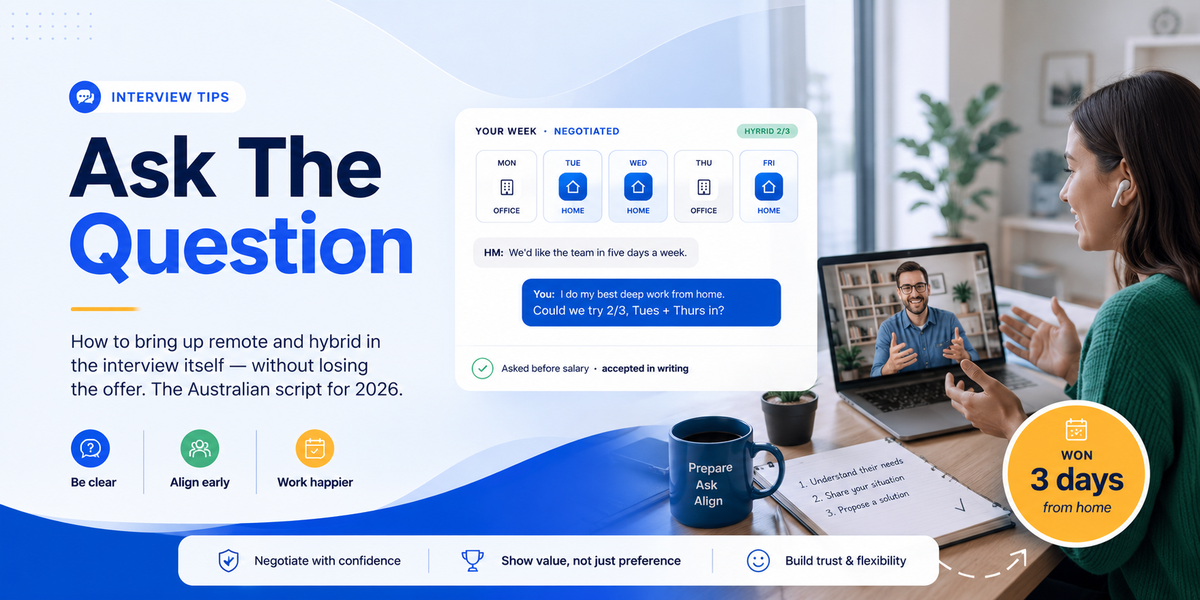
How to negotiate remote work during a job interview in 2026 requires a different approach than it did in 2022.
The pandemic-era assumption that remote work was freely available has given way to a more complex reality. Major Australian employers including Commonwealth Bank mandated four days per week in-office from early 2025. ANZ, major law firms, and several government departments have followed with three to four day office requirements. The remote work landscape has not disappeared, but it has contracted significantly in parts of the Australian market.
Remote and hybrid arrangements are still achievable, and in many sectors they are still the norm. But negotiating them in 2026 requires more strategic preparation, better timing, and more specific evidence than candidates needed two years ago.
In this guide, we give you the timing, the framing, the scripts, and the Australian legal context you need to negotiate a remote or hybrid arrangement with genuine confidence.
Looking for roles that already offer remote or hybrid arrangements? Browse AI-matched Australian jobs on CloudColleague. Many listings specify flexible work options upfront so you know before you apply. Browse flexible roles on CloudColleague
The 2026 Remote Work Landscape in Australia: What Has Changed?
Before any practical advice, the most useful thing is to understand the current reality rather than the advice calibrated to 2022.
According to the Australian Bureau of Statistics, approximately 37% of Australian workers worked from home at least some of the time as of early 2026. That figure is well above pre-pandemic levels but meaningfully below the pandemic peak. The trend line over 2025 and 2026 has moved consistently toward more office presence at most large Australian employers.
The return-to-office mandate wave has been significant. Commonwealth Bank mandated four days per week in-office from early 2025. ANZ followed with three to four day expectations. Multiple law firms, government departments, and financial services organisations have implemented similar requirements. These mandates are not reversals of remote work as a concept. They are recalibrations of the balance that many employers feel shifted too far during the pandemic.
Despite this, remote and hybrid work remains genuinely negotiable in a substantial portion of the Australian market. Technology companies, in-house marketing and communications teams, professional services roles in smaller firms, and many startups and scale-ups continue to offer genuine flexibility. Atlassian and Canva have maintained strong flexible work practices and set a clear precedent in the Australian tech sector.
The key insight for 2026 negotiation is this: the employer category matters more than your negotiating skill. Research which category your target employer falls into before any interview begins. A candidate negotiating remote work at Commonwealth Bank in 2026 is in a fundamentally different position from one negotiating at a Sydney tech startup.
Read Next: How to Explain Being Fired in a Job Interview in 2026: The Exact Answer Framework
Before the Interview: How to Research the Company’s Remote Policy?
Everything that should happen before any interview conversation about remote work.
Check the Job Posting Carefully
Job postings increasingly specify work arrangements in 2026. Look for explicit language: “hybrid (3 days office)”, “remote-first”, “on-site required”, or a specific office location. The absence of any remote or hybrid mention in a 2026 posting is itself a meaningful signal that the employer expects significant in-office presence.
Increasingly, the number of days is specified directly in the listing. “3 days in our Melbourne CBD office” removes ambiguity. “Flexible working arrangements” without specification leaves room for negotiation.
Research the Employer’s Stated Policy
Check the company’s LinkedIn page, Glassdoor reviews filtered to Australia, the company website’s About and Culture sections, and any recent press coverage about their work arrangement policies. Major Australian employers have frequently publicised their RTO decisions through media, industry publications, and staff announcements that sometimes surface in news searches.
Knowing whether an employer has an active RTO mandate before the first interview prevents you from entering a negotiation with no viable outcome. It also tells you whether this is the right employer to pursue at all, depending on what arrangement you actually need.
Look for Signals in the Job Listing Language
Language that signals openness to remote or hybrid arrangements: “flexible work arrangements”, “outcomes-focused environment”, “trust our people”, “distributed team”, “async-friendly”, “results-based culture”.
Language that signals office expectation: “collaborative in-person culture”, a specific CBD location mentioned, “team-based environment”, any specific day count listed, “on-site role”.
Know Your Non-Negotiable Before You Start
Before any interview, define clearly what arrangement you are actually willing to accept. Full remote only? Two to three days office per week acceptable? Location flexibility with occasional office visits when needed? Knowing your genuine minimum prevents you from agreeing to something in the interview that you will need to renegotiate after you start. Renegotiating an arrangement you agreed to on day one is significantly harder than negotiating it clearly before you sign.
When to Raise Remote Work: A Stage-by-Stage Guide?
The timing of when you raise remote work is as important as how you raise it. Most candidates either raise it too early in a first interview, which signals the arrangement matters more than the role, or too late after they have already signed, which puts them in a renegotiation they should have had before accepting.
The correct sequence is research before the first interview, confirm signals in the second interview, and negotiate specifics after the offer.
First Interview: Listen and Observe, Do Not Lead With It
Do not raise remote work as an early question in a first interview. Doing so signals that the arrangement is your priority, which creates a poor impression before you have established your value as a candidate. Most experienced interviewers interpret an early remote work question as a candidate more focused on where they will work than what they will do.
What to do instead: listen carefully for how the interviewer describes the team, the culture, and the working environment. Phrases like “we all come in together on Tuesdays for collaboration” or “our team is distributed across Sydney and Melbourne” give you meaningful information about the current arrangement without requiring a direct question.
If you are asked about location or working style, answer honestly and briefly: “I am based in [city] and I am open to discussing the working arrangement that best suits the role and the team.”
Second or Third Interview: Confirm the Arrangement
By the second or third interview, you have established enough credibility and mutual interest to ask about working arrangements as part of understanding the role properly.
“Could you tell me a bit more about how the team typically works? Are most people coming in full-time, or does the team have a hybrid arrangement in place?” This is a question gathering information for your own decision-making, not a negotiation. It gives you the data you need for the post-offer conversation.
If the answer reveals an arrangement that does not work for you, you now know this before investing further in the process. That is valuable information regardless of the outcome.
After the Offer: Negotiate the Specifics
The ideal moment to negotiate the specific terms of a remote or hybrid arrangement is after you have received an offer and before you have signed. At this point, the employer has confirmed they want you. They have invested interview time and typically declined other candidates. You have maximum leverage.
The conversation shifts from “is this possible?” to “can we work out the specifics together?” This is the moment for direct, collaborative negotiation rather than exploratory questioning.
Already have an Job offer? Learn :How to Negotiate Salary After Receiving a Job Offer to negotiate best salary for your new job.
How to Frame the Request: Making the Case for Remote Work?
The framing language you use in an Australian hiring context matters more than most candidates realise.
Frame It as a Productivity and Performance Benefit
The most effective remote work negotiations in Australian corporate contexts frame the arrangement as beneficial to the employer rather than as a personal lifestyle preference. Australian hiring managers respond better to evidence-based, outcomes-focused framing than to personal convenience arguments.
“I do my best focused work in a hybrid model and I have consistently delivered strong outcomes in this arrangement” is more effective than “I prefer not to commute five days a week.”
“In my previous role, I managed our quarterly reporting process entirely remotely and delivered ahead of schedule for three consecutive quarters” is more effective than “I am very productive when working from home.”
Lead With Evidence of Past Remote Performance
Concrete evidence of past remote performance is the single most persuasive element of any remote work negotiation. Metrics, specific outputs, and manager endorsements from previous remote or hybrid roles carry far more weight than general arguments for remote work.
Think through your track record before the conversation:
- What specific outcomes did you deliver in a remote or hybrid arrangement?
- What did your manager say about your performance in that environment?
- Are there any measurable results (project completion rates, client satisfaction scores, output volume) that you can point to as evidence of your remote effectiveness?
Candidates who bring evidence to this negotiation consistently achieve better outcomes than those who make the same request without it.
Propose a Trial Period if the Employer Is Hesitant
Offering a three to six month trial period with agreed performance metrics is one of the most effective ways to negotiate remote work at an employer who is uncertain or who has an active RTO policy but some flexibility.
“I am completely open to starting on a full in-office basis during the initial period to get properly integrated with the team. After three to six months, once we have both seen how I work, I would like to revisit the arrangement and discuss whether a hybrid model could work well for the role. Would you be open to that structure?”
This reduces the perceived risk for the employer, puts the arrangement on a defined and agreed timeline, and demonstrates your commitment to the role over your commitment to working remotely. It is often the option that unlocks flexibility that a direct request would not have achieved.
Prefer to apply for roles where flexible work is already confirmed? Browse AI-matched jobs on CloudColleague. Find verified Australian employers with flexible arrangements specified upfront. Start as a seeker on CloudColleague.
Ready-to-Use Scripts for Common Scenarios
These scripts are written for Australian professional norms: direct, respectful, collaborative, and evidence-led.
When the Job Posting Says Nothing About Remote Work
In the second or third interview: “I want to make sure I understand the working model before we go further. How does the team typically operate in terms of office presence and remote working? And is there flexibility in that arrangement for the right candidate?”
After the offer: “I am really excited about this role and I want to make this work. Before I confirm, I would like to understand a bit more about the working arrangement. Is there flexibility to work remotely [X] days per week, or is the expectation primarily in-office?”
When the Employer Has an RTO Mandate but You Want Some Flexibility
“I noticed the role is primarily office-based, and I completely understand the importance of in-person collaboration for this type of work. I wanted to ask whether there is any flexibility for focused remote working within that overall arrangement, perhaps one day per week for deep project work. And I have found that model produces strong outcomes for the kind of analytical work this role involves.”
When Remote Work Is Essential for You and the Posting Is Silent
After the offer, not before: “I am very keen on this role and I want to be transparent about one thing before I respond. A remote or hybrid arrangement is important to me for [brief, honest reason, for example caring responsibilities, interstate location, or the nature of my focused work]. I was hoping we could discuss whether there is any flexibility in the working model. Could we explore what that might look like?”
If remote work is non-negotiable for you, raise it before accepting rather than expecting to renegotiate after you start. Renegotiating an agreed arrangement during the first months of a new role is significantly harder and damages the relationship you are trying to build.
When Proposing a Formal Trial Arrangement
“I understand that the team typically works from the office [X] days per week. I would be happy to commit to that arrangement during an initial period to get properly established with the team. After [three to six months], I would appreciate the opportunity to formally revisit the arrangement. Would you be open to building that review into our agreement from the start?”
Want to earn from short term tasks? Browse freelance tasks on CloudColleague, and earn from day one.
The Australian Legal Context You Need to Know
These two pieces of Australian workplace law are completely absent from every competing article on this topic, and both are directly relevant to remote work negotiations.
Fair Work Act Flexible Work Request Right
Under the Fair Work Act, employees who have worked for an employer for 12 months, or long-term casuals who have been employed for 12 months on a regular basis, have a legal right to request flexible work arrangements. This right covers changes to hours, patterns, and location of work, including remote and hybrid arrangements.
When a flexible work request is submitted, the employer must consider the request seriously and can only refuse on reasonable business grounds. They must provide a written response within 21 days. If the request is refused, the written response must explain the business grounds for the refusal.
This matters for negotiation strategy in a specific way. If you accept a role with a full in-office arrangement and work there for 12 months, you then have a legal right to formally request a hybrid or remote arrangement. The employer must engage with that request properly. This changes the calculation around accepting a role with a currently inflexible arrangement: 12 months is not a permanent commitment to the arrangement you started with. It is the waiting period for a protected legal right to formally request a change.
Right to Disconnect
Australia’s Right to Disconnect legislation, which came into effect in August 2024, gives employees the right to refuse to monitor or respond to contact from their employer outside their ordinary working hours, unless the refusal is unreasonable. This applies across all industries and employer sizes as of August 2025.
This is directly relevant to remote work negotiations because it establishes a legal framework for work-life boundaries in remote and hybrid arrangements. When discussing remote work with an employer, you can reference this framework as part of establishing clear expectations about availability and working hours. “I want to make sure we are aligned on availability expectations as part of the working arrangement” is a reasonable and legally grounded conversation to have.
Australian Industry Context: Where Remote Work Is and Is Not Negotiable in 2026
Remote work negotiability varies dramatically by Australian industry. Investing negotiation energy in sectors where the arrangement is genuinely non-negotiable produces frustration rather than outcomes.
Technology roles at Australian startups and scale-ups: Highly negotiable. Atlassian, Canva, and the broader Australian tech sector have maintained strong flexible work practices.
Finance and professional services (Big 4, investment banking, major law firms): Significantly less negotiable in 2026. Most major Australian financial services employers have active RTO policies.
Government and public sector: Typically three to four days in-office as a minimum for most roles, with variation by department. The Australian Public Service Commission provides guidelines rather than mandates, with individual agencies setting their own policies.
Healthcare, nursing, allied health, and trades: Largely non-negotiable for operational roles. These positions require physical presence by nature. Research, policy, and administrative roles within healthcare organisations often do have hybrid flexibility.
Marketing, communications, and creative roles: Moderate negotiability. Agency environments typically expect more in-office presence than in-house roles. Many in-house marketing and communications roles at Australian companies now offer two to three days remote as standard.
Education: Limited flexibility for teaching roles but meaningful flexibility for administrative, curriculum, instructional design, and policy roles within educational institutions.
Find Australian roles where flexible work is already part of the package. Create a free profile on CloudColleague and get AI-matched to verified employers hiring right now, many of whom specify their work arrangement upfront.Get started free on CloudColleague
Hiring and want to attract strong candidates? Post a role on CloudColleague in under five minutes. Smart matching surfaces pre-vetted professionals across every Australian industry. Specify your work arrangement upfront to attract the right candidates.Start hiring on CloudColleague
Frequently Asked Questions on Negotiate Remote Work During a Job Interview
For How to negotiate remote work during a job interview, timing is key. Research the company’s policy before your interview. Ask general questions about working arrangements in the second or third interview. The best time to negotiate specific remote or hybrid terms is after you receive a job offer, when leverage is highest and terms are still flexible.
Not if it is raised appropriately. In Australian hiring, asking about remote work in later interviews or after an offer is normal. It only becomes a risk if you bring it up too early or frame it as a demand instead of a discussion about role performance and outcomes.
First, check if the company already offers flexibility. In the interview, ask how the team typically balances office and remote work. After an offer, make a clear, reasonable request (for example, one or two remote days per week) and link it to productivity and focus.
After 12 months of employment, you can request flexible work under the Fair Work Act. The employer must consider it and respond within 21 days, but they can refuse on reasonable business grounds. There is no automatic right to remote work from day one.
Always get it in writing before signing the contract. Confirm agreed remote or hybrid arrangements by email so there is a clear record. This avoids misunderstandings and protects both you and the employer.