Explaining being fired in a job interview is one of the most anxiety-inducing questions in any job search. But here is what most people searching this topic do not know: being fired is not the dealbreaker they fear.
What interviewers are actually evaluating is not the fact that you were let go. They are evaluating how you talk about it. Candidates who answer this question with honesty, brevity, and a clear sense of what they learned consistently make a stronger impression than candidates who hedge, evade, or redirect blame toward their former employer.
In this guide, we give you the exact three-part answer structure, four scenario-specific sample answers for the most common termination situations, a clear list of what never to say, and practical guidance on preparing your answer before the interview. All of it is grounded in the Australian job market and Australian workplace law.
Is your Interview coming up? Make sure you are applying to Australian roles that are a genuine fit for your skills. Browse AI-matched jobs on CloudColleague right now. Browse open roles on CloudColleague
What Interviewers Are Actually Evaluating When They Ask This Question?
Before any practical advice, the most useful thing is to change how you think about this question.
When an interviewer asks why you were fired, they are not trying to catch you out. They are not expecting perfection. Research consistently shows that a significant proportion of working professionals have experienced at least one termination during their career, and many interviewers have experienced one themselves.
What they are evaluating is three specific things?
Self-awareness: Do you understand what happened and your role in it? A candidate who can articulate the circumstances of their termination clearly, without defensiveness, demonstrates the kind of reflective capacity that employers value in any role.
Accountability: Can you take ownership of your contribution to the situation without deflecting responsibility onto your employer, your manager, or your colleagues? Accountability without self-destruction is one of the rarest and most valued qualities an interviewer encounters.
Growth: Have you learned something meaningful since the termination that makes you a more capable, self-aware candidate for this role? Demonstrated growth after adversity is not just an acceptable answer. It is often a compelling one.
Candidates who answer this question well, acknowledge what happened, take appropriate ownership, and explain what changed clearly consistently create a stronger impression than candidates who answer awkwardly or evasively, even if those candidates were never fired.
Feeling hesitated about the interview? Want to practice for the interview? Read Mock Interview App vs Career Coach and know the real difference, which one gets you hired in 2026.
What Australian Candidates Need to Know Before the Interview?
There are two pieces of Australian-specific information that change how most candidates feel about this question before they even answer it.
Reference Check Can and Cannot Reveal in Australia
Most candidates fear that a former employer will disclose damaging information in a reference check. In Australia, this fear is generally larger than the actual risk.
Most Australian organisations instruct their HR departments to confirm only dates of employment and job title when responding to a reference check request. The reason for departure is rarely disclosed in a formal reference check because of liability concerns. When a prospective employer’s HR team calls your former company, they will typically receive: “Yes, [name] worked here from [date] to [date] as a [title]. We can confirm employment details but are unable to provide further information.”
The more meaningful risk is a personal reference from a manager or colleague who knew the circumstances. Prepare your references carefully. Have a conversation with each reference you plan to provide about how they will characterise your departure. Choose references who can speak positively and specifically about your work rather than anyone who might add unwanted detail.
Dismissal vs Redundancy Under the Fair Work Act
Under the Fair Work Act in Australia, being fired and being made redundant carry different legal meanings, and that distinction affects how you should describe your departure accurately.
An employer creates a genuine redundancy when they no longer require anyone to perform the employee’s job and they comply with any consultation requirements in the relevant award or agreement. If the company eliminated your role because it restructured operations, offshored the function, merged departments, or removed the position entirely, Australian law classifies the situation as a redundancy, not a firing.
A dismissal occurs when an employer ends the employment relationship because of the employee’s conduct or performance.
The distinction matters because “I was made redundant when the company restructured its Asia-Pacific operations” is factually, legally, and professionally different from “I was dismissed.” If your departure falls under genuine redundancy, use that language accurately. It removes the performance implication entirely.
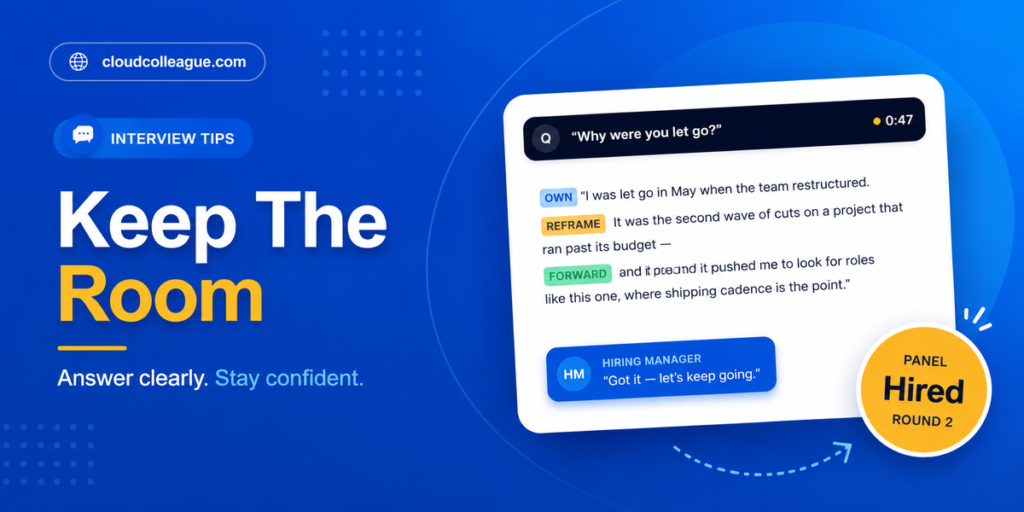
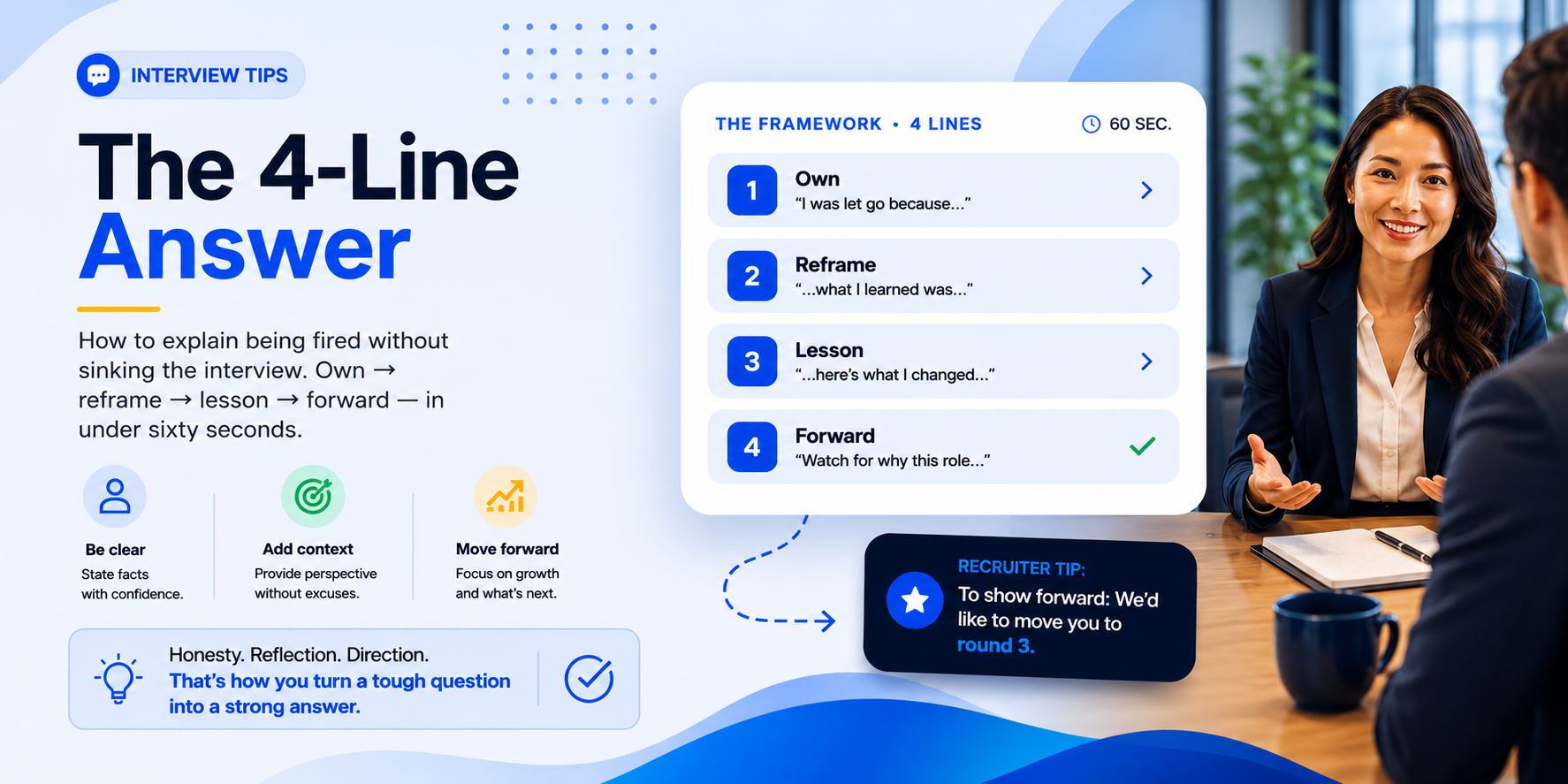
The Three-Part Answer Framework
This is the practical core of the article and the element no competing guide provides. Every piece of advice about this interview question comes down to the same principles: be honest, be brief, show growth. But principles without structure leave candidates in front of a mirror the night before an interview still unsure what to actually say.
Here is the structure that works for almost every termination scenario. It is brief, honest, forward-looking, and practiseable.
Part 1: Acknowledge Briefly (One to Two Sentences)
State what happened clearly and without excessive detail. Do not hedge. Do not start with qualifications. And Do not apologise before stating the fact. Acknowledge the termination and the general reason in the fewest accurate words possible.
The goal of part one is to demonstrate that you are comfortable stating what happened without flinching. Discomfort at this stage signals that the experience is not fully processed, which creates concern for the interviewer.
Example: “I was let go from my role at [company] after about 18 months. The primary reason was that my performance in the first six months did not meet their expectations in a specific area.”
Part 2: Take Ownership or Provide Context (Two to Three Sentences)
This is where most candidates either succeed or fail. If the termination was performance-related, take clear ownership of your contribution to the situation. Do not over-explain, do not list mitigating factors, and do not attribute the outcome primarily to external circumstances. Ownership is what builds trust.
If factors genuinely outside your performance caused the termination, such as redundancy, a culture mismatch, or major changes to the role you were hired for, provide honest and brief context. Note that even in these situations, the best candidates acknowledge what they would do differently in evaluating a new role.
Performance example: “I had moved into a role that required significantly stronger data analysis skills than I had at the time. I underestimated the learning curve and did not ask for support early enough when I recognised the gap. That is something I take full responsibility for.”
Redundancy example: “The company restructured operations and moved the function to its Singapore hub, which eliminated my role along with several others. Throughout my time there, I consistently met or exceeded performance expectations.” The decision was a business one rather than a performance one.”
Part 3: Pivot to Learning and Readiness (Two to Three Sentences)
This is the turn that transforms the answer from a confession into a demonstration of character. State specifically what you learned, what you did differently, or how you developed in the period following the termination. Then connect that directly to why you are now a stronger candidate for this role.
The pivot should be genuine and specific, not formulaic. “I learned from the experience and moved on” is not a pivot. “I completed a structured data analytics program and spent six months working on data projects to close the gap I had identified” is a pivot with evidence.
Example: “After leaving, I completed a Google Data Analytics certificate and took on three freelance data projects to build the skills I had been missing. I actively sought out this role because the data analysis requirements align directly with where I have invested my development time over the past year.”
Scenario-Specific Sample Answers
The three-part framework applies across all scenarios, but the emphasis and tone shift depending on the reason for the termination. Here are complete sample answers for the four most common situations.
Fired for Performance
This is the most common and the most emotionally charged scenario. The key is to acknowledge the performance issue clearly, explain why it happened without attributing it primarily to your employer, and show specifically what changed.
Sample answer: “I was let go after about a year when my sales numbers consistently fell below the team’s targets. Looking back, I had overestimated my readiness for a high-volume outbound sales environment and did not ask for coaching early enough when I recognised I was struggling. After leaving, I enrolled in a structured consultative sales methodology program and spent six months in a sales support role to rebuild my fundamentals from a stronger base. I am now specifically targeting roles where relationship-led selling is the primary skill rather than outbound volume, because that plays to my genuine strengths and interests.”
Made Redundant
Redundancy is the most straightforward scenario to explain because it is genuinely outside your performance. The key is to state the business reason clearly, confirm your performance was not the issue if that is accurate, and move quickly to what you did during the transition period.
Sample answer: “My role was made redundant when the company decided to consolidate its marketing operations across Asia-Pacific into its Singapore hub. The decision was a business restructuring rather than a performance issue. My manager was supportive and has agreed to be a reference. I used the transition period to complete my Google Analytics certification and deliver some freelance content strategy work for two small Australian businesses while I searched for my next permanent role.”
Poor Fit or Culture Mismatch
This scenario requires the most careful framing because it can easily sound like blame if poorly delivered. The key is to acknowledge your role in not assessing the fit correctly during the hiring process, rather than framing the employer as the problem. The interviewer needs to believe you have learned how to evaluate fit, not that you blame your former employer for a mismatch.
Sample answer: “I was let go after about eight months when it became clear that the working style and the role’s autonomy level were not what either of us had expected. I think I did not ask the right questions during the interview process about how decisions were made and how much independent ownership I would have in the role. Those turned out to be areas where expectations and reality did not align well. I have since been much more specific in the way I evaluate roles and conversations, and I genuinely think this position is a much closer match for how I work best. The structure of your team and the level of ownership your JD describes is exactly what I was looking for.”
Misconduct or Serious Workplace Disagreement
This is the most sensitive scenario and requires the most careful preparation. If the termination followed a formal disciplinary process, you need to be honest, brief, and focus heavily on accountability and what changed. Avoid specific identifying details about the people involved or the nature of the incident.
Sample answer: “I was dismissed after a workplace dispute that escalated beyond what either party handled well. I take responsibility for my role in how it developed. It was a genuinely difficult situation that taught me a great deal about conflict resolution and the importance of addressing problems through formal channels early rather than allowing them to build. I have since worked with a professional coach on communication and conflict management skills, and I am specifically looking for a role where there is a clear and transparent culture around how disagreements are raised and managed.”
Answer prepared and confidence building. Find Australian roles worth interviewing for. CloudColleague provides seeker with a choice for both jobs and tasks. Browse freelance tasks at CloudColleague.
What Never to Say When Explaining Being Fired
Most interview guides spend more words on what to say than on what destroys your chances. This section redresses that balance. These are the specific behaviours and phrases that immediately create a negative impression, with neutral alternatives for each.
Never Badmouth Your Former Employer
This is the single most disqualifying behaviour when explaining a termination, and it happens more often than candidates realise because they are emotionally activated by the question.
Saying anything negative about your former employer, your former manager, or your former colleagues signals one thing to the interviewer: when you leave this company, you will say the same things about them. That risk is immediately disqualifying regardless of how legitimate your grievance is.
Never say: “My manager had it in for me from the start and made my life difficult.”
Say instead: “We had different working styles that I do not think either of us managed as well as we could have.”
Never say: “The company was disorganised and constantly changing direction. It was impossible to succeed there.”
Say instead: “The role evolved significantly from what was originally described, and I found it difficult to perform at my best without clearer direction. That taught me to ask more specific questions about organisational stability in interviews.”
Never Over-Explain or Over-Justify
The instinct when anxious is to explain everything, anticipate every possible follow-up question, and justify every decision you made. Resist this completely.
A long, detailed explanation of why you were fired keeps the conversation focused on the termination rather than on your qualifications. It signals that the experience is still raw and not fully processed. Answer the question, then stop. If the interviewer wants more, they will ask.
Never Deny or Downplay
Describing a dismissal as “a mutual decision” when it was not, saying you resigned when you were actually fired, or omitting a termination from a direct question are all forms of deception that a reference check or background check may surface.
Discovered dishonesty in an interview process ends the application immediately. In some industries, particularly financial services, professional services, and regulated sectors in Australia, it can have consequences beyond the immediate application.
Honesty is both the ethical and the strategic choice. A truthful account of a termination, delivered with confidence and growth, is far less damaging than dishonesty discovered at any stage.
Never Express Ongoing Bitterness or Emotion
Even if the termination was genuinely unjust, expressing visible anger, upset, or resentment in the interview does not serve you. Interviewers read visible emotion as unresolved conflict and a potential risk factor in the workplace.
Process the experience before you interview. If you are still emotionally close to the termination, consider working with a career coach. Else use a mock interview platform to practise delivering the answer calmly before you face it in a real interview. The calm, measured perspective of someone who has moved past the experience is the tone you are aiming for.
How to Practise Until the Answer Feels Natural?
This is the step most candidates skip, and it is the most important one. An answer that sounds confident and natural in an interview is one that has been rehearsed specifically until it feels that way. The best way to practise is also through Mock Interview app. The CloudColleague guide on Best Mock Interview Platform is best for your practise.
Write your three-part answer down first. Write it, read it back, and edit it until it is honest, brief, and forward-looking.
Say the answer out loud at least ten times before your interview. What reads well on paper frequently feels stilted or over-rehearsed when spoken. Repetition builds the fluency that makes an answer sound natural rather than prepared.
Do a mock interview with someone you trust. Ask them to follow up your initial answer with: “Can you tell me a bit more about that?” Practise answering the follow-up with the same calm brevity. Most interviewers will probe at least once.
Record yourself on your phone and watch it back. Notice where your body language tightens, where you hesitate, and where the answer loses momentum. Adjust accordingly. Your physical presentation matters as much as the words.
Consider one session with a career coach or a practice session through a mock interview platform. For a question this important, external feedback from someone who can observe your delivery and body language adds something that self-directed practice cannot fully replicate.
Interview ready. Now apply to Australian roles where you can thrive. Create a free verified profile on CloudColleague and get AI-matched to employers actively hiring across every Australian industry right now.Get started free on CloudColleague
Hiring and need strong candidates? Post a role on CloudColleague in under five minutes. Smart matching surfaces pre-vetted professionals across every Australian industry.Start hiring on CloudColleague
Frequently Asked Questions
You are not legally required to volunteer information about a termination unless asked directly. However, if an interviewer or application form asks whether you have been terminated, answer honestly. In Australia, background and reference checks may reveal the information anyway. The safest approach is to prepare a confident, honest explanation rather than avoid the topic.
Acknowledge the issue clearly in one or two sentences and take ownership of your role in the outcome. Then shift the focus to what changed, such as a skill improved, a course completed, or a different work approach adopted.
Most Australian employers limit formal reference checks to confirming employment dates and job titles because of liability concerns around negative comments. The bigger risk is often an informal reference from a former manager or colleague. Choose references carefully and discuss how they will describe your departure before sharing their details.
If the form asks whether you have been terminated, answer truthfully and keep the explanation brief and professional. If it only asks for a reason for leaving, phrases like “Employment ended” or “Role concluded” are accurate without sounding evasive. Use a fuller explanation later in conversation if needed.
Aim for 60 to 90 seconds when spoken aloud. A shorter answer can sound evasive, while a longer one keeps attention on the termination instead of your qualifications. Practise your response and cut unnecessary details if it runs too long.