The most effective interview tips for introverts are not about pretending to be extroverted. They are about understanding what confident presentation actually requires and recognising that introverts are structurally well-positioned to deliver it in most Australian interview formats.
Interviews are not won by the loudest candidate or the most enthusiastic handshake. They are won by the candidate who gives the most specific, evidence-backed, clearly delivered answers. That candidate is more likely to be well-prepared than naturally charismatic. And introverts, as a group, prepare more thoroughly than most.
In this guide, we give you the exact strategies to present confidently as yourself, not as a performance of someone else. We also give you something no competitor article provides: a clear framework for understanding which type of interview anxiety you are experiencing and the specific solution for each one.
Preparing for an interview? Make sure you are applying to Australian roles that genuinely fit your working style. CloudColleague AI-matches professionals to verified employers based on skills and fit, not just job title. Browse roles on CloudColleague
The Three Types of Interview Anxiety (And Why This Matters)
Most advice about introvert interview anxiety treats it as a single thing to be overcome. It is not. There are three distinct types, and each requires a different solution. Identifying which type you experience tells you exactly where to focus your preparation energy.
Content Anxiety: Not Knowing What to Say
Content anxiety is the fear of going blank or not having a relevant answer when a question is asked. It is the most common type and the most straightforwardly solvable.
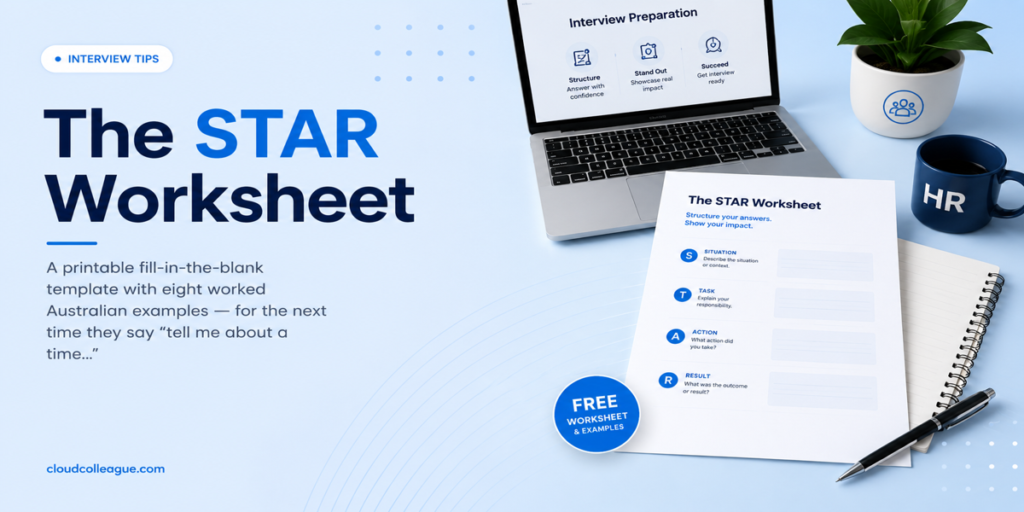
The solution is not confidence. It is preparation. Specifically, it is building a library of STAR method stories (Situation, Task, Action, Result) that cover the most common interview question categories: leadership, collaboration, conflict, failure, achievement, and problem-solving.
A candidate who has prepared eight to ten STAR stories has almost no risk of genuine content anxiety because almost every behavioural question connects to a story they have already rehearsed. The problem is not that the content does not exist. The problem is that it has not been organised and practised into accessible, retrievable form.
Read Next: How to Answer “Why Were You Fired?” Without Killing Your Chances? (Australian Guide)
Performance Anxiety: Knowing the Answer But Freezing Under Pressure
Performance anxiety is the freeze response: you know the answer but the social pressure of the interview room temporarily disconnects you from it. This is a different problem from content anxiety and requires a different solution.
The solution is rehearsal until the delivery becomes automatic. Saying your STAR stories out loud ten or more times until they feel natural removes the gap between knowing the content and delivering it fluently under pressure. Rehearsal is different from memorisation. You are not trying to recite a script. You are building the fluency that allows the content to surface even when the social environment competes with your recall.
Performance anxiety responds to repetition more than to confidence-building exercises. The delivery needs to be practised, not just the content.
Social Anxiety: The Unfamiliar Room and Stranger Dynamic
Social anxiety is the discomfort of an unfamiliar physical environment with people you do not know evaluating you. For introverts, this novelty layer compounds the other two types of anxiety and is often underestimated as a factor in interview performance.
The solution is environmental familiarisation and a structured pre-interview routine that manages your social energy before you walk into the room. Knowing who you will meet, arriving early enough to get comfortable with the physical space, and having a specific sequence of activities in the hour before the interview significantly reduces the novelty that drives this type of anxiety.
We cover the full pre-interview routine below.
Introvert Strengths That Australian Interviewers Actually Value
Before the practical strategies, the most useful reframe is recognising that Australian interview formats are structurally well-suited to introvert strengths.
Australian corporate, government, and healthcare hiring processes are heavily behavioural-interview driven. Behavioural interviews reward structured preparation, specific story recall, and measured delivery over spontaneous charisma and social energy. These are precisely the areas where well-prepared introverts consistently outperform less-prepared candidates regardless of personality type.
The egalitarian Australian workplace culture also tends to view theatrical confidence with more scepticism than many US or UK hiring contexts. The cultural dynamic sometimes described as “tall poppy syndrome” means that measured, evidence-based answers that let the work speak for itself often land better with Australian interviewers than enthusiastic self-promotion. Candidates who display excessive confidence without specific evidence to back it are occasionally viewed negatively by Australian hiring teams.
The pause before answering, which introverts instinctively use and often feel anxious about, is read positively by most experienced Australian interviewers. It signals deliberate rather than reactive thinking. A candidate who thinks before speaking demonstrates the reflective quality that many Australian managers specifically value in their teams.
Active listening, which introverts do naturally, means they pick up nuance in questions, ask better clarifying questions when needed, and give more precisely targeted answers than candidates who respond before fully processing what was asked.
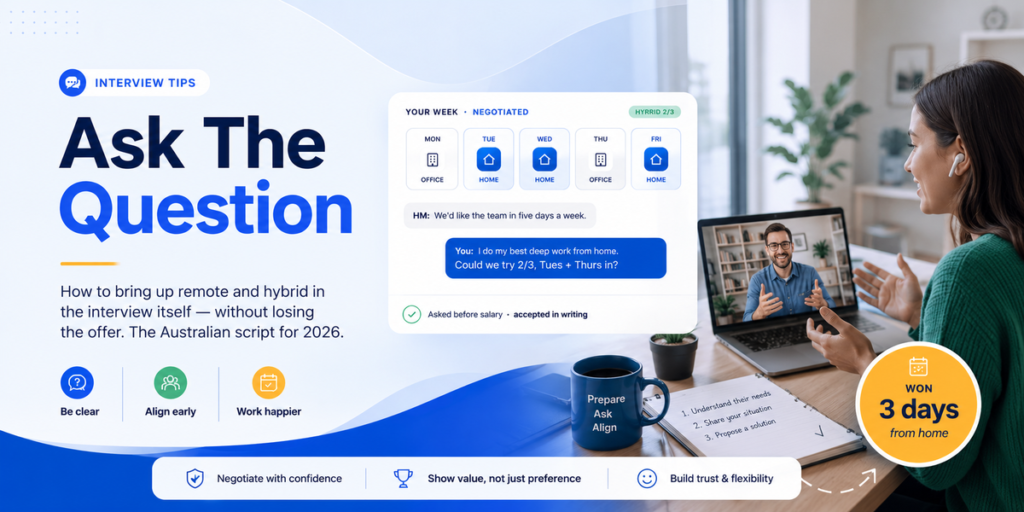
Read the guide : How to Negotiate Remote Work During a Job Interview to get prepared for the interview.
The Confident Language Technique
This is one of the most immediately impactful strategies available to introverts in interviews, and it is one that no competing article in this space currently names or explains explicitly.
Introverts characteristically undersell their own contributions with qualifying and hedging language. This is not dishonesty. It is a deeply ingrained communication habit that reflects genuine humility. In an interview context, it is also one of the most damaging patterns an introvert can display.
When you say “I was somewhat involved in that project,” the interviewer hears uncertainty. When you say “I led that project,” they hear competence. Both descriptions may be equally accurate. The language is the difference.
Interviewers are listening for ownership. They are evaluating whether you are the candidate who makes things happen or the candidate who observes things happening. The words you choose signal which one you are.
Qualifying Language to Eliminate and Replace
These are the most common introvert hedging patterns with direct replacements.
“I was somewhat involved in…” Replace with: “I led…” or “I managed…” or “I was responsible for…”
“We kind of figured out…” Replace with: “I identified the solution by…” or “My approach was to…”
“I helped with…” Replace with: “I contributed [specific action] to…” or “My role was to deliver…”
“I think I did reasonably well at…” Replace with: “I delivered [specific measurable outcome].”
“It was a team effort but I…” Replace with: “I was specifically responsible for [component], which [outcome].”
“I was sort of leading the project…” Replace with: “I led the project, which involved…”
The pattern is consistent: remove the qualifier, state the ownership directly, and let the evidence carry the claim.
How to Practise the Technique?
Write out your five most commonly told career stories in full sentences. Read them aloud and underline every qualifying word or phrase. Rewrite each underlined phrase using direct ownership language. Read the new version aloud at least ten times. Record yourself and listen back specifically for any remaining hedges that crept back in.
The goal is that the direct language sounds and feels natural by the time you sit in the interview room. For most introverts, the first few repetitions feel uncomfortable because the direct language sounds overconfident. After ten repetitions it begins to sound accurate. After twenty it sounds natural.
The 90-Minute Pre-Interview Routine for Introverts
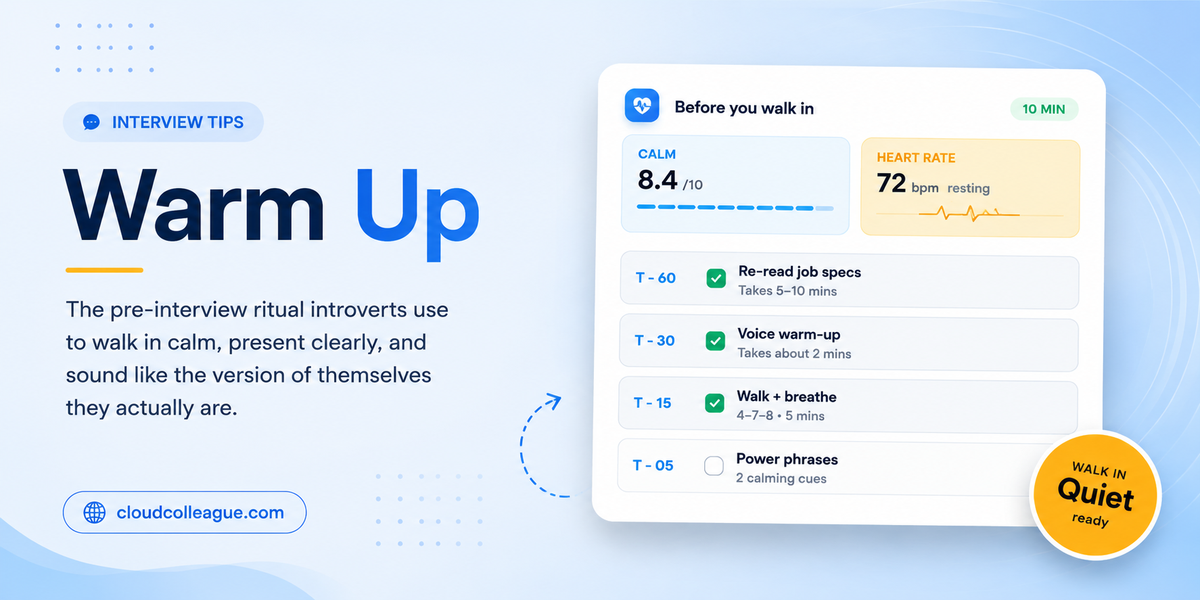
Most interview advice says “arrive early and prepare thoroughly.” This section gives you the specific sequence of activities in the 90 minutes before an interview that manages social energy and puts you in the room at peak readiness.
The sequence matters as much as the individual activities.
90 Minutes Before: Review Your Resume and STAR Stories
Spend 20 to 30 minutes reading your resume slowly and deliberately. Not to check for errors. To re-anchor yourself in your own track record.
Read each bullet point and briefly recall the story behind it: what happened, what you did specifically, what the outcome was. This is the pre-interview resume review technique described in more detail in our resume tips for introverts article. It works because introverts often disconnect from their own evidence under social pressure. Reading your resume before walking in re-establishes that connection before the interview environment competes with it.
After the resume review, read through your top five STAR stories. Not to memorise them word for word. To remind yourself that you have specific, compelling evidence ready for the most common question categories.
60 Minutes Before: Travel and Environment Familiarisation
Arrive at the interview location with at least 15 minutes to spare, but do not go inside immediately. Walk around the block, sit in a nearby cafe, or spend a few minutes in a quiet outdoor space.
Getting physically comfortable with the neighbourhood and the building before you enter removes one layer of novelty. Check the name, title, and LinkedIn profile of your interviewers so you enter the room having already formed a mental picture of at least one familiar face.
If the interview is video-based, check your audio, lighting, and connection 15 minutes before the call. Spend the time between your technical check and the call in the same quiet, deliberate state rather than scrolling or filling time with unrelated tasks.
30 Minutes Before: Controlled Breathing
Find a quiet space and spend five minutes on controlled breathing: four counts in through the nose, hold for four counts, four counts out through the mouth. Repeat this cycle eight to ten times.
This specific breathing technique activates the parasympathetic nervous system and reliably reduces cortisol and adrenaline levels. It is one of the few anxiety management techniques with consistent physiological research behind it, and the effect is noticeable within five minutes.
Do not scroll social media or check news during this period. Protect the mental space you have prepared. External inputs compete with the settled focus you are building.
5 Minutes Before: Posture and Physical Readiness
Sit or stand in an upright, open posture for two to three minutes before entering the interview room or starting the video call. Research has documented that posture influences physiological markers of confidence, including cortisol and testosterone levels, in ways that meaningfully affect performance under pressure.
Open, upright posture immediately before a high-pressure interaction improves physiological readiness. It is a small step but it is backed by research and costs nothing to implement.
Prepared and ready to interview? Make sure you are applying to roles worth the effort. Browse AI-matched Australian jobs on CloudColleague. Find verified employers who are actively hiring right now. Start as a seeker on CloudColleague.
During the Interview: Strategies That Play to Introvert Strengths
Use the STAR Method as Your Anchor
Every behavioural question has the same underlying structure: “Tell me about a time when…” The STAR method (Situation, Task, Action, Result) gives you a reliable framework for answering every variation of this question type.
For introverts, the STAR structure serves a second purpose beyond content organisation. It gives you a framework to hold onto when the social pressure of the interview environment competes with recall. If you feel the freeze response starting, returning to the structure (Situation… Task… Action… Result…) anchors your delivery while your thinking catches up.
The Action and Result components are the most important. Spend the majority of your answer on what you specifically did and what specifically changed as a result. The Situation and Task components set the context but should not dominate the answer.
Use the Pause Deliberately
When asked a question, pause for one to three seconds before beginning your answer. This feels longer than it is from the inside. From the outside, it reads as composed and deliberate.
The pause gives you the moment to select the right STAR story from your prepared library rather than reaching for the first thing that comes to mind. It also signals to the interviewer that you are considering the question seriously rather than performing a pre-rehearsed response.
Most Australian interviewers read the pause positively. A candidate who thinks before speaking demonstrates exactly the reflective quality that many Australian managers value.
Turn the Interview Into a Conversation
Prepare three to five specific, researched questions about the role, the team, and the organisation. Asking a question that references something specific from the company’s recent news, the job description, or the industry context signals genuine preparation and turns the interview from a one-directional evaluation into a two-way conversation.
Introverts typically handle genuine conversations better than performances. This technique shifts the dynamic deliberately. A well-researched question that generates a real discussion is one of the most memorable things a candidate can do in any interview, and it consistently differentiates introverts who have prepared deeply from candidates who ask generic questions that signal surface engagement.
Name Your Working Style With Confidence
If asked about your working style, preferences, or personality, name your introvert qualities with confidence rather than as caveats.
“I do my best analytical thinking independently and in focused work blocks. I am deliberate about how I communicate, which means my written output is typically very precise and my verbal contributions are considered rather than frequent.”
This is not an apology. It is a professional description of a valuable working style. Framing it with confidence rather than hedging (“I am a bit of an introvert, I hope that’s OK”) changes how the interviewer processes the information entirely.
The Post-Answer Pivot
After delivering each STAR answer, end with a brief connecting statement that links your story to the specific role you are interviewing for. “That experience is directly relevant to this role because…” or “What I learned there applies here because…”
This pivot demonstrates that you prepared specifically for this interview rather than recycling generic stories, and it gives the interviewer the explicit connection they are looking for between your past and their specific opportunity.
After the Interview: The Introvert’s Post-Interview Plan
Most interview advice ends when you leave the building. For introverts, what happens in the two hours after the interview significantly affects both the immediate application outcome and the quality of performance in subsequent interviews.
The Thank-You Email: Your Most Powerful Post-Interview Tool
Send a specific, thoughtful thank-you email within two hours of leaving the interview. Reference one specific point from the conversation, connect it to your experience or interest, and reaffirm your enthusiasm for the role.
Write it while the details of the conversation are fresh. Include one thing that was discussed that you found genuinely interesting or that connects directly to something in your background. This level of specificity is what differentiates a thank-you email that is remembered from one that is politely filed away.
The thank-you email takes 15 minutes. It consistently differentiates introvert candidates who invest in it from competitors who either skip it or send a generic two-line note.
The Debrief: Capture What Worked and What to Adjust
Immediately after the interview, spend ten minutes writing down your honest assessment of the session. Which STAR stories landed well? Which questions caught you off guard and why? What would you say differently? What did you learn about the role or the team that changes your level of interest?
This debrief is preparation for the next stage of the process. The information is most useful when captured immediately, while the details and emotional texture of the experience are still vivid. A written debrief within one hour of leaving is worth more than a mental review three days later.
The Recharge: Protect Your Social Energy
Schedule at least one to two hours of quiet, solo time after any interview. This is not self-indulgence. It is energy management.
Introverts experience significant social energy drain from interviews regardless of how well they performed. An introvert who arrives at a second interview or a follow-up conversation already socially depleted performs worse than one who has genuinely recovered. Treat post-interview recharge time as part of the preparation for the next stage of the process, not as rest after the work is done.
What Australian Introverts Specifically Need to Know
Australian behavioural interviews are the norm across corporate, government, healthcare, and professional services hiring processes. The STAR method is the expected answer structure in most formal interviews at major Australian employers. Candidates who prepare their STAR stories and practise delivering them consistently outperform less-prepared candidates regardless of personality type.
The Australian egalitarian workplace culture is genuinely more hospitable to introvert interview styles than many international hiring contexts. Measured, specific, data-backed answers that let the evidence speak are respected in Australian hiring. Theatrical enthusiasm without specific evidence is viewed more skeptically by many Australian interviewers than by their US counterparts.
Introverts who are not yet in roles that suit their working style often experience heightened interview anxiety because they are already anxious about whether the new job will be any better. Using CloudColleague’s AI matching to identify roles that genuinely suit introvert working styles (focused, output-driven, with clear autonomy) reduces this underlying anxiety before interview preparation even begins. An introvert who is genuinely excited about the role they are interviewing for performs significantly better than one who is performing enthusiasm for a role they are uncertain about.
Interview strategies in place. Now find Australian roles that suit how you work. Create a free profile on CloudColleague and get AI-matched to verified Australian employers hiring across every industry right now.Get started free on CloudColleague
Hiring and need focused, analytical professionals? Post a role on CloudColleague in under five minutes. Smart matching surfaces pre-vetted candidates with the specific skills you need.Start hiring on CloudColleague
Frequently Asked Questions on Interview Tips for Introverts
For strong Interview tips for introverts, confidence comes from preparation, not personality change. Prepare 8–10 STAR method stories covering common behavioural questions and practise them aloud until fluent. Use clear ownership language (“I led” instead of “I was involved”). A short pre-interview routine helps manage energy.
Common mistakes include using weak or vague language, answering before fully understanding the question, failing to connect experience to the role, and skipping the thank-you email.
Yes, if framed professionally. Avoid apologetic language. Instead of saying you are “a bit of an introvert,” describe strengths like focused thinking and strong written communication. This turns personality into a workplace advantage rather than a limitation.
Each STAR story should be practised at least 10 times out loud. Around 20 repetitions builds natural delivery, and 30 improves performance under pressure. Recording yourself at least twice helps identify filler words, weak phrasing, and pacing issues.
No. Australian behavioural interviews focus on evidence, not personality style. Candidates who give clear, structured, fact-based answers often outperform overly talkative candidates. Measured communication with strong examples is typically valued more than high-energy delivery.