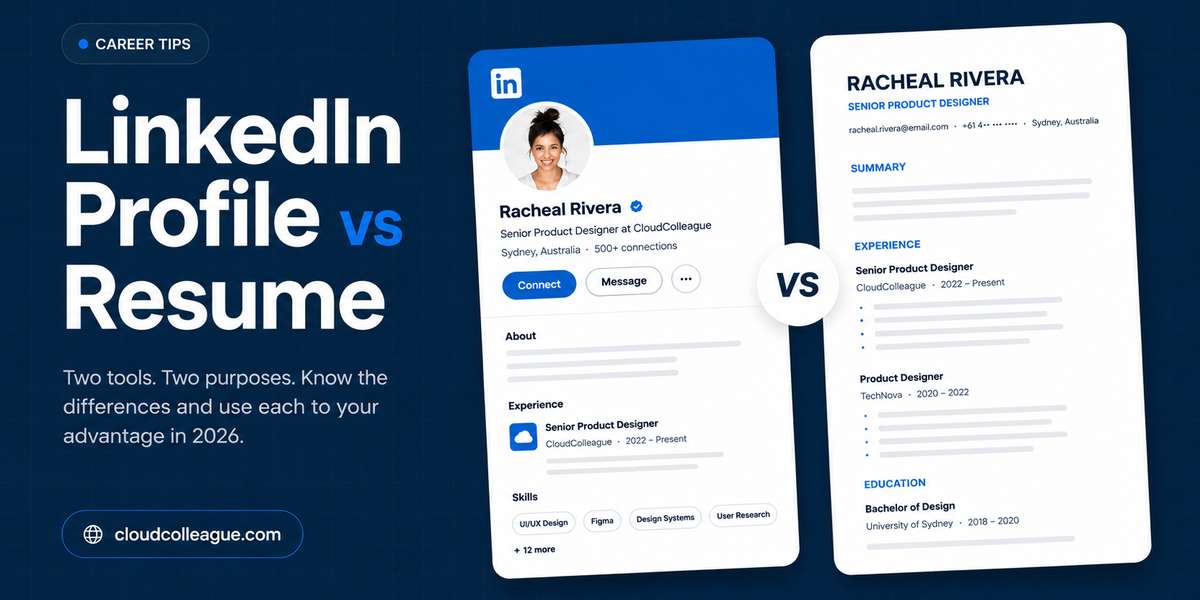
When a recruiter receives your job application, they rarely read your resume first. The LinkedIn profile vs resume question has a clear answer in 2026 if you understand how modern recruiters actually work. Over 95% of recruiters use LinkedIn to find and evaluate candidates. But your resume is still what gets you the offer. These two documents are not competing with each other. They serve completely different purposes at completely different stages of the hiring process.
In this guide, we break down exactly what recruiters check first, what each document needs to do, and how to make both work together in the Australian job market. You will leave with a clear action plan for where to invest your time.
Ready to get found by Australian employers? Create a free verified profile on CloudColleague and get AI-matched to roles that fit your skills and experience across every industry.Get started free on CloudColleague
The Short Answer: LinkedIn Gets You Found, Your Resume Gets You Hired
Here is the verdict before we go into the details.
LinkedIn is a discoverability and first-impression tool. It works for you 24 hours a day, even when you are not actively applying for roles. Recruiters search LinkedIn to find candidates who match what they need, often before those candidates have even seen the job posting.
Your resume, on the other hand, is a precision decision-support document. It is tailored to one specific role, formatted for ATS screening, and designed to give a hiring manager exactly the information they need to make an interview decision.
Neither document replaces the other. Together, they cover the entire journey from being found to getting hired. Separately, each one has a job it does better than the other. Understanding this changes everything about how you invest your preparation time.
How Recruiters Actually Use LinkedIn vs Your Resume in 2026?
This is the section most articles skip. Knowing the exact recruiter workflow tells you precisely where each document matters and when.
Step 1: LinkedIn Recruiter Search
Most recruitment journeys begin before you have applied for anything.
Recruiters use LinkedIn Recruiter with Boolean search queries and filters including location, job title, years of experience, skills, and connection proximity. Your profile either appears in those results or it does not. Keywords in your headline, about section, experience descriptions, and skills section determine whether you show up.
The data here is significant. Profiles with complete information appear in 40 times more searches than incomplete ones. Your visibility in recruiter search is almost entirely a function of how well your LinkedIn profile is optimised, not how good your resume is.
Step 2: Profile Scan (6 to 10 Seconds)
If your profile appears in a recruiter search, it gets a six to ten second scan. In that time, a recruiter checks your headline, your current role and employer, your approximate years of experience, your location, and whether your profile looks credible and complete.
A professional photo matters more than most people realise. Profiles with photos receive 21 times more profile views and 36 times more messages than those without. An incomplete profile or a missing photo signals low effort, and recruiters move on immediately.
Step 3: Outreach or Application Review
If the profile passes the scan, one of two things happens. For passive candidates, the recruiter sends a direct message or InMail. For active applicants, the recruiter checks your LinkedIn as part of reviewing your formal application.
At this stage, LinkedIn functions as a credibility check and an extension of your resume. Recruiters look for consistency, additional context, and signals that the person behind the application is genuine and professionally engaged.
Step 4: Resume Request and ATS Screening
Once a recruiter is interested, they request your resume or review the one submitted through an ATS platform like Workday, Taleo, or Greenhouse. This is where the resume takes over entirely.
The ATS scans your document for keywords, formatting compatibility, and relevant experience. The hiring manager then reads it for narrative, achievements, and role-specific fit. By this point, LinkedIn has already done its job. The resume now has to close the deal.
What LinkedIn Does That a Resume Cannot?
LinkedIn has several structural advantages that no resume can replicate, regardless of how well it is written.
Passive Discoverability
Your LinkedIn profile works for you around the clock, even when you are not looking for a job. Recruiters run searches constantly. If your profile is well optimised, you receive inbound opportunities without sending a single application.
A resume, by contrast, only works when you actively submit it somewhere. It has zero visibility to the market unless you put it in front of someone. LinkedIn inverts this completely.
Social Proof Through Recommendations and Endorsements
LinkedIn recommendations are the one thing a resume structurally cannot replicate. A specific, detailed recommendation from a former manager or senior colleague is verified third-party social proof. It tells recruiters not just what you have done, but how others experienced working with you.
Skill endorsements add a further credibility layer. Endorsed skills rank higher in recruiter search results and signal that your claimed expertise has been validated by people who know your work.
Multimedia and Portfolio Evidence
LinkedIn lets you attach links, documents, videos, presentations, and project showcases directly to your experience sections. This lets you show work that a resume cannot contain: a live product, a published article, a case study, a conference presentation, or a design portfolio.
For professionals in tech, creative industries, marketing, and consulting, this capability is a significant competitive advantage over a plain text resume.
Network Signals and Activity
LinkedIn’s algorithm update in 2025 and 2026 means that activity now affects profile visibility in recruiter searches. Recruiters see more active profiles first in their results.
A candidate who posts thoughtful content, comments on industry discussions, and engages with their professional network signals genuine industry involvement. Furthermore, connection proximity matters. Being a second-degree connection to a recruiter increases your likelihood of appearing in their search results. A resume has no equivalent to any of these signals.
What Your Resume Does That LinkedIn Cannot?
Your resume is not obsolete. It serves a distinct and irreplaceable function in the hiring process, and LinkedIn cannot substitute for it in the moments that count most.
ATS Compatibility and Keyword Targeting
Every formal job application passes through an ATS before a human reads it. Between 75% and 90% of companies in Australia use ATS platforms to screen applications. Your LinkedIn profile does not go through this process.
Your resume must be formatted correctly, use the right keywords from the specific job description, and present your experience in a structure the system can parse cleanly. LinkedIn cannot be tailored per application. Your resume can and absolutely should be.
Targeted, Role-Specific Positioning
Your LinkedIn profile is a broad marketing asset written for everyone who might find you. Your resume is a precision document written for one specific role, one specific team, and one specific set of hiring criteria.
This tailoring is what converts recruiter interest into an interview offer. A LinkedIn profile that tries to appeal to everyone often persuades no one when the stakes are high. A tightly tailored resume, on the other hand, makes the hiring decision feel easy.
Formal Application Requirement
Most Australian employers, including government departments, large corporations, and businesses using platforms like CloudColleague and SEEK, require a resume as part of the formal application process.
LinkedIn is typically checked after the application is received, not instead of it. Without a strong resume, the application does not advance regardless of how impressive your profile looks. The resume remains the entry ticket to the formal hiring process.
Your profile and resume are ready. Now find the right Australian employer. Browse AI-matched roles on CloudColleague across tech, admin, health, trades, and more. Thousands of verified Australian businesses hiring right now. Browse open roles on CloudColleague
LinkedIn Profile vs Resume: Head-to-Head Comparison
Here is how both documents compare across the eight criteria that matter most to Australian job seekers.
| Criteria | LinkedIn Profile | Resume | Verdict |
| Discoverability | 24/7 passive search visibility | Zero unless actively submitted | LinkedIn wins |
| ATS compatibility | Not applicable | Essential for formal applications | Resume wins |
| Tailoring per role | General, cannot be customised per job | Tailored to each specific application | Resume wins |
| Social proof | Recommendations and endorsements | None | LinkedIn wins |
| Multimedia | Links, videos, portfolios, documents | Plain text only | LinkedIn wins |
| Network signals | Activity and connections visible | None | LinkedIn wins |
| Formal applications | Rarely sufficient alone | Required by most employers | Resume wins |
| First impression speed | Profile scan in 6 to 10 seconds | Read after initial interest is confirmed | LinkedIn wins |
As you can see, neither document dominates across the board. Consequently, treating them as competitors rather than partners costs you at every stage of the hiring process.
The Consistency Rule: What Must Match Between Your LinkedIn and Resume
This is the practical section most job seekers get wrong, and it costs them more than they realise.
Recruiters actively cross-check your LinkedIn profile against your submitted resume. Discrepancies in key fields are an immediate red flag. They signal either dishonesty or carelessness, and neither impression survives a background check or recruiter review.
What Must Align Exactly
- Job titles at every employer, exactly as listed on your resume
- Employer names as officially registered, not shortened or informal versions
- Dates of employment, including start and end month and year for every role
- Education qualifications, institution names, and graduation years
- Any certifications or professional licences listed on both documents
Discrepancies in any of these fields create serious credibility problems. Background checking services compare LinkedIn against your submitted documents systematically. Getting these wrong is a risk that simply does not need to exist.
What Does Not Need to Match
- The exact wording of your bullet points or achievement descriptions
- The length or depth of your role descriptions (your resume is typically more detailed)
- Tone: your resume is formal and concise, your LinkedIn profile can be conversational and written in first person
- Every role you have ever held: LinkedIn can include older or shorter positions that do not appear on a tightly targeted resume
- Recommendations, endorsements, and activity: these are LinkedIn-only elements with no resume equivalent
Many job seekers over-correct by making both documents identical. This defeats the purpose of each one. Your resume is a precision tool. Your LinkedIn is a broad professional presence. They should complement each other, not duplicate each other.
Hiring and need strong candidates? Post a role or task in under five minutes. Smart matching surfaces pre-vetted candidates across every Australian industry. No agency markups, no long waits.Start hiring on CloudColleague
How to Prioritise Your Time: LinkedIn vs Resume by Situation?
Different job search stages demand different levels of investment in each document. Here is a clear guide based on your specific situation.
If You Are Actively Applying for Roles Right Now
Prioritise your resume. Tailor it to each application with keywords from the job description. Make sure your LinkedIn is complete and consistent with your resume, but do not spend three hours perfecting your LinkedIn headline when you have five applications to submit today.
The resume is what the ATS sees first in an active application. LinkedIn plays a supporting role at this stage.
If You Are Open to Opportunities but Not Actively Applying
Prioritise your LinkedIn profile. Enable Open to Work for recruiters only so your current employer cannot see it. Optimise your headline and about section for the specific roles you want next. Post or comment in your industry at least once per week.
Your LinkedIn profile is your only active asset in the market when you are not submitting applications. This is where recruiter-led opportunities begin.
If You Are Targeting Senior or Executive Roles in Australia
Both documents need to be at their highest quality simultaneously. LinkedIn recommendations from credible people in your industry carry significant weight at senior level. Your resume needs tight, achievement-focused bullet points with measurable results throughout.
Invest equal time and, if budget allows, professional help in both. The financial return on one well-landed senior role covers the investment many times over.
If You Are a Fresh Graduate or Early Career Professional in Australia
LinkedIn is especially powerful at this stage because your resume has limited experience to show.
Use LinkedIn to demonstrate industry engagement. Follow and comment on thought leaders in your target field. Join relevant groups. Add any project work, internship achievements, or volunteer experience that does not fit neatly on a one-page resume. Let your LinkedIn profile show the fuller picture of who you are becoming professionally.
If You Are a Professional New to Australia
LinkedIn is often your first point of credibility in the Australian market. Local recruiters may not immediately recognise your international employers or qualifications from a resume alone.
A strong LinkedIn profile with local connections, industry engagement, and clear skills visibility helps bridge that recognition gap before your resume ever reaches a hiring manager. Building your Australian network on LinkedIn is one of the highest-ROI activities for new arrivals in the job market.
New to Australia and looking for work? CloudColleague has a dedicated resource for professionals building their career here. Start with a free verified profile and get matched to roles across every Australian industry.First time in Australia? Start here
Profile optimised and resume polished? Here is where to put both to work. Create a free profile on CloudColleague, get AI-matched to verified Australian roles, and apply directly to employers who are actively hiring right now.Get started free on CloudColleague
Frequently Asked Questions
In most cases, recruiters discover candidates on LinkedIn before reviewing a resume. However, once you apply, the resume drives the hiring decision. Consequently, LinkedIn builds visibility, while the resume secures interviews.
LinkedIn is more important for being discovered by recruiters. However, resumes matter more for formal applications on platforms like SEEK and company career pages. Therefore, both are essential in the Australian job market.
Key details must match, including job titles, dates, and employers. However, LinkedIn should be more conversational and less formal. Additionally, your resume should remain tailored for each application.
Complete your profile fully, as complete profiles rank higher in searches. Furthermore, use job-relevant keywords in your headline and summary. Additionally, keep your profile active through weekly engagement or posts.
Sometimes yes, especially during early recruiter outreach. However, most Australian employers still request a resume before final hiring decisions. Consequently, LinkedIn opens doors, while the resume closes the deal.