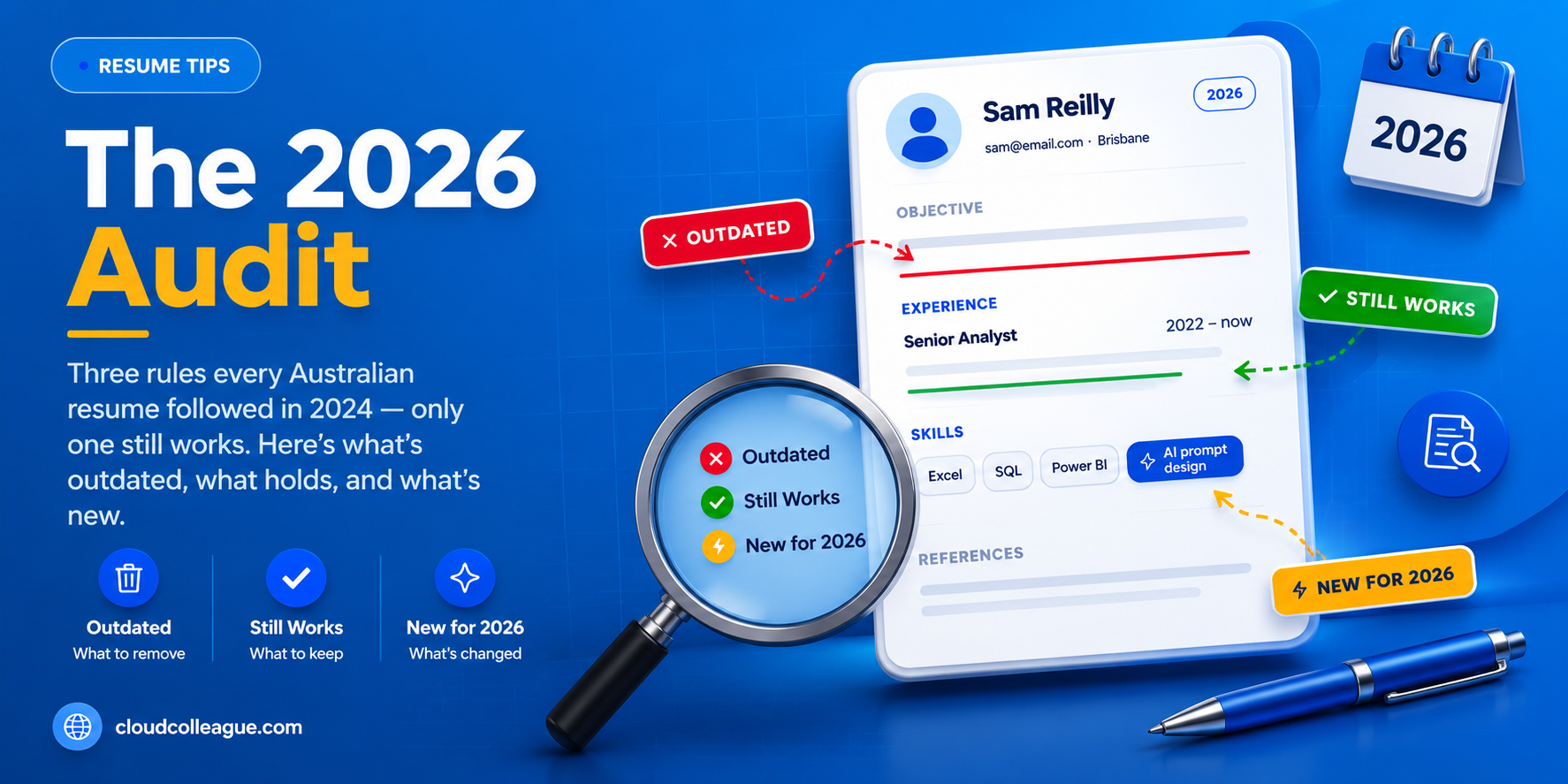
Resume rules that changed in 2026 have shifted significantly enough that advice from two years ago is now actively hurting some candidates.
The data tells the story clearly. The average resume in 2026 is 2.59 pages according to Zety’s State of Resume report. 68.6% of recruiters now prefer two-page resumes. Modern ATS platforms have moved from keyword counting to semantic analysis. And AI-generated resume content, which flooded hiring pipelines throughout 2024 and 2025, is now detectable enough by experienced recruiters that authentic, specific, personally-voiced resumes stand out more sharply than at any point in the last decade.
This article maps every major rule that changed, every rule that still holds, and what Australian job seekers specifically need to know. Every rule gets a verdict. Every verdict gets a clear explanation and a practical alternative.
Resume updated with 2026 rules. Find Australian roles worth applying to. Browse AI-matched jobs on CloudColleague from 18,000+ verified Australian employers right now.Browse open roles on CloudColleague
Rules That Are Completely Outdated in 2026
These are the rules that were still being taught two years ago and that are now actively damaging applications. Stop following them.
The One-Page Rule – OUTDATED
The one-page rule originated in an era when resumes were printed on paper and physically handed to hiring managers managing stacks of physical documents. It made practical sense in that context. In 2026, resumes are reviewed on screens, ATS systems handle multi-page documents without penalty, and the rule has been comprehensively overtaken by data.
According to AI Apply’s 2026 survey of 1,013 HR professionals, 82.1% say the ideal resume length is one to two pages, with 51% specifically preferring two pages. A separate analysis by Gainrep found that 68.6% of recruiters prefer two-page resumes, while only 21.6% still consider one page ideal. Zety’s State of Resume report puts the average resume in 2026 at 2.59 pages.
The updated length guidance:
- Early career (under five years of experience): one page is fine, two pages is acceptable if the content genuinely warrants it
- Mid-career (five to fifteen years): two pages is the standard
- Senior professionals and executives: two to three pages with substantive content throughout
One important caveat that has not changed: every line on your resume must earn its place. Two pages of padded responsibilities is worse than one tight page of genuine achievements. The right question in 2026 is not “how long should my resume be?” It is “does every line on my resume add value?”
For Australian job seekers specifically: two pages for mid-career professionals was already the Australian professional norm before 2026. The change is primarily relevant for early career candidates who were previously told to compress a solid three-year record onto a single page regardless of how much valuable content that excluded
The Objective Statement – OUTDATED
“Seeking a challenging role where I can leverage my skills and grow professionally in a dynamic environment.”
This sentence, or any variation of it, is the fastest possible way to signal to a recruiter that you have not put genuine thought into your application. The objective statement tells the recruiter what you want from a job. They are not evaluating applications based on what you want. They are evaluating based on what you can deliver.
Replace it with: A professional summary of three to four sentences that names your role level, your primary domain, your most significant quantified achievement, and your clear target. Lead with evidence of what you deliver, not a statement of what you seek.
Strong: “Financial analyst with six years of experience in corporate treasury and FX risk management across ASX-listed energy companies. Designed and implemented an automated currency exposure dashboard that reduced manual reporting time by 70%. Targeting senior financial risk management roles in the Australian energy and resources sector.”
That summary communicates domain, scale, achievement, and target in three sentences. An objective statement communicates nothing that a recruiter did not already know.
References Available on Request – OUTDATED
This line wastes valuable resume space on information that every recruiter already assumes. Every candidate has references. Every recruiter knows this. Stating it adds nothing and signals that your template is outdated.
Remove it completely. Use the space for an additional achievement bullet or a certification. Every square centimetre of your resume should carry information that advances your candidacy. A line about reference availability does not.
Keyword Stuffing – OUTDATED AND NOW COUNTERPRODUCTIVE
Keyword stuffing was a marginal strategy with legacy ATS systems that scored keyword frequency independently of context. It is now counterproductive for two reasons.
First, modern semantic-matching ATS platforms including Greenhouse and Lever evaluate contextual relevance rather than keyword frequency. Unnatural keyword repetition in disconnected contexts does not improve semantic matching scores. It may actively reduce them.
Second, a keyword-stuffed resume that passes ATS screening is then read by a human recruiter who immediately recognises it as a template-filled document. In 2026, with AI-generated resumes flooding hiring pipelines, recruiters are specifically attuned to generic, uniform language. A resume that reads like it was assembled from keyword prompts is disqualifying at the human review stage even if it cleared automated screening.
What replaces keyword stuffing is covered in the new rules section below.
Including Your Full Street Address – OUTDATED
Including your full street address on a resume is a privacy risk and adds no useful information at the initial screening stage. Australian employers do not need your street number and suburb to determine whether you are eligible for a role. They need to know your city and state for location relevance, and nothing more.
Remove your street address. Keep your suburb and state. This is both the current professional norm and a basic privacy protection for a document that may be shared across multiple systems.
Read Next: Healthcare Resume Template 2026
Rules That Still Work in 2026
These rules are worth keeping exactly as they are, despite the noise suggesting everything has changed.
Quantified Achievements in Every Bullet – STILL WORKS, MORE IMPORTANT THAN EVER
Numbers differentiate candidates now more than they ever have, and for a 2026-specific reason: AI-generated content consistently produces unmeasured, generic bullet points. When AI writes a bullet about project management, it produces “managed cross-functional project teams to deliver business outcomes on time and within budget.” When a genuine candidate writes about their project management experience with specific evidence, they produce “led a seven-person team across three sites to deliver a AUD $4.2M infrastructure program seven days ahead of schedule and AUD $340K under budget.”
A recruiter reading 80 applications per day can distinguish between these two bullets in under three seconds. In 2026, with AI flooding pipelines, the distinguishing signal of a genuine human candidate is often specific numbers, specific names, specific dates, and specific contexts that only someone who lived the experience could produce.
The format that works: Action verb, what you did, at what scale, with what measurable result. Every bullet point should answer all four. If a bullet cannot answer all four, it needs to be rewritten or removed.
Reverse Chronological Format – STILL WORKS
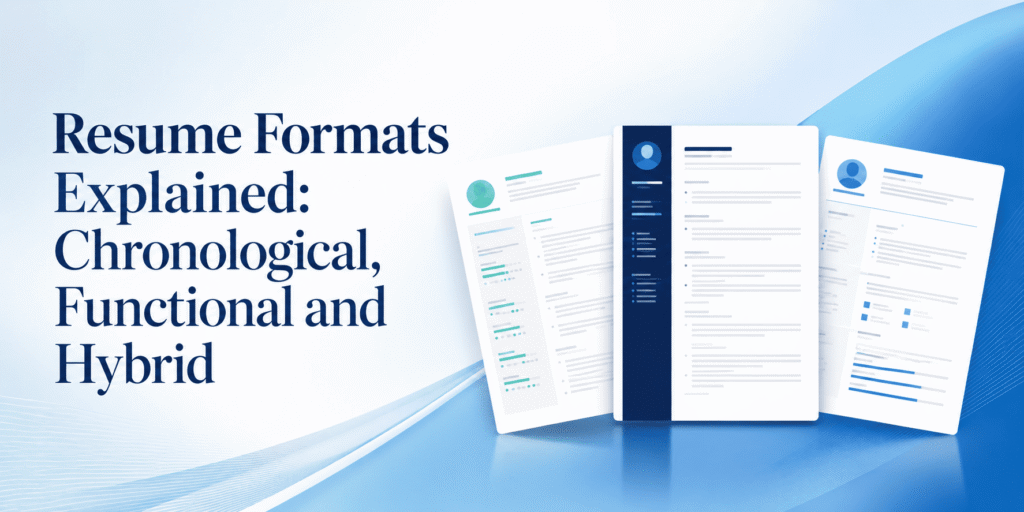
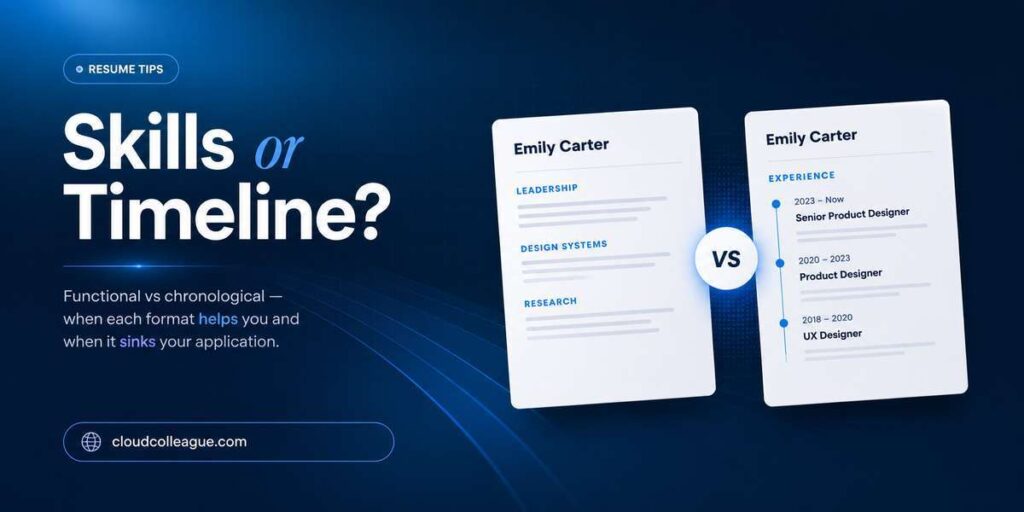
Reverse chronological is still the correct format for the vast majority of candidates. ATS systems are built to parse employment history in reverse chronological order. Recruiters are trained to read resumes in reverse chronological order. Both audiences are disoriented by functional or combination formats that deviate from the standard.
Functional and hybrid formats remain acceptable in specific situations: industry switches where the most recent job title misleads, career re-entries where the most relevant experience is not the most recent, and senior professionals who lead with an achievement summary before the chronological record. In every other situation, reverse chronological is still the right choice.
Single-Column Layout for ATS Applications – STILL WORKS
Despite design trends toward two-column layouts and sidebar resumes, single-column layouts remain the correct choice for any application submitted through an ATS-screened portal.
Multi-column resumes still produce text extraction errors on Taleo, Workday, SAP SuccessFactors, and iCIMS, which are the primary ATS platforms used by large Australian employers in banking (Commonwealth Bank, Westpac, ANZ), resources (BHP, Rio Tinto), and professional services (Big 4 firms). For applications through SEEK employer portal integrations, government portals, and any corporate careers page using these legacy systems, single-column is still the safe and correct choice.
Two-column and design-forward layouts are appropriate for creative and design roles where visual presentation is part of the professional assessment, and for applications submitted directly to human reviewers rather than through ATS portals. They are not appropriate as the default resume format in 2026.
Job-Specific Tailoring – STILL WORKS, MORE IMPORTANT THAN EVER
Tailoring your resume to each specific job description is still the most effective single action a candidate can take, and in 2026 it is more impactful than at any previous point. With AI tools enabling the mass-generation of applications, the volume of untailored, generic submissions on any popular SEEK role has increased dramatically. A resume that is clearly tailored to the specific role and employer stands out more sharply against that background than it did three years ago.
The contrast effect is real. When a recruiter has processed 50 generic, AI-assisted applications and then encounters one that names specific details from the job description, references something specific about the company, and contains achievement bullets that clearly connect to the stated requirements of the role, the difference is immediately visible.
Tailoring does not mean rewriting your resume from scratch for every application. It means updating your professional summary to reflect the specific role, ensuring the two or three most prominent skill terms from the job description appear naturally in your achievement bullets, and checking that your most relevant experience is positioned prominently rather than buried.
Standard Section Headings – STILL WORKS
Work Experience, Education, Skills, Certifications. Standard section headings are still recognised by all ATS platforms in 2026. Creative alternatives remain a risk.
“My Journey,” “What I Bring,” “Career Highlights,” and “Professional Background” are still not in the ATS recognition library for most systems. Content under these headings is either filed in a miscellaneous category or missed entirely. The standard headings are not limiting. They are the language the systems were built to read.
Rules reviewed. Now find Australian roles worth applying a strong resume to. Browse AI-matched jobs on CloudColleague. Apply to the right targets with the right approach. Start as Seeker on CloudColleague.
New Rules That Apply in 2026 Only
These are genuine changes that did not exist as advice two years ago. They reflect changes specific to 2025 and 2026 in hiring technology, AI adoption, and recruiter behaviour.
List Your AI Tools – But With Evidence, Not Claims
In 2023, listing ChatGPT or Copilot on a resume felt risky or performative. In 2026, AI literacy is a genuine professional skill that Australian and global employers actively look for in candidates across almost every function and industry level.
But there is a meaningful difference between two types of AI disclosure, and getting this wrong is worse than not mentioning AI at all.
Worthless AI claims:
- “Familiar with ChatGPT”
- “Proficient in AI tools”
- “Experience with generative AI”
- “AI-literate”
These claims are as meaningless in 2026 as “comfortable with Microsoft Office” was in 2010. Everyone uses AI tools. Claiming familiarity without specificity is not a differentiator.
Credible AI achievements:
- “Used Claude to automate monthly stakeholder reporting, reducing preparation time by six hours per week.”
- “Built a Copilot prompt library for our team of 12 that reduced first-draft email production time by 40%.”
- “Used AI-assisted analysis to identify customer churn patterns across 40,000 accounts, informing a retention initiative that reduced churn by 14%.”
- “Automated invoice processing using GPT-4 API integration, reducing manual data entry errors from 8% to under 1%.”
The rule: name the specific tool, describe the specific task, state the specific measurable outcome. Generic AI claims are as ineffective as generic soft skill claims. Specific AI achievements are genuinely differentiating in 2026 because very few candidates document them with enough specificity to be credible.
Ready with your resume? Cover letter is also equally important for job apply. Read our guide on: Cover Letter Template That Pairs With an ATS Resume
Write to Survive AI Detection, Not Just ATS Scanning
In 2026, experienced recruiters have processed enough AI-generated resume content to recognise its characteristic patterns without needing a detection tool. The signals include uniform bullet point length across all roles regardless of the complexity of the experience, an absence of specific metrics and proper nouns that only a genuine participant would know, generic language that could describe any candidate in any industry at any company, and a certain frictionless smoothness of phrasing that lacks the texture of authentic professional experience.
The new rule is not to avoid AI in your resume writing process. AI is a useful drafting tool for structure, language, and starting points. The rule is to use AI as a starting point and then specifically personalise the output with your own metrics, your own context, your own voice, and your own specific details that only someone who lived the experience could supply.
A resume that uses AI for structure and then inserts genuine specificity throughout will outperform both a pure AI-generated resume and a poorly written human-authored one. The goal is not to sound like a human wrote it without AI. The goal is to sound like a specific human with specific experience wrote it about their specific work.
Semantic Keywords in Context, Not Keyword Lists
The shift from keyword-density ATS to semantic-matching ATS changes the strategy for keyword inclusion in a specific and practical way that most candidates have not yet updated.
Legacy ATS systems (Taleo, Workday) primarily scan for keyword presence. A keyword in your skills section and a keyword in your work experience section both count. Frequency matters.
Semantic ATS systems (Greenhouse, Lever, and increasingly others) evaluate whether keywords appear in meaningful, achievement-rich context. A keyword in a skills list carries less weight than the same keyword appearing in an achievement sentence that demonstrates the capability in action.
The practical update: your achievement bullets now do double work. “Led a 14-person project management team delivering a AUD $8M infrastructure program on time and under budget” satisfies the “project management” keyword requirement for semantic ATS while simultaneously demonstrating the capability to a human reader. “Project management” in a skills list satisfies a legacy keyword scan but demonstrates nothing.
Keyword lists are not worthless. But embedding the same keywords in specific achievement sentences produces a resume that works for both legacy and semantic ATS while also being more compelling to every human who reads it.
Career Breaks Are Resume Entries, Not Gaps to Be Hidden
LinkedIn’s career break feature, which allows users to list career breaks with reason categories (caregiving, health, education, personal development, and others), has normalised the concept of acknowledged career interruptions in professional timelines. In 2026, Australian employers have largely absorbed this normalisation.
A resume that includes a clearly labelled career break entry with dates and a brief description is more credible and more honest than one where the break is invisible or awkwardly explained through date manipulation.
The new rule: treat a career break as a resume entry in your work history. Include the dates, a brief reason category, and two or three bullet points describing any productive activity during the period. A labelled, explained career break is professionally transparent. An unexplained date gap invites assumptions that are frequently worse than the honest explanation.
What Australian Job Seekers Specifically Need to Know
The one-page rule change is less dramatic for Australian candidates than for US candidates. Two pages for mid-career professionals was already the Australian professional norm before 2026. Australian hiring managers never applied the strict one-page rule that dominated US resume advice. What has changed is that early career candidates now have broader permission to use two pages if their content genuinely warrants it, and that the data supporting this is now explicit and citable.
SEEK
SEEK is still the dominant Australian job board and handles two-page PDFs without penalty. The single-column format is still the safest choice for applications through SEEK employer portal integrations, which use a variety of ATS backends including Workday, Taleo, and proprietary systems. When in doubt, single-column PDF is the right choice for any SEEK-integrated application.
The semantic ATS shift
The semantic ATS shift is most relevant for Australian tech company applications. Atlassian, Canva, REA Group, SEEK (as an employer), Culture Amp, and most Australian technology companies and growth-stage startups use Greenhouse or Lever for their hiring. These platforms use semantic matching. For applications to these employers specifically, the shift from keyword-density optimisation to contextually-embedded keyword strategy produces meaningfully better ATS performance.
AI-generated resume content is visible to Australian recruiters. With popular SEEK roles attracting 300 to 500 applications, Australian recruiters and HR teams are now processing enough volume to recognise AI-generated patterns rapidly. The specific metrics, proper nouns, and authentic voice that distinguish a genuine candidate’s resume from AI-generated content are also exactly what makes a resume compelling to an experienced human reviewer. Write for the human. The ATS compatibility and the human impression work together when the writing is specific, evidenced, and authentic.
CloudColleague’s AI matching
CloudColleague’s AI matching evaluates your full skills profile rather than just your resume document. Maintaining a current CloudColleague seeker profile with specific, skills-based descriptions of your capabilities surfaces you to Australian employers who are actively searching for candidates with your background, regardless of whether your current job title perfectly matches their search terms.
Resume rules updated and resume ready. Find Australian roles to target. Create a free profile on CloudColleague and get AI-matched to 18,000+ verified Australian employers hiring right now.Get started free on CloudColleague
Hiring in 2026 and need to find the right candidates? Post a role on CloudColleague in under five minutes. Smart matching surfaces pre-vetted professionals across every Australian industry.Start hiring on CloudColleague
Frequently Asked Questions
It depends on your career stage. One page suits early-career candidates with under five years of experience, though two pages is acceptable if the content justifies it. Two pages is now the standard for most mid-career professionals, while two to three pages is normal for senior leaders with governance, board, or executive achievements. Current recruiter data shows most employers now prefer two-page resumes because they provide enough evidence without sacrificing readability. The rule that still matters: every line must add value.
No. Modern ATS platforms like Greenhouse and Lever evaluate contextual relevance rather than raw keyword repetition. The best strategy is embedding target keywords naturally into quantified, achievement-focused bullet points. Generic keyword-heavy resumes now stand out negatively to recruiters reviewing applications manually.
Yes, but only with evidence-backed achievements. “Familiar with ChatGPT” is meaningless in 2026. Instead, show measurable impact: “Used OpenAI ChatGPT to streamline reporting workflows, reducing preparation time by six hours weekly.” Name the tool, explain the task, and quantify the outcome.
Yes. Replace it with a professional summary focused on what you deliver, not what you want. A strong summary quickly communicates your seniority, expertise, and most relevant quantified achievement.
Australia is more accepting of two-page resumes for experienced professionals. Photos, marital status, and date of birth are not included. WAM is used instead of GPA for Australian graduates. ATS optimisation also differs because Australian employers commonly use systems like Workday, Taleo, and Greenhouse alongside SEEK