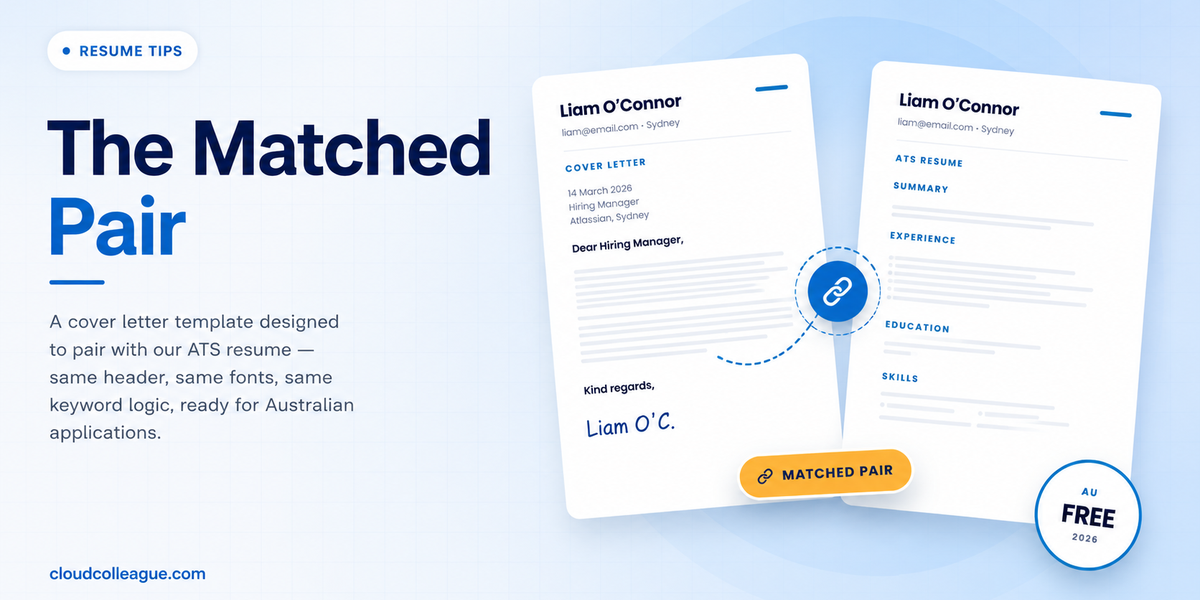
This cover letter template for ATS resume applications is free, editable in Word and Google Docs, and designed to pair visually with the ATS resume template in our free resume download article. No signup required. No account needed.
The most important thing to understand before using any cover letter template: ATS does read your cover letter. Modern applicant tracking systems index the cover letter document for keyword search even when they do not formally score it the same way they score resumes. ATS-safety for a cover letter is primarily about format rather than keyword density. This template is formatted correctly, calibrated to Australian cover letter conventions, and ready to personalise for any Australian job application in 2026.
Download the Template: No Signup, No Account, No Cost
Google Docs version (recommended): [Open the Cover Letter Template in Google Docs] [COVER LETTER TEMPLATE LINK]
To use: Click the link, then File > Make a Copy. This saves your own editable version to your Google Drive.
Microsoft Word version: [Download Cover Letter Template (.docx)] [WORD DOWNLOAD LINK]
To use: Download the file, open in Word, and save a copy with your name before editing.
Pairing note: This template uses Calibri 11pt body text, the same header format, and the same margins as the CloudColleague ATS resume template. If you use both templates together, your application will present as a single, visually coherent professional document.
Template downloaded. Find Australian roles worth applying to right now. Browse AI-matched jobs on CloudColleague from 18,000+ verified Australian employers. Browse open roles on CloudColleague.
What “ATS-Friendly” Actually Means for a Cover Letter?
This is the distinction that every competing cover letter template article gets wrong, and it is the most practically important thing to understand before writing a single word.
Cover letter ATS-safety is fundamentally different from resume ATS-safety. Here is the distinction.
For resumes, ATS systems formally parse and score documents against job description keyword matches. Keyword density, section headings, date formats, and text extraction quality all affect your automated score before a human reads anything.
For cover letters, most modern ATS platforms including Workday, Taleo, Greenhouse, and iCIMS index the cover letter document and make it searchable, but do not formally score it against keyword criteria the way resumes are scored. The cover letter is primarily assessed by a human recruiter after the ATS has filtered the resume pool.
This means ATS-safety for a cover letter means three things and not a fourth.
- It means single-column, text-only formatting that the ATS can read without parsing errors.
- It means no tables, no text boxes, no graphics, and no decorative elements that break text extraction.
- It means standard fonts at appropriate sizes.
- It does not mean the same dense keyword optimisation that resumes require.
Your resume does the ATS keyword work. Your cover letter does the human impression work. Both need to be formatted correctly for ATS. But the cover letter’s primary job is to make a human reader want to meet you, not to score highly in an automated ranking. Read our resume writing guide for creating resume with best ATS score.
Read Next:Resume Rules That Changed in 2026: What Still Works, What’s Outdated?
The Pairing Principle: Why Matching Matters?
A cover letter that visually matches its paired resume creates professional coherence that signals attention to detail before the recruiter reads a single word. This is what we call the pairing principle, and it is one of the clearest differentiators between an application that looks like it came from a careful, professional candidate and one that looks like it was assembled from different templates at different times.
When a recruiter opens a matched resume and cover letter, they process both documents as part of a single, coherent application suite. The visual consistency reinforces the impression of someone who manages details carefully, which is a valuable signal for almost any professional role.
The matching elements that matter are straightforward.
Font: Same typeface and size throughout both documents. This template uses Calibri 11pt body text, matching the CloudColleague ATS resume template.
Header format: Same name presentation and contact detail layout. Your name appears at the top of both documents in the same weight, size, and style.
Line spacing: Same body text spacing, 1.15 or single, across both documents.
Margins: Same margin settings on all sides, 2.54cm, matching the ATS resume template.
If you are using a resume template from another source, match your cover letter font and spacing to that document before submitting. The visual consistency is the goal, not adherence to any specific design.
Read Next: How to Write a Cover Letter That Gets Noticed?(2026 Guide)
Australian Cover Letter Conventions for 2026
Australian professional cover letters in 2026 have specific formatting and tone conventions that differ meaningfully from the US cover letters that most template articles are calibrated to. None of the competing templates for this keyword address any of these.
Length:
One page maximum. Three paragraphs is the most effective structure for most Australian professional applications. Australian cover letters are notably shorter than their US equivalents. A cover letter that extends to a second page signals poor editing rather than thoroughness.
Address block:
Modern Australian professional cover letters in 2026 typically omit the traditional full address block that US cover letters include. Your contact details are already on your resume header. Adding a street address, suburb, postcode, and the employer’s address at the top of a cover letter is dated in most Australian corporate, professional services, and technology contexts. Include your name, mobile, and email if you want to make the cover letter usable as a standalone document, but omit the full address correspondence block.
Salutation:
If the job posting names a specific contact person, use “Dear [First Name] [Last Name].” If no contact is named, “Dear Hiring Manager” is professional and appropriate. Avoid “To Whom It May Concern,” which reads as dated in most Australian professional contexts in 2026.
Date format:
Use DD Month YYYY, for example “26 May 2026,” not MM/DD/YYYY.
Tone:
Direct, professional, and confident. Australian workplace culture responds well to concise, evidence-based language. Excessive formality reads as dated. Excessive informality is equally inappropriate. The tone should sound like a professional speaking to another professional, not a supplicant addressing an authority.
Salary expectations:
Do not include salary expectations in your cover letter unless the job posting specifically and explicitly requests them.
Subject line:
If submitting by email rather than through a portal, include a clear subject line: “Application for [Role Title] at [Company Name].” This ensures your email is findable and categorisable by anyone reviewing incoming applications.
The Template Structure: Three Paragraphs That Work
Australian cover letters that advance candidates through shortlisting follow a consistent structure. Three paragraphs. One page. Under 400 words. Here is the complete structure with worked examples.
The Header: Matching Your Resume
Your name, contact details, and LinkedIn URL use the same format and font as your resume header. This is the pairing principle in practice.
[YOUR FULL NAME] — 16pt Calibri, bold, centred
[Suburb, State] | [Mobile: 04XX XXX XXX] | [email@email.com] | [linkedin.com/in/yourname]
Then below the header:
[26 May 2026]
Dear [Contact Name / Hiring Manager],
Re: Application for [Role Title] at [Company Name] (optional but useful for portal and email submissions)
Paragraph 1: The Opening (3 to 4 Sentences)
State the role, your strongest relevant credential, and one specific reason you are applying to this employer. Do not begin with “I am writing to apply for.” This is the most common and most forgettable cover letter opening in existence. Recruiters read it hundreds of times per week and process it as a signal that the rest of the letter will say nothing specific either.
Lead instead with your credential or a specific connection to the role.
Sentence structure:
- Sentence 1: Your seniority level, domain, and years of experience. Name the role.
- Sentence 2: Your single most relevant achievement for this specific role, with a number.
- Sentence 3: One specific reason you are applying to this employer, based on something you researched.
Strong opening example:
“Marketing manager with seven years of brand strategy and campaign management experience in FMCG, I am applying for the Senior Brand Manager role at [Company]. In my current role at [Employer], I led the full brand refresh for a AUD $45M product category, growing category share by 4.2 percentage points in 18 months. [Company]’s recent repositioning in the premium health foods segment and your stated commitment to consumer-led innovation align directly with the work I have been doing and the direction I want to take my career.”
Weak opening example (what not to write):
“I am writing to express my interest in the Senior Brand Manager position at your esteemed company. I believe I would be an excellent candidate for this role based on my extensive experience in the marketing field.”
The strong version names the credential, the achievement, the financial scale, and one specific piece of employer research in three sentences. The weak version says nothing specific about anything. A recruiter who reads 80 applications per day has already discarded the weak version by sentence two.
Paragraph 2: The Body (3 to 5 Sentences)
Provide one to two specific pieces of evidence from your background that directly address the key requirements in the job description. Then connect that evidence to this employer’s specific context or challenge.
Evidence structure: What you did, at what scale, with what measurable result.
Employer connection: How that experience addresses something specific about this role or this employer.
Example body paragraph:
“My experience spans both large-scale retail campaigns, including a AUD $8M national launch that achieved 97% distribution within six weeks, and precision digital brand work, including a targeted reactivation campaign that reduced lapsed customer churn by 22%. I have worked specifically in the health and wellness category for the past three years, which means I bring both executional credibility and category knowledge. Reviewing the job description, I noted the specific emphasis on integrating performance marketing with traditional brand building. This is exactly the capability combination I have developed across my last two roles and one I am confident I can apply immediately in your brand team.”
The body paragraph does three things: provides two specific evidenced achievements with numbers, claims category-specific knowledge, and connects to a specific requirement named in the job description. Each of these signals genuine preparation for this specific application rather than a generic template.
Paragraph 3: The Closing (2 to 3 Sentences)
State your interest clearly, confirm availability, and thank the reader. Do not repeat what you said in paragraphs one and two. Do not add a list of your qualities. One sentence of genuine interest, one sentence of availability, one sentence of thanks.
Example closing:
“I am genuinely interested in contributing to [Company]’s brand team at this particular stage of the company’s development. I am available for interview at your convenience and can be reached on [mobile] or at [email]. Thank you for your time and consideration.”
Then: “Yours sincerely,” followed by your full name.
Cover letter written and ready. Now find Australian roles worth sending it to. Browse AI-matched jobs on CloudColleague across every Australian industry right now. Start as a Seeker on CloudColleague
Keyword Inclusion for ATS Cover Letters
Because ATS systems index cover letters for keyword search rather than formally scoring them, keyword inclusion in a cover letter is a natural, moderate exercise rather than the deliberate density optimisation required for resumes.
The most effective approach for Australian applications is to use the job title from the posting at least once in your opening paragraph, and to incorporate two to three of the most prominent skill or competency terms from the job description naturally within your evidence paragraph. Do not repeat keywords artificially or force them into sentences where they sound unnatural.
The clearest sign that a cover letter has been over-optimised for ATS keywords is that it reads awkwardly to a human. A cover letter that sounds like it was written by someone trying to include specific phrases rather than someone speaking naturally about their experience will be disqualifying to the human recruiter who reads it after ATS screening. Your resume handles keyword density. Your cover letter handles human impression. Keep the roles separate.
One specific technique that works well: read the job description and identify the two or three phrases that appear most prominently or repeatedly. Incorporate those phrases naturally in the body paragraph where you describe your most relevant experience. This is not keyword stuffing. It is using the employer’s own language to describe work you have genuinely done, which is both accurate and effective.
Applied for job? Preparing for the interview ? Read our guide on: STAR Method Answer Template for Behavioral Interviews in 2026
Cover Letter Variations for Common Australian Scenarios
When You Have No Specific Contact Name
Use “Dear Hiring Manager” rather than “To Whom It May Concern.” The first is professional and direct. The second is formal to the point of being dated in most Australian professional contexts. If the employer is a small business or startup and the job posting is clearly from a specific founder or director, it is worth spending five minutes on LinkedIn to identify the name before defaulting to “Dear Hiring Manager.”
When You Are Applying With a Career Gap or as a Career Changer
Address the context briefly in your opening paragraph, then move immediately to evidence. Do not lead with the gap or the career change as the primary subject of your opening. Lead with your credential and your strongest relevant evidence, then provide one brief sentence of context about the transition if it is not already obvious from your resume.
“Following 14 months of parental leave, I am returning to the marketing profession with both updated skills and a clear focus on brand strategy roles” is one sentence of context embedded after your credential statement, not a paragraph of explanation. The cover letter is a sales document, not an explanation document.
When the Application Says “Cover Letter Optional”
Submit a cover letter. Research consistently shows that tailored cover letters increase callback rates even when listed as optional. The cover letter is optional for the employer to read at shortlisting. It is not optional as a demonstration of genuine interest in a specific role rather than a mass-application approach.
Hiring managers remember the candidates who submitted specific, tailored cover letters. They do not remember the candidates who did not submit one. Submit the letter.
When Applying Through SEEK Without a Specific Portal
Paste your cover letter text into the SEEK cover letter field if one is provided in the application form, and also attach it as a separate PDF alongside your resume. Some SEEK applications display the pasted text. Others process the attachment. Providing both ensures visibility regardless of how the specific employer’s SEEK account is configured.
For SEEK portal text fields, keep your cover letter to 250 to 350 words. Portal fields truncate longer text in some system configurations. A cover letter written for a portal field should be slightly shorter than one attached as a separate document.
What Australian Job Seekers Specifically Need to Know
The Pairing Principle
The pairing principle creates a real professional advantage. Applications submitted as a matched resume and cover letter set consistently present more professionally than applications with mismatched formatting. The visual coherence between documents signals that the candidate produces coordinated, detail-oriented work. This is a small but genuine differentiator at the shortlisting stage, particularly for roles in professional services, finance, and corporate environments where presentation standards are a proxy for work quality.
Australian cover letter read rates vary significantly by hiring context. In high-volume application environments (roles attracting 200 or more applications on SEEK), cover letters are less consistently read at initial screening. In lower-volume environments, targeted searches, and roles sourced through direct employer portals, cover letters are read more reliably. Write a cover letter for every application regardless. When it is read, it should reveal something about your specific motivation and fit that the resume cannot communicate.
SEEK Portal Applications
For SEEK portal applications, the three-paragraph structure produces a cover letter that fits comfortably within most portal text fields without truncation and reads well when a hiring manager scans it in under 60 seconds. That 60-second read window is the practical target for a Australian cover letter in 2026.
CloudColleague
CloudColleague applications allow you to upload a resume to your seeker profile. For specific role applications, your cover letter is submitted with each individual application. The most efficient approach for an active job search is to keep your base cover letter in a Google Doc and update only the employer-specific research sentence, the role title, and the contact name for each new application. The evidence paragraphs remain largely consistent across applications to similar roles.
Resume and cover letter ready as a matched pair. Now find Australian roles worth applying to. Create a free verified profile on CloudColleague and get AI-matched to 18,000+ verified Australian employers hiring right now.Get started free on CloudColleague
Hiring and need great candidates? Post a role on CloudColleague in under five minutes. Smart matching surfaces pre-vetted professionals across every Australian industry.Start hiring on CloudColleague
Frequently Asked Questions
Yes, but differently from resumes. Modern ATS platforms like Workday, Greenhouse, and iCIMS index cover letters and make them searchable to recruiters. Your cover letter is not scored like a resume, but recruiters can still find your application through keywords used naturally in the document. The safest approach is an ATS-safe, single-column format with moderate keyword usage.
Keep it to one page and roughly 250–400 words. Australian employers generally prefer concise, direct writing over long, highly detailed letters. Three short paragraphs work best: opening relevance, evidence of fit, and a clear closing.
Yes, but naturally. Use the exact job title once in the opening paragraph and include two to three important terms from the job description where they fit organically. ATS cover letter optimisation is about searchability, not keyword density. If the wording feels forced, recruiters will notice immediately.
Use a simple single-column layout with standard fonts like Arial or Calibri, normal headings, and no tables, icons, text boxes, or graphics. Save as PDF unless the employer specifically requests Word. This format parses correctly across Australian ATS systems and uploads cleanly to SEEK
Yes, especially for competitive Australian roles. A tailored ATS-friendly cover letter still increases callback rates because it adds context, personality, and employer-specific interest beyond the resume alone.