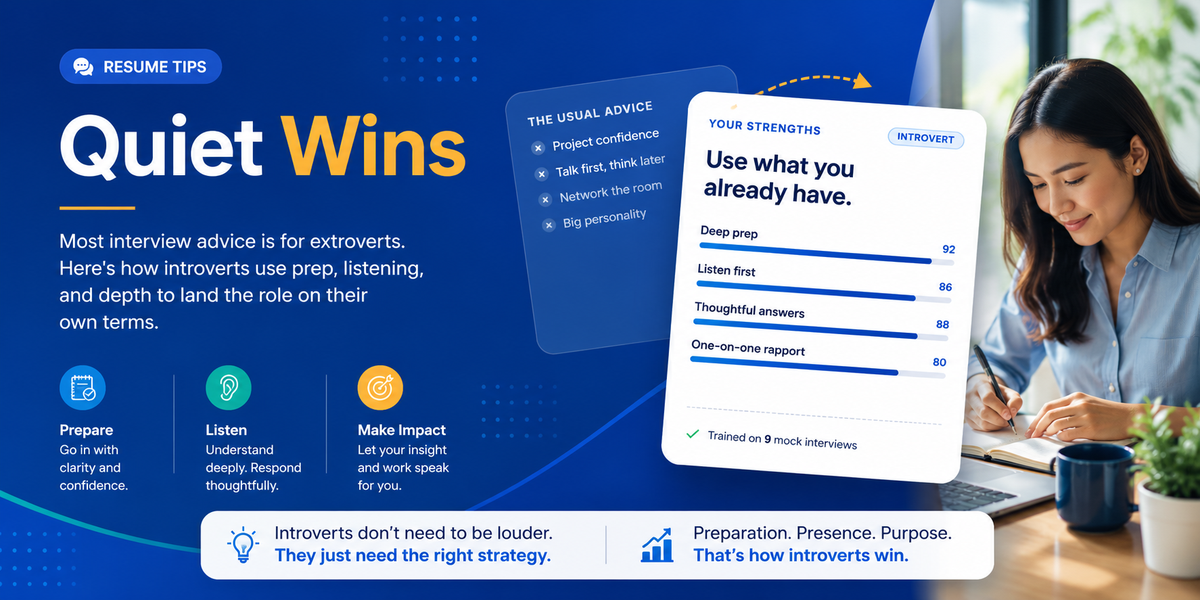
Most resume and interview advice is written by and for extroverts. It emphasises networking, projecting confidence, and performing enthusiastically in high-pressure social situations.
For introverts, this advice often creates anxiety rather than solving it.
These resume tips for introverts take a different approach. They show you how to write a resume that leads with your genuine strengths, how to use that resume as a confidence tool before your interview, and how to perform authentically in a room where the expected style may feel at odds with how you naturally operate.
Introversion is not a liability in a job search. It is a set of capabilities that most employers genuinely value but that most introverts have never been shown how to signal clearly on paper.
Finding roles that suit your working style matters as much as the resume. Browse AI-matched Australian jobs on CloudColleague. Find positions that genuinely fit your strengths and your preferred way of working. Browse roles on CloudColleague
Introvert Strengths That Employers Actually Value (And How to Show Them on a Resume?)
Before any practical resume advice, the most useful thing is to change how you think about what you bring.
Research on workplace performance consistently shows that introverts outperform extroverts in specific, valuable contexts: roles requiring sustained analytical focus, environments where careful listening produces better outcomes than fast talking, and positions where written communication quality is a meaningful differentiator. Susan Cain’s research in this area documents what many employers already know: introverts make up a significant proportion of high performers, including a majority of senior executives across many industries.
The problem is not that introverts lack value. The problem is that most resume and interview frameworks are built around extrovert communication styles, so introverts end up underselling capabilities that are genuinely rare and genuinely needed.
Here is how to translate each introvert strength into resume language that speaks for itself.
Deep Focus and Analytical Thinking
Introverts typically sustain concentration on complex problems for extended periods without distraction. This is directly valuable in analytical roles, research functions, writing-intensive positions, and any work that rewards careful thinking over fast-talking.
On a resume, this strength shows through project complexity, solo achievement statements, and quantified outcomes that required sustained effort rather than social coordination.
Weak bullet: “Analysed data for the marketing team.”
Strong bullet: “Conducted a six-month longitudinal analysis of customer churn patterns across 40,000 accounts, producing a segmentation model that reduced churn by 18% in the subsequent quarter.”
The strong version tells the interviewer exactly what you did, at what scale, over what period, and with what result. It does not require you to perform confidence. It simply states the evidence.
Active Listening and Observation
Introverts typically process information more deeply before responding, which makes them attentive listeners who notice details that faster-responding colleagues often miss. In client management, stakeholder advisory, research, and complex negotiation roles, this is a significant competitive advantage.
On a resume, show listening-based insight through outcomes rather than descriptions of process.
Strong signal: “Identified a recurring client concern through quarterly review conversations that led to a product feature request, subsequently adopted by 34% of the client base within six months.”
This bullet does not claim the candidate is a good listener. It shows what their listening produced.
Written Communication Quality
Most introverts prefer written communication and, as a result, produce higher-quality written output than many of their peers. This advantage is chronically underused in job searches.
A more thoughtful, specific cover letter signals capability before the interview begins. A well-crafted LinkedIn profile attracts inbound interest without requiring networking events. A detailed post-interview thank-you email that references specific conversation points often differentiates an introvert candidate from competitors who sent a brief, generic note.
The written communication advantage is available at every stage of the job search. Most introverts use it only partially.
Preparation and Thoroughness
Introverts typically over-prepare relative to most people, which is a meaningful advantage in structured interviews, technical assessments, and roles where accuracy and due diligence are primary requirements. The instinct to research deeply, prepare carefully, and check work thoroughly is not a personality quirk. It is a professional capability that many employers find difficult to find at the level introverts naturally deliver it.
On a resume, show preparation and thoroughness through examples of systematic process design, error reduction, risk identification, and careful quality work.
Strong signal: “Redesigned the tender review process to incorporate a three-stage quality check, reducing submission errors from 14% to 2% across 60 annual tenders.”
Are you fresher and struggling with Resume format? Read guide: Best Resume Format for Freshers With No Experience
How to Write a Resume That Works for an Introvert Going Into Interviews?
The core insight connecting resume writing to interview performance is this: a resume that accurately represents your introvert strengths reduces interview anxiety by pre-establishing your value before you walk into the room.
When your resume has done the work of communicating who you are and what you have achieved, the interview becomes a conversation about what is already established rather than an audition from scratch. That shift in dynamic is significant for introverts, who often perform far better when the social pressure of first-impression-making has already been reduced by a strong written document.
Lead With Solo and Independent Achievements
Most generic resume advice pushes candidates to describe team contributions prominently. For introverts, this framing frequently undersells the work they actually did.
If you designed the system, conducted the analysis, produced the report, or built the process, say so specifically and directly. “Led a cross-functional team initiative” is often less accurate and less impressive than “designed and implemented a supplier evaluation framework now used as standard across three business units.”
Your independent contributions deserve direct, clear language. Attributing your work to a team when you were the primary driver is both inaccurate and a disservice to your own candidacy.
Quantify Everything
Numbers do the speaking for you, and they do it without requiring social performance.
A bullet point that includes a specific metric is more compelling than any amount of descriptive language because it presents verifiable evidence rather than claims about capability. For introverts who find self-promotion uncomfortable, quantified achievements are the most natural form of confident self-presentation available. They simply state what happened.
Ask yourself for every bullet point: what was the scale, what was the timeframe, and what measurably changed because of what I did? Even approximate figures are more powerful than vague descriptions. “Approximately AUD $2M in managed budget” is more compelling than “managed significant budgets.”
Write a Specific, Evidence-Based Professional Summary
Your professional summary is the recruiter’s first impression of you before any human contact occurs. For introverts, this section is particularly important because it sets the frame for who you are before anyone has met you.
Avoid generic adjectives: dedicated, hardworking, results-oriented, team player. These words appear on nearly every resume and add nothing. Instead, name your specific functional expertise, your most significant demonstrable achievement, and your clear target.
Strong example: “Financial analyst with six years of experience in corporate treasury and foreign exchange risk management. Built the company’s first automated currency exposure dashboard, reducing manual reporting time by 70% and enabling daily rather than weekly risk visibility. Targeting treasury and financial risk management roles in the Australian energy and resources sector.”
This summary does not claim the candidate is anything. It shows who they are through evidence. That approach is both more honest and more compelling.
Include Evidence of Collaborative Work Without Overstating It
Introverts often contribute meaningfully to collaborative work through specific, substantive functions: facilitating a structured workshop, producing the shared document the team worked from, managing the project communication log, or synthesising group input into a final recommendation.
Name these specific contributions rather than generic statements. “Collaborated with stakeholders across three business units” tells a recruiter nothing. “Facilitated a six-week cross-functional working group that produced the company’s first shared data governance policy” tells them exactly what your collaborative contribution looked like.
This approach signals genuine collaborative capacity without requiring you to claim a social energy that does not accurately represent how you work best.
Use Your Cover Letter as Your Strongest Written Asset
A thoughtful, specific cover letter is one of the most underused advantages available to introvert candidates.
While some candidates rely on networking and personality to open doors, introverts can invest equivalent energy into a carefully researched, precisely targeted cover letter that references specific details about the role, addresses a particular challenge the company is facing, and explains specifically why the fit is genuine.
A cover letter of this quality consistently differentiates introvert candidates from faster-applying competitors who sent a paragraph about being passionate and hardworking. The introvert who read the company’s annual report, noted a specific strategic challenge, and connected their experience directly to it will be remembered. The candidate who sent three sentences of enthusiasm will not.
Resume and cover letter ready. Now find Australian roles worth applying to. Browse AI-matched jobs on CloudColleague across tech, admin, health, trades, and more. Start as a seeker on CloudColleague.
Using Your Resume as a Confidence Anchor Before the Interview
Here is a technique that no competing article mentions and that consistently helps introvert candidates walk into interviews more grounded.
Read your resume carefully in the 30 minutes before your interview begins. Not to memorise it. Not to check for typos. To remind yourself, in your own words, of what you have actually done and achieved.
Introverts often struggle in interviews not because they lack capability but because the social pressure of the interview environment temporarily disconnects them from their own track record. The unfamiliar room, the stranger asking questions, the awareness of being evaluated: all of these activate social anxiety that competes with clear recall.
Reading your resume before walking in re-anchors you to the evidence. When the interviewer asks about a specific project, you have already reminded yourself what it was, what you did, what challenge you faced, and what the outcome was. The answer comes from a place of anchored confidence rather than on-the-spot recall under social pressure.
This technique works because a well-written resume is already a curated list of your strongest professional moments. Reading it before the interview is the equivalent of a warm-up before a performance. The stories are already present. The interview becomes a conversation about what is already established rather than a test of what you can produce under pressure.
Pair this with the interview preparation strategies below and the dynamic of the interview changes fundamentally.
Interview Strategies That Play to Introvert Strengths
The same qualities that make introverts strong resume writers also make them strong in specific interview formats. The key is to create conditions that allow those strengths to show.
Prepare More Than Anyone Else in the Room
Over-preparation is an introvert’s structural advantage in interviews. While some candidates rely on improvisation and social energy to carry a conversation, introverts who have prepared deeply for every likely question perform more consistently and more impressively under the structured conditions of a formal interview.
Research the company in depth before any interview. Understand their strategic priorities, their recent news, and their competitive landscape. Prepare STAR method stories (Situation, Task, Action, Result) for at least eight to ten likely behavioural questions. Know your resume evidence so thoroughly that any question the interviewer asks connects naturally to a story you have already prepared and practised.
The candidate who can say “that connects directly to a project I led in my previous role, let me walk you through it” immediately signals both capability and preparation. This is the introvert’s home ground.
Turn the Interview Into a Structured Conversation
Interviews that feel like interrogations are harder for introverts than interviews that feel like genuine conversations. You can influence this dynamic through the questions you ask.
A candidate who has researched the company and asks specific, insightful questions about strategic direction, team structure, or current challenges turns the interview into a two-way exchange. This dynamic reduces the social pressure of being constantly evaluated and creates space for the kind of thoughtful, engaged conversation that introverts typically handle well.
An introvert candidate who asks three genuinely researched questions often leaves a stronger impression than an extrovert who performed enthusiastically but asked questions that signal surface preparation.
Use the Pause to Your Advantage
Introverts typically pause before answering a question, which feels uncomfortable to them but frequently reads as confident and thoughtful to the interviewer.
Rather than filling silence with filler words (um, so, basically, like), allow the pause to work for you. A brief pause before answering signals that you are considering the question seriously rather than producing the first words that come to mind. A candidate who pauses, thinks briefly, and then delivers a structured answer consistently makes a stronger impression than one who starts speaking immediately and organises the answer while talking.
In Australian interviews, where behavioural questions are the norm and structured answers are expected, this measured delivery aligns precisely with what most interviewers are looking for.
Leverage the Written Follow-Up
The post-interview thank-you email is the introvert’s most powerful post-interview tool and one of the most neglected opportunities in any job search.
While some candidates send a brief generic note, an introvert candidate who writes a specific, thoughtful email referencing a particular point from the conversation, connecting it to their background, and clearly reaffirming their interest in the role creates a lasting impression.
Write this email within two hours of leaving the interview. Include one specific reference to something that was said, something you learned about the role or the team, or a connection between their challenges and your specific experience. This level of specificity is something extroverts often skip in favour of speed. It is something introverts, given 30 minutes of quiet reflection, typically produce with ease.
If you need a guide for job interview. Read guide Prepare for the Job Interview .
What Australian Introverts Specifically Need to Know
Australian corporate, government, and healthcare hiring processes are heavily behavioural-interview driven. This is a structural advantage for introverts.
Behavioural interviews reward preparation, specific story recall, and structured delivery over social performance and spontaneous charisma. The STAR method is the standard framework across most Australian corporate and public sector hiring. Introverts who prepare their STAR stories thoroughly and practise delivering them clearly and specifically consistently outperform less-prepared candidates regardless of personality type.
Australian workplace culture has a distinct egalitarian character. Employees who produce high-quality, consistent work without excessive self-promotion are generally respected. SEEK is Australia’s dominant job board. Your uploaded resume needs to be ATS-safe and keyword-optimised for the roles you are targeting, in addition to being evidence-based and introvert-appropriate.
CloudColleague lists roles across every Australian industry and includes task-based opportunities that suit introvert working styles particularly well: focused, independent, output-driven work with clear deliverables and measurable outcomes. A completed task with positive client feedback is a credible evidence point that can be added to your resume immediately.
Resume built, interview prepared. Find Australian roles where your working style is an asset. Create a free profile on CloudColleague and get AI-matched to verified Australian employers hiring across every industry right now.Get started free on CloudColleague
Hiring and need detail-oriented, focused professionals? Post a role or task on CloudColleague in under five minutes. Smart matching surfaces pre-vetted candidates with the specific skills you need.Start hiring on CloudColleague
Frequently Asked Questions on Resume Tips for Introverts
Not usually. Australian employers commonly use structured behavioural interviews that reward preparation, clear examples, and calm delivery. Well-prepared introverts often perform strongly in these formats. The best strategy is to prepare STAR method stories and practise them until they feel natural.
Introverts should focus on measurable achievements, analytical strengths, and quality work rather than broad personality claims. A strong summary with specific expertise and results is more effective than calling yourself a “people person.” Metrics and outcomes should support every bullet point.
Prepare strong answers for: “Tell me about yourself,” “Describe a time you worked in a team,” “How do you handle pressure?” and “What is your greatest weakness?” Use concise examples with clear outcomes. Reviewing your answers and resume before the interview improves confidence significantly.
Preparation is the most effective solution. Practise STAR stories aloud, research the company, review your resume beforehand, and arrive early. During the interview, pause before answering instead of rushing. A thoughtful thank-you email afterward also reinforces professionalism.
No. Most Australian employers value competence, reliability, and evidence of performance more than personality type. Excessive self-promotion can even be viewed negatively in some workplaces. Well-prepared introverts who communicate clearly and demonstrate capability often perform extremely well in Australian hiring processes.