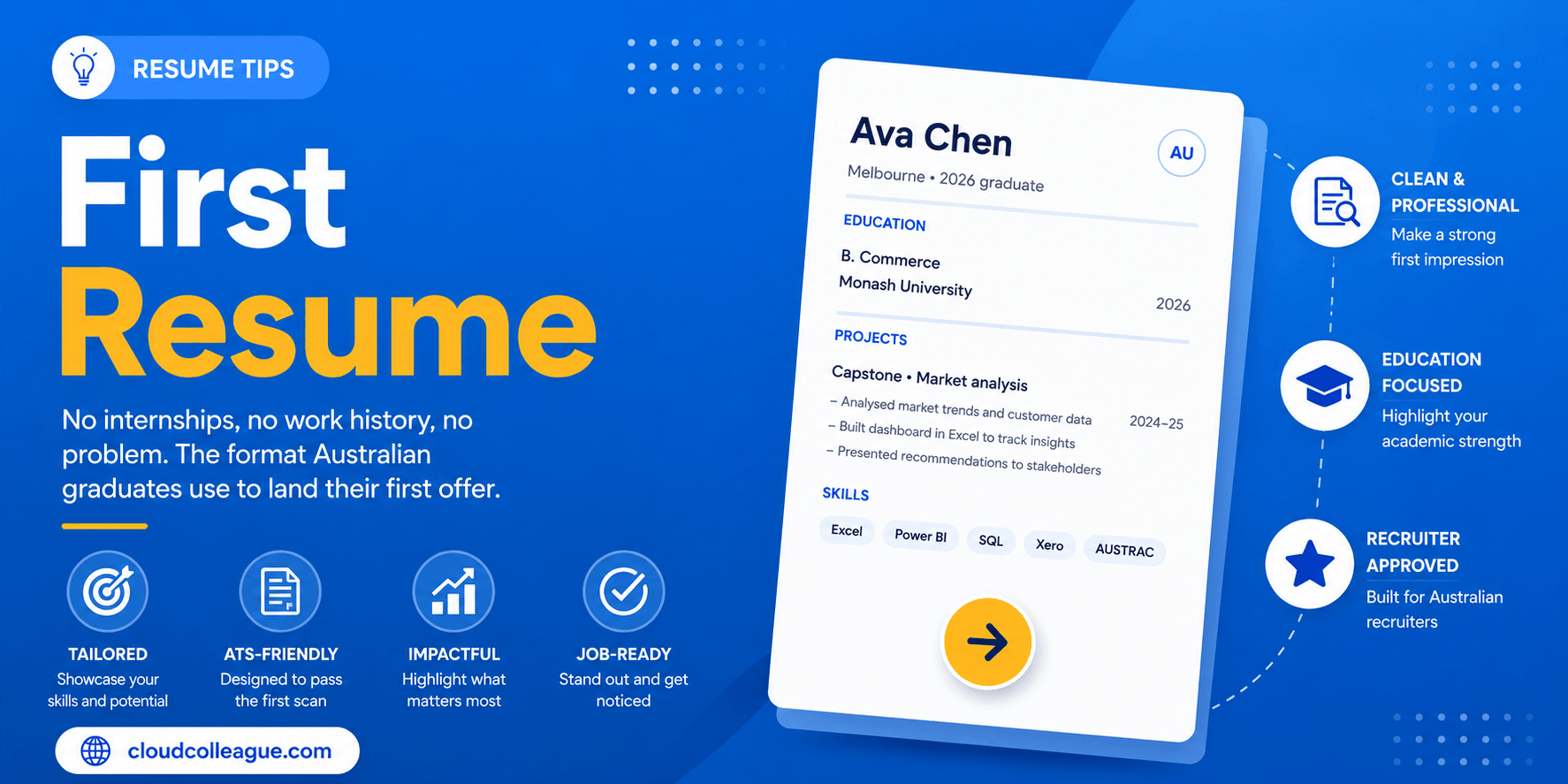
The best resume format for freshers with no experience is not the one that hides your lack of work history. It is the one that makes the strongest possible case for what you do have: your education, your projects, your skills, and your potential.
No experience does not mean nothing to show. It means your resume cannot follow the same playbook as someone with three years of work history.
In Australia, recruiters spend six to ten seconds on a first scan of a resume, and 82% use ATS software to screen applications before any human reads a word. That means two things for a fresher: the format you choose needs to lead with your strongest material, and it needs to be one that ATS systems can actually read.
This guide gives you a clear answer on which format to use, what sections to build, and how to fill the page with real, specific evidence even if you have never held a formal job.
Building your first resume? Find entry-level roles and tasks on CloudColleague that welcome freshers with no formal experience. Thousands of Australian opportunities listed right now.Browse entry-level roles on CloudColleague
The Four Resume Formats: Which One Is Right for a Fresher?
Most articles present all four resume formats as equally valid choices. They are not. Here is the honest breakdown for freshers.
Chronological Format: Best If You Have Internship or Part-Time Experience
The chronological format lists your most recent experience first and works backwards through your history. ATS systems are built to parse this format. It is what recruiters expect and what most hiring processes are designed around.
For freshers, it works best when you have at least one internship, part-time role, or sustained volunteer position that is relevant to your target role. Lead with your education section, follow with your experience, then your skills and projects below.
If you have any relevant paid or unpaid work history at all, chronological is the safer choice. It signals confidence in your timeline and does not raise any red flags.
Hybrid (Combination) Format: Best for Most Freshers With No Formal Experience
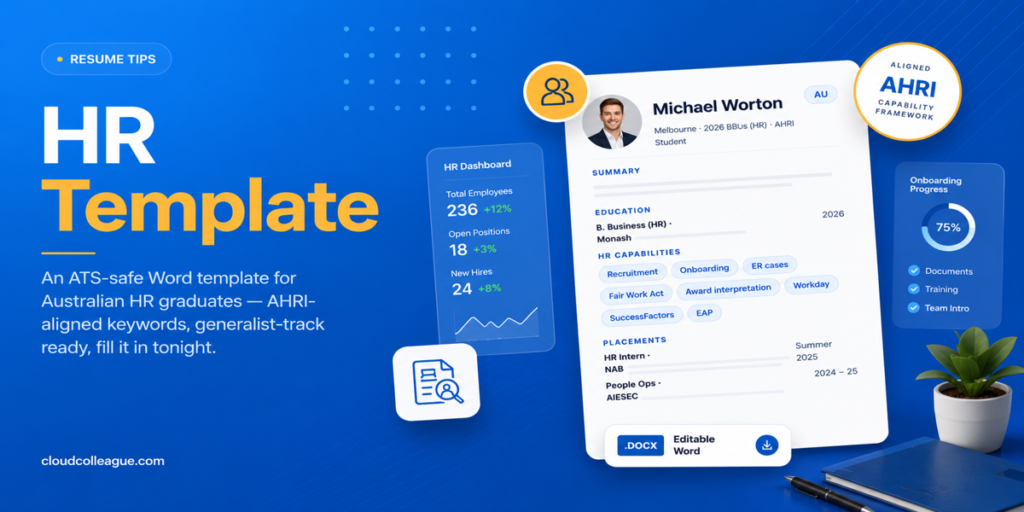
The hybrid format leads with a professional summary and a skills or key achievements section before your education and any experience sections below. This structure lets you front-load what is most relevant to your target role without hiding your limited work history.
Most importantly, it is ATS-safe when built on a single-column layout. And it gives recruiters the strongest possible first impression of what you bring before they reach the point in your resume where work experience would normally appear. The resume writing tips cover How to Write a Resume? for no experience freshers as well.
This is the recommended default format for the majority of Australian freshers.
Functional Format: Why Freshers Should Avoid It
A functional resume leads with grouped skill categories and pushes employment history to the bottom or removes dates entirely. The logic sounds appealing: lead with what you can do rather than where you have worked.
In practice, recruiters have seen this pattern many times. It raises the same red flag it raises for experienced candidates: what is this person hiding? For a fresher, it signals a lack of confidence rather than strategic presentation. Additionally, ATS systems are built to extract employment data in chronological order, and a functional resume disrupts that extraction in ways that can hurt your automated score.
Avoid the functional format unless you have a very specific reason that makes it unavoidable.
Creative Format: Only for Design, Creative, and Portfolio-Based Roles
Visual resumes with custom graphics, colour blocks, icons, and design-forward layouts can work for graphic design, UX, illustration, and creative roles where visual presentation is itself part of the evaluation.
For all other roles, including corporate, technology, healthcare, finance, and business roles, a creative format creates ATS risk that a fresher cannot afford. The rule is simple: if the role requires you to be creative, a creative resume signals fit. If it does not, it signals poor judgment about what employers want to see.
Have already build resume? Now check the Best Free ATS Resume Checker and land your dream ob or tasks.
The Recommended Resume Structure: Section by Section
Here is how to build your fresher resume from top to bottom, with specific guidance on how to make each section compelling even without formal work history.
Contact Information and Header
Your header needs your full name, a professional email address, your phone number, and your city and state. Do not include your full street address.
A professional email means firstname.lastname@gmail.com or a variation. Nicknames, numbers from high school, and humorous addresses all create a poor first impression before the recruiter has read a word of your actual resume.
Add your LinkedIn profile URL if your profile is complete and consistent with your resume. Add a GitHub link or portfolio URL if you are applying for technical or creative roles. In Australia, do not include a photo, date of birth, or gender on your resume. These are not standard practice and add no value.
Professional Summary (Not an Objective Statement)
A professional summary is two to three sentences at the top of your resume that tell the recruiter who you are, what you bring, and what role you want. It replaces the old-style objective statement, which is generic, employer-focused-in-the-wrong-direction, and ignored by most recruiters.
The difference is significant.
Strong summary: “Recent Data Analytics graduate from RMIT University with a distinction average and hands-on experience applying Python and SQL across two major project briefs. Completed analysis of a 40,000-record dataset for a simulated client engagement. Seeking a junior data analyst role to apply quantitative reasoning and clear communication to real business problems.”
Weak objective: “Motivated and hardworking graduate seeking an entry-level position where I can develop my professional skills and contribute to a dynamic team.”
The strong version has specific evidence. The weak version is written by nearly every fresher in Australia and remembered by none of the recruiters who read it. Specifics, not adjectives.
Education Section
For most freshers, education moves to the top of the resume immediately after the summary. It is your primary credential and your strongest proof of capability.
Include your degree, institution, and graduation year or expected graduation date. Add your WAM (Weighted Average Mark) if it is above 75 out of 100. Australian employers understand WAM and expect it stated as “WAM: 78/100” rather than a letter grade, which is not a standard Australian academic measure.
List three to five subjects that are directly relevant to your target role under a “Relevant Coursework” subline. These signal domain knowledge even without formal work experience. If you received awards, scholarships, Dean’s List recognition, or any academic distinction, include them here.
Do not include high school education once you have a university degree unless a specific high school achievement is exceptional and recent enough to be meaningful.
Skills Section
List your hard skills first. Hard skills are specific, nameable, and demonstrable: programming languages, software platforms, analytical tools, design programs, data systems, and technical methodologies. These are the keywords ATS systems are looking for and the first thing a technical recruiter scans.
Soft skills are only worth listing if they are evidenced somewhere else in your resume. Writing “strong communicator” means nothing if there is no bullet point elsewhere that proves you have communicated something to someone at scale. Either provide the evidence or leave the claim out.
For tech roles, name your languages, frameworks, databases, and tools specifically (Python, SQL, React, Figma, Tableau, AWS). For business roles, name the software and methods you have used (Excel, Power BI, Salesforce, financial modelling, market research, project management). Keep the list to ten to fifteen items you can confidently discuss in an interview.
Projects Section: The Most Important Section for Most Freshers
This section replaces work experience for freshers who have no formal job history, and it is where the difference between a strong fresher resume and a weak one is made.
Generic project descriptions add no value. A recruiter reading “developed a web application for my final year project” learns nothing about your capability, your approach, or your results.
Strong project bullet: “Built a full-stack e-commerce platform using React and Node.js with mock payment integration. Tested by 150 simulated users. Presented to a faculty panel of five judges and received a distinction grade.”
Weak project bullet: “Created a website using HTML and CSS for a university assignment.”
The strong version shows tools used, scale (150 users), audience (faculty panel of five), and outcome (distinction). Every element adds evidence. Every element gives the recruiter something to ask about in an interview.
Include two to four projects at most. Quality over quantity. For each project, name it, name the tools used, state the scale or scope (users, data volume, team size, budget), and state the outcome or recognition received.
Personal projects count equally to university projects. Kaggle competition entries with documented results, GitHub repositories with a clean README, hackathon participation, open-source contributions, and freelance work of any kind all belong here.
Volunteer Work, Extracurriculars, and Part-Time Roles
Every Australian fresher has more to show here than they realise. The problem is framing, not evidence.
“Event Coordinator” on a resume is just a title. No one gets shortlisted for a title. “Coordinated logistics for a 600-person university festival, managing a team of eight volunteers and a AUD $12,000 budget with zero vendor cancellations on the day” is a story with scale, responsibility, and outcome. Recruiters remember stories.
Part-time retail, hospitality, and service roles demonstrate reliability, customer communication, composure under pressure, and time management. These are qualities every employer values regardless of the role. Do not omit them. Do not describe them as “served customers.” Describe what you actually did, at scale.
Volunteering signals initiative and community engagement, both qualities Australian employers explicitly value. A volunteer role at a food bank, a sports club, a community organisation, or an environmental group belongs on your resume if you held any form of responsibility within it.
Certifications and Additional Qualifications
Include any relevant professional certifications. Google Analytics Individual Qualification, Microsoft Office Specialist, AWS Cloud Practitioner, Lean Six Sigma Yellow Belt, and similar credentials signal professional development that goes beyond the classroom.
Online courses from Coursera, LinkedIn Learning, edX, or Udemy are worth listing if they are directly relevant to the target role and you have a completion certificate to show. Include the issuing organisation and completion date for every certification listed.
If you hold a Working With Children Check (WWCC) or a National Police Check (NPC), include these in your certifications section. They are required for many entry-level roles in education, healthcare, aged care, and community services in Australia, and listing them proactively removes a common administrative step from the employer’s process.
First Time in Australia? Australia can be good option for new workers seeking opportunities. Visit CloudColleague and land your first dream job in Australia.
The ATS Risk Every Australian Fresher Needs to Understand
This matters more for freshers than for any other group of job seekers, and most fresher guides do not explain it clearly enough.
82% of Australian employers use ATS software to screen resumes before a human reads them. An experienced candidate with a keyword-dense work history can sometimes survive a mild formatting problem because the ATS finds enough relevant content to pass them through anyway. A fresher with limited content cannot absorb this risk. A formatting failure on a fresher resume means the ATS reads nothing useful, scores you at zero, and you never reach a human reviewer.
These formatting rules are non-negotiable for a no-experience resume:
- Single-column layout: no sidebars, no two-column templates, no graphic elements
- Standard fonts: Arial, Calibri, or Times New Roman. No decorative, script, or novelty fonts
- No tables or text boxes: these break ATS text extraction regardless of how well-designed they look
- Standard section headings: use Education, Skills, Projects, Experience. Not creative equivalents
- No key information in headers or footers: ATS systems frequently skip these sections entirely
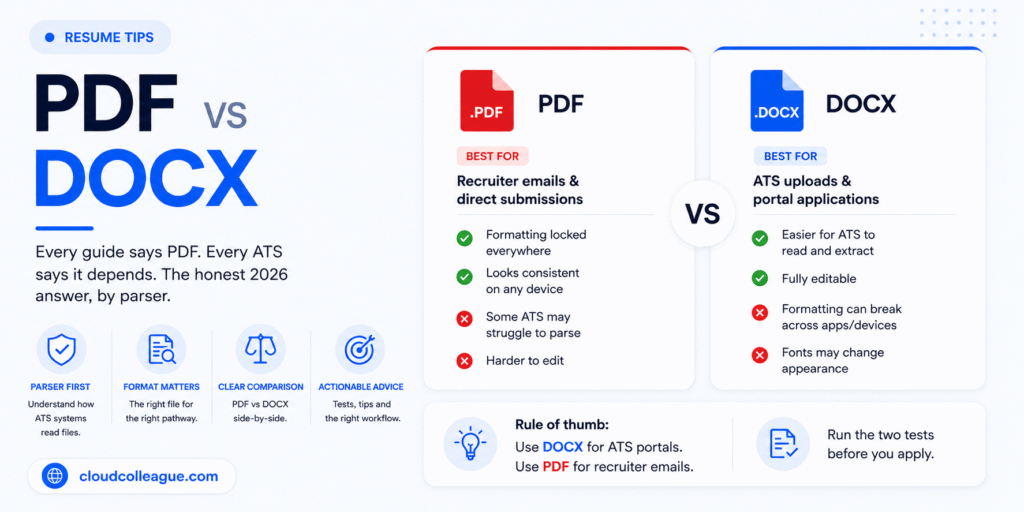
- Save as PDF from Word or Google Docs, not from a design tool like Canva
Run the copy-paste test before every application. Open your PDF, select all text with Ctrl+A, copy it, and paste it into a plain text editor. If the text appears clean and in the correct order, your resume is ATS-safe. If it is garbled or incomplete, your PDF was exported incorrectly and needs to be regenerated before you apply.
How to Turn What You Have Into Compelling Evidence
Most freshers underestimate how much evidence they already have. The problem is not a lack of experience. It is a failure to frame existing experience with the specificity and scale that makes it land with a recruiter.
Quantify Your University Projects
Every project has measurable components that most freshers leave out. Dataset size. Team members. Presentation audience size. Grade received. Weeks taken. Lines of code. Users tested with. Client satisfaction score.
Ask yourself five questions about each project you have completed: What was the scale? Who was the audience? What tools did I use? What was the outcome? And, What would have been worse or different without my contribution? The answers to those questions are your bullet points.
Quantify Your Extracurricular Roles
Event coordinator: how many attendees, how many volunteers managed, what budget, zero incidents on the day? Club treasurer: how many members, what was the annual budget, any financial audit or reporting completed? Sports captain: how many seasons, what record, how did the team perform? Tutor: how many students, over how many weeks, what grade improvement did your students achieve?
Every leadership or responsibility role has at least one measurable dimension. Find it and put it in your resume.
Quantify Your Part-Time Work
Retail and hospitality work is more valuable than most freshers think, and more quantifiable than they realise. “Served more than 100 customers per shift in a high-volume lunch rush environment” demonstrates composure and customer communication. “Trained three new team members on point-of-sale systems and food safety procedures” demonstrates knowledge transfer and leadership. “Maintained a 4.9-star customer satisfaction rating over two years” demonstrates consistent performance.
Do not write “responsible for serving customers.” Write what you actually did, at scale, with an outcome.
What Australian Freshers Specifically Need to Know
CloudColleague lists tasks and entry-level roles across every Australian industry that frequently do not require formal experience. Bidding on tasks through CloudColleague builds a documented professional track record faster than waiting several months for graduate program outcomes. Freshers who complete tasks on the platform have real work history, real client feedback, and real evidence of professional capability to add to their next resume version.
SEEK is Australia’s dominant job board for entry-level roles. Your resume needs to upload cleanly in PDF or DOCX format. Single-column, ATS-safe resumes perform best on SEEK’s parsing system. However, multi-column and design-heavy templates frequently break on upload.
GradConnection is the primary platform for Australian Graduate Program applications. Deloitte, KPMG, PwC, Westpac, Rio Tinto, and federal government departments run structured programs here. Crucially, these applications expect a one-page resume as a firm requirement.
Australian employers use LinkedIn to verify resume details before interviews. Set up your profile before applying anywhere. Additionally, ensure job titles, dates, and education match your resume exactly. Recruiters often withdraw applications when they find discrepancies.
Australian corporate employers expect a one-page resume from fresh graduates. A two-page fresher resume signals poor editing discipline, not more experience.
The WAM versus GPA difference matters for Australian applications. State it as “WAM: 78/100” rather than converting to a letter grade. Australian employers understand WAM and expect it in this format.
Resume complete. Now find your first Australian role. Create a free profile on CloudColleague and get matched to entry-level jobs, graduate roles, and tasks that welcome freshers across every Australian industry.Get started free on CloudColleague
Hiring entry-level talent or looking for task help? Post a role or task on CloudColleague in under five minutes. Access a pool of motivated fresh graduates ready to contribute from day one.Start hiring on CloudColleague
Frequently Asked Questions
The hybrid format suits most Australian freshers with no formal work experience. It leads with a professional summary and skills section, then moves into education, projects, and any volunteer or part-time work. Additionally, this structure stays ATS-safe on a single-column layout.
One page is the expectation for all standard entry-level and graduate applications in Australia. GradConnection applications expect a one-page resume as a firm standard. If you cannot fit relevant content onto one page, you are including material that does not belong. Instead, cut mercilessly and keep what is strongest.
Lead with a professional summary, then education including your WAM and relevant coursework. Follow with a skills section listing demonstrable hard skills. Additionally, add two to four projects with specific tools, scale, and outcomes. Below that, include volunteer work, part-time roles, or club leadership with quantified results. Finally, add certifications or online courses.
No. Recruiters associate functional resumes with candidates hiding gaps, short tenures, or skill mismatches. For freshers, it signals a lack of confidence in your timeline. Additionally, it creates ATS parsing problems because systems extract employment data chronologically. Instead, use a hybrid format to lead with skills without the red flag.
Use a single-column layout with no sidebars, text boxes, or graphics. Stick to standard fonts like Arial, Calibri, or Times New Roman. Additionally, keep contact details out of headers and footers. Save as PDF using Word or Google Docs, not Canva. Finally, run the copy-paste test before submitting.