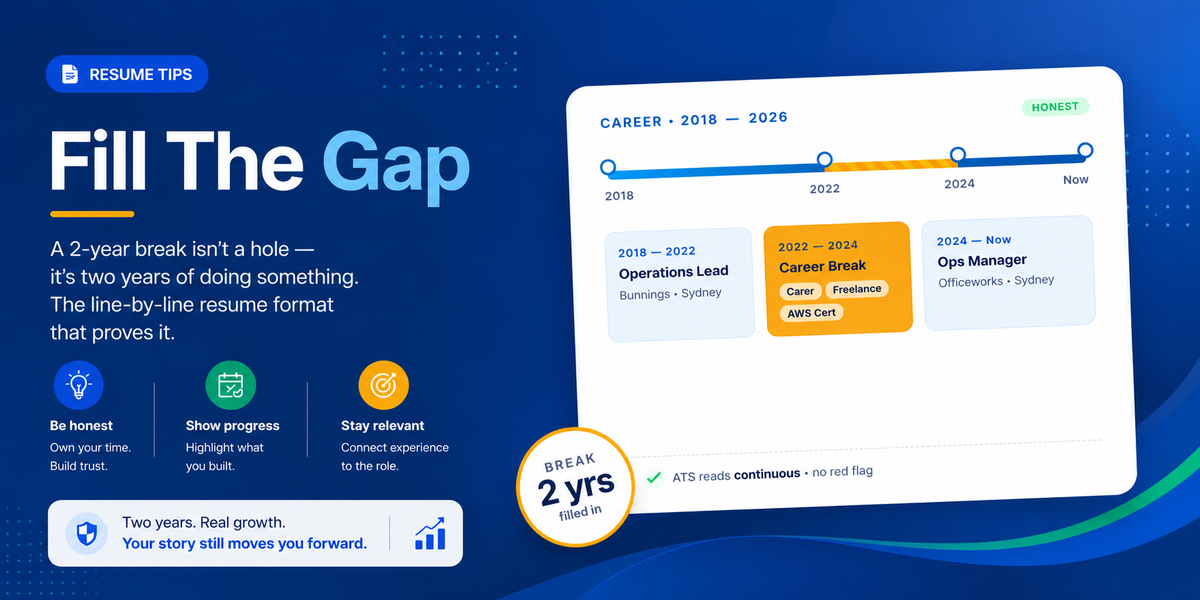
Learning how to write a resume after a 2-year employment gap is less intimidating than it feels right now.
In 2026, 91% of hiring managers say they are open to candidates with career breaks. The gap itself is rarely the problem. The problem is when candidates try to hide it, minimise it, or use a resume format specifically designed to obscure it. These strategies raise more questions than the gap itself ever would.
In this guide, we show you exactly how to address a two-year gap honestly. Frame it professionally, and write a resume that gets interviews in the Australian job market. We also give specific framing examples for the five most common types of career breaks. Because the right language depends entirely on your specific situation.
Returning to work? Find Australian employers who are actively hiring and open to career returners. CloudColleague lists verified roles across every industry right now.Browse roles on CloudColleague
The Good News First: What Employers Actually Think About Career Gaps in 2026?
Before any practical advice, the most important thing to know is that the landscape has changed significantly.
In 2026, 91% of hiring managers report being open to candidates with career breaks. LinkedIn’s own research confirms that the stigma around career gaps has declined sharply across most industries and countries, including Australia. Many employers now recognise that career interruptions for caregiving, health, study, and personal development are a normal and often enriching part of a professional life.
Australian employers have moved faster than most in normalising career breaks. Career gaps carry genuine cultural respect in Australian corporate environments. The Fair Work Act’s protections for carer’s leave and parental leave mean that Australian HR professionals are more experienced at evaluating career returners than their counterparts in many other markets.
What employers are evaluating is not whether you had a gap. They are evaluating whether you are honest about it, whether you remained professionally engaged or personally productive during it, and whether you are clearly ready to return.
Transparency is both the ethical and the strategic choice. Every attempt to obscure a two-year gap through resume format tricks, date manipulations, or omissions is a risk that outweighs any perceived benefit.
Read Next: Best Resume Builder for MBA Freshers in 2026
Do Not Use a Functional Resume Format
Before the practical steps, there is one piece of advice that still circulates widely and that needs to be corrected directly.
Several major career websites, including some with genuine authority, still recommend the functional resume format for candidates with employment gaps. This advice is outdated and actively harmful in 2026.
A functional resume leads with grouped skill categories and pushes your work history with dates to the bottom of the document. The intention is to draw the recruiter’s attention to your skills before they encounter the gap in your timeline. In practice, the opposite happens.
Recruiters have seen the functional format used as a gap-hiding strategy hundreds of times. When an experienced recruiter encounters a functional resume, the first thing many of them think is: what is this person hiding? The format creates suspicion that the gap itself would not have generated.
The ATS problem is equally serious. ATS platforms are built to extract employment data in chronological order. Job titles, employer names, dates, and bullet points under each role. A functional resume that groups skills separately and buries the employment history disrupts this extraction. Your resume may score lower than a chronological document with the same keywords simply because the system cannot correctly parse the structure.
The correct format for a resume with a two-year employment gap is a hybrid (combination) format. It leads with a professional summary and skills section. Then presents your work history chronologically with dates intact and a brief career break entry where the gap appears. This format is honest, ATS-safe, and recruiter-friendly.
To learn more about Functional Resume read: Functional Resume vs Chronological Resume: Which Should You Use in 2026?
The Right Resume Format for a Two-Year Employment Gap
Here is the section-by-section structure that works best for gap resumes in the Australian market.
Professional Summary
Your professional summary is the most important section on a gap resume. It appears at the top of your document, before your work history. It gives you the opportunity to frame your return to work on your own terms before the recruiter reaches the gap in your timeline.
A strong professional summary for a gap resume does three things. It names your target role and your key strengths. It references your gap briefly and positively in one sentence. And it signals your readiness to return and your current value without dwelling on the interruption.
Strong example: “Operations manager with eight years of supply chain and logistics experience across manufacturing and retail. Following a two-year period of family caregiving, returning to the workforce with updated project management certification and a clear focus on operational efficiency roles in the Australian market.”
Weak example: “Experienced operations professional seeking a new opportunity after a period away from work.”
The strong version contextualises the gap in one sentence and immediately moves to readiness and value. The weak version sounds apologetic and vague, which draws more attention to the gap than a confident one-sentence explanation would.
Skills Section
In the hybrid format, your skills section follows your professional summary and sits above your work history. This ensures the recruiter sees your functional value before they encounter the chronological record.
Include hard skills, relevant tools and platforms, and any skills you maintained or developed during the gap. If you completed a certification, learned a new tool, or took on volunteer responsibilities during the gap period, include the relevant skills here and back them up in your career break entry below. Know about Soft Skills vs Hard Skills which is better ?
Work History With a Career Break Entry
List your work history in reverse chronological order with full dates. Where the gap appears, add a career break entry as if it were a role. Include the dates, a brief descriptive title, and two to three bullet points describing what you did during the period.
The format looks like this:
Career Break / [Month Year] to [Month Year]
Bullet points should show three things: a brief reason for the break (one line), any productive activity during the gap (courses, volunteer work, freelance projects, caregiving responsibilities), and a signal of readiness to return.
A career break entry prevents the recruiter from encountering an unexplained blank period in your timeline, which is always worse than a briefly explained one. Unexplained gaps invite assumptions. Explained gaps invite conversation.
Gap-Type Specific Framing: What to Say for Your Situation
This is the section that every other article on this topic leaves out. The right framing language for a career break depends entirely on why the break happened. Here are specific examples for the five most common gap types.
Caring for a Family Member
This is the most common reason for a two-year gap in Australia, and one that carries genuine dignity and often significant transferable skill development. Frame it honestly and briefly without over-explaining medical or personal details about the person you cared for.
Professional summary sentence: “Following two years as a primary carer for a family member with a serious health condition, I am returning to the workforce with strong stakeholder communication, crisis management, and complex project coordination skills developed through the caregiving experience.”
Career break entry:
Career Break / January 2023 to December 2024
- Served as primary carer for a parent with a progressive health condition, coordinating medical appointments, liaising with specialist teams, and managing household operations for the full period.
- Completed Google Project Management Certificate during evenings to maintain professional development and update skills alongside caregiving responsibilities.
- Returning to full-time work following the establishment of appropriate long-term care arrangements.
Australian context note: Australian employers are familiar with carer gaps. The Fair Work Act’s provisions for carer’s leave mean that Australian HR professionals understand these interruptions at a structural level. Carer gaps carry no stigma in most Australian corporate, healthcare, and government environments.
Mental Health or Personal Health Recovery
This gap type requires the most careful framing because it involves personal health information you are not obligated to disclose. You are not required to name a specific condition on your resume or in an interview. The right framing acknowledges the gap briefly and pivots immediately to your current readiness and capability.
Professional summary sentence: “After addressing a personal health matter that required a focused period of recovery, I am returning to full-time work with renewed energy, updated digital skills, and a clear focus on content strategy roles in the Australian market.”
Career break entry:
Career Break / March 2023 to February 2025
- Took necessary time to address a personal health matter requiring structured recovery.
- Completed HubSpot Content Marketing Certification and Google Analytics Individual Qualification during the recovery period to maintain professional development.
- Engaged in regular freelance writing projects for three small businesses, producing an average of four pieces of content per week throughout the final six months.
Note: “Personal health matter” is professionally appropriate language that is widely understood in Australian hiring contexts. You are not required to elaborate beyond this, and a professional recruiter will not ask you to.
Redundancy and Difficult Re-entry
Being made redundant in a downturn and then facing a slow market before landing a new role is one of the most common and most misunderstood gap scenarios. Many candidates feel embarrassed by this situation when they should not. Economic cycles produce redundancies at every level and in every industry. Frame the redundancy honestly and emphasise what you did during the transition period.
Professional summary sentence: “Following redundancy during a period of sector-wide restructuring in the financial services industry, I used an extended transition period to complete two professional certifications and deliver freelance finance consulting to three small businesses before returning to the full-time job market.”
Career break entry:
Career Break / June 2023 to July 2025
- Redundancy following company-wide restructuring affecting 30% of the finance team.
- Completed Chartered Financial Analyst (CFA) Level 1 examination and Xero Certified Advisor certification during the transition period.
- Delivered freelance bookkeeping and financial reporting services to three small business clients, managing monthly reconciliations and quarterly reporting for a combined portfolio of approximately AUD $2.4M in annual revenue.
Study and Academic Sabbatical
If you studied full-time during the gap period, it is not a gap at all. It is intentional professional investment. Lead with the qualification, frame the entire period as deliberate development, and do not apologise for it.
Professional summary sentence: “Recently completed a full-time MBA with a Marketing specialisation at AGSM (UNSW) after stepping away from employment to invest in formal business education that will directly support the marketing leadership roles I am now targeting.”
Career break entry:
Career / Academic Development / February 2023 to November 2024
- Full-time MBA student at AGSM (UNSW), specialising in Marketing Strategy and Consumer Behaviour. WAM: 80.
- Completed six-month consulting internship with boutique strategy firm during second year of program, delivering market entry analysis for two FMCG clients.
- Captain of MBA case competition team, reaching national semifinals in the 2024 ANZ Strategy Challenge.
Travel or Personal Sabbatical
Extended travel, particularly if it included volunteer work, language development, or cross-cultural professional experience, is increasingly well-regarded by Australian employers. Frame it honestly and extract the specific professional value from the experience rather than presenting it as leisure.
Professional summary sentence: “Took a deliberate two-year career sabbatical for extended travel across Southeast Asia and South America, including a six-month volunteer teaching placement in Vietnam that developed strong cross-cultural communication, curriculum design, and stakeholder management skills that I am now bringing back to the Australian market.”
Career break entry:
Career Sabbatical / September 2022 to October 2024
- Extended international travel across eight countries in Southeast Asia and South America, including language immersion programs in Spanish (intermediate) and Vietnamese (beginner).
- Completed six-month English teaching volunteer placement with Teach Away Vietnam, managing a class of 28 adult learners and developing a curriculum used by subsequent teachers at the program.
- Returned to Australia October 2024 with renewed professional focus and a clear career direction toward international business development roles.
Ready to return to the Australian workforce? Find verified Australian employers who are actively hiring on CloudColleague. Browse AI-matched roles across every industry right now. Start as a seeker on CloudColleague.
The Three-Document Strategy for a Gap Resume
Your resume is not the only place your career break will be evaluated. Recruiters check LinkedIn. Cover letters are read alongside resumes. A coherent, consistent narrative across all three documents is the most important single principle for a career return strategy.
Your Resume
Use the hybrid format described above. Professional summary at the top that frames your return confidently. Skills section before work history. Career break entry with dates and two to three descriptive bullet points in the work history section. Keep the career break explanation brief. The resume is your most formal document and brevity is a virtue.
Your Cover Letter
Your cover letter is where you have slightly more space to give context if the situation warrants it. Address the gap in one to two sentences after your opening paragraph, then pivot immediately to your qualifications and enthusiasm for the specific role.
Do not lead your cover letter with the gap. Do not allow the gap to occupy more than three to four sentences in total. The cover letter is a sales document that should focus on why you are the best candidate for this specific role. The gap is a minor narrative element, not the story.
A strong cover letter sentence: “Following two years of family caregiving, I am returning to full-time employment with a clear focus on project management roles where my stakeholder coordination and complex logistics experience are directly applicable.”
Then move on. The recruiter does not need more than one or two sentences at this stage.
Your LinkedIn Profile
LinkedIn introduced a dedicated Career Break feature that lets you list a career break in your experience section with a reason category and a brief description. Use it.
A gap that is invisible on LinkedIn and present on your resume creates a discrepancy that recruiter cross-checking will find. Recruiters routinely verify resume details against LinkedIn profiles, and unexplained differences in employment timelines raise questions that a consistent narrative would not.
Your LinkedIn career break entry should match the dates and general framing of your resume career break entry. It does not need to be identical word for word, but the dates, the reason category, and the general description should be consistent.
What Australian Job Seekers Specifically Need to Know
Australian employers have moved faster than most English-speaking markets in normalising career breaks. Carer gaps in particular carry genuine cultural respect, and Australian HR professionals are experienced at evaluating candidates returning from caregiving commitments.
CloudColleague’s task-based marketplace offers Australian career returners a fast path to rebuilding a documented professional track record while the full-time job search is underway. A completed task with positive client feedback on CloudColleague is a credible evidence point you can add to your resume’s project or freelance section immediately. For candidates who feel they need recent work history before applying for permanent roles, completing two or three tasks on CloudColleague within the first month of your return provides exactly that.
Australian law does not require you to disclose medical conditions, mental health history, or personal family circumstances on a resume or in an interview. “Personal health matter” and “family caregiving commitment” are professionally appropriate, widely understood, and legally protected reasons that require no further elaboration if you choose not to provide it.
For government and public sector roles in Australia, selection criteria responses carry more weight than the resume itself. Address the gap in the relevant selection criteria response using the same framing language as your professional summary, and connect any skills developed during the gap period to the specific criteria being assessed.
Resume written and ready. Now find Australian employers who are actively hiring. Create a free verified profile on CloudColleague and get AI-matched to roles from 18,000+ verified Australian businesses that fit your experience and location.Get started free on CloudColleague
Hiring and open to career returners? Post a role on CloudColleague in under five minutes. Smart matching surfaces pre-vetted professionals across every Australian industry, including candidates returning from career breaks.Start hiring on CloudColleague
Frequently Asked Questions on Write a Resume After a 2-year Employment Gap
Yes. Most hiring managers are open to candidates with career breaks in 2026. A two-year gap is not a major issue if explained honestly and confidently. Australian employers increasingly accept gaps caused by caregiving, health, study, or personal development.
No. Functional resumes often create more suspicion because recruiters assume the candidate is hiding something. ATS systems also prefer chronological work history. A hybrid resume with skills at the top and clear work history below is the safer option.
Mention the gap briefly, then focus on your readiness and strengths. For example: “After a two-year caregiving break, returning with updated digital marketing skills and a strong interest in content strategy roles.” Avoid overexplaining or apologising.
You are not legally required to give full details, especially for health or family reasons. However, a short explanation like “family caregiving,” “career sabbatical,” or “professional development” is usually better than leaving the gap unexplained.
Australian employers are far more accepting of career breaks than in the past, especially for caregiving, health, or study reasons. Most recruiters care more about honesty, clarity, and readiness to return than the gap itself.