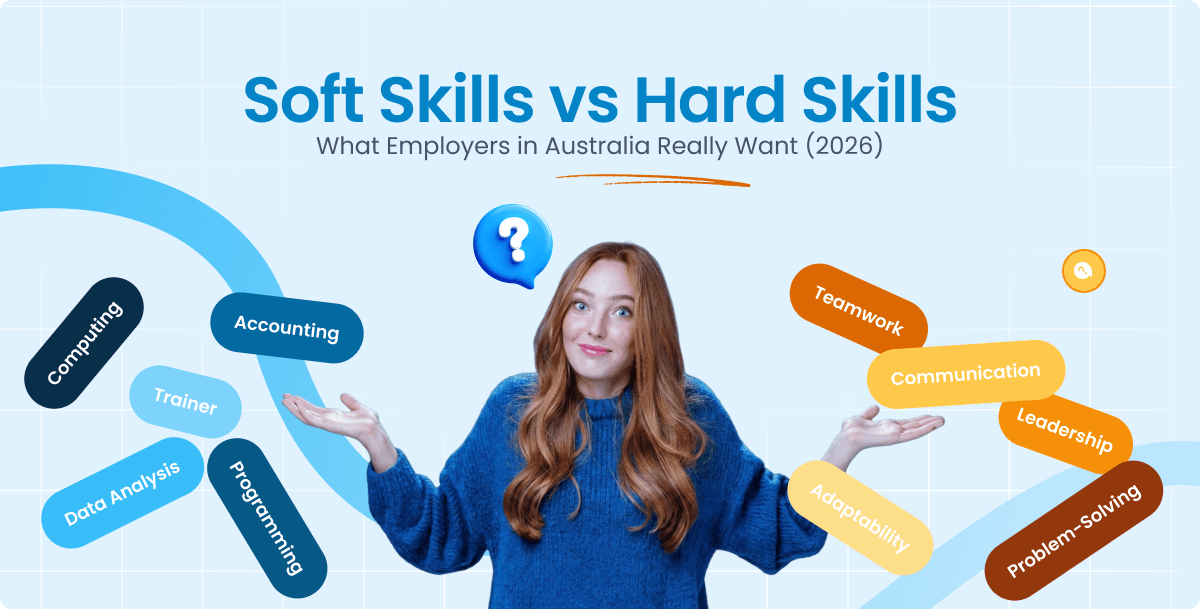
Two candidates. Same qualification, Same number of years of experience and Same industry background. One gets the job. The other does not. We are talking about Soft Skills vs Hard Skills here.
The reason one candidate gets the offer over another is almost never the hard skills. By the time two candidates sit in the same interview room, technical qualifications have already been assessed as broadly equivalent. What determines the outcome from that point is harder to put on a resume. Soft skills reveal how a person actually works, communicates, adapts, and performs under pressure.
The soft skills versus hard skills debate is one of the most misleading frames in the Australian professional market. The distinction matters, but it encourages professionals to treat the two as competing priorities rather than complementary ones. Employer surveys say the same thing year after year. Hard skills determine whether your application passes the initial filter. Soft skills determine whether you get the offer.
This guide covers both sides of that equation in full. It explains what hard skills and soft skills actually are. It covers what Australian employers consistently say they most want and most struggle to find in 2026. Transferable skills and why they matter for career changers and no-experience candidates are also covered. The guide explains how to identify your own skill profile accurately. It shows how to demonstrate both skill types in job applications and interviews. Finally, it addresses how the balance between soft and hard skill demand is shifting as AI reshapes the Australian professional market.
The Soft vs Hard Skills Debate Is Costing You Career Opportunities
The most common version of this debate asks: which matters more? Most research produces an answer that depends on career stage, role type, and hiring context. That answer is accurate but completely unhelpful for a professional deciding where to invest development effort.
A more useful framing is straightforward. Hard skills get you to the room. Soft skills determine what happens once you are in it. LinkedIn’s Global Talent Trends data confirms this clearly. Soft skills drive the primary reason candidates fail at the interview stage. Hard skills remain the primary filter for whether an application reaches the interview stage at all. Deficiency in either creates a ceiling on career progress regardless of strength in the other.
The National Skills Commission’s Skills Priority List confirms the same finding. Technical skill shortages and soft skill deficiencies both rank among the most commonly cited hiring barriers across Australian occupation categories. Australian employers are not choosing between soft and hard skill candidates. They are struggling to find candidates who bring genuine strength in both.
The third framing error is treating soft and hard skills as fixed and separate categories. In practice, the most valued professional capabilities in 2026 sit at the intersection of both. Data storytelling combines data analysis with communication. Change management combines project methodology with emotional intelligence and interpersonal influence. AI literacy combines tool proficiency with judgment about when and how to apply it. Professionals who understand this convergence and invest accordingly are navigating the current market most effectively.
Hard Skills Defined: Examples Across Industries
Hard skills are specific, teachable, and measurable capabilities that professionals typically acquire through formal education, structured training, professional certification, or deliberate extended practice. Three characteristics define a hard skill: structure and replicability in how it can be taught, objectivity in how it can be measured or tested, and verifiability through credentials, assessments, demonstrated work samples, or direct testing.
Hard skills are inherently field-specific and role-specific. The technical capabilities required of an accountant, a software engineer, a registered nurse, and a structural engineer are entirely different from each other. What they share is the characteristic of being learnable through structured pathways and verifiable through objective assessment. This is what makes hard skills the primary filter in the initial stages of the hiring process: a recruiter reviewing 50 applications can quickly identify which candidates hold the required qualifications, certifications, or technical experience. The soft skills assessment requires a conversation.
Hard Skills in Technology and Digital
Technology and digital hard skills have expanded well beyond the technology sector. Digital literacy is now a baseline expectation across virtually every professional role regardless of industry. Basic computer operation is no longer a distinguishing skill. Data analysis, cloud platform proficiency, and AI tool usage are increasingly differentiating ones.
The specific technology hard skills appearing most consistently in Australian job listings in 2026 include several key categories. Data analysis and visualisation tools include Excel advanced functions, Power BI, Tableau, and Google Analytics. Programming languages include Python, SQL, JavaScript, and R for data and technical roles. Cloud platforms include AWS, Azure, and Google Cloud. Cybersecurity fundamentals cover network security principles and common threat frameworks. CRM and marketing automation platforms include Salesforce, HubSpot, and Adobe Experience Cloud. Design and creative tools include Adobe Creative Suite, Figma, and Canva for roles with visual communication requirements.
Google’s digital skills research in Australia consistently finds a clear pattern. Professionals who invest in digital hard skills earn more and win promotions faster. They also experience lower unemployment rates than those who do not. This holds true across virtually every industry and seniority level. Investing in digital hard skills is not only a technology career strategy. It is a general career advancement strategy in the Australian market of 2026.
Hard Skills in Finance and Business
Finance and business hard skills span a wide range. At the foundational level, bookkeeping and accounting software proficiency are essential. Xero and MYOB dominate the Australian small and medium business market. Proficiency with both is a baseline expectation for bookkeeping and accounting roles at most experience levels.
Microsoft Excel remains the most widely required hard skill in finance and business roles globally and in Australia. Advanced function proficiency is consistently listed for mid-level and senior finance positions. Pivot tables, VLOOKUP equivalents, Power Query, and financial modelling skills all appear regularly as specific requirements. Sophisticated financial modelling, regulatory compliance expertise, and strategic analysis capability sit at the more advanced end of the spectrum.
Project management hard skills have expanded significantly as a requirement beyond dedicated project management roles. Agile and SCRUM methodology familiarity now appears in job descriptions for software, marketing, product, and operations roles. Formal project management credentials carry strong market recognition in Australia. The Project Management Professional qualification, PRINCE2, and Agile certifications all provide verifiable credentials that support hard skill claims effectively.
Hard Skills in Healthcare, Trades, and Other Fields
In regulated professions, hard skills are often inseparable from formal professional registration requirements. A registered nurse’s clinical skills are both a licensing requirement and a hiring criterion. The same applies to a lawyer’s legal knowledge, an engineer’s technical expertise, and a teacher’s curriculum delivery and assessment skills.
Trade occupations follow a similar pattern. Licensing and certification frameworks define the relevant hard skills. An electrician’s licence, a plumber’s licence, a construction industry White Card, and technical competencies assessed through apprenticeship completion are all verifiable hard skill credentials. TAFE plays the central role in building and credentialing trade hard skills across Australia. Employers nationally recognise and consistently accept TAFE qualifications across the full range of trade categories.
The same principle applies across all fields. Every profession has a set of hard skills representing the minimum technical competency required for entry. A more advanced set distinguishes the specialist practitioner from the generalist one. Understanding which tier of the hard skill spectrum you occupy relative to your target role is the foundation of a realistic development investment decision.
Soft Skills Defined: Examples Across Industries
Soft skills are the interpersonal, behavioural, and cognitive capabilities that determine how effectively a professional applies technical knowledge in real working situations. They are harder to define than hard skills and harder to teach through structured programmes. Measuring them objectively is also more difficult. That combination of characteristics makes them more valuable, not less.
The World Economic Forum’s Future of Jobs Report 2025 places soft skills at the top of the global skills priority list for 2025 to 2030. Analytical thinking, creative thinking, resilience, flexibility, motivation, self-awareness, and curiosity all rank explicitly above most technical skills. The Australian HR Institute’s annual workforce survey confirms the same pattern locally. A significant proportion of Australian employers report greater difficulty hiring for soft skills than for technical ones. Candidates lack not qualifications but the interpersonal and behavioural capabilities that make those qualifications useful in a real team environment.
Soft skills operate across three dimensions. Interpersonal skills govern how you work with, communicate with, and influence other people in professional contexts. Self-management skills govern how you manage your own time, priorities, emotions, and professional behaviour under pressure. Cognitive skills govern how you think, solve problems, adapt to changing circumstances, and make decisions under ambiguity.
A professional who is genuinely strong across all three dimensions is a rare hire. That is precisely why the supply of candidates with strong soft skills consistently falls below employer demand in the Australian market.
Communication and Interpersonal Soft Skills
Communication is the most foundational interpersonal soft skill. It is also the one most consistently listed as both required and difficult to find in Australian employer surveys. What employers mean by communication skills is broader than most candidates assume. Active listening is one component. Adjusting register and style for different audiences and contexts is another. Presenting complex ideas to non-specialist audiences without losing accuracy matters significantly. Navigating professional disagreement constructively and influencing others’ thinking without formal authority round out the full capability set.
Collaboration and teamwork are closely related interpersonal soft skills. Both appear frequently in Australian job descriptions and are frequently misunderstood by candidates. Employers are not simply assessing whether you are pleasant to work with. They are assessing whether you can contribute effectively to shared goals in a team context. Navigating the inevitable conflicts and competing priorities that arise in collaborative work is equally important. Maintaining constructive professional relationships with people whose working styles differ significantly from your own is what employers are actually looking for.
Self-Management Soft Skills
Self-management soft skills determine a professional’s effectiveness when not being directly supervised or directed. Time management and prioritisation allow professionals to manage competing demands and meet commitments without external structure. Emotional intelligence covers self-awareness, self-regulation, empathy, and social skill. It governs how effectively you manage your own emotional responses and read others’. Adaptability and resilience are the capacities to maintain effectiveness when circumstances change unexpectedly and to recover direction after setbacks.
Attention to detail and reliability are two self-management soft skills Australian employers consistently cite as undersupplied. This is particularly true at the early career and graduate level. Both are genuinely difficult to assess from a resume and cover letter alone. Behavioural interview questions and reference checks are the primary assessment mechanisms for them. A candidate who demonstrates a track record of delivering accurate, on-time work in high-standard contexts proves these capabilities more credibly than any application document claim.
Cognitive Soft Skills
Critical thinking, problem solving, creativity, and learning agility are the cognitive soft skills rising fastest in employer demand. AI adoption is the primary driver of this shift. AI tools are increasingly competent at information retrieval and standard analysis of structured data. First-draft outputs from well-defined prompts are also within AI’s growing capability. The tasks that remain genuinely human require judgment in ambiguous situations. Creative synthesis across multiple domains, ethical reasoning in high-stakes contexts, and asking the right question before looking for an answer are all distinctly human capabilities.
Decision-making under ambiguity or incomplete information is a cognitive soft skill that mid-career and senior employers particularly value. Problems at this level are genuinely complex. Poor judgment carries significant consequences. Harvard Business Review research consistently identifies learning agility as one of the strongest predictors of leadership effectiveness and career advancement. It describes learning agility as the ability to acquire new knowledge and adjust behaviour quickly when circumstances require it. This holds true across industries and countries.
What Are Transferable Skills and Why Do They Matter?
Transferable skills apply across multiple roles, industries, and professional contexts regardless of where you developed them. They matter most for career changers, professionals moving between industries, and early career candidates without direct work experience.
Both soft and hard skills can be transferable. Communication, leadership, problem solving, and adaptability transfer across virtually every professional context. Project management methodology, financial modelling, data analysis, and training facilitation transfer across industries even when specific domain knowledge differs.
Employers value transferable skills for a specific reason. Applying a capability in a genuinely different context demonstrates a higher level of mastery than applying it repeatedly in a familiar one. A project manager who has led projects in construction, financial services, and technology demonstrates that their capability is genuine and portable, not merely contextual.
The table below shows how a secondary school teacher’s capabilities translate directly into a corporate learning and development context.
| Skill in Teaching Context | Transferable as in Corporate L&D Context |
| Lesson planning and curriculum design | Learning programme development and instructional design |
| Classroom facilitation and delivery | Group facilitation, training delivery, and workshop design |
| Student progress assessment | Learning outcome measurement and training effectiveness evaluation |
| Differentiating instruction for diverse learners | Adult learning methodology and personalised development pathways |
| Parent and stakeholder communication | Stakeholder management and reporting to business leaders |
| Behaviour management and conflict resolution | Performance coaching and difficult conversation facilitation |
| Curriculum compliance and reporting | Programme governance and regulatory training compliance |
The capability is the same in both contexts. The language used to describe it is what changes in the application. This reframing process is the core skill of career transition applications. It is available to any professional who audits their experience for underlying capabilities rather than accepting the job-title framing their employment history presents.
Top Soft Skills Australian Employers Are Hiring For in 2026-27
Three sources give the most useful data on what Australian employers want in soft skills, and all three are worth treating as complementary. The Australian HR Institute’s annual workforce survey asks employers directly what capabilities they struggle to find most. LinkedIn’s Talent Insights data analyses the skills most commonly listed in Australian job descriptions across industries. The National Skills Commission’s workforce analysis tracks soft skill shortages across Australian occupation categories and maps their labour market implications.
The consistent pattern across all three sources is that the soft skills in highest demand in the Australian market are not unusual. They are the capabilities that allow professionals to work effectively with other people, manage their own behaviour and output reliably, and think clearly under conditions of complexity and uncertainty. The gap between what employers want and what the candidate market supplies is not a gap in knowledge of what soft skills are. It is a gap in genuine demonstrated capability.
Communication Skills: The Baseline That Is Rarely Met
Communication appears at or near the top of virtually every Australian employer survey on desired candidate qualities, and the consistency of this finding across industries, seniority levels, and role types over many years makes it one of the most reliable signals in the Australian professional market. What is less consistent is the understanding of what Australian employers mean when they list communication skills as a requirement.
Australian hiring managers most commonly report a communication deficiency that surprises many candidates: not written communication. Most candidates who reach the interview stage can write an adequate professional email. What Australian HR Institute research most frequently identifies is the ability to present ideas verbally with clarity and confidence under pressure, in front of people with more authority or expertise than the presenter. This means structuring a complex idea into a clear, accessible narrative for a non-specialist audience, listening actively and responding specifically to what was actually said rather than what was expected, and navigating pushback or disagreement in real time without becoming defensive or losing the argument.
Adaptability and Resilience: The Most Sought-After Quality in a Changing Market
The National Skills Commission identifies adaptability as the single most consistently requested soft skill across Australian employers in 2026, a finding that reflects the pace of structural change in most Australian industries rather than a cyclical preference. Employers are not asking for adaptability because it sounds good in a job description. They are asking for it because the roles they are hiring for today will require meaningfully different capabilities in 12 to 18 months, and the cost of hiring a professional who cannot adjust to that change is significant.
What adaptability looks like in a hiring context is specific rather than general. A candidate who claims to be adaptable without providing behavioural evidence is offering nothing more than a positive self-assessment. A candidate who describes a specific situation where a project they were leading changed direction significantly mid-execution, explains the specific decisions they made to adjust their approach, and states what the outcome was has provided the recruiter with actual evidence that their adaptability claim is credible. The distinction is the difference between a resume trait and a demonstrated capability.
Resilience is distinct from adaptability and valued separately. Adaptability is the ability to change course when circumstances require it. Resilience is the ability to maintain direction and effectiveness after a significant setback, rejection, or failure. Gallup’s research on Australian workforce performance finds that teams with high average resilience outperform comparable teams on every productivity measure after significant organisational disruptions, which is the finding that drives senior hiring managers to weight resilience so highly in leadership and professional role hiring.
Critical Thinking and Problem Solving: The AI-Proof Skills
Critical thinking and problem solving are the soft skills increasing most consistently in value as AI adoption grows. The World Economic Forum, McKinsey Global Institute, and the Australian HR Institute all agree on this point. Understanding why is worth the time.
In 2026, AI tools retrieve information, summarise documents, and identify patterns in structured data effectively. Producing plausible first-draft outputs from well-defined prompts is also within their capability. Recognising when someone is asking the wrong question is not. Identifying the ethical dimensions of a business decision falls outside their reach. Synthesising genuinely novel insights from unstructured information remains distinctly human. Applying contextual judgment when the right answer depends on factors the available data does not contain is another area where AI falls short. These capabilities define critical thinking and problem solving precisely. They grow more valuable as automation absorbs routine information tasks.
Australian employers listing critical thinking as a requirement assess candidates for specific capabilities. Evaluating the quality of information rather than just its presence is one. Reasoning from evidence rather than from assumption or convention is another. Identifying the correct question to answer before looking for an answer is equally important. Demonstrate these capabilities through specific examples of decisions made and problems solved. General claims of analytical capability produce far weaker results.
Emotional Intelligence: The Leadership Differentiator
Emotional intelligence is the cluster of capabilities including self-awareness, self-regulation, empathy, and social skill that governs how effectively a professional manages their own emotional responses and reads and responds to the emotional states of the people they work with. The Australian Institute of Company Directors and the Australian HR Institute both identify it as the capability that most consistently differentiates high-performing professionals from technically equivalent peers in leadership and senior professional roles.
Gallup’s research on Australian manager effectiveness produces a consistent finding: teams led by managers with high emotional intelligence report significantly higher engagement, produce higher productivity, and experience lower voluntary turnover than teams led by managers with equivalent technical capability but lower emotional intelligence. The effect size is large enough to be commercially significant, which is why progressive Australian organisations have shifted their senior hiring criteria substantially toward emotional intelligence assessment over the past decade.
The challenge for candidates is that emotional intelligence cannot be credibly claimed in an application document. A resume line that says high emotional intelligence tells a recruiter nothing they can assess. What tells them something credible is a behavioural interview answer that describes a specific situation involving genuine interpersonal complexity, explains how the candidate managed their own response, how they read and responded to the other party’s perspective, and what the professional outcome was. The evidence requirement is why emotional intelligence assessment is concentrated in the interview stage rather than the initial screening stage.
Collaboration and Teamwork: More Complex Than It Sounds
Collaboration is simultaneously the most universally listed and the most variably understood soft skill in Australian job descriptions. The word appears in so many job listings that it has almost lost meaning as a differentiating criterion, which is exactly why candidates who understand what genuine collaborative capability looks like have a competitive advantage in demonstrating it.
Australian employers are not assessing whether you enjoy working with other people or whether your colleagues find you pleasant. They are assessing whether you can contribute effectively to outcomes that require collective effort, navigate the conflict and competing priorities that arise in every real team environment, manage the friction between your preferred approach and the approaches of team members who think and work differently, and maintain professional relationships under pressure while still advocating clearly for your own perspective and the perspective of your function.
The most credible teamwork evidence in a job application context is a specific example of a difficult collaborative situation that was resolved effectively, not a smooth one that required no real effort. A candidate who can describe the specific nature of a team conflict, their specific contribution to resolving it, and the specific outcome for the team and the project has provided evidence of genuine collaborative capability rather than a claim of general agreeableness.
Top Hard Skills Australian Employers Are Hiring For in 2026-27
The National Skills Commission’s Skills Priority List, LinkedIn’s Emerging Jobs data for Australia, and SEEK’s salary and demand reporting all point to a consistent pattern in the Australian hard skill market: digital and data skills have crossed from specialist requirements in technology roles to baseline expectations across most professional roles, and AI tool proficiency is moving rapidly along the same trajectory from differentiating to expected.
Data and Digital Literacy: The New Baseline
Data literacy, the ability to read, interpret, and draw valid conclusions from charts, dashboards, and analytical reports, now extends well beyond data and analytics functions in Australian professional roles. Marketing professionals interpret campaign performance data. Operations professionals work with productivity and process data. Finance professionals beyond specialist analyst roles produce and interpret data-driven reporting. Healthcare administrators manage patient flow and resource utilisation data.
Australian job listings across non-technology professional roles most consistently require these data skills: Excel advanced functions for data manipulation and modelling, Google Analytics for web and digital channel performance analysis, Power BI or Tableau for dashboard creation and business reporting, and basic SQL for data querying in organisations with data warehouse infrastructure. Microsoft’s research on Australian workplace productivity consistently finds that proficiency with the Microsoft 365 suite, including Excel, PowerPoint, Teams, and SharePoint, stands as the single most consistently cited hard skill requirement across all industry categories in the country.
For professionals who describe themselves as not technical, the gap between their current digital hard skill profile and the market’s baseline expectations is worth auditing honestly. LinkedIn Learning, Coursera, Udemy, and Google’s free digital skills programmes all provide accessible pathways to building these capabilities at a level sufficient to meet the baseline requirements in most non-specialist roles.
Technology and AI Tool Proficiency
AI tool proficiency is the hard skill with the steepest demand growth trajectory in the Australian professional market in 2026. Proficiency with large language model tools including those built on GPT architecture and similar foundation models, AI-assisted data analysis tools, and automated workflow platforms is beginning to appear as a listed requirement or listed preference in Australian job descriptions across marketing, communications, finance, legal, and administrative functions, not just technology roles.
The important distinction for career development purposes is between two related but different capabilities: the hard skill of knowing how to use specific AI tools effectively, which is teachable and learnable through structured practice; and the soft skill of knowing when and how to apply judgment that AI tools cannot provide, which develops through professional experience and reflection. Both are valued. The combination of both is what differentiates professionals who use AI to amplify their capability from those who use AI to substitute for capabilities they have not developed.
Salesforce’s annual State of Work report for Australia consistently finds that Australian professionals who have invested in AI tool proficiency report higher productivity, higher confidence in their career prospects, and higher employer satisfaction ratings than those who have not, across all age groups and experience levels. This is not a technology career finding. It is a general professional market finding.
Industry-Specific Technical Skills With the Highest Demand
The National Skills Commission’s Skills Priority List identifies specific occupation categories where technical skill shortages are most acute in Australia in 2026. Technology roles including software developers, cybersecurity analysts, cloud engineers, and data scientists represent the largest absolute volume of hard skill shortages. Healthcare roles including registered nurses, aged care workers, and allied health practitioners represent the most geographically distributed shortages with particular acuity in regional and rural areas.
Construction and engineering employers consistently identify Building Information Modelling (BIM) proficiency, sustainability assessment capability, and modern project management software skills as shortage areas. Marketing and communications employers report persistent difficulty filling roles that require SEO technical expertise, paid digital advertising platform proficiency, and marketing analytics capability across most Australian industry categories. Financial services employers point to model risk management, regulatory compliance frameworks, and financial technology platform proficiency as their most acute shortage areas.
For professionals in any of these fields, the hard skill shortage context means that targeted investment in the specific technical capabilities most in demand in your field is likely to produce a more significant market value increase than equivalent investment in more broadly applicable but less specifically demanded skills.
A Practical Way to Map Your Soft and Hard Skills
Australian professional self-assessment research consistently finds that professionals overestimate their hard skills and underestimate their soft skills. Professionals overestimate hard skills because they conflate familiarity with proficiency: using a tool or attending training in a methodology does not equal applying it effectively under real professional conditions. Professionals underestimate soft skills because these capabilities embed so deeply into their natural working style that they become invisible as skills rather than recognised as developed capabilities.
Both patterns produce poor career and application decisions. Professionals who overestimate their hard skills apply for roles where their actual capability level produces disappointment on both sides. Professionals who underestimate their soft skills fail to position and demonstrate these capabilities effectively in applications and interviews, and lose opportunities to candidates who are less capable but more self-aware.
Step 1. Audit Your Hard Skills Against Market Evidence
The market-calibrated approach to hard skill audit starts with the job listings for your target role rather than with your own self-assessment. Search 20 to 30 job listings on SEEK, CloudColleague and LinkedIn for roles that represent your current target position or the next step up from where you are. Note the hard skills that appear consistently across most listings. These are the market-validated requirements for that role type, which is more reliable than any generic competency framework.
Map your verified hard skills against this list with honest assessment of your actual proficiency level rather than your familiarity level. A hard skill you claim on a resume should be supportable by a recognised qualification or certification, a portfolio of demonstrated work you could show an employer, or a track record of applying the skill in a professional context at the standard the role requires. If you cannot satisfy at least one of these three verification tests for a skill you are claiming, the claim is overstated relative to what the hiring process will reveal.
Step 2. Audit Your Soft Skills Through External Feedback
Self-assessment of soft skills is systematically less accurate than external assessment because the blind spots in interpersonal and behavioural capabilities are by definition not visible from the inside. A professional who interrupts others in meetings does not usually perceive themselves as an interrupter. A professional who becomes defensive under criticism does not usually perceive their defensiveness as the other party experiences it. The soft skill audit that is most useful for career development purposes is the one that incorporates genuinely honest external input.
Asking specifically for input on communication clarity, collaborative working style, adaptability, and problem-solving approach produces more useful soft skill feedback than asking for general performance feedback. The Australian HR Institute’s 360-degree feedback frameworks, available through most professional association programmes, provide a structured approach to gathering this multi-source input. Professionals who do not have access to formal 360 tools can approximate the process by asking three to five trusted professional contacts, a former manager, a peer colleague, and a junior colleague whose judgment they respect, for their honest assessment of specific soft skill dimensions.
Step 3. Identify Your Transferable Skills From All Contexts
The full-context audit for transferable skills requires looking beyond your formal employment history to every context in which you have applied professional-level capabilities: volunteer work, community leadership, academic projects, personal projects, sport and team leadership, family and caring responsibilities, and any informal professional activity that required skill application and produced outcomes.
For each significant activity, ask three questions: what did I actually do, what capabilities did it require to do it effectively, and what resulted from my contribution? The answers to these three questions will surface a much broader transferable skill profile than a job-title review of your employment history typically produces, particularly for early career professionals, career changers, and candidates returning to the workforce after time away.
What Employers Want to See From Your Skills on Paper?
The principle that separates effective skill communication from ineffective skill communication in job applications is simple and consistently overlooked: claiming a skill and demonstrating it are fundamentally different and only one of them influences hiring decisions. A resume that lists communication skills as a competency tells a recruiter nothing they cannot assume about every candidate. A resume that contains a bullet point describing a specific communication challenge, the approach taken, and the measurable outcome produced, tells a recruiter something specific and credible.
Proving Your Hard Skills to Employers on Paper
Hard skills on a resume serve two distinct functions. In the skills section, they act primarily as keywords for ATS systems. List each skill using the exact terminology the employer used in the job description. An ATS searching for “Salesforce CRM proficiency” will not reliably match “customer relationship management software.”
In the work experience section, hard skills carry the most credibility when connected to specific, quantified outcomes. Describing the skill in isolation produces a weaker result. The difference in impact is significant and consistent.
| Weak Hard Skill Claim | Strong Hard Skill Demonstration |
| Proficient in Google Analytics | Used Google Analytics to identify a 34% drop in mobile conversion rate. Proposed a UX fix that recovered approximately $18,000 in monthly revenue within 90 days. |
| Experience with Xero | Managed monthly reconciliation for 12 client accounts in Xero. Reduced average reconciliation time from four hours to 90 minutes through a standardised template adopted by the full team. |
| Advanced Excel skills | Built a dynamic financial model in Excel that automated a quarterly reporting process. Reduced preparation time from two days to four hours and eliminated a category of manual entry error. |
| Knowledge of Agile methodology | Led a cross-functional team of eight through three consecutive Agile sprints. Delivered a customer-facing product feature two weeks ahead of a 12-week schedule. |
The strong demonstrations in the right column do not just claim the hard skill. They show the skill being applied at a professional level in a real context with a measurable result. This is the evidence standard that hiring managers are looking for and that most resumes do not meet.
How to Present Soft Skills That Get You Shortlisted?
Soft skills cannot be credibly claimed on a resume. They must be demonstrated through behavioural evidence. The primary vehicle for soft skill demonstration is the behavioural interview answer. Structure these using the STAR method: Situation, Task, Action, Result. STAR forces a specific real example rather than a general assertion.
| Soft Skill | Common Interview Question | What the Evidence Should Show |
| Communication | Tell me about a time you communicated a complex idea to a non-expert audience | Audience identification, content adaptation, format choice, and the reaction or outcome that confirmed the communication was effective |
| Adaptability | Tell me about a time you had to significantly change your approach mid-project | The nature of the change, the specific decisions made to adjust, what was abandoned and why, and the outcome of the adapted approach |
| Problem solving | Tell me about a time you identified and resolved a problem that was not part of your formal role | How the problem was identified, the diagnostic process, the solution approach chosen and why, and the specific outcome it produced |
| Emotional intelligence | Tell me about a time you managed a difficult professional relationship | Self-awareness about your own reactions, specific actions taken to manage the dynamic, what you learned about the other party’s perspective, and how the relationship or outcome changed |
| Teamwork | Tell me about a time you worked through a significant disagreement with a colleague | The nature of the disagreement, your approach to engaging with the other person’s position, what specific actions moved the situation forward, and the team outcome |
In cover letters, reference soft skills through a single specific example connected to a requirement in the job listing. A cover letter that says “I have strong communication skills” followed by nothing provides no evidence. Two sentences describing a specific comparable situation provides a genuine signal.
How Australia’s Skill Demands Are Changing in 2026–27?
The two forces most significantly reshaping skill demand in the Australian professional market are AI and automation adoption and the structural shift toward more complex, judgment-intensive work that follows from the automation of routine tasks. Understanding these forces and their implications for specific skill investments is one of the most practically important career development activities available to Australian professionals right now.
McKinsey Global Institute’s analysis of Australian labour market automation risk finds that automation will hit high-volume, structured tasks first, particularly information retrieval, standard template completion, and routine customer interaction. Tasks requiring genuine judgment in complex situations, creative synthesis across multiple domains, interpersonal influence in high-stakes relationships, and ethical reasoning in contested situations resist automation most effectively.
The World Economic Forum projects that disruption will affect 44 percent of core skills globally by 2027, and this carries a specific, actionable implication for Australian professionals. The capabilities least likely to face disruption sit at the intersection of strong soft skills and AI-complementary hard skills. Data storytelling combines data analysis with communication. Change management combines project management with emotional intelligence and stakeholder communication. Strategic advisory work combines domain expertise with the judgment and communication skills that make that expertise valuable in a specific organisational context.
The convergence of soft and hard skills in high-value professional roles is the defining feature of the Australian skills market in 2026. The professionals who are investing accordingly, building genuine depth in both dimensions rather than treating them as competing priorities, are the ones navigating the current market with the most confidence and the most options.
Soft Skills and Hard Skills by Career Stage
Hiring managers shift their emphasis between soft and hard skills at each career stage — and the pattern is consistent enough to guide your development decisions. Knowing where you sit in this pattern tells you exactly where to invest your development effort, which is one of the most practical things the soft vs hard skills framework can do for you.
Early Career and Graduate Level
At the early career and graduate level, your technical qualification gets you in the door, it determines whether employers consider your application. But when candidates share broadly equivalent qualifications, soft skills almost entirely determine who gets hired. The Australian Graduate Outcomes Survey consistently finds that soft skill deficiency, particularly in professional communication and self-management, drives a disproportionate share of early career hiring failures compared to technical shortfalls.
The hard skills that genuinely differentiate early career candidates from the pool of equally qualified peers are those that go beyond the baseline qualification: a relevant certification in addition to the degree, demonstrable proficiency with specific tools that the employer uses, evidence of having applied technical skills in a real project context beyond coursework, and any TAFE or university qualification that includes a supervised work placement. These additions are achievable before entering the job market and materially change the competitive position of an early career candidate relative to peers with equivalent academic results but no applied experience.
Mid-Career Professional Level
By mid-career, the technical baseline is assumed rather than assessed as a differentiator, and the primary hiring competition shifts to soft skill territory. Candidates for mid-level professional and emerging leadership roles are competing primarily on the strength of their communication capability, their demonstrated ability to lead and influence without formal authority, their track record of navigating organisational complexity effectively, and their capacity to produce outcomes through collaborative effort rather than individual technical contribution.
The hard skill investment that matters most at mid-career is currency rather than foundational competence: staying current with the technical evolution of your field rather than relying on the skills developed early in your career. A marketing professional whose digital skills were cutting-edge in 2018 but who has not invested in AI tool proficiency, advanced analytics capability, or modern platform expertise since then is facing a hard skill currency problem that will become a career advancement barrier as the market continues to evolve.
Senior and Leadership Level
At the senior and leadership level, the ratio shifts decisively toward soft skills as the primary determinant of effectiveness, advancement, and value. The Australian Institute of Company Directors and the Australian HR Institute both consistently identify emotional intelligence, strategic communication capability, the ability to lead through organisational ambiguity and uncertainty, and the capacity to develop other professionals as the defining capabilities that separate highly effective senior leaders from technically competent ones at the same level.
This does not mean that hard skills become irrelevant at the senior level. Financial literacy, sufficient data literacy to engage meaningfully with evidence-based decision-making, and the domain expertise that gives a senior leader credibility with their team and external stakeholders all remain important. What changes is the proportion of total professional value that derives from technical capability versus the interpersonal, judgment, and leadership capabilities that only genuine professional maturity and deliberate development produces.
Both Skills Matter. Knowing How to Prove Them Is What Wins Jobs
The soft skills versus hard skills question has a clear answer for Australian professionals in 2026: you need both, the balance between them shifts across career stages and role types, and the competitive advantage does not come from having more of either but from being able to demonstrate each with specific, credible, outcome-focused evidence rather than generic claims.
The professionals who move fastest in the Australian job market are not the most technically qualified or the most interpersonally gifted. They are the ones who understand what employers are actually looking for at each career stage, who have invested deliberately in both dimensions of their skill profile, and who can translate that investment into evidence that a hiring manager can assess and act on.
Start with your next job application. Open your resume and find one hard skill claim with no evidence attached to it. Rewrite it as a specific achievement bullet point with a measurable outcome. Then find one soft skill claim stated without supporting evidence. Replace it with a single sentence that references a specific situation where that capability produced a real professional result. Those two changes, repeated systematically across all your application materials, change the picture that hiring managers see when they review your candidacy.
Ready to put your skills to work? Browse tasks, jobs, and professional opportunities on CloudColleague where skill-based hiring means your capabilities speak louder than your job titles. Start applying at cloudcolleague.com.
Frequently Asked Questions About Soft Skills and Hard Skills
Hard skills are measurable technical capabilities verified through qualifications or assessments. Soft skills are interpersonal and behavioural capabilities that determine how effectively you apply those technical skills with other people.
Neither. Hard skills get you to the interview. Soft skills determine the outcome. Deficiency in either creates a career ceiling regardless of how strong you are in the other.
Communication, adaptability, critical thinking, emotional intelligence, and genuine collaborative capability consistently the most demanded and most under-supplied in the Australian market.
Capabilities that apply across roles and industries regardless of where they were developed. The most valuable skill category for career changers and candidates without direct experience.
Use the STAR method – Situation, Task, Action, Result. Specific evidence from difficult situations beats general claims every time.
Data literacy, AI tool proficiency, software development, digital marketing, and technical skills in healthcare, construction, cyber-security, and financial services.
Yes, through deliberate practice in real situations with honest feedback, not training programmes. Development is slower and less linear than hard skills, which is why most professionals under invest in it.