Have you ever felt like everyone around you seems to have a clearer stages for career development plan than you do? The truth is, most people are figuring it out as they go, and that’s completely normal. But what separates the professionals who grow consistently from those who feel stuck is having a framework to guide their decisions.
Career development frameworks aren’t just academic theories. They’re practical maps that help you understand where you are right now, where you’re heading, and what you need to do to get there. Whether you’re just starting out, changing careers, or planning your next big move, the right framework can be a genuine game-changer.
In this guide, we’ll break down the most widely used career development models, in plain, practical terms, so you can find the one that fits your situation and start using it today. There are many types of career development, here’s how to find yours.
| Quick Answer: Career development frameworks are structured models that help professionals understand their growth journey. The most commonly used include the 5 Stages of Career Growth, 6 Phases of Career Development, the 5 P’s, the 7 Steps in Career Path Development, and the Big 5 Career Theories. Each serves a different purpose,this guide helps you find the right one for your stage. These career stages apply to every professional. |
The 5 Stages of Career Growth
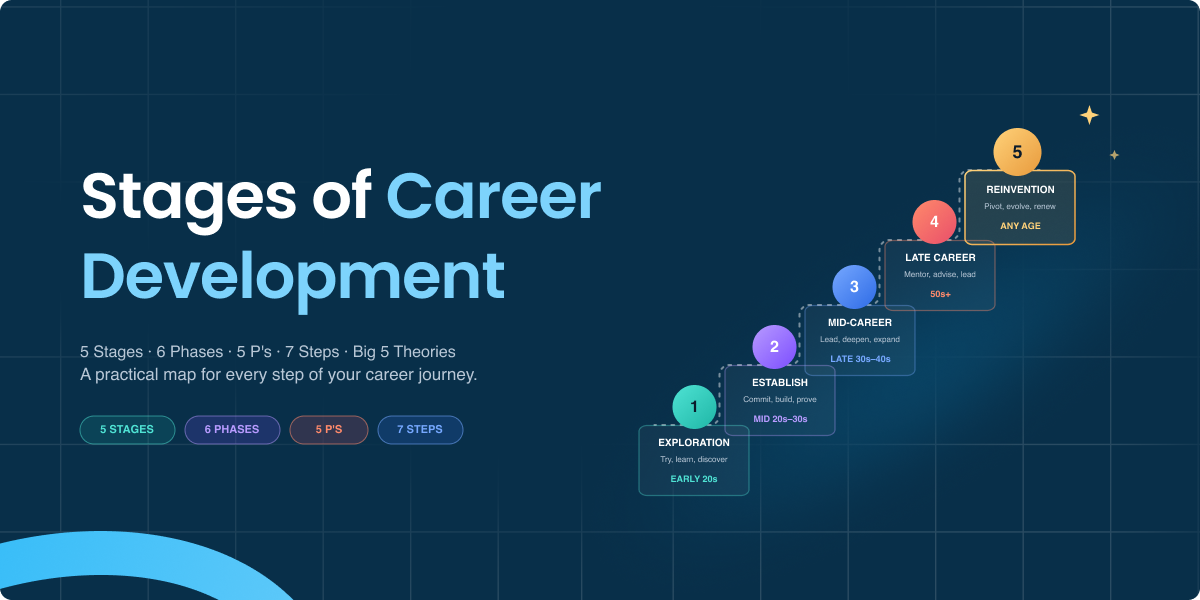
No matter what industry you’re in, most professionals move through five broad stages over the course of their careers. Understanding the stages and types of career growth helps you set realistic goals, make the right decisions, and avoid the frustration of chasing milestones that don’t fit where you are right now.
Exploration Stage Typical age range:
| Early 20s (or any career start) What’s happening: You’re trying things out, testing industries, roles, and working styles. You may not know exactly what you want yet, and that’s okay. This stage is about gathering experience and information. What to focus on: Say yes to varied experiences. Try different roles, industries, or freelance tasks on CloudColleague. Prioritise learning over earning in the short term. |
Establishment Stage Typical age range:
| Mid-20s to mid-30s What’s happening: Career Progression begins when you comit to one direction. You’ve found a direction and you’re committing to it. You’re building credibility, developing your professional identity, and proving your value in your chosen field. What to focus on: Be deliberate about skill development. Seek mentors. Take on stretch projects that build your reputation. Set your first medium-term career goals. |
Mid-Career Stage Typical age range:
| Late 30s to mid-40s What’s happening: You’re established and now focused on advancement, moving into leadership, taking on bigger responsibilities, or deepening your expertise. Some professionals also reassess their direction at this stage. What to focus on: Invest in leadership and management skills. Build your network intentionally. Consider whether you want to go deeper in your current path or broader across new areas. |
Late Career Stage Typical age range:
| 50s and beyond What’s happening: You’re at or near the peak of your professional influence. Your focus may shift toward legacy,mentoring others, contributing at a strategic level, or consolidating your achievements. What to focus on: Share your expertise. Take on advisory or mentoring roles. Consider how your skills and experience can create value in new ways,including consulting or freelance work. |
Transition / Reinvention Stage Typical age range:
| Any age What’s happening: Career transitions can happen at any stage. Whether you’re changing industries, returning after a break, going freelance, or pivoting to something entirely new,this stage requires courage and a clear plan. What to focus on: Be honest about transferable skills. Research your new target industry thoroughly. Use platforms like CloudColleague to build a portfolio in your new direction before fully committing. |
Read Next: How to Set Career Goals: Examples, Types & Free Template?
The 6 Stages of Career Development
While the 5 stages describe your overall career arc, the 6 phases or stages of career development describe the process you go through each time you’re making a career decision or transition. Think of this as a repeating cycle,not a one-time journey.
| Assessment What happens: You take stock of your current situation,your skills, interests, values, and where you are in your career. Action: Do a honest self-assessment. What do you do well? What energises you? What are you avoiding? |
| Research What happens: You gather information about career options, industries, roles, and opportunities that align with your assessment. Action: Explore job listings on CloudColleague. Talk to professionals in roles you’re interested in. Research salary benchmarks and growth trajectories. |
| Decision-Making What happens: You weigh your options and commit to a direction, a new role, a skill to develop, or a career path to pursue. Action: Use a simple pros/cons framework. Don’t wait for perfect certainty, make the best decision with the information you have, then stay open to adjusting. |
| Skill-Building What happens: You develop the knowledge, qualifications, and capabilities you need to succeed in your chosen direction. Action: Enrol in a course, earn a certification, or take on freelance tasks that build your skills in real-world conditions. |
| Job Search & Action What happens: You actively pursue opportunities, applying for roles, building your professional presence, and networking. Action: Update your CloudColleague profile, optimise your resume, and apply for roles that align with your goals. Consistency beats perfection here. |
| Refinement & Growth What happens: You’re in the role, now you refine your approach, build on your successes, and start the cycle again as you continue to grow. Action: Seek feedback regularly. Set new goals every 90 days. Stay curious and keep developing, growth never really stops. |
The 5 P’s of Career Development
The 5 P’s framework is a mindset model, it’s less about specific steps and more about the attitudes and habits that drive sustainable career growth. It works equally well whether you’re employed full-time, freelancing, or running your own business.
1) P- Purpose:
| Understanding why you work, what drives you beyond a pay cheque, is the foundation of meaningful career growth. Purpose gives you direction when decisions get hard and keeps you motivated through setbacks. In practice: Write down the three things that matter most to you in your work. Use these as a filter when evaluating new opportunities. |
2) P- Plan:
| A career without a plan is just a series of reactions to whatever happens next. A clear plan, even a rough one, gives you something to move toward and helps you say no to distractions. In practice: Set one short-term goal (3–6 months), one medium-term goal (1–2 years), and one long-term vision (5 years). Review quarterly. |
3) P- People:
| No career grows in isolation. The people around you, mentors, peers, managers, collaborators, and even clients on CloudColleague, shape your opportunities, your growth, and your reputation. In practice: Invest in one new professional relationship per month. Reconnect with a former colleague. Find a mentor in your target area. |
4) P- Practice:
| Skills and knowledge don’t develop through intention alone, they develop through consistent, deliberate practice. The professionals who grow the fastest are the ones who actively seek out opportunities to apply what they’re learning. In practice: Take on real projects, not just courses. Use CloudColleague to find tasks that stretch your capabilities in practical, measurable ways. |
5) P- Persistence:
| Career growth is rarely linear. There will be rejections, setbacks, slow periods, and moments of doubt. The professionals who ultimately succeed are not those who avoid failure, they’re the ones who keep going through it. In practice: Reframe setbacks as data, not verdicts. Every rejected application, missed promotion, or failed project teaches you something. Use it. |
What Are Career Progression Steps? A 7-Step Plan
If you’re looking for a step-by-step action plan for career progression steps, this framework gives you a clear sequence to follow, whether you’re starting fresh, changing direction, or levelling up within your current field.
- Self-Assessment: Start with an honest inventory of your skills, interests, strengths, values, and working style. This is the foundation, everything else builds on how well you know yourself.
- Set Clear Goals: Define what you want to achieve and by when. Use the SMART framework, Specific, Measurable, Achievable, Relevant, Time-bound. Vague goals produce vague results.
- Research Career Paths: Explore what’s possible. Look at job listings on CloudColleague to understand what roles exist, what they pay, and what skills they require. Talk to people already doing what you want to do.
- Build Required Skills: Identify the gap between where you are and where you want to go, then close it deliberately, through courses, certifications, or hands-on experience in real projects.
- Gain Relevant Experience: Experience is what transforms knowledge into credibility. Take on freelance tasks, volunteer projects, or stretch assignments that let you demonstrate your capabilities in real-world conditions.
- Build Your Network: Actively connect with professionals in your target field. Attend industry events, engage on LinkedIn, and build your presence on platforms like CloudColleague where employers and clients actively search for talent.
- Review and Adjust Regularly: Career paths rarely go exactly as planned, and that’s okay. Review your goals every 90 days. Celebrate progress, identify what’s not working, and adjust your plan accordingly.
The Big 5 Theories of Career Development
If you’ve ever searched for career development frameworks and ended up drowning in academic jargon, this section is for you. Here are the five most influential career development theories, explained in plain language, with a focus on what they actually mean for your career decisions.
1. Holland’s RIASEC Theory Plain English:
| Your personality type predicts what kinds of work environments and careers you’ll thrive in. Holland identified six types: Realistic, Investigative, Artistic, Social, Enterprising, and Conventional. Most people are a mix of two or three. Best for: People who want to align their career with their natural strengths and personality, especially useful in early career or when considering a career change. |
2. Super’s Life-Span, Life-Space Theory Plain English:
| Career development is a lifelong process that unfolds across different life roles, not just your job, but also your role as a parent, partner, citizen, and learner. Your career doesn’t exist in isolation from the rest of your life. Best for: Professionals trying to balance career goals with broader life goals,particularly useful during major life transitions like having children, relocating, or approaching retirement. |
3. Social Cognitive Career Theory (SCCT) Plain English:
| Your beliefs about your own abilities (self-efficacy) and your expectations about outcomes heavily influence the career paths you pursue. In other words, if you don’t believe you can do it, you probably won’t try. Best for: Professionals dealing with self-doubt or imposter syndrome, or anyone who wants to understand why they’ve been avoiding certain opportunities. |
4. Chaos Theory of Careers Plain English:
| Careers are complex, non-linear, and shaped by chance as much as planning. Rather than trying to predict the future, this theory encourages you to stay open, adaptable, and ready to act when unexpected opportunities arise. Best for: Professionals in rapidly changing industries or those who’ve experienced unexpected career detours, it reframes uncertainty as normal rather than problematic. |
5.Planned Happenstance Theory Plain English:
| Some of the best career opportunities come from chance events,but it’s not purely luck. Professionals who are curious, persistent, flexible, optimistic, and willing to take risks are far more likely to benefit from unexpected opportunities than those who aren’t. Best for: Anyone who wants to move beyond rigid planning and become more open to the unexpected, especially useful for freelancers and portfolio career professionals. |
Which Career Development Framework is Right for You?
With so many models to choose from, the most important thing is to pick one and actually use it. Here’s a quick decision guide to help you find your starting point:
| Your Situation | Best Framework | Start Here |
| I’m just starting my career or exploring options | 5 Stages of Career Growth | Start at Stage 1: Exploration |
| I’m making a career decision or planning a transition | 6 Phases of Career Development | Start at Phase 1: Assessment |
| I want a mindset and habits model I can apply daily | The 5 P’s Framework | Start with Purpose |
| I need a concrete, step-by-step action plan | 7 Steps in Career Path Development | Start with Step 1: Self-Assessment |
| I want to understand the psychology behind career choices | Big 5 Career Theories | Start with Holland’s RIASEC |
| My career has been unpredictable and I need a new perspective | Chaos Theory / Planned Happenstance | Embrace uncertainty,start networking |
The key insight: no single framework is perfect for every situation. The most effective professionals use different frameworks at different stages,drawing on the 5 stages for big-picture context, the 7 steps for planning, and the 5 P’s as a daily mindset. Start with the one that resonates most right now and build from there.
Your Career Has a Framework,Now Use It
Understanding career development frameworks is valuable. But the professionals who actually grow are the ones who take that understanding and turn it into action,setting goals, building skills, seeking opportunities, and staying consistent through the inevitable ups and downs.
You don’t need a perfect plan. You need a starting point, a clear next step, and the courage to take it.
CloudColleague is built to support every stage of your career journey. Explore jobs, freelance tasks, and professional services that align with where you are,and where you want to go. Your next career step is closer than you think.
| Start Your Career Journey on CloudColleague: Browse thousands of jobs and freelance tasks across Australia,tailored to every stage of your career development. No commission on tasks. No upfront fees. Just real opportunities to grow. |
Frequently Asked Questions Career Development Stages
The best way to identify your stage is to honestly assess your current situation. Are you still exploring what you want to do (Stage 1)? Or, are you committed to a path and building credibility (Stage 2)? Are you focused on advancing within an established career (Stage 3)? Or are you at a point of transition (Stage 5)? Your stage is determined by your experience and mindset,not just your age.
Absolutely, in fact, they’re more relevant than ever. In a rapidly changing job market shaped by AI, automation, and global remote work, having a structured way to think about your career growth is one of the most valuable tools you can have. The frameworks themselves evolve, but the underlying principles,self-awareness, goal-setting, skill development, networking, and adaptability,are timeless.
In theory, yes, particularly if you transition into a senior role quickly or move into a completely new field later in life. But skipping stages often means missing foundational experiences that become important later. Many professionals who ‘skip’ the exploration stage, for example, find themselves reassessing their direction in mid-career. It’s generally better to move through each stage intentionally, even if briefly.
CloudColleague supports every stage of career development. Whether you’re in the exploration stage (trying different types of work through tasks and freelance projects), the establishment stage (building a portfolio and client base), the advancement stage (taking on larger projects and leadership roles), or in transition (pivoting to a new industry), CloudColleague gives you access to real opportunities that support your growth, wherever you are in your journey.