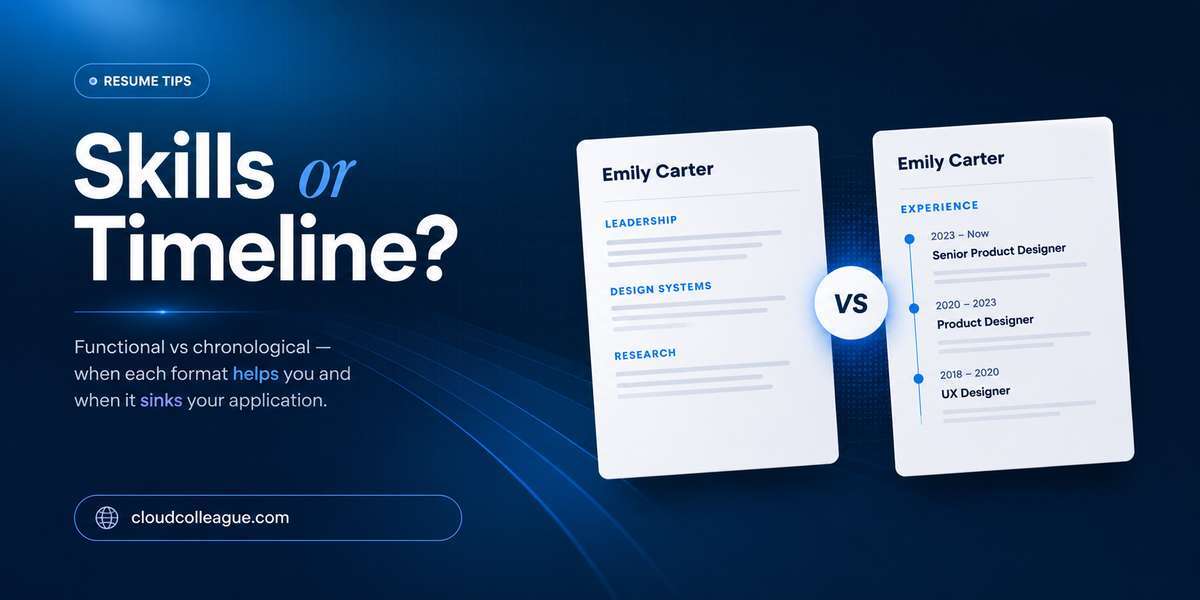
Most job seekers spend days perfecting the content of their resume – carefully crafting bullet points, quantifying achievements, tailoring their summary – and then put it all into the wrong format. It sounds like a small mistake. It isn’t. The format you choose determines whether an ATS system can parse your resume correctly, whether a recruiter can find what they need in six seconds, and whether your application makes it to the interview pile or the rejection folder.
In 2026, the rules around resume formats have sharpened considerably. AI-powered screening tools are more common than ever, recruiter preferences have hardened, and one format – the functional resume – has become quietly toxic in most hiring situations, despite still being widely recommended online.
This guide cuts through the noise. We’ll explain all three major resume formats, tell you exactly when each one works, and give you a simple decision framework so you know – for your specific situation – which format to use.
Format sorted – now find the right job. CloudColleague connects job seekers with 18,000+ verified Australian employers across tech, admin, health, trades, and more. AI-matched to your profile. →Browse open roles on CloudColleague
The honest answer upfront: which format wins in 2026?
Before we go into the detail, here is the verdict:
Chronological is the right choice for approximately 90% of job seekers. It is what recruiters expect, what ATS systems are built to read, and what signals a clean, confident career history.
Hybrid is the right choice for the remaining 10% – career changers, people returning from a break, and professionals whose most relevant experience is spread across different roles or industries.
Functional is almost never the right choice in 2026. It triggers ATS failures, raises red flags with recruiters, and rarely achieves what job seekers hope it will.
If you are in a hurry, that is the answer. If you want to understand why – and make sure you are picking the right one for your specific situation – read on.
What is a chronological resume?
A chronological resume – more precisely, a reverse-chronological resume – lists your work history starting with your most recent role and working backwards. Each role gets its own entry: job title, employer name, dates of employment, and a set of bullet points describing your responsibilities and achievements.
Your education, certifications, and skills typically appear below your work history, with a professional summary at the top.
This is the format most people picture when they think “resume.” It has been the standard for decades for a simple reason: it works. Recruiters can scan it in seconds, ATS systems parse it cleanly, and hiring managers can immediately verify your most recent experience and track your career progression.
When chronological works best?
- You have a steady work history in the same or a related field
- Your most recent role is directly relevant to the job you are applying for
- You are applying to large companies, government roles, or corporate environments
- Your career shows clear upward movement – growing responsibility, higher titles, broader scope
- You are targeting Australian industries such as healthcare, education, trades, finance, or public sector roles
When chronological works against you?
- You have an employment gap of six months or more
- You have changed jobs frequently and the pattern looks unstable on paper
- You are switching to a completely different industry
- Your most relevant experience is from older roles rather than recent ones
- You are a fresh graduate with limited paid work history
If any of these situations apply to you, a chronological format will not hide the issue – it will highlight it. But the answer is not to switch to a functional resume. The answer is a hybrid, which we will cover shortly.
What is a functional resume?
A functional resume – sometimes called a skills-based resume – flips the structure. Instead of leading with your work history, it leads with a grouped list of skills and abilities. Your employment history is either shortened significantly or pushed to the bottom of the page, sometimes with dates omitted entirely.
The logic sounds appealing: if your work history has gaps, is non-linear, or is in a different field, why not lead with your skills instead?
Here is why it backfires.
When functional can work?
There are a small number of situations where functional resumes are appropriate:
- Freelancers or contractors with no traditional employment history at all
- People entering paid work for the first time after years of volunteering
- Highly specialised portfolio-based roles where skills and credentials are the only thing that matters
This list is short deliberately. Functional resumes are a niche choice for niche situations – not a general solution to a difficult career history.
Why functional resumes fail ATS in 2026 – the risk most people miss?
This is the part that most online guides skip, and it is the most important thing to understand before you choose a format.
ATS platforms – including Workday, Taleo, Greenhouse, iCIMS, and Lever – are built around one assumption: your resume is chronological. They are designed to extract specific data points in a specific order: job title, employer name, employment dates, then bullet points describing the role. That extracted data is what gets scored against the job description.
A functional resume breaks this logic entirely. When an ATS encounters a skills section at the top with no associated dates or employers, it either misfiles the data or cannot parse it at all. Your years of experience get misread. Your job titles may not be extracted. In the worst cases, the resume scores as if it were submitted blank.
Beyond the ATS problem, there is the recruiter problem. Recruiters in Australia and globally receive dozens to hundreds of applications per role. They have learned to read resumes fast – and they know exactly what a functional format signals. Research consistently shows that approximately 90% of recruiters prefer reverse-chronological resumes. Many actively distrust functional formats because they associate them with candidates who are trying to hide something: a gap, a short tenure, a job that ended badly.
Even the US Department of Labor explicitly advises against using functional resumes for most job seekers. When a government employment agency tells you not to use a format, that is worth taking seriously.
The bottom line: unless you have a very specific reason that makes a functional resume unavoidable, do not use it.
The third option nobody talks about: the hybrid resume
Here is what most comparison articles miss entirely.
The real answer for career changers, people with employment gaps, and professionals with non-linear histories is not a functional resume – it is a hybrid resume, also called a combination resume.
A hybrid resume combines the best of both formats. It leads with a skills summary and key achievements section – giving you the chance to highlight transferable skills and reframe your experience upfront. But it still includes a full reverse-chronological work history below, with dates intact.
This makes it ATS-safe – because the employment history section gives the software exactly what it needs to parse correctly. And it makes it recruiter-friendly – because the skills summary at the top immediately signals your value, before they even reach your work history.
How to structure a hybrid resume
- Contact information
- Professional summary (3–4 lines positioning your value)
- Core skills or key achievements section (6–10 bullet points)
- Work history in reverse chronological order – with full dates
- Education and certifications
The critical detail is point four. The work history section with dates is what separates a hybrid resume from a functional one and keeps it ATS-compatible. If you remove the dates or collapse the work history to a single line at the bottom, you have created a functional resume – with all the problems that entails.
When hybrid beats both other formats?
- Career changers – lead with the transferable skills you want the recruiter to notice, then prove them with your work history
- Employment gaps – the skills summary reframes the narrative before the recruiter reaches the gap
- Returning after maternity leave or a carer’s break – lead with what you bring, not the gap
- New graduates with strong internship or project experience but limited paid roles
- Professionals with diverse experience across multiple industries or functions
Resume format decided? Here’s the next step. Create a free profile on CloudColleague and get AI-matched to Australian jobs that fit your actual experience – not just your keywords. →Start as a job seeker
Chronological vs functional vs hybrid: head-to-head
| Chronological | Functional | Hybrid | |
| ATS compatibility | Excellent | Poor | Good |
| Recruiter preference | Strongly preferred (90%) | Often distrusted | Accepted |
| Best career stage | Any with steady history | Very limited use cases | Career changers, returners |
| Employment gap handling | Exposes gaps | Hides dates (raises flags) | Reframes via skills section |
| Australian industry fit | All sectors | Rarely appropriate | Tech, creative, diverse backgrounds |
| Setup difficulty | Low | Medium | Medium |
Which resume format should YOU use? A simple decision framework.
Answer these questions in order:
- Do you have a reasonably steady work history in the same or a related field?
Yes → Use chronological. It is the safest, most widely accepted choice and requires no explanation to a recruiter. - Are you changing careers or does your most relevant experience come from older roles?
Yes → Use hybrid. Lead with the transferable skills, back them up with your full work history. - Do you have an employment gap of six months or more?
Yes → Use hybrid. Address the gap briefly in your professional summary. Do not use functional – it makes the gap look worse, not better. - Are you a fresh graduate with limited paid experience?
Yes → Use hybrid if you have strong internship or project work to lead with. Use chronological if your part-time or casual work is relevant to your target role. - Are you a freelancer or contractor with no traditional employment at all?
This is one of the few situations where functional may be appropriate – but only if you can still include a clear timeline of your project work.
Learn about which tool is better for ATS friendly resume: Jobscan vs ResumeWorded.
Best resume format for Australian job seekers specifically
Australia’s hiring landscape has some industry-specific expectations worth knowing:
In government and public sector roles, chronological is not just preferred – it is often required. Selection criteria documents expect a clear record of experience mapped to specific competencies.
In trades, construction, healthcare, and education, employers are looking for role history and qualifications front and centre. Chronological is the clear choice.
In corporate finance, law, and consulting, the chronological format signals professionalism and career trajectory. Any deviation will be noticed and questioned.
In tech startups and creative agencies, there is slightly more flexibility. A hybrid resume with a strong skills section is broadly accepted, particularly for portfolio-based or cross-functional roles.
CloudColleague’s platform spans all of these sectors – from full-time permanent roles in enterprise organisations to short-term tasks and contract work in fast-moving startups. The format that performs best across the board, for most people applying through the platform, is chronological or hybrid.
Best format if you have an employment gap
Use a hybrid resume. Write a brief, honest explanation of the gap in your professional summary – something like “Following a period of family caregiving, I am returning to the workforce with updated skills in [X].” Then move into your core skills section before the recruiter reaches the gap in your work history.
What you should not do is use a functional resume and omit the dates. Recruiters have seen this pattern thousands of times. It does not hide the gap – it highlights that you are trying to hide something, which is worse.
Best format for a career change
Hybrid, consistently. Lead with the transferable skills that connect your past to the role you are targeting. Frame your work history to emphasise the elements that are relevant – even if your job titles do not immediately signal the right fit. The goal is not to obscure your background but to reframe it strategically before the recruiter forms a first impression. Get to know
Best format for fresh graduates
If you have strong internship experience, project work, or relevant extracurriculars, a hybrid resume lets you lead with those before your limited work history becomes the focus. If your part-time or casual work is genuinely relevant to the role, a clean chronological resume works just as well.
What fresh graduates should never do is use a functional resume to pad out a skills section with vague competencies (“strong communicator,” “team player,” “detail-oriented”) in place of real evidence. Recruiters see through this immediately.
Read Next: How to Write a Resume that gets an Interview to get more industry insights.
What Australian recruiters actually want to see?
Recruiter preferences in Australia align closely with global trends. In every major survey of hiring professionals, the chronological format comes out on top – typically by a margin of 85–90% over other formats.
The reason is practical, not arbitrary. A recruiter reviewing 80 applications for a single role needs to verify relevant experience fast. The chronological format puts the right information in the right place: most recent role first, dates clearly marked, achievements in context. A recruiter can confirm fit – or rule it out – in under ten seconds.
The functional format disrupts this flow. It forces the recruiter to hunt for information they expect to find immediately. Even when the underlying experience is strong, a format that slows down a recruiter’s scan is working against you.
The hybrid format is accepted when it is executed well – specifically, when the skills section at the top is substantive and relevant, and the work history below is complete with dates. A hybrid resume that leads with generic skills and then hides the work history reads the same as a functional resume to an experienced recruiter.
The safest rule: give recruiters exactly what they expect to find, in exactly the place they expect to find it. Lead with your strongest, most relevant content – whether that is your most recent role or a skills summary – and make sure the full chronological record is there to back it up.
Your resume is ready. Here’s where to use it. Create a free verified profile on CloudColleague and get matched to Australian employers who are actively hiring in your field – right now. →Create your free profile
Hiring for your team? Post a role or task in under five minutes. Smart matching surfaces pre-vetted candidates across every Australian industry. → Start hiring on CloudColleague
Frequently asked questions
Yes, in most cases. ATS platforms extract job titles, employer names, and employment dates chronologically. However, functional resumes prioritise skills instead of work history. Consequently, many ATS platforms misread or misclassify the document. Larger companies create greater ATS risk for functional resumes.
Chronological resumes remain the safest option for Australian job seekers. Recruiters across healthcare, government, trades, and corporate sectors prefer this structure. Furthermore, ATS platforms process chronological resumes more accurately. Career changers and returning professionals should consider hybrid resumes instead.
No, and recruiters recognise this tactic immediately. Functional resumes rarely hide employment gaps successfully. Instead, recruiters often assume candidates conceal important information. Consequently, the format creates additional concern during screening. A hybrid resume performs far better for employment gaps.
A hybrid resume combines skills and chronological experience effectively. The document starts with skills, achievements, and strengths. Then, it includes full reverse-chronological work history with employment dates. As a result, recruiters scan experience quickly while ATS platforms process the resume correctly.
Yes, recruiters strongly prefer chronological resumes. Research consistently shows most recruiters favour reverse-chronological formatting. This structure highlights recent experience and career progression clearly. Furthermore, chronological resumes improve ATS compatibility significantly. Nevertheless, hybrid resumes usually perform better than functional formats.