Understanding your work rights as an international student in Australia is essential. It helps you earn income safely while studying and protects your visa status. The good news is that Australia provides genuine and protected work rights for student visa holders. A part-time job can help cover living costs and build valuable experience. Work rules have changed in recent years. This guide explains what you need to know. It covers how many hours you can work, the conditions attached to your visa, common student jobs, tax and superannuation basics, and the consequences of breaching the rules.
| Please note: the student work-hour cap was changed in mid-2023 and a further change has been proposed for 2026. This guide is general information, last reviewed for early 2026. Always confirm the current limit and your specific visa conditions through your VEVO record and the Department of Home Affairs (homeaffairs.gov.au) before relying on it. |
| Looking for student-friendly work? Browse Tasks to find flexible opportunities or explore our Guides on Tasks to learn how task-based work fits around your studies. |
Can International Students Work in Australia?
Yes, but only if you hold a Student visa (Subclass 500). Once your course has officially started, you are legally allowed to work in Australia. You also receive the same workplace protections as any Australian worker. This includes the right to earn at least the minimum wage and work in safe conditions. You can also raise concerns with the Fair Work Ombudsman without affecting your visa status.
Working while you study is a popular and practical choice. It helps with rent and living costs, builds local experience and a professional network, and deepens your connection to Australian life. The key is to stay within your visa conditions, because your studies must remain your main purpose for being in Australia.
Read Next: Australian Work Visa: Step-by-Step Application Guide
How Many Hours Can You Work in Australia?
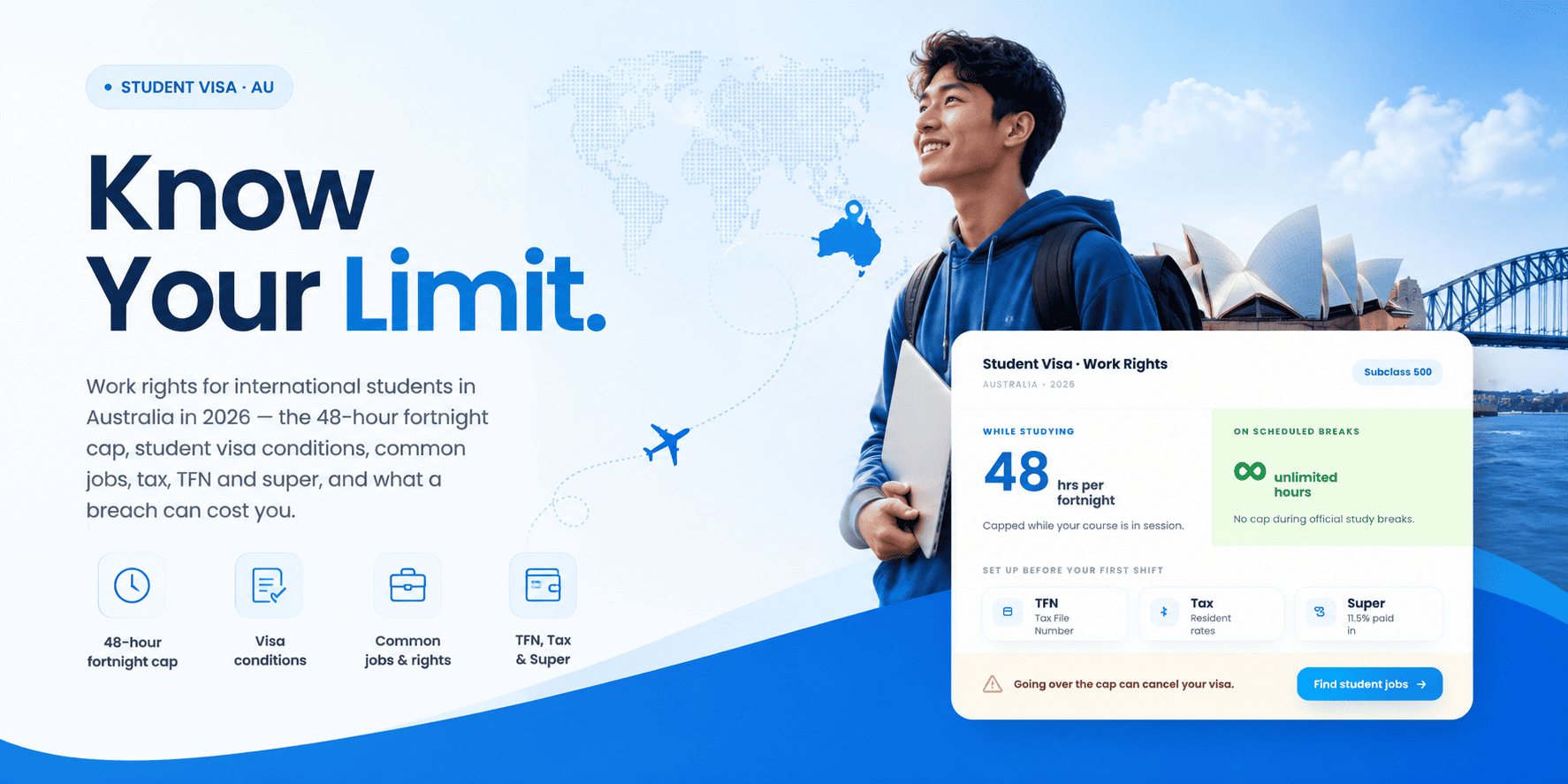
This is the most important rule to get right. While your course is in session, you can work up to 48 hours per fortnight. During scheduled course breaks, such as semester holidays, you can work unlimited hours. The table below summarises how the limit applies in different situations.
| Situation | Work Hours Allowed |
| While course is in session | Up to 48 hours per fortnight (all jobs combined) |
| During scheduled course breaks | Unlimited hours |
| Master by Research or PhD students | No work-hour limit once the course begins |
| Before your course starts | No work permitted yet |
| Mandatory placements (on CRICOS) | May be exempt from the cap |
Two details catch students out. First, a fortnight is a fixed rolling 14-day period that starts on a Monday. You cannot average your hours over a month or change the start date to suit a busy roster.
Second, the 48-hour limit applies to all your jobs combined. This includes gig work, such as delivery jobs completed through an ABN.
The 48-hour cap replaced the previous 40-hour limit in July 2023. Students enrolled in a Master by Research or PhD program are exempt from work-hour limits once their course begins.
| Proposal alert: an increase of the cap to 60 hours per fortnight has been proposed to take effect from 1 July 2026, but it is not law and no legislative instrument has been issued. Do not work beyond 48 hours based on this proposal, as breaching the current limit risks visa cancellation regardless of any pending change. |
Conditions on Your Student Visa
Your right to work is governed by Condition 8105 and a handful of related rules that keep study as your priority. You cannot begin working until your course has formally started, even if you arrive early. You must maintain your enrolment and meet academic progress requirements, and you must keep adequate health insurance for the duration of your stay.
There are also limits on the kind of work you can do. Student visa holders cannot work in the sex or adult-services industry, and you should avoid sham contracting or cash-in-hand jobs that evade tax, since these create both legal and visa risk. Mandatory work placements that form a registered part of your course (listed on CRICOS) may be exempt from the 48-hour cap, but voluntary or external work still counts.
Types of Jobs Students Commonly Do in Australian cities
International students work across many industries, usually in casual or part-time roles that flex around class schedules. Hospitality and retail are the most common, including cafe and restaurant work, baristas, kitchen hands, and shop assistants, because they offer evening and weekend shifts and frequent hiring.
Beyond these roles, many students work in food and parcel delivery, tutoring, and academic support. Others find work in administration, reception, customer service, aged care, disability support, or on-campus positions at their university. Some roles, such as aged care and disability support, may require a relevant certificate.
Casual jobs usually include a 25% loading instead of paid leave entitlements. Weekend and public holiday shifts often attract higher penalty rates. As a result, when you work can have a significant impact on how much you earn.
Read Next: What Are Internship Jobs? A Beginner’s Guide.
Tax, TFN, and Superannuation Basics
Once you start working, a few financial basics keep you compliant and ensure you are paid correctly. First, apply for a Tax File Number (TFN) through the ATO as soon as you can, because without one your employer must tax you at the highest rate. With a TFN, you pay the correct, usually low, rate of tax.
Most students benefit from the $18,200 tax-free threshold. This means you may owe little or no income tax on a typical part-time wage. If you earn more than $450 in a month, your employer must also pay superannuation. The current rate is 12% of your ordinary earnings. This payment goes into a retirement fund and is separate from your wage. When you leave Australia permanently, you can claim your super through the Departing Australia Superannuation Payment scheme. However, tax is withheld from the refund. Keep your payslips and lodge a tax return each year. Many international students are entitled to a tax refund.
| Money tip: get your TFN before your first shift, keep every payslip, and lodge a tax return each year. Many international students are owed a refund and can also reclaim their super when they leave. |
What Happens If You Breach Work Conditions?
Breaching your work conditions is one of the most serious mistakes an international student can make. It is important to understand the consequences. If you work more hours than permitted while your course is in session, you will breach Condition 8105. In serious cases, the Department of Home Affairs may cancel your student visa.
The consequences extend well beyond the present. A breach can lead to visa cancellation, refusal of future visa applications, and a negative immigration history that follows you, which can derail a post-study work visa or a later PR application. Employers who breach the rules face penalties too. The safest approach is simple: track every hour you work across all jobs using a calendar or app, never assume a proposed rule change is in force, and when in doubt, work fewer hours. Because budgeting matters when your hours are capped, our cost of living guide can help you plan.
| Find work that fits your studies and your visa. Search part-time roles on CloudColleague or create your free profile to connect with student-friendly employers. |
Frequently Asked Questions
Yes. Student visa (Subclass 500) holders can work in Australia, with full workplace protections, once their course has started. The main condition is a limit on hours while your course is in session, with unlimited hours during scheduled breaks.
You can work up to 48 hours per fortnight while your course is in session, and unlimited hours during official course breaks. A fortnight is any rolling 14-day period starting on a Monday, and the cap covers all your jobs combined.
Yes. You need a Tax File Number to work, and you pay tax on your earnings, though the $18,200 tax-free threshold means many students owe little or none. You also receive 12 percent superannuation if you earn over $450 in a month, which you can claim when you leave Australia permanently.
Breaching your work condition is serious and can lead to your student visa being cancelled, which also harms future visa applications, including post-study and PR pathways. Always track your hours across every job.
Yes. All paid work counts toward the 48-hour cap while your course is in session, including gig work such as food delivery done through an ABN. You must add it to your hours from any other jobs.