Understanding the steps for an Australian work visa is the foundation of any successful move to Australia for work. The system can look complex at first, with several visa types and a multi-stage process, but it follows a logical order once you break it down. This guide explains the main work visas, how to choose the right one, the full step-by-step application process, the documents, costs, and processing times, and the common mistakes that derail applications.
| Please note: Australian visa rules, fees, and occupation lists change regularly. This guide is general information, last reviewed for early 2026, not migration advice. Always verify current requirements on the Department of Home Affairs website (homeaffairs.gov.au) or with a registered migration agent before you apply. |
| Lining up work alongside your visa? Browse roles on CloudColleague or create your free profile to connect with Australian employers. |
Types of Australian Work Visas in Details
Australia offers several work visas, grouped into three broad categories: points-tested skilled visas, employer-sponsored visas, and temporary work-and-travel visas. Each suits a different situation, and knowing the differences is the first step to choosing well. The table below summarises the main options.
| Visa | Type | Key Requirement | Leads To |
| Skills in Demand (482) | Employer-sponsored, temporary | Job offer + sponsor | PR via 186 |
| Skilled Independent (189) | Points-tested PR | High points, listed occupation | Permanent |
| Skilled Nominated (190) | State-nominated PR | State nomination (+5 points) | Permanent |
| Skilled Regional (491) | Regional provisional | Regional nomination (+15) | PR via 191 |
| Working Holiday (417/462) | Temporary work + travel | Age and country eligibility | Temporary |
The Skills in Demand visa (Subclass 482) is the main employer-sponsored route and requires a job offer from an approved sponsor. The General Skilled Migration visas, Subclass 189, 190, and 491, are points-tested and suit applicants without a sponsor, with the 189 being fully independent, the 190 requiring state nomination, and the 491 being a regional provisional visa. Working holiday visas (Subclass 417 and 462) offer temporary work and travel for eligible nationalities and ages.
How to Choose the Right Visa for Australia in 2026?
In 2026, the right visa depends on three things: whether you have a job offer, whether your occupation is on the relevant list, and your points score. If an Australian employer is willing to sponsor you, the Skills in Demand visa is often the fastest route. If you do not have a sponsor but have strong skills and a listed occupation, a points-tested skilled visa is your path.
Your points score then shapes which skilled visa is realistic. The 189 is the most competitive and the most flexible, the 190 adds five points through state nomination but ties you to that state, and the 491 adds fifteen points but requires regional living. Before deciding, estimate your score with the Australia PR points calculator, since it determines which pathways are actually open to you.
| Quick guide: have a sponsor, choose 482; no sponsor but high points, aim for 189; need extra points, consider 190 (state) or 491 (regional). Recent graduates should also look at the post-study route. |
Step-by-Step Application Process
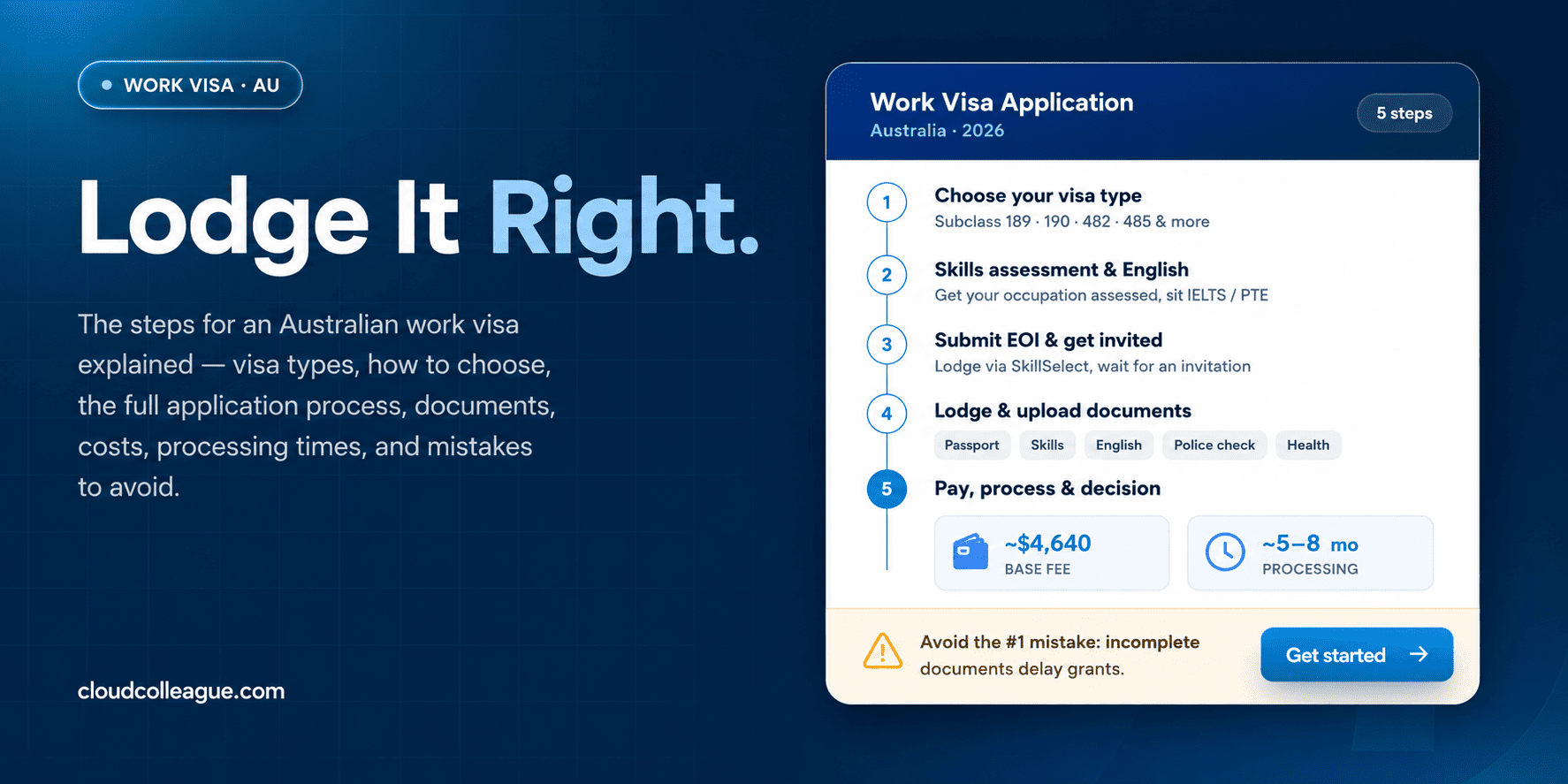
For the points-tested skilled visas, the process follows a clear sequence. Working through it in order is essential, because each step depends on the one before.
- Check your occupation. Confirm your job matches an ANZSCO code on the relevant occupation list, as this determines your eligibility for every later step.
- Complete a skills assessment. Apply to the assessing authority for your occupation, such as ACS for IT, Engineers Australia for engineers, or VETASSESS for many professions.
- Sit an English test. Take an accepted test like IELTS or PTE and aim high, since English ability carries significant points.
- Submit an Expression of Interest (EOI). Lodge your EOI through SkillSelect with your points claim. It stays valid for two years and is not yet a visa application.
- Receive an invitation to apply. If your score is competitive, you receive an invitation in one of the regular rounds. You then have 60 days to lodge.
- Lodge your visa application. Apply within the deadline, upload all documents, pay the fee, and complete health and police checks.
- Await the decision. A case officer may request more information; respond promptly. On approval, you receive your visa grant and any initial entry date.
Employer-sponsored visas follow a slightly different path: you secure a job offer, your employer lodges a nomination (and must now show they genuinely tried to recruit locally), and you then apply for the visa. If you are still job-hunting from abroad, our guide on how to get a job in Australia from overseas covers that side in detail.
Read Next: Australia’s Skill Shortage List: In-Demand Occupations (2026)
Documents You’ll Need for Visa
Strong documentation is the single biggest factor in a smooth application, since Home Affairs data links a large share of delays to document quality. Prepare these early so you can lodge quickly once invited.
- Identity documents: a valid passport and birth certificate, plus any name-change records.
- Skills assessment: the positive assessment outcome from your occupation’s authority.
- English test results: a current, accepted test score meeting the required level.
- Qualifications and references: degrees, transcripts, and detailed, dated employment references showing your duties.
- Health and character: a medical examination and police clearances from every country you have lived in.
- State nomination or sponsorship: nomination approval (190/491) or your employer’s nomination (482), where relevant.
Costs and Processing Times
Australian work visas are not cheap, and timelines vary widely, so plan your budget and schedule realistically. The table below gives indicative figures for the main visas and the skills assessment that precedes them.
| Item | Indicative Cost (main applicant) | Indicative Processing |
| Skills assessment | $500 to $1,500 | 6 to 12 weeks |
| Subclass 189 | About $4,770 | Around 7 months |
| Subclass 190 | About $4,770 | Around 6 to 8 months |
| Subclass 491 | About $4,770 | Around 12 to 14 months |
| Subclass 482 | About $3,670 | Often 2 months (priority) |
On top of the headline visa charge, budget for skills assessment, English testing, health checks, police clearances, and fees for any family members included in your application. Processing times also depend on your occupation’s priority, the completeness of your documents, and overall application volumes, so treat these figures as guides rather than guarantees.
Common Mistakes to Avoid
Most failed or delayed applications come down to a handful of avoidable errors. Steering clear of them gives you the best chance of a smooth grant. The most common is an inaccurate points claim, where applicants overstate their score and have it reduced at assessment, costing them the invitation.
Other frequent pitfalls include weak or undated employer references, which are the leading cause of skills-assessment rejection, and missing the 60-day window to lodge after an invitation. Applicants also stumble by submitting an EOI before their English result is ready, ignoring requests for information from a case officer, or assuming an EOI submission guarantees an invitation, which it does not. Finally, many forget that visa rules change, and rely on outdated information
| Avoid this trap: an EOI is not a visa application, and meeting the 65-point minimum does not guarantee an invitation. Build the strongest, most accurate points claim you can, and verify every requirement against the official source before lodging. |
| Lining up work alongside your visa? Start as a Seeker to begin your job search, or browse our Guides on Tasks to learn how task-based work works. |
Frequently Asked Questions
The usual steps are: confirm your occupation is on the relevant list, complete a skills assessment, sit an English test, submit an Expression of Interest (EOI) in SkillSelect, receive an invitation to apply, lodge your visa application with documents, and await a decision. Employer-sponsored visas instead start with a job offer and sponsor nomination.
It varies by visa. The employer-sponsored Subclass 482 Core Skills stream is often processed in about two months for priority roles, the Subclass 189 takes around seven months, the 190 around six to eight months, and the regional 491 around twelve to fourteen months. A skills assessment adds six to twelve weeks beforehand.
Government fees are significant. The Subclass 189 and 190 cost about $4,770 for the main applicant, and the Subclass 482 about $3,670, with extra fees for family members. A skills assessment adds roughly $500 to $1,500, plus English testing and medical and police checks.
Not for the points-tested skilled visas (189, 190, 491), which are based on your skills and score. You do need a job offer and an approved sponsor for the employer-sponsored Skills in Demand (482) visa.
You need at least 65 points to be eligible, but that is rarely enough to be invited. Competitive applicants often need 80 to 95 points, especially in popular fields like IT, so maximising your score matters.