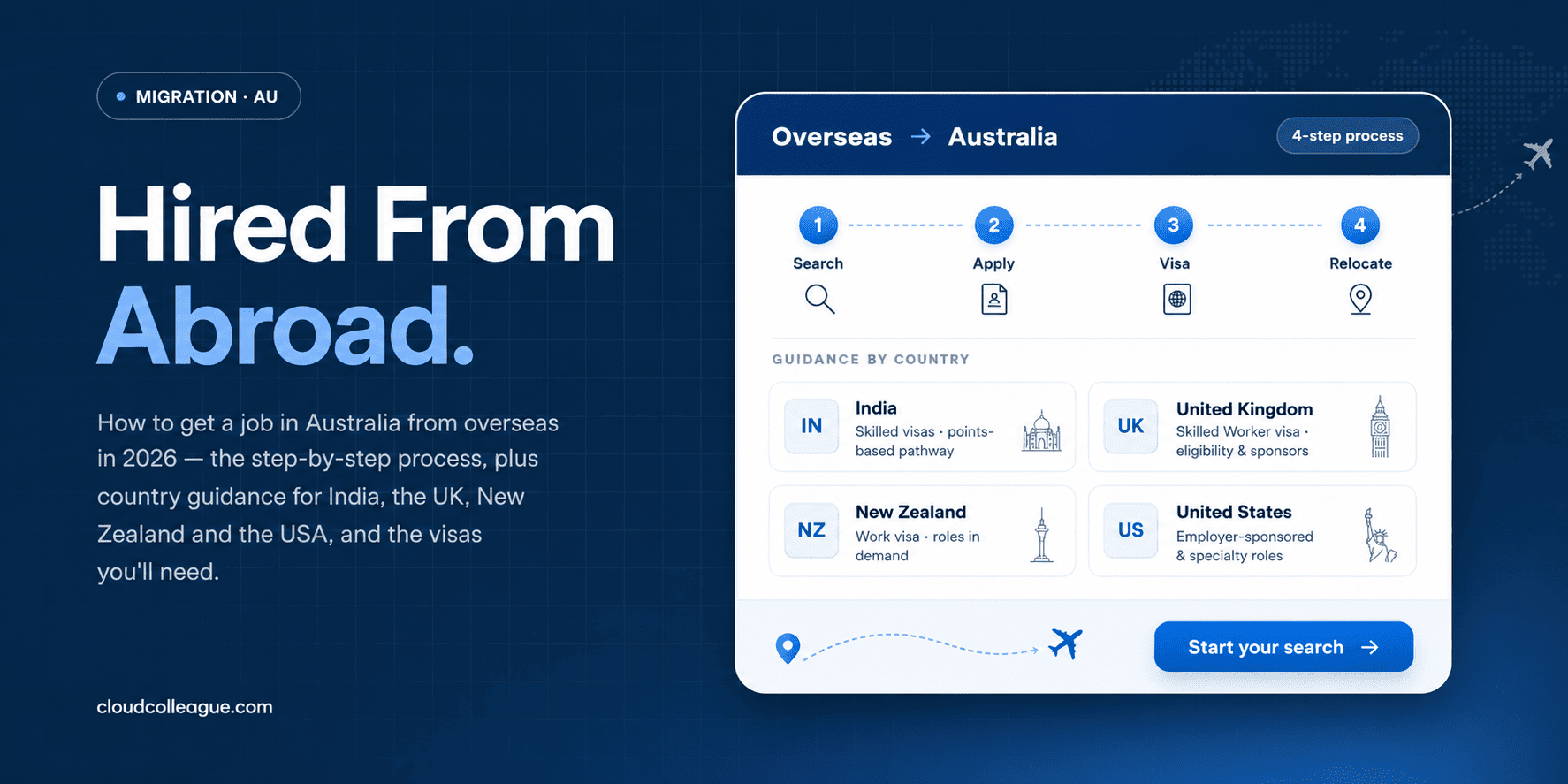
Learning how to get a job in Australia from overseas is the first step toward one of the world’s most rewarding moves for your career and lifestyle. The good news is that it is very achievable, especially if your skills are in demand. Australia faces shortages across healthcare, engineering, IT, trades, and more, and employers actively recruit international talent. This guide explains the general process, then breaks down country-specific guidance for applicants from India, the UK, New Zealand, and the USA, plus the visas you are likely to need.
| Starting your search from abroad? Explore First Time in Australia or Start as a Seeker to prepare for opportunities in Australia. |
Can You Get a Job in Australia from Overseas?
Yes, and many people do it every year. Employers regularly hire skilled workers who are still offshore, particularly in occupations on the national shortage lists, and modern video interviews make remote hiring routine. The key is to follow the right order. In most cases, your visa and job are linked. Getting the sequence wrong can waste time.
The single most important factor is whether your occupation is in demand. If it appears on the Core Skills Occupation List or a state’s skilled list, your path is far smoother, since these roles unlock both sponsorship and points-tested visas. Before anything else, check the current skill shortage list for Australia to confirm where you stand.
Read Next: Post-Study Work Visa Australia: Eligibility & Application.
General Steps to Get Hired from Overseas
Whatever your country, the process follows a similar arc. Working through it methodically gives you the best chance of arriving with a job or a clear path to one.
- Confirm your occupation is listed. Match your job to an ANZSCO code and check it appears on the relevant occupation list, since everything else depends on this.
- Complete a skills assessment. Have your qualifications and experience assessed by the authority for your occupation, such as ACS for IT, Engineers Australia for engineers, or ANMAC for nurses.
- Prove your English. Sit an accepted test such as IELTS or PTE and aim high, because English scores carry significant points and many roles require them.
- Choose and apply for the right visa. Decide between employer-sponsored and points-tested routes, then lodge an expression of interest or visa application as appropriate.
- Job-hunt remotely. Tailor your resume to Australian conventions, apply online, and use video interviews. Be upfront about your visa status and timing.
- Plan your move. Once you have a visa or offer, organise relocation, finances, and your first few weeks on the ground.
| Order matters: occupation check, then skills assessment, then English, then visa, then job search. Skipping the early steps is the most common reason overseas applications stall. |
Country-Specific Guidance
The general process is the same, but the practical route differs a lot depending on where you are applying from. Here is what matters most for the four most common origins.
From India
India is one of the largest sources of skilled migrants to Australia. The migration pathways are well established. Indian professionals in IT, engineering, healthcare, and accounting remain in strong demand. Most use either the Skills in Demand visa with employer sponsorship or a points-tested skilled visa.Skills assessments are conducted by bodies such as ACS, Engineers Australia, and VETASSESS. Competitive applicants often achieve between 85 and 95 points. For a full breakdown of roles, pay, and migration pathways, see our guides to the best high-paying jobs for Indian migrants and the Australia PR points calculator.
India is also part of the Work and Holiday (Subclass 462) program through a capped ballot. This creates an additional temporary pathway for younger applicants.
From the UK
British applicants have several strong options. Skilled professionals can access the same employer-sponsored and points-tested visas as other migrants. UK qualifications are widely recognised, which helps simplify skills assessments. The standout extra option is the Working Holiday visa (Subclass 417), open to UK passport holders aged 18 to 35, which lets you live, work, and travel for up to a year, extendable through specified regional work. Many Britons use the working holiday route to test life in Australia before pursuing a longer-term skilled or sponsored visa.
Common UK-to-Australia fields include healthcare, education, construction, and finance, all areas with ongoing demand. If you are early in your career or simply want flexibility, the working holiday visa is often the easiest first step, while experienced professionals may go straight for sponsorship.
From New Zealand
New Zealand is the exception that changes everything, so it deserves special attention. Thanks to the close relationship between the two countries, New Zealand citizens do not need to apply for a visa in advance at all. When you arrive in Australia with a valid New Zealand passport, Australia automatically grants you a Special Category Visa (Subclass 444). There is no application form, sponsorship requirement, or points test.
| Key difference for New Zealanders: the SCV 444 lets you live and work in Australia indefinitely with full work rights, and since 1 July 2023, eligible SCV holders can apply directly for Australian citizenship after four years of residence, without first obtaining a permanent visa. No other nationality has this freedom of movement. |
In practice, this means a New Zealander can accept an Australian job offer and simply fly over to start, treating the job search much like applying within Australia. There is no visa hurdle to clear first, which makes New Zealand citizens uniquely attractive to employers who want someone able to start quickly.
From the USA (as an American)
Americans cannot rely on a single dedicated work visa the way some imagine, since the well-known E-3 visa runs the other way and is for Australians working in the United States, not Americans coming to Australia. Instead, US citizens use the same general routes as most applicants: employer sponsorship through the Skills in Demand visa, or the points-tested skilled visas if their occupation qualifies.
There is also a temporary option. US passport holders are eligible for the Work and Holiday visa (Subclass 462), which allows work and travel for up to a year and can be extended through specified regional work. This is a popular way for younger Americans to experience Australia and gain local work history, which can later support a skilled or sponsored application. As with every country, the smoothest path depends on whether your occupation is in demand.
Visas You’ll Likely Need
Most overseas job seekers end up on one of a handful of visas. The table below summarises the main options so you can see which fits your situation.
| Visa | Purpose | Best If You |
| Skills in Demand (482) | Employer-sponsored work | Have or can get a job offer |
| Skilled Independent (189) | Points-tested PR, no sponsor | High points, occupation on list |
| Skilled Nominated (190) | State-nominated PR | State needs your occupation |
| Skilled Regional (491) | Regional, points bonus | Open to regional areas |
| Working Holiday (417/462) | Temporary work + travel | Eligible age and country |
The Skills in Demand visa (Subclass 482) is now the primary employer-sponsored route, having replaced the older temporary skill shortage visa. The points-tested General Skilled Migration visas (189, 190, and 491) suit those without a sponsor, and working holiday visas offer a temporary entry for eligible nationalities and ages. Each has its own eligibility, costs, and timelines, so for a full breakdown read our dedicated Australian work visa guide, and estimate your score with the Australia PR points calculator.
| Wherever you are applying from, start your search here. Browse Australian roles on CloudColleague or create your free profile to connect with employers open to overseas candidates. |
Frequently Asked Questions
Yes. Many people secure roles before arriving, especially in shortage occupations like healthcare, engineering, IT, and trades. The usual route is to confirm your occupation is on the relevant list, complete a skills assessment, apply for the right visa, and job-hunt remotely using video interviews.
If you have an in-demand skill and an employer willing to sponsor you, the Skills in Demand visa (Subclass 482) is often the most direct route. Without a sponsor, the points-tested skilled visas (189, 190, 491) are the main alternative. New Zealand citizens can simply move and work without a visa.
Not always. Employer-sponsored visas require a job offer, but the points-tested General Skilled Migration visas (189, 190, 491) do not, though a job offer or state nomination can boost your points and chances.
It varies widely. Skills assessment can take weeks to months, visa processing adds more time, and the job search itself depends on your field. Many skilled applicants plan for a process of six to twelve months from start to arrival.
Effectively yes. New Zealand citizens are granted a Special Category Visa (Subclass 444) automatically on arrival, with no application or sponsorship, allowing them to live and work in Australia indefinitely.