Knowing the top industries for migrants in Australia is the smartest way to plan a successful move, because the sectors with the deepest skills shortages are the ones that hire overseas workers fastest and sponsor visas most readily. Australia faces a shortage of more than 350,000 skilled workers, and certain industries simply cannot fill roles with local talent alone. This guide covers why these industries recruit migrants, which sectors lead, the roles and entry requirements in each, and which offer the clearest pathways to permanent residency.
| Ready to find work in a high-demand industry? Explore First Time in Australia or Start as a Seeker to discover opportunities across Australia. |
Why Do These Industries Hire Migrants?
The reason is simple economics: demand for workers outstrips local supply. An ageing population, rapid digital transformation, major infrastructure programs, and a resources boom have created shortages that Australia cannot meet domestically. When employers cannot fill roles locally, they turn to skilled migration, and the government supports this through occupation lists that prioritise these exact fields.
This is why your industry matters as much as your individual skills. Roles on the national shortage lists unlock both employer sponsorship and points-tested visas, and they tend to hire faster and pay better. Before targeting a sector, check the current skill shortage list for Australia to confirm your occupation is in demand.
Read Next: Australian Work Visa: Step-by-Step Application Guide
The Top Industries for Migrants
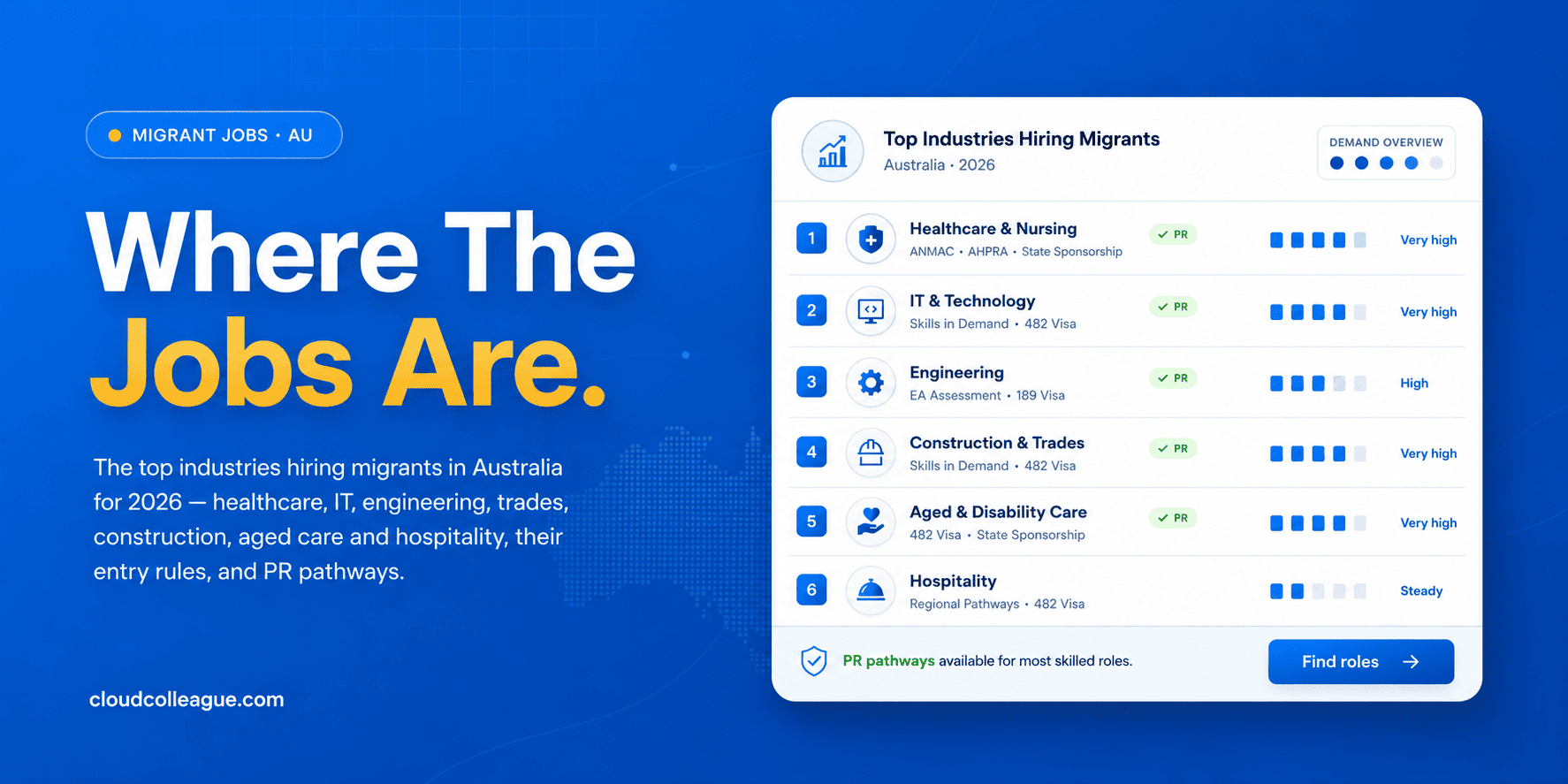
Seven industries stand out for hiring overseas workers in 2026. The table below summarises each, with the common migrant roles and what you typically need to enter.
| Industry | Common Migrant Roles | Typical Entry Requirement |
| Healthcare | Nurses, aged care workers, allied health | Degree or Certificate III/IV + registration |
| Information technology | Developers, cyber security, data engineers | IT degree or certifications, ACS assessment |
| Engineering | Civil, mechanical, mining engineers | Engineering degree, Engineers Australia |
| Trades | Electricians, plumbers, welders, carpenters | Trade qualification + TRA assessment |
| Construction | Project managers, site supervisors, labourers | Experience, White Card, some need diplomas |
| Aged & disability care | Care workers, support workers | Certificate III/IV, police check |
| Hospitality | Chefs, cooks, baristas, hotel staff | Experience, sometimes a trade certificate |
Healthcare sits firmly at the top, driven by an ageing population and chronic shortages of nurses, aged care workers, and allied health professionals. Information technology follows, as enterprises move into cloud, AI, and cyber security and compete hard for developers and data specialists. Engineering and the trades are buoyed by infrastructure and resources work, while construction needs both skilled managers and on-site workers. Aged and disability care is one of the fastest-growing fields of all, and hospitality offers accessible entry across the country’s restaurants, cafes, and hotels.
Roles and Entry Requirements
Entry requirements vary widely by industry, which is good news, because it means there is a pathway whatever your background. Clinical healthcare roles such as nursing require a recognised degree and registration with AHPRA, while aged and disability care roles are far more accessible, usually needing only a Certificate III or IV plus a police check.
Technology and engineering roles require relevant degrees and a skills assessment, through the ACS for IT or Engineers Australia for engineers. The trades need a recognised vocational qualification assessed by Trades Recognition Australia, plus tickets like a White Card for site work. Construction spans both ends, from labouring roles needing little formal study to project management roles wanting experience or a diploma. Hospitality is among the easiest to enter, often rewarding experience and reliability over formal credentials, though chef roles benefit from a trade certificate.
| Strategy tip: match your existing skills to the industry that values them, then close any gap with a targeted certificate or assessment. A Certificate IV or a single licence can open a whole sector. |
Which Industries Offer PR Pathways?
For many migrants, the real question is not just which industry hires, but which leads to permanent residency. The strongest PR pathways run through industries whose occupations sit on the Core Skills Occupation List, because these unlock both employer-sponsored visas and the points-tested skilled visas.
Healthcare, engineering, IT, and the trades are the safest bets, appearing prominently on skilled lists and frequently attracting sponsorship and state nomination. Aged care and some hospitality roles, such as chefs, also feature on skilled lists, supporting residency pathways that did not exist a few years ago. The practical approach is to choose an in-demand occupation, gain Australian experience, and build toward a skilled or employer-sponsored visa. For the full process from offshore, read our guide on how to get a job in Australia from overseas.
Country-specific opportunities matter too. Indian professionals, for example, are heavily represented in IT, healthcare, and engineering, with well-established migration routes. For tailored guidance, see our guide to the best high-paying jobs for Indian migrants.
| Find your industry and start applying. Search roles on CloudColleague or create your free profile to connect with Australian employers in high-demand sectors. |
Frequently Asked Questions
Healthcare leads, followed by information technology, engineering, trades, construction, aged and disability care, and hospitality. These sectors face the deepest skills shortages, so they actively recruit overseas workers and often offer sponsorship.
Aged care, hospitality, and some trades have relatively accessible entry points, often needing a Certificate III or IV plus a police check rather than a university degree. Demand is high, which makes hiring faster, though clinical and technical roles still require formal qualifications.
Many do. Healthcare, engineering, trades, and IT feature heavily on the Core Skills Occupation List, which unlocks employer-sponsored and points-tested skilled visas. Aged care and some hospitality roles also appear on skilled lists, supporting residency pathways.
Yes. Australia has a serious shortage of electricians, plumbers, welders, and carpenters, with some trades receiving skilled visa invitations at the lowest points threshold. Trades often pay well and offer faster routes to PR than many office roles.
Not always. Clinical, IT, and engineering roles need degrees, but trades require vocational qualifications, and aged care and hospitality often need only a certificate plus the right to work. Match your existing skills to the industry’s requirements.