The Australia PR points system is the engine behind skilled migration, and understanding it is the key to a successful permanent residency application. Instead, Australia uses a points-based system, ranks skilled applicants by score, and invites the highest-scoring candidates in each occupation. The more you understand how points are awarded, the more you can do to maximise your score and your chances. This guide explains what the system is, how points are calculated, the minimum needed, a worked example, and how to boost your total.
| Getting ready for life in Australia? Explore First Time in Australia and start as a Seeker to connect with jobs and opportunities that match your skills. |
What Is the Points-Based PR System?
The points test is a competitive ranking system used by the Department of Home Affairs to assess candidates for the General Skilled Migration visas: the Subclass 189 (Skilled Independent), 190 (Skilled Nominated), and 491 (Skilled Work Regional). You submit an Expression of Interest (EOI) through SkillSelect declaring your points, and you enter a pool with everyone else in your occupation.
Crucially, this is a ranking system rather than a pass mark. While meeting the minimum score makes you eligible, invitations go to the highest-scoring candidates first within each occupation. As a result, two people with the same score can experience very different outcomes depending on how competitive their field is. Furthermore, the system rewards applicants who are young, skilled, well-qualified, and proficient in English.
Read Next: Jobs in Hervey Bay: Local Industries and Where to Find Work in 2026
How Australian PR Points Are Calculated?
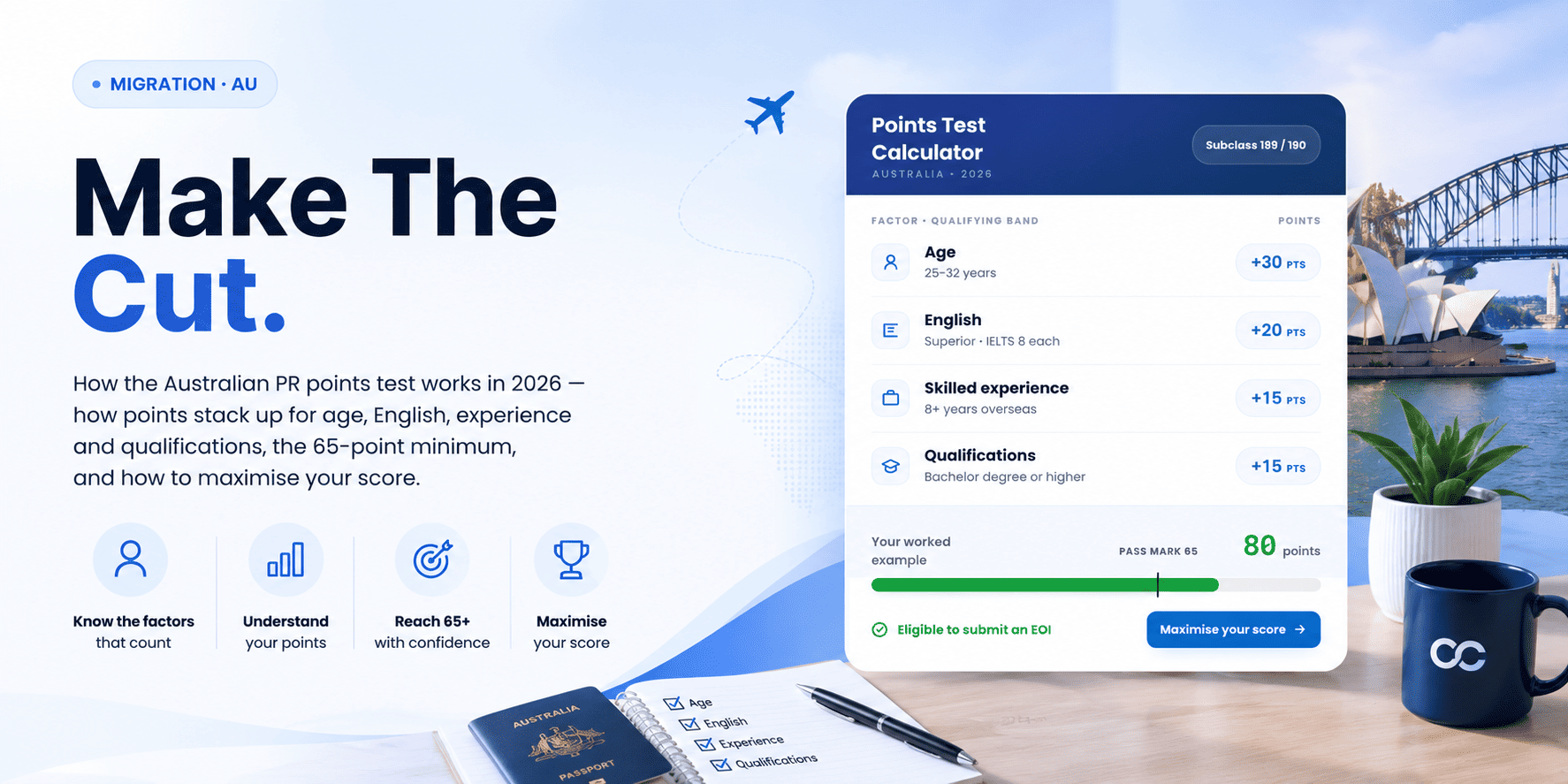
Your score is the sum of several factors, each with its own cap. The table below shows the main components and the points available in 2026.
| Factor | Points Available |
| Age (25 to 32) | 30 (maximum); 25 for 33 to 39 |
| English (Superior, IELTS 8 all bands) | 20; Proficient (IELTS 7) gives 10 |
| Overseas skilled experience (8+ yrs) | 15 (maximum) |
| Australian skilled experience (8+ yrs) | 20 (maximum) |
| Qualifications (bachelor or PhD) | 15 to 20 |
| Australian study requirement | 5 |
| Specialist education (Australian PhD) | 10 |
| Partner skills | up to 10 |
| State nomination (190) / regional (491) | 5 / 15 |
| Professional Year / NAATI language | 5 each |
Age is the biggest single factor, peaking at 30 points for applicants aged 25 to 32 and falling thereafter. English is the next major lever: Proficient English, meaning IELTS 7 in every band, earns 10 points, while Superior English, IELTS 8 in every band, earns 20. A vital detail is that these scores must be met in each individual band, not just on average, which catches out many applicants.
Work experience is split between overseas (up to 15 points) and Australian (up to 20 points), rewarding more years in your nominated occupation. Qualifications add up to 20 points for a doctorate or 15 for a bachelor’s degree, with extra points for an Australian PhD in a specialist field. Beyond these, you can claim bonuses for an Australian study requirement, partner skills, a Professional Year, a NAATI community language credential, and state or regional nomination.
Minimum Points and How Invitations Work
The technical minimum to submit an EOI is 65 points. Without at least 65, you cannot enter the pool at all. However, and this is the part that surprises most people, 65 points rarely results in an invitation in 2026. Because the system is competitive, the real cut-off is set by demand and supply in your occupation.
In practice, most Subclass 189 applicants now need 85 to 95 points or more to be invited, particularly in popular fields like IT, accounting, and finance. Invitations are issued in regular rounds, and your EOI stays valid for two years. This is why many applicants pursue a multi-pathway strategy, lodging a 190 state nomination alongside their 189 EOI to improve their odds. To see how the EOI fits the wider process, read our Australian work visa guide.
| Reality check: 65 points only gets you into the pool. Treat it as the floor, not the goal. Aim for the competitive score in your specific occupation, which is often 85 to 95 or higher. |
Worked Example: A Sample Applicant’s Score
To see how it adds up, consider Priya, a 29-year-old software developer applying from overseas. Her score builds as follows.
| Priya’s profile | Points |
| Age 29 (25 to 32 band) | 30 |
| Proficient English (IELTS 7 all bands) | 10 |
| Bachelor’s degree | 15 |
| 6 years overseas skilled experience | 10 |
| Partner with skills assessment & competent English | 10 |
| Base total (before nomination) | 75 |
| With 190 state nomination (+5) | 80 |
Priya reaches 75 points on her base profile, and 80 with a state nomination through the Subclass 190. In a competitive field like software development, 80 may still fall short of the 189 cut-off, but it makes her a realistic candidate for state nomination. If she lifted her English to Superior, she would gain another 10 points and reach 90, transforming her chances. This shows how a single improvement, especially in English, can move an applicant from borderline to highly competitive.
How to Maximise Your PR Points in Australia?
Because the system is competitive, small gains matter, and several levers are within your control. The most powerful for many applicants is English: moving from Proficient to Superior adds 10 points, often the difference between waiting indefinitely and receiving an invitation. It is usually the fastest, cheapest improvement available.
Other proven boosters include gaining more years of skilled experience, completing a higher qualification, and securing state nomination (+5) or regional nomination (+15), the latter being one of the largest single boosts available. If you have a partner, having them complete a skills assessment can add up to 10 points, and a NAATI community language credential or a Professional Year adds 5 each. If you are studying in Australia or recently graduated, the post-study route can also feed into your points, and our guide on how to get a job in Australia from overseas explains how local experience strengthens your profile.
| Fastest wins: lift your English band scores, pursue regional nomination (+15), and have your partner assessed. Together these can add 25 or more points without years of extra work. |
| Ready to put your plan into action? Search roles on CloudColleague or create your free profile to build Australian experience that strengthens your PR profile. |
Frequently Asked Questions
It scores skilled visa applicants out of a total built from age, English ability, work experience, qualifications, partner skills, and bonuses like state nomination. You submit an Expression of Interest with your claimed points, and the highest-ranked candidates in each occupation are invited to apply for permanent residency.
The minimum to submit an Expression of Interest is 65 points. However, 65 rarely earns an invitation in 2026; most occupations need 85 to 95 or more, especially competitive fields like IT and accounting.
Age gives the most points when you are young. Applicants aged 25 to 32 at the time of invitation receive the maximum 30 points, those aged 33 to 39 get 25 points, and points reduce further with age, ending at 45.
Common boosters include improving your English to Proficient or Superior, gaining more skilled work experience, completing a higher qualification, securing state nomination (+5) or regional nomination (+15), having your partner assessed, or gaining a NAATI community language credential.
Yes, the base calculation is identical. The difference is the bonus: the 190 adds 5 points for state nomination and the 491 adds 15 points for regional nomination, both on top of your base score.