If you are wondering how many hours are in a full time job in Australia, the short answer is 38 hours a week. This is the national standard set by the Fair Work Act, and it applies to most employees across the country. Knowing the rules behind that number helps you understand your pay, your leave, and your right to refuse unreasonable extra hours, whether you are a local worker, a new migrant, or an international student.
| Ready to get started? Create your free account and start as a Seeker or Employer on CloudColleague. |
Standard Full-Time Hours in Australia: The 38-Hour Week
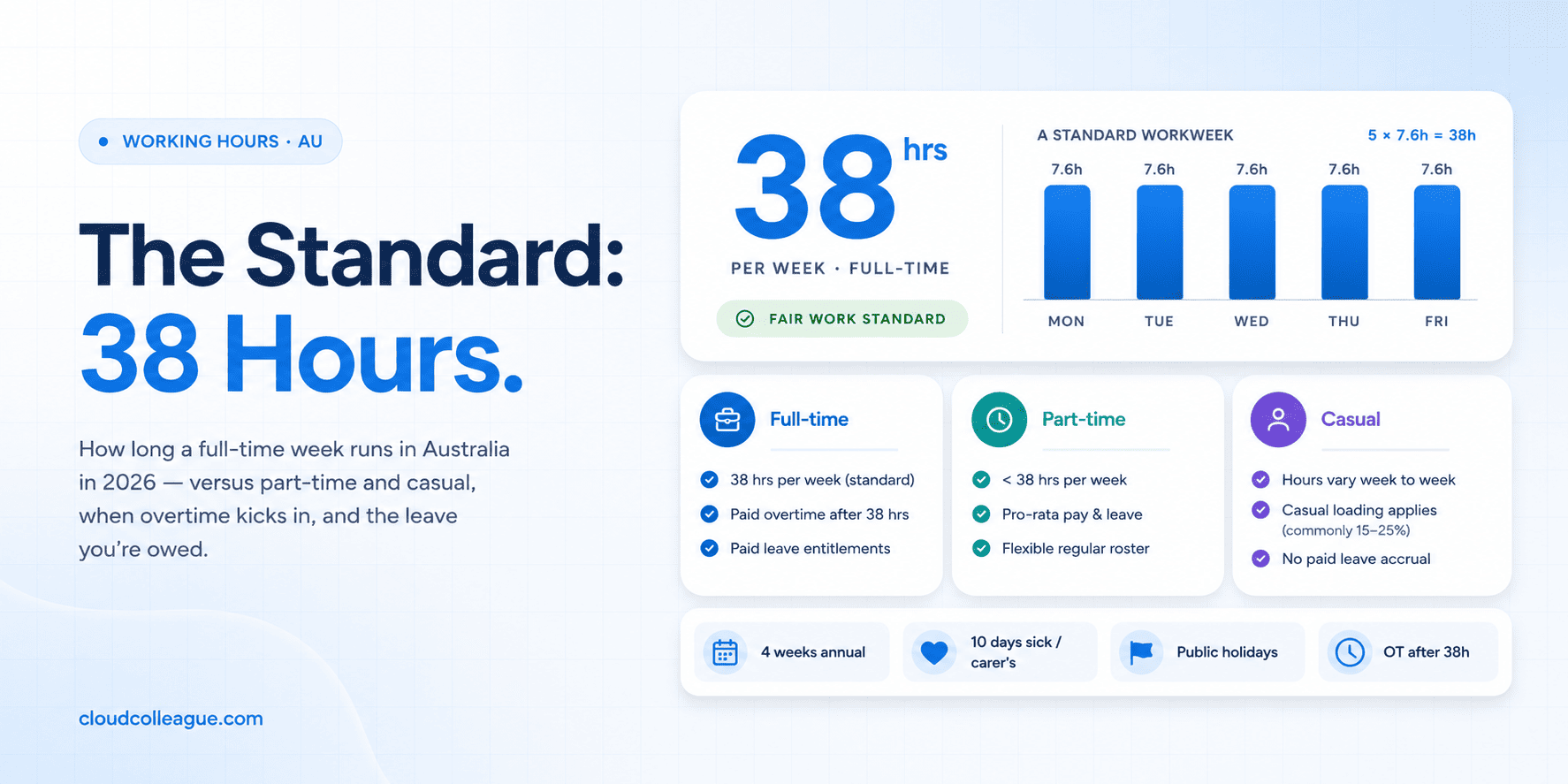
Under the National Employment Standards, full-time employees work a maximum of 38 ordinary hours per week. This is one of the eleven core entitlements that every employer must provide, and it forms the baseline for almost every contract and award in the country. In practice, most people spread those 38 hours across five days, working about 7.6 hours a day.
The 38-hour figure can be averaged in some workplaces. An award or enterprise agreement may let you work, for example, 152 hours over a four-week cycle, which still averages 38 hours a week. This flexibility is why some workers do longer days followed by an extra day off, or a nine-day fortnight, while remaining full-time.
Full-Time vs Part-Time vs Casual
Australia recognises three main employment types, and the differences go well beyond hours. Full-time and part-time employees enjoy guaranteed work and paid leave, while casual workers trade those entitlements for a higher hourly rate. The table below compares them at a glance.
| Feature | Full-Time | Part-Time | Casual |
| Ordinary hours | 38 per week | Agreed, under 38 | No set hours, per shift |
| Ongoing work | Guaranteed | Guaranteed | No firm commitment |
| Paid annual leave | 4 weeks | 4 weeks (pro-rata) | None |
| Paid sick leave | 10 days | Pro-rata | None |
| Casual loading | No | No | Yes, 25% extra |
| Notice / redundancy | Yes | Yes | Generally no |
Part-time employees work fewer than 38 agreed ordinary hours each week but receive the same entitlements as full-time staff on a pro-rata basis. Casual employees have no firm commitment to ongoing work and are paid per shift, so they receive a 25 percent casual loading to make up for missing leave and notice protections.
Overtime, Breaks, and Entitlements
Beyond 38 hours, an employer can request reasonable additional hours, but there is no fixed cap on what reasonable means. Fair Work weighs several factors: any risk to your health and safety, the amount of notice you receive, your personal and family circumstances, whether you are paid overtime, and the usual pattern of work in your industry. If a request fails that test, you are entitled to refuse it.
Overtime pay, rest breaks, and meal breaks are usually set by the relevant Modern Award or agreement rather than a single national rule, so they vary by industry. Many awards pay overtime at 1.5 times the normal rate, with higher penalty rates on weekends and public holidays. Since August 2024, employees at larger businesses also have a right to disconnect, meaning they can reasonably decline to monitor or answer work contact outside their hours.
Full-Time Leave Entitlements
Paid leave is one of the biggest advantages of full-time work in Australia. Every full-time employee receives four weeks of paid annual leave each year, based on their ordinary hours, with an extra week for some shift workers. This leave accumulates as you work and carries over if you do not use it.
Full-time staff also get 10 days of paid personal and carer’s leave a year, which covers both sickness and caring for an unwell family member, plus paid compassionate leave and access to family and domestic violence leave. Parental leave provides up to 12 months unpaid, with a right to request another 12 months, and from 1 July 2026 government-funded Paid Parental Leave rises to 26 weeks that both parents can share.
| Bottom line: full-time means 38 ordinary hours a week, four weeks paid annual leave, 10 days paid sick and carer’s leave, and 12 percent superannuation on top of your pay. |
| Looking for work in Australia? Browse your matching jobs on CloudColleague and tasks on CloudColleague that match your skills, experience, and availability. |
Frequently Asked Questions
Yes. An employer can ask you to work reasonable additional hours beyond 38, and there is no fixed cap on what counts as reasonable. The test weighs your health and safety, the notice given, your personal circumstances, whether you receive overtime, and industry norms. You can refuse hours that are unreasonable.
Many salaried professionals are paid an annual figure that absorbs reasonable extra hours rather than hourly overtime. Your contract or award sets the ordinary hours, and the salary must still meet or beat the minimum the award would pay for those hours plus any overtime.
Usually, but an award or enterprise agreement can set different ordinary hours or allow averaging, for example 152 hours over four weeks. The average must still come to 38 hours a week unless extra hours are reasonable.
Most full-time roles run about 7.6 hours a day across five days to reach 38 hours a week, though patterns vary. Some workers do four longer days or nine-day fortnights under agreed arrangements.
Yes. On top of your salary, your employer pays 12 percent superannuation into a retirement fund in 2026, regardless of whether you are full-time or part-time.