The skill shortage list in Australia is one of the most important resources for anyone planning to migrate for work. It determines which occupations can access skilled visas. Australia faces ongoing shortages across healthcare, construction, engineering, technology, and education. To address these gaps, the government uses official occupation lists to guide skilled migration. This guide explains what the lists are, the most in-demand occupations in 2026, how they affect your visa options, how to check your occupation, and how to use the information to plan your move.
| Please note: the occupation lists are reviewed regularly, usually annually from 1 July, and were last consolidated into the Core Skills Occupation List framework in late 2024 with updates through 2026. This guide is general information, last reviewed for early 2026. Always confirm the current lists on the Department of Home Affairs (homeaffairs.gov.au) and Jobs and Skills Australia (jobsandskills.gov.au) websites before making decisions. |
| Found your occupation in demand? Start as a Seeker to explore opportunities or browse our Guides on Tasks to discover flexible ways to earn in Australia. |
What Is the Skill Shortage / Occupation List?
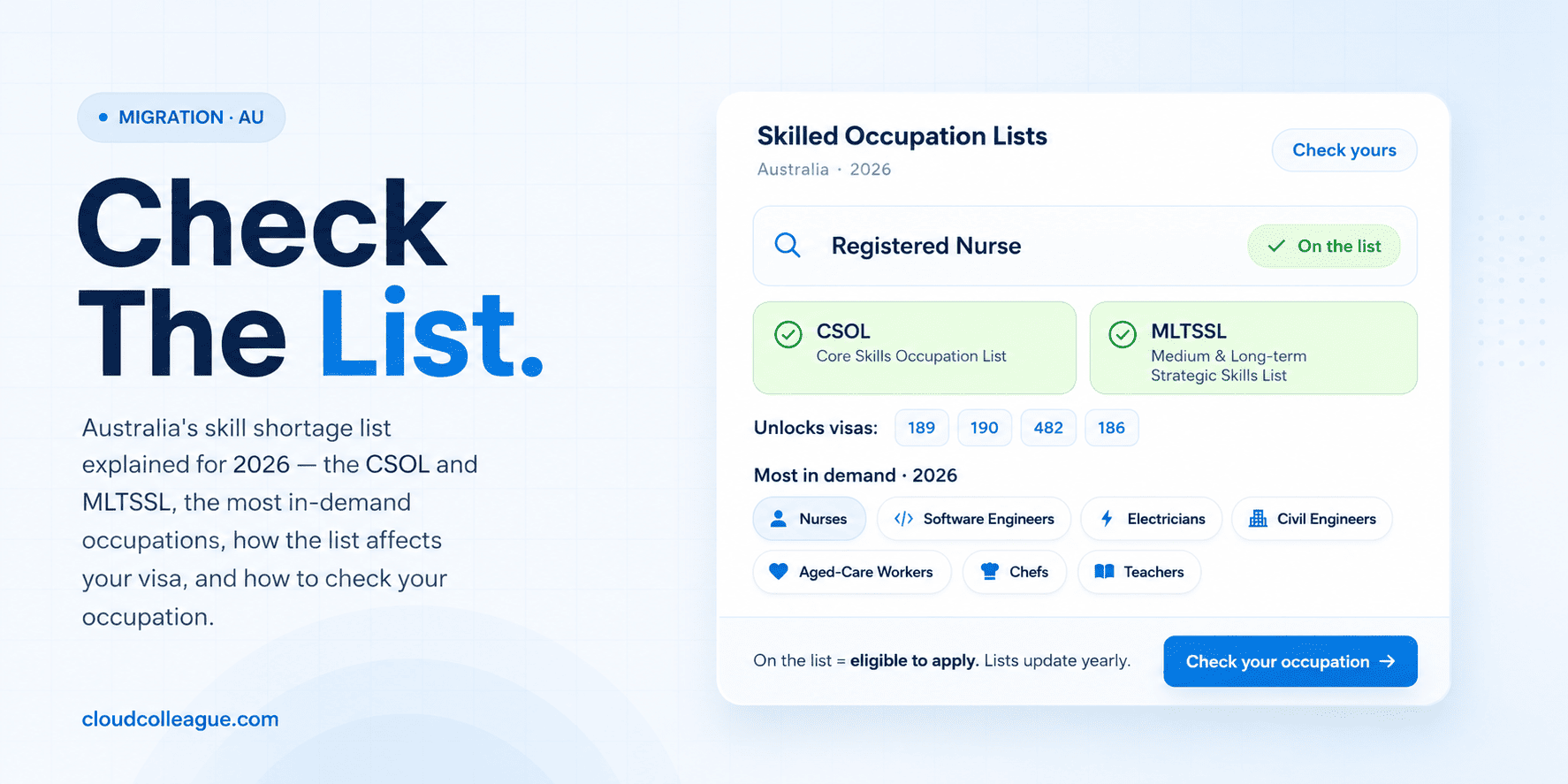
Australia does not rely on a single list. Instead, it uses several official occupation lists to identify jobs that cannot be filled by local workers. The most significant recent change was the introduction of the Core Skills Occupation List (CSOL) in December 2024. It replaced the former Priority Migration Skilled Occupation List. The CSOL now includes around 456 occupations across healthcare, construction, IT, engineering, agriculture, hospitality, and other sectors.
The CSOL is the primary list for employer-sponsored migration, applying to the new Skills in Demand visa and the Direct Entry stream of the permanent Employer Nomination Scheme. Separately, the Medium and Long-term Strategic Skills List (MLTSSL) continues to apply to the points-tested skilled visas. These lists are built on evidence, drawing on the annual Occupation Shortage Report from Jobs and Skills Australia, which assesses where shortages are genuine and persistent.
Most In-Demand Occupations in Australia
The 2025 National Occupation Shortage assessment found that about 29% of assessed occupations remain in acute shortage. It also found that 139 occupations have faced persistent shortages every year since 2021. In response, the government has prioritised what it calls outcome-based migration. This approach focuses on the care economy, the net zero energy transition, digital infrastructure, construction, and education. The table below shows the leading sectors and example occupations.
| Sector | Example In-Demand Occupations | Shortage Level |
| Healthcare & care | Registered nurses, aged care and disability workers, GPs, physiotherapists | Very high |
| Construction & trades | Electricians, plumbers, carpenters, bricklayers, project managers | Very high |
| Engineering | Civil, mechanical, electrical, mining engineers | High |
| Information technology | Software engineers, cyber security, data specialists | High |
| Education | Early childhood, secondary, and special education teachers | High |
| Net zero & energy | Renewable energy technicians, related trades | Growing fast |
Healthcare sits at the very top, with registered nurses across aged care, ICU, and mental health, plus midwives and physiotherapists, receiving the highest volume of sponsorship invitations nationally. Our guide to nursing jobs in Australia covers that field in depth. Construction and trades are buoyed by the national housing shortage, while IT, engineering, and teaching round out the most in-demand groups. For a sector-by-sector view of where migrants are hired, see our guide to the top industries hiring migrants in Australia.
Read Next: Jobs in Mackay: Mining, Trades, and Local Work Opportunities in 2026.
How the List Affects Your Visa Options?
Your occupation’s place on these lists is the gateway to skilled migration. It directly affects which visas you can apply for. If your occupation is on the CSOL, you may be eligible for sponsorship through the Skills in Demand visa or nomination under the permanent Subclass 186 Direct Entry stream. If it appears on the MLTSSL, you can pursue points-tested General Skilled Migration visas, including the Subclass 189, 190, and 491.
There can also be a processing advantage. Occupations in government priority sectors, such as healthcare, construction, and digital technology, often receive faster visa processing and more sponsorship opportunities. Being on a list does not guarantee a visa, but not being on one closes most skilled pathways entirely. To understand how this fits into the full application, read our Australian work visa guide.
| Key point: the CSOL drives employer-sponsored visas, the MLTSSL drives points-tested visas. Check which list your occupation sits on, because it decides which pathway is open to you. |
How to Check If Your Occupation Qualifies?
Checking your occupation is a precise process, and getting it right early saves months. Start by identifying your ANZSCO occupation code, the official classification that matches your role to a specific title and skill level. Your real-world job title is less important than the code, since the lists work entirely from ANZSCO.
- Find your ANZSCO code. Match your duties, not just your title, to the closest official occupation classification.
- Search the official lists. Look up your code on the Core Skills Occupation List and the points-tested lists on the Department of Home Affairs website.
- Note which visas it supports. Being on the CSOL supports employer-sponsored visas; being on the MLTSSL supports points-tested visas, and some occupations appear on both.
- Check state lists too. States and territories publish their own nomination lists for the 190 and 491, which can include occupations not open federally.
- Confirm requirements. Verify the skills assessment authority, registration, and any experience needed for your occupation.
How to Use the List to Plan Your Migration?
The smartest applicants treat the shortage list as a planning tool, not just a checklist. If your occupation is clearly in demand, move quickly, since priority roles process faster and competition for invitations is lower. If your occupation is borderline or not listed, you have options: gain qualifications or experience that shift you into a listed occupation, target a state whose list includes your role, or consider the regional 491 visa, which often has broader lists and lower point requirements.
Use the list alongside a realistic points assessment, because eligibility and competitiveness are two different things. Estimate your score with the Australia PR points calculator, then match it against the occupations and visas open to you. Build your plan around an in-demand occupation, a strong points claim, and the state or pathway where you are most competitive, and revisit it whenever the list updates.
| Plan with current data: because the lists change each year and occupations can be added or removed, always re-check the official source before lodging an Expression of Interest or accepting a sponsorship offer. |
| Ready to act on the demand? Search in-demand roles on CloudColleague or create your free profile to connect with employers hiring for shortage occupations. |
Frequently Asked Questions
It is the set of official occupation lists that identify jobs Australia cannot fill with local workers. The main one for employer-sponsored migration is now the Core Skills Occupation List (CSOL), which contains around 456 occupations, while the Medium and Long-term Strategic Skills List (MLTSSL) still applies to the points-tested skilled visas.
Healthcare and care roles lead, including registered nurses and aged care workers, followed by construction trades like electricians and carpenters, engineers, IT and cyber security specialists, and teachers. Around 29 percent of assessed occupations remain in acute shortage.
If your occupation is on the relevant list, you can access skilled visa pathways. The CSOL unlocks the employer-sponsored Skills in Demand visa and the 186 Direct Entry stream, while the MLTSSL supports the points-tested 189, 190, and 491 visas. Priority occupations also tend to be processed faster.
Match your job to its ANZSCO code, then search the official Core Skills Occupation List and the points-tested lists on the Department of Home Affairs website. Confirm which visa each list supports, since being on one list does not automatically mean eligibility for every visa.
The lists are reviewed annually to align with the migration program year starting 1 July, guided by the latest Occupation Shortage Report from Jobs and Skills Australia, though urgent changes can happen more often. Always check the current version before you plan.