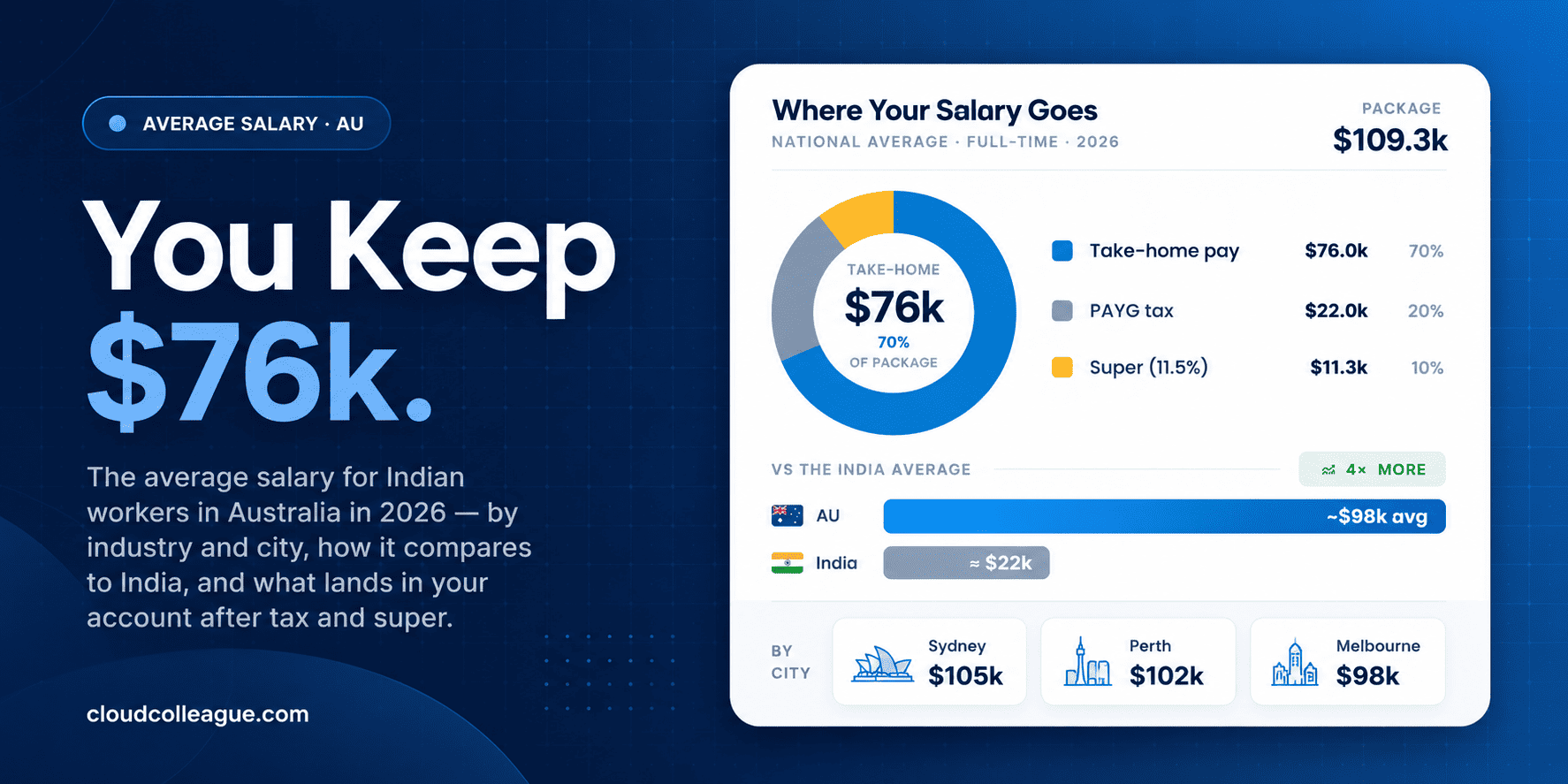
If you want to understand the average salary in Australia for Indians, the first thing to know is that “average” can be misleading. Australia reports two very different numbers. The mean, or average, full-time salary reached about $106,700 a year in late 2025, yet the median, the true midpoint, sits closer to $78,000 to $90,500. A small group of very high earners in mining, finance, and surgery pulls the average upward, so the median often tells a more honest story.
For Indian workers specifically, there is no separate official figure, because the Australian Bureau of Statistics does not break earnings down by country of origin. However, Indian professionals tend to cluster in high-demand fields such as IT, healthcare, and engineering, which means many earn at or above the national average. Your actual pay depends heavily on your industry, city, and experience, so this guide breaks all three down clearly.
| Want to learn more about earning through tasks? Explore our Guides on Tasks or browse available tasks on CloudColleague and start building experience today. |
National Average Salary Overview
The Australian Bureau of Statistics recorded average weekly ordinary time earnings for full-time adults at $2,051.10 in November 2025, which works out to roughly $106,700 a year. That figure crossed the symbolic six-figure mark in early 2026. The median full-time wage, by contrast, sits around $78,000, and only the top 10 percent of workers earn above $150,900.
These numbers matter for migrants because they set realistic expectations. If you land a role paying $95,000 to $120,000, you are already earning above the typical Australian worker. The minimum wage, for reference, is $24.95 an hour, or about $948 a week for a standard 38-hour week, so even entry-level full-time pay clears most living costs in regional areas.
Read Next: Best High-Paying Jobs in Australia for Indian Migrants 2026
Average Salary by Industry for Migrant Workers
Industry is the single biggest driver of pay, and the gap is wide. Mining workers average close to $171,000 a year, while accommodation and food services sit under $80,000. The fields where Indian migrants in Australia are concentrated land comfortably in between. For the full ranking of top earners, see our guide to the highest-paying jobs in Australia.
In technology, software engineers average $110,000 to $150,000, with senior specialists reaching $170,000 to $200,000 or more. In healthcare, registered nurses earn $75,000 to $110,000, and demand keeps climbing as the population ages. Engineers earn $80,000 to $140,000, while accountants sit between $70,000 and $150,000. Data and cyber security roles pay the most outside mining and medicine, often $110,000 to $190,000.
Because Indian jobseekers are heavily represented in these exact sectors, their typical earnings track the upper-middle of the national range. To see which of these roles are easiest to enter on a skilled visa, read our breakdown of the best high-paying jobs for Indian migrants.
Read Next: How the Australia PR Points System Works?
Average Salary by City: Sydney, Melbourne, Perth, Brisbane
Where you work changes your pay almost as much as what you do. The table below shows typical full-time ranges in the four cities most popular with Indian migrants, along with a quick note on each.
| City | Typical Full-Time Salary | Notes for Migrant Workers |
| Sydney | $95,000 to $140,000+ | Highest tech and finance pay, but the highest rents |
| Melbourne | $90,000 to $130,000 | Large Indian community, strong tech and infrastructure |
| Perth | $95,000 to $150,000+ | Mining premiums lift pay, lower housing than Sydney |
| Brisbane | $85,000 to $130,000 | Growing construction and engineering demand, good value |
Sydney pays the most for technology and finance, but it also carries Australia’s highest rents, so a big salary does not always mean big savings. Perth rewards mining and resources skills with strong premiums and more affordable housing. Melbourne offers the largest established Indian community plus solid tech and infrastructure demand, while Brisbane combines growing engineering work with good value living costs. if you need more information on salary and its structure, see our guide on what Is Salary?.
How Does It Compares to the Same Role in India?
The jump in gross pay is dramatic. A mid-career software engineer earning around 15 lakh in Bangalore can earn roughly AUD 120,000 in Sydney, which is about 4.4 times more in absolute terms. Nurses, accountants, and engineers see similar multiples when they move.
Purchasing power tells a subtler story. Australian rent, groceries, and transport cost far more than in most Indian cities, so the real gain is smaller than the headline multiple suggests. The smart approach is to compare what you can save and invest each month, not just gross salary. Our cost of living guide walks through typical monthly budgets so you can estimate your genuine net benefit.
| Key point: a salary that looks four times higher may translate to a smaller real gain after rent and tax. Always compare net savings, not gross pay. |
Tax, Super, and Take-Home Pay Basics
Your advertised salary is not what lands in your bank account. Australia uses progressive resident tax rates for 2025-26: no tax on the first $18,200, 16 percent up to $45,000, 30 percent up to $135,000, 37 percent up to $190,000, and 45 percent above that. A 2 percent Medicare levy applies on top for most residents.
In practice, take-home pay is usually about 75 percent of gross. On a $100,000 salary, a resident pays around $20,788 in income tax plus a $2,000 Medicare levy, an effective rate near 22.8 percent, which is lower than the headline 30 percent bracket because the lower slices are taxed less. From 1 July 2026, the 16 percent bracket drops to 15 percent, so most workers keep a little more.
Superannuation is the pleasant surprise. On top of your salary, your employer pays 12 percent into a retirement fund in 2026, so a $100,000 base actually comes with about $12,000 in extra super. Always check whether a job advertises a figure that includes or excludes super, since that single detail can change the offer by thousands.
| Ready to find a role that matches these numbers? Search current openings on CloudColleague or create your free profile to connect with employers hiring skilled migrants now. |
Frequently Asked Questions
There is no separate official figure for Indian workers, but most cluster in IT, healthcare, and engineering, so their earnings typically sit at or above the national full-time average of about $106,700 a year. Many mid-career Indian professionals earn between $90,000 and $140,000.
The Australian Bureau of Statistics put average weekly ordinary time earnings at $2,051.10 in November 2025, or roughly $106,700 a year. The median is lower, around $78,000 to $90,500, which better reflects what a typical worker earns.
Take-home pay is usually about 75 percent of gross. On a $100,000 salary, a resident pays around $20,788 in income tax plus a $2,000 Medicare levy, an effective rate near 22.8 percent.
Usually not in the base figure. Employers pay 12 percent superannuation on top of your gross salary in 2026, so always check whether a quoted package is inclusive or exclusive of super.
Not automatically. Gross pay can be four times higher than in India, but rent, groceries, and transport are also far higher, so compare net savings after living costs rather than headline salary.