If you are asking what intern jobs are, you are at the start of a smart career move. Intern jobs are short-term roles that give you real, hands-on experience in a profession or industry, usually while you study or soon after you finish. Internships focus on learning and skill development rather than long-term employment, helping you determine whether a career path is the right fit before you commit to it.
| Ready to find your first placement? Browse internship and entry-level roles on CloudColleague or create your free profile to get noticed by employers. |
What Is an Internship?
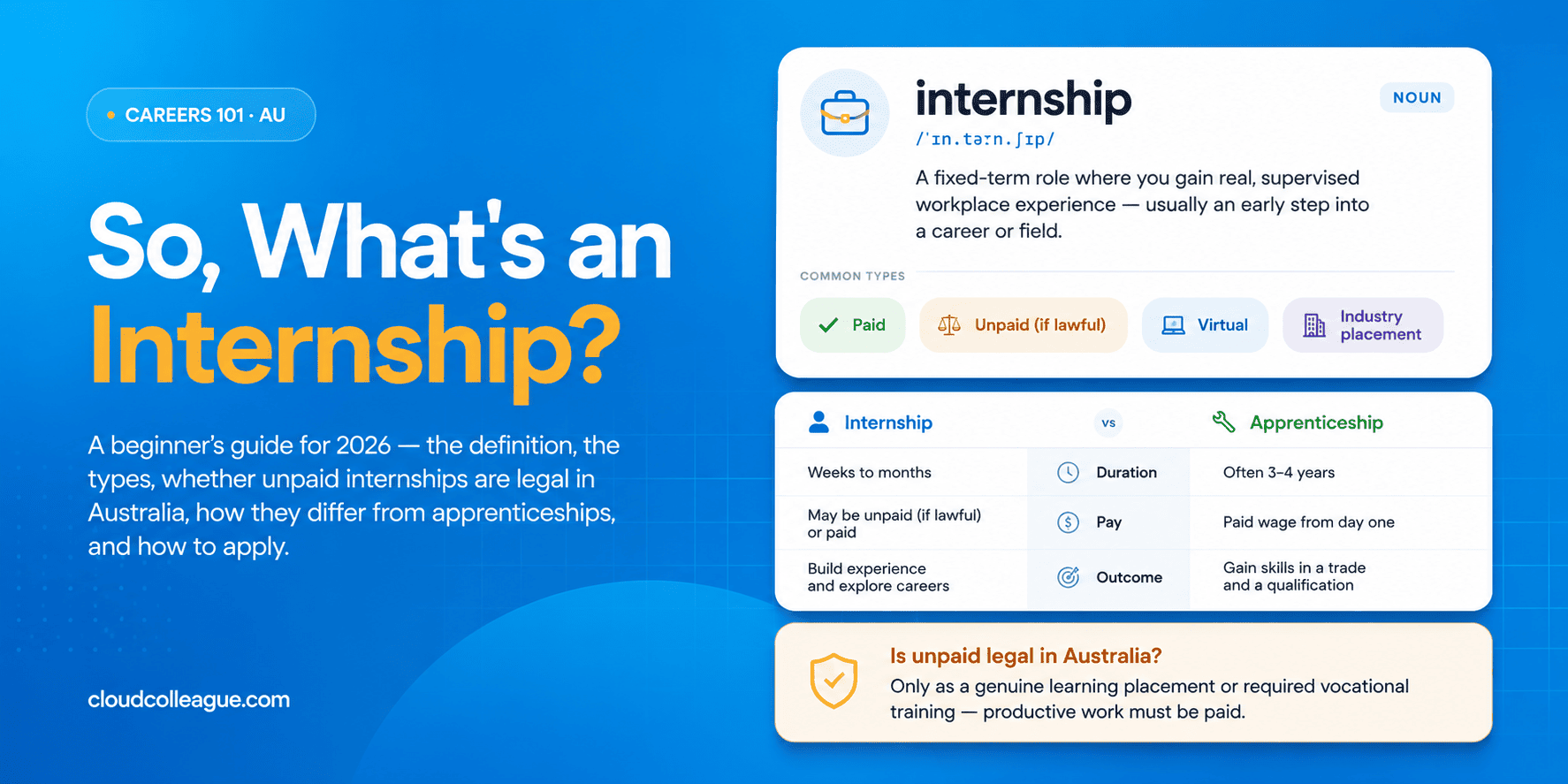
An internship is a work experience arrangement where you join a business to learn a specific role or industry. The core purpose is education and exposure, so you build practical skills, observe how a workplace runs, and start a professional network. Internships are a valuable bridge between study and full employment, and they sometimes span several months and lead to ongoing work.
Unlike a regular job, an internship puts your development first. A good program gives you mentorship, structured tasks, and feedback, so you leave with skills and references you can use to launch your career. That learning focus is also what shapes the rules around pay, which we cover below.
Read Next: Best Australian Cities for Jobs & Career Opportunities
Types of Internships
Internships come in several formats, and knowing the difference helps you choose the right one. Paid internships treat you like an employee and offer wages along with experience, which is common in fields such as engineering, finance, and technology. Unpaid internships are usually tied to a course as a formal placement, and strict rules apply to them in Australia.
Virtual internships have grown quickly and let you work remotely on real projects, which suits students balancing study or those in regional areas. Industry placements, often arranged by your university or TAFE, embed you in a host organisation as part of your qualification. Each type offers experience, but the pay and structure differ, so always confirm the terms before you start.
Are Unpaid Internships Legal in Australia?
This is the question that trips up both students and employers, so it deserves a clear answer. Unpaid internships are legal in Australia, but only in limited circumstances. The Fair Work Act does not actually define the word intern, so what matters is whether an employment relationship exists in practice, not the label on the arrangement.
There are two main ways an unpaid internship can be lawful. The first is a genuine vocational placement, which must be a required part of an authorised education or training course and approved by the institution, with no entitlement to payment. The second is where no employment relationship exists, meaning the work is mainly observational, the main benefit flows to you as the learner, and you are not doing productive work that a paid employee would otherwise do.
| Important: if you do productive work such as drafting documents, handling client calls, or running social media, you are almost certainly an employee and must be paid at least the minimum wage or award rate. Calling the role an internship does not change that. |
Getting this wrong exposes a business to back-pay claims and penalties under the Fair Work Act, so the rules protect you. To understand your broader entitlements, especially if you are studying here, read your work rights in Australia.
How Internships Differ From Apprenticeships and Graduate Roles?
People often confuse these three pathways, but they serve different stages of a career. The table below sets them side by side so you can pick the right one for your situation.
| Pathway | What It Is | Best For |
| Internship | Short-term experience in a role or industry, often weeks to a few months | Students, recent grads, career changers |
| Apprenticeship | Paid, structured training that combines work and formal study, often years | School leavers entering a trade |
| Graduate role | A permanent, paid entry-level job for degree holders, usually 1 to 2 year programs | University graduates |
In short, an apprenticeship is a paid, multi-year route into a trade that blends work with formal study, while a graduate role is a permanent entry-level job for people who already hold a degree. An internship sits earlier and is shorter, with the emphasis on exploring a field and building foundational experience rather than committing to a long program.
How to Find and Apply for an Internship?
Start where the opportunities are concentrated. University career portals, industry bodies, and dedicated internship programs list many placements, and your education provider can often connect you directly with host organisations. Build and maintain professional relationships, as employers often fill internships through referrals before they advertise them.
Online job platforms are the fastest way to scan many roles at once. For a full rundown of where to look, see our guide to the best job search websites in Australia. Tailor your resume to highlight relevant coursework, projects, and soft skills when you apply, as employers assess interns based on their potential rather than extensive experience.
Finally, prepare for a short, friendly interview that focuses on your motivation and willingness to learn. Ask about the program structure, pay, and skills you will develop so you can choose a placement that genuinely advances your career.
| Quick checklist: confirm whether the role is paid or a vocational placement, check it offers real mentorship and learning, and make sure it fits your visa or course rules before you accept. |
| Start your search today. Find internships or browse online tasks on CloudColleague and Start as a Seeker so employers can find you first. |
Frequently Asked Questions
Intern jobs are short-term roles that let you gain hands-on experience in a profession or industry, usually while studying or soon after. They focus on learning and building skills rather than long-term employment, and they often help you decide whether a career path suits you.
Many are. If you perform productive work that benefits a business, the employer must generally treat you as an employee and pay you at least the applicable minimum wage or award rate. Unpaid internships are only lawful as genuine vocational placements through an approved course, or when the work is observational and creates no employment relationship.
Most run from a few weeks to several months. Vocational placements follow the length set by your course, while paid internships often align with university breaks or run part-time alongside study.
They often can. A strong internship builds skills, references, and industry contacts, and many employers use them as a talent pipeline. There is no guarantee of a job, but interns frequently convert to graduate or ongoing roles.
Yes, but visa conditions apply, including limits on paid work hours during study. Always check your visa and your education provider’s rules before accepting a placement.