Finding a cleaner used to mean asking a neighbour, putting up with patchy work, and hoping the next one turns up. In 2026, Australian households and small businesses will have something better: online platforms that let you compare verified cleaners, see real reviews, agree on a fair price, and book a clean for next week.
This guide walks through exactly how to find a reliable home cleaning service in Australia through online platforms – what to look for, what to pay, how to avoid the most common pitfalls, and how to build a long-term cleaning relationship that actually saves you time.
Why Have Online Platforms Replaced the Old Way?
The traditional model, calling a cleaning company, agreeing on a vague hourly rate, hoping for the best, has three problems:
- No transparency on price. Quotes vary wildly for the same scope.
- No verifiable reviews. You rely on the company’s testimonials, which they choose themselves.
- No accountability. If something goes wrong, your only recourse is to find someone else next time.
Modern online cleaning platforms in 2026 fix all three. You see prices upfront. You read real reviews from real customers. And if a job goes wrong, the platform’s dispute and rebooking systems give you a clear path to resolution.
Read Next: How to Hire a Tech Contractor in Australia Without Going Through a Recruitment Agency?
Step 1 – Know What Type of Cleaning You Actually Need
Different cleans call for different types of cleaners. Sort yourself into one of these categories before you start looking:
- Regular weekly or fortnightly home cleaning: same cleaner each visit, predictable scope.
- One-off deep clean: kitchens, bathrooms, behind appliances, full attention.
- End-of-lease (bond) cleaning: receipt-backed scope to satisfy a real estate inspection.
- Move-in cleaning: pre-occupation clean, often combined with carpet steam.
- Spring clean or seasonal deep clean: periodic top-up beyond regular service.
- Post-renovation or post-build clean: dust-heavy, specialist scope.
- Carpet cleaning, window cleaning, oven cleaning: specialist single-task cleans.
- Commercial cleaning: offices, retail, allied health, gyms.
Each category has different scopes, prices, and skills required. A cleaner who is excellent at weekly tidy-ups may not be the right pick for an end-of-lease bond clean.
Step 2 – Get Clear on Scope Before You Post
The single biggest reason cleaning relationships go wrong is mismatched expectations. Before you contact a cleaner, write down:
- What rooms are included
- What is in scope in each room (e.g. wipe surfaces, mop floors, clean inside microwave)
- What is explicitly out of scope (e.g. inside cupboards, oven interior, balconies)
- Frequency (one-off, weekly, fortnightly, monthly)
- Estimated total square metres if you know it
- Any specific concerns (allergies, pets, eco-friendly products, fragile items)
- Access details (keys, codes, parking)
A 5-minute scope brief saves you 2 hours of post-clean disputes.
Step 3 – Understand the Going Rates for Cleaning in Australia in 2026
Cleaning rates vary by city, type and scope. The following 2026 ranges are typical Australia-wide:
| Cleaning Type | Typical Price (AUD) |
| Standard hourly clean | $40 – $70 / hour |
| Weekly home clean (2 bed/1 bath) | $90 – $160 / visit |
| Weekly home clean (3 bed/2 bath) | $130 – $220 / visit |
| Fortnightly clean (3 bed/2 bath) | $150 – $250 / visit |
| One-off deep clean (3 bed home) | $300 – $600 |
| End-of-lease clean (2 bed unit) | $300 – $550 |
| End-of-lease clean (3+ bed house) | $450 – $900 |
| Oven clean | $80 – $180 |
| Carpet steam (per room) | $40 – $80 |
| Window clean (interior + exterior) | $150 – $400 |
| Commercial office clean (per visit) | $80 – $300 / visit |
Prices rise in Sydney and Melbourne CBD, and for evening or weekend bookings. Outside the city, expect the lower end of each band.
If a quote is dramatically below market, ask why. Often it means a junior cleaner with limited insurance, or a scope that does not include what you think it does.
Step 4 – Pick the Right Platform
Australian households in 2026 typically choose between these options:
- General Australian hiring and task marketplaces like CloudColleague: strong for scheduled, professional and ongoing cleans where verification and reviews matter.
- Local task platforms: strong for one-off urgent or casual cleans.
- National cleaning chains: consistent service, often higher prices and less flexibility.
- Independent cleaners through local Facebook groups: variable quality, harder to verify.
For most ongoing cleans, a verified marketplace gives the best balance of price, quality and protection. For one-off urgent cleans, a local task platform can be faster.
| Need a cleaner for next week? Post your cleaning task free on CloudColleague and get matched to verified Australian cleaners. |
Step 5 – Vet the Cleaner Properly
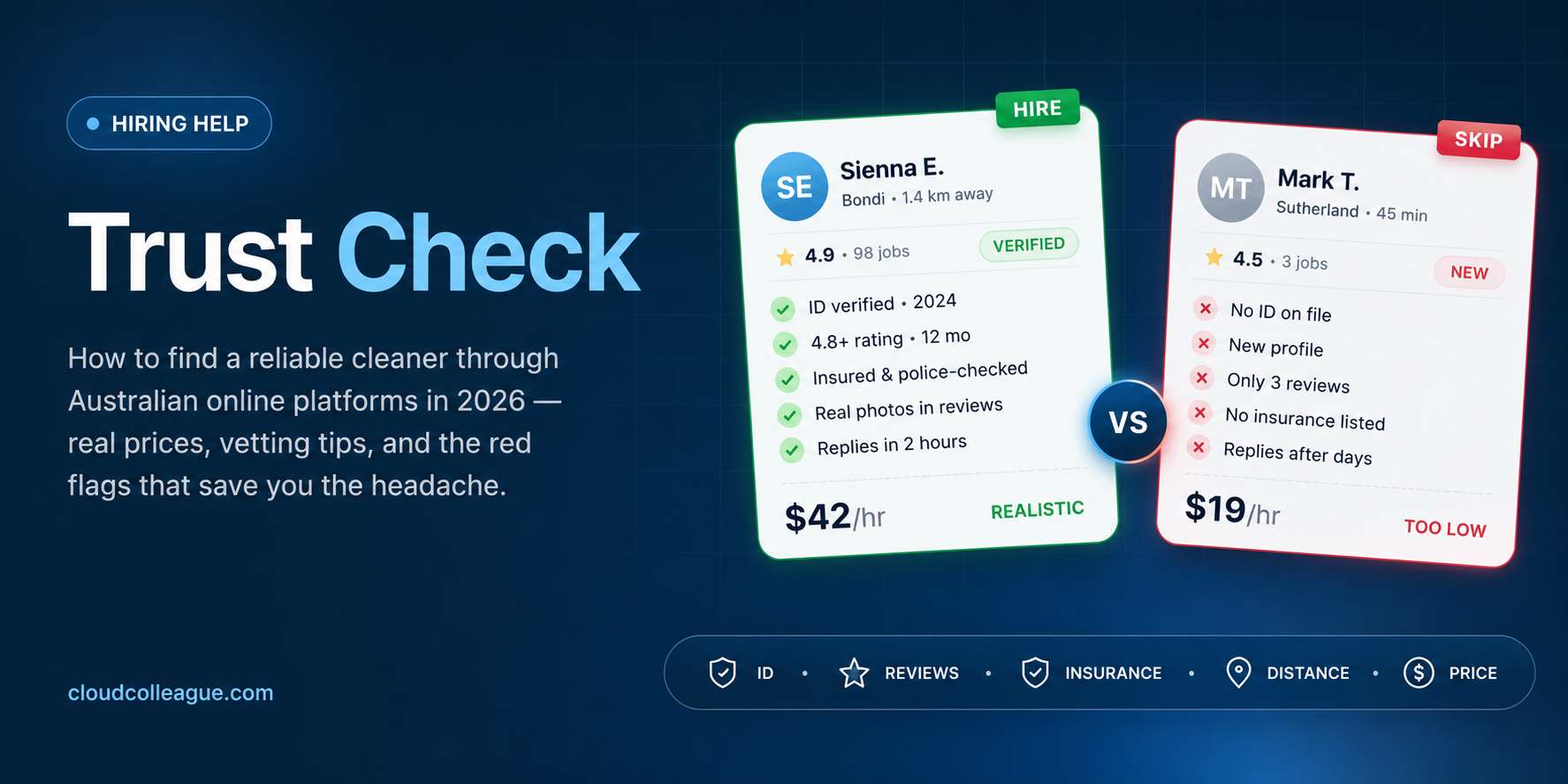
A reliable cleaner has most or all of these markers:
- Active profile with recent reviews. At least 5 to 10 reviews from the last 6 months.
- Public liability insurance. Should cover at least $5 million.
- Workers compensation cover if they have employees.
- ABN for legal invoicing.
- A response time of under 24 hours to your initial enquiry.
- A clear scope offer, not vague “everything you need.”
- Police check for households with vulnerable members or for ongoing access to a key.
- Specific experience with your type of clean (regular, bond, commercial).
If a cleaner cannot evidence the first four, keep looking. The fifth (police check) is essential for any clean where you give the cleaner ongoing access while you are out.
Step 6 – Read Reviews Like a Pro
The mistake most people make with online reviews is reading only the star ratings. The signal is in the words. When evaluating a cleaner:
- Read the 3-star and 4-star reviews more carefully than the 5-stars. They are usually the most honest.
- Look for patterns, not single incidents. One unhappy customer is normal; three with the same complaint is a flag.
- Check recency. A great cleaner from 18 months ago may have changed.
- Watch for how the cleaner responds to criticism. A calm, professional reply is a strong positive signal.
- Be wary of 5-star reviews that all sound the same. Generic praise is sometimes copy-paste.
Spending 10 minutes on review analysis can save you weeks of headaches.
Step 7 – Have a Brief Conversation Before the First Clean
For anything beyond a single one-off task, a 10-minute call or chat before the first clean is worth it. Cover:
- Confirm scope in plain language
- Discuss products and equipment (yours, theirs, eco preferences)
- Address pets, allergies, fragile items, off-limits areas
- Agree on time, access and parking
- Confirm price and payment method
- Set a clear feedback mechanism for the first 2 cleans
Cleaners who have this conversation willingly are almost always the ones worth booking. Those who avoid it often produce variable results.
Step 8 – Pay Through the Platform, Not Cash
This is the single most important rule of using a cleaning platform: pay through the platform.
Paying through the platform:
- Activates payment protection
- Keeps your reviews and history on record
- Protects the cleaner from non-payment too
- Provides receipts for tax (if you run a business)
Paying cash undermines all of these for both sides and exits the marketplace’s accountability framework.
Step 9 – Build a Long-Term Relationship
The biggest savings in cleaning come from continuity. A regular cleaner who knows your home is faster, more thorough and more reliable than a new one each time. Tactics for keeping a great cleaner:
- Be predictable. Same time, same day, same scope.
- Leave a tip occasionally at the end of the year or for unusually heavy work.
- Write an honest review when the work has been consistently great.
- Be communicative. Tell them what changes early, instead of letting it become a dispute.
- Respect their schedule. Last-minute reschedules damage the relationship faster than anything.
A great long-term cleaner is one of the highest-leverage household relationships you can build.
End-of-Lease Cleaning: A Special Case
Bond cleaning has its own rules. Most Australian property managers expect:
- A receipt-backed clean with itemised scope
- Oven and rangehood deep clean
- Carpet steam cleaning (often a separate booking)
- Internal window cleaning
- Detailed cleaning of skirting boards, doors and walls
- Garage and outdoor area if part of the lease
If you want a bond-back guarantee, work only with cleaners who explicitly offer one. Confirm what is and is not included, and what their process is if the property manager raises issues.
Read Next: In-Demand Skills Employers Are Hiring for in Australia Right Now (2026)
Commercial Cleaning Through Online Platforms
Small Australian businesses increasingly hire commercial cleaners through the same platforms households use. The differences for commercial:
- Public liability and workers comp are non-negotiable.
- Out-of-hours scheduling (evenings, early mornings) is usually preferred.
- Consumables (soap, paper, bin liners) should be quoted separately.
- Specialist scope for medical, fitness, food service or warehouse premises adds 20 to 40 percent on top.
- Service agreements of 3 to 12 months often unlock better rates.
If you run an allied health clinic, gym, café or office, an online platform can get you 2 to 3 quotes within days for direct comparison.
Still in dilemma on tasks bidding? Read: How to Bid on Tasks and Actually Win?, to win your tasks at CloudColleague.
Common Mistakes Australian Households Make When Hiring Cleaners
A short hit-list:
- Choosing only by price. The cheapest cleaner is rarely the best value.
- No written scope. Leads to disputes about what was and was not included.
- Paying outside the platform. Voids your protection.
- No backup plan. Have a second cleaner you could call if your regular cancels.
- Reading only 5-star reviews. The honest signal is in 3- and 4-star reviews.
- Skipping insurance check. Damage without insurance becomes your problem.
- Booking last minute for end-of-lease. Quality bond cleaners book out 2 to 3 weeks ahead.
Avoid these and the experience improves dramatically.
Find a Cleaner You Can Trust
A reliable home cleaning service in Australia in 2026 is no longer a matter of luck. With a clear scope, the right platform, proper vetting and a structured first conversation, you can find a cleaner who saves you hours every week and stays for years.
| For households: Be an employer and start hiring and connect with verified Australian cleaners today. |
| For cleaners: Browse cleaner related tasks, setup your profile and start receiving cleaning tasks across Australia. |
Frequently Asked Questions
Most three-bedroom homes pay $130 to $220 per weekly clean, depending on city, size and scope.
For most renters, yes. A professional bond clean almost always returns more in bond than it costs, and protects against disputes.
Regular cleans maintain the home. Deep cleans address build-up, inside appliances, behind furniture, skirting boards, blinds, grout. Deep cleans are typically 1.5 to 2.5 times the cost of a regular clean.
Most reputable platforms either include or require their cleaners to hold public liability insurance. Confirm before booking, especially for high-value items in your home.
Real platform reviews are far more reliable than testimonials on a cleaning company’s own website. Look at volume, recency, response patterns and consistency.
Both options work. Cleaners bringing their own usually costs a small premium. Eco-friendly preferences are easier to control when you provide products.
Through the platform, with as much notice as possible. Most platforms expect 24 to 48 hours notice; last-minute cancellations may incur a fee.
Most are self-employed contractors operating their own small businesses. Some larger services use employees with workers compensation cover.