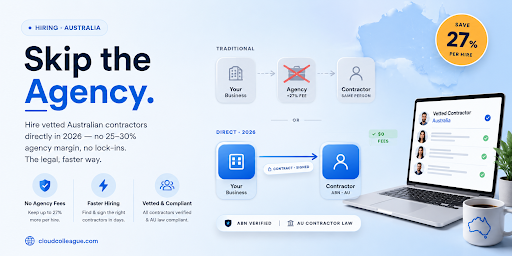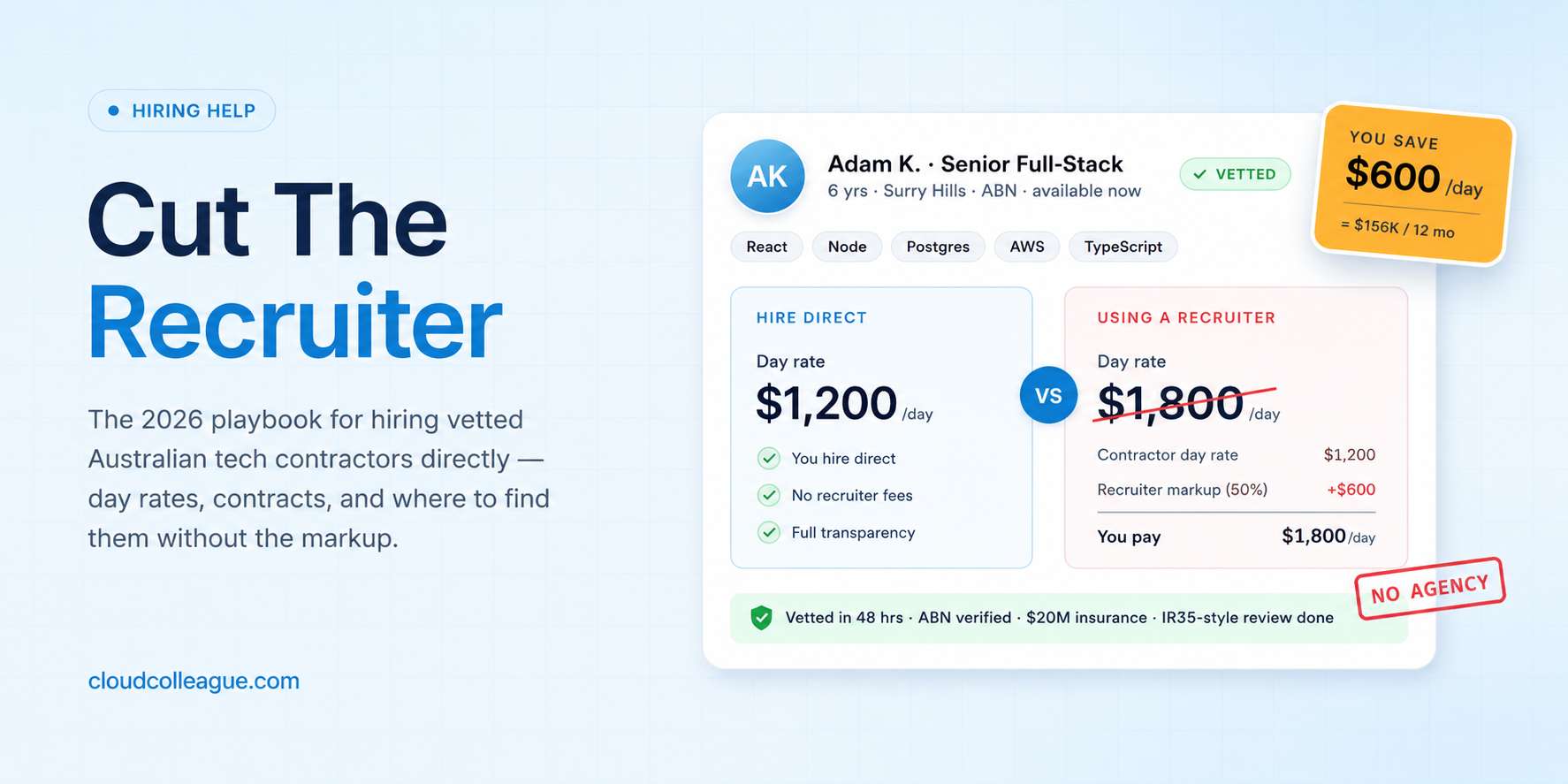
Tech recruitment agencies in Australia charge between 18 and 30 percent on contractor day rates. On a six-month engagement at $1,000 a day, that is up to $36,000 in fees a business never sees the work for. In 2026, Australian startups, scale-ups and even enterprise teams are routing more of their tech contracting directly, saving the markup, getting faster turnaround, and building closer relationships with the contractors they actually want to keep.
This guide is for engineering leaders, founders and operations managers who want to hire IT and software contractors in Australia without going through a traditional recruitment agency. It covers day rates, contract structures, tax and classification rules, and the platforms and processes that make direct hiring fast and safe.
Why Direct Tech Contracting Has Taken Off in Australia in 2026?
Three forces drove the shift:
- Mass remote work broke the geographic monopoly that agencies relied on.
- Verified contractor profiles removed the agency’s traditional quality filter.
- Modern hiring marketplaces added matching, escrow and reference systems that mimic the agency stack at a fraction of the cost.
The result: businesses now reach the same Australian tech contractor pool that agencies have, without the 20-percent overhead.
Read Next: How Australian Healthcare Businesses Can Find Casual and Contract Staff Online?
How to Find a Reliable Home Cleaning Service in Australia Through Online Platforms in 2026?
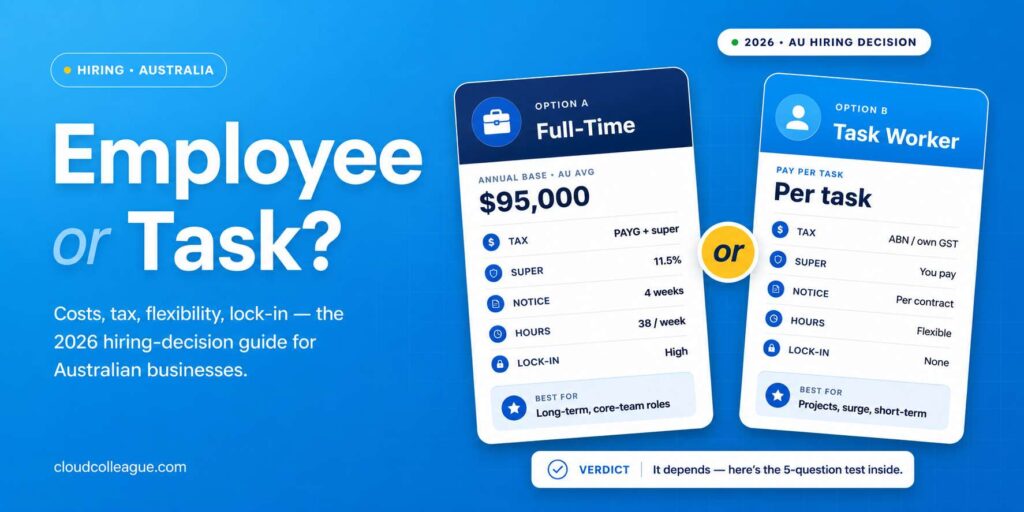
When to Hire a Tech Contractor vs an Employee?
Before picking a contractor over an employee, get clear on the work. Hire a contractor when:
- The work is project-based with a clear end state (e.g. “build the new payments service” or “migrate from AWS to GCP”).
- You need a specialist skill you cannot justify hiring full-time.
- You are validating a new product line before committing to a permanent team.
- You need to scale capacity for 3 to 12 months without long-term headcount.
- The role is highly specialised (cloud security architect, ML engineer, embedded systems) and you cannot find or afford a permanent hire.
Hire an employee instead when:
- The work is core, ongoing, and unbounded in scope.
- You need someone integrated into culture, mentorship and roadmap.
- The role demands long-term context and relationships across the org.
- You can offer competitive compensation and a growth path.
For most tech orgs in 2026, the right answer is a hybrid: a small permanent core plus a contractor bench for specialised or peak-demand work.
2026 Tech Contractor Day Rates in Australia.
These ranges reflect direct-hire day rates for Australian-based contractors, excluding agency markups:
| Role | Junior (AUD/day) | Mid (AUD/day) | Senior (AUD/day) |
| Frontend developer (React, Vue) | $550 – $800 | $800 – $1,200 | $1,200 – $1,700 |
| Backend developer (Node, Python, .NET, Java) | $600 – $850 | $850 – $1,250 | $1,250 – $1,800 |
| Full-stack developer | $600 – $850 | $850 – $1,300 | $1,300 – $1,800 |
| Mobile developer (iOS / Android / RN / Flutter) | $650 – $900 | $900 – $1,350 | $1,350 – $1,900 |
| DevOps / SRE | $700 – $1,000 | $1,000 – $1,500 | $1,500 – $2,200 |
| Cloud architect (AWS / Azure / GCP) | $900 – $1,200 | $1,200 – $1,700 | $1,700 – $2,500 |
| Data engineer | $700 – $1,000 | $1,000 – $1,500 | $1,500 – $2,100 |
| Data scientist / ML engineer | $800 – $1,100 | $1,100 – $1,700 | $1,700 – $2,400 |
| AI / LLM engineer | $900 – $1,300 | $1,300 – $1,900 | $1,900 – $2,800 |
| Cybersecurity engineer | $900 – $1,300 | $1,300 – $1,900 | $1,900 – $2,800 |
| QA / Test automation | $550 – $800 | $800 – $1,200 | $1,200 – $1,700 |
| UX / UI designer | $600 – $850 | $850 – $1,300 | $1,300 – $1,800 |
| Tech program manager | $900 – $1,300 | $1,300 – $1,800 | $1,800 – $2,500 |
Rates are higher in Sydney and Melbourne, slightly lower in Brisbane, Adelaide and Perth, and meaningfully lower in regional Australia. Specialist niches (defence-cleared, regulated industries, cutting-edge AI) carry an additional 15 to 40 percent premium.
For comparison, going through an agency typically adds 18 to 30 percent on top of these rates, with no improvement in quality at the contractor end.
Step 1 – Scope the Engagement Properly.
Tech contracting failures almost always trace back to vague scoping. A high-quality scope brief contains:
- The problem statement: what business outcome the contractor is solving.
- The deliverables: concrete shippable artifacts (services, features, migrations, integrations).
- Acceptance criteria: how “done” is judged (tests passing, load metrics, code review approval).
- The current stack: languages, frameworks, cloud, tools.
- The team interface: who they report to, who they collaborate with, what meetings they attend.
- Engagement length: fixed term, indefinite with notice, or milestone-based.
- Time zone and onsite expectations.
Spend an hour on this before you post. It dramatically improves both the quality of applications you receive and the speed of onboarding once you select.
Step 2 – Classify the Engagement Correctly.
The ATO and Fair Work Ombudsman look at the substance of the relationship, not the contract label. A genuine IT contractor in Australia:
- Holds an ABN and invoices for services.
- Provides their own equipment (laptop, dev environment).
- Controls how the work is performed within agreed deliverables.
- Can subcontract or delegate (within agreed terms).
- Carries commercial risk (rework at own cost if quality fails).
- Often works for multiple clients.
If you direct the contractor’s hours daily, provide their laptop, integrate them like a staff member, and they work exclusively for you for years, the ATO may classify them as an employee regardless of the contract.
Get classification wrong and you face backpay obligations, superannuation arrears, and penalties. When in doubt:
- Use the ATO’s employee/contractor decision tool
- Get an accountant or employment lawyer to review the engagement structure
- Consider whether the contractor should engage via their own Pty Ltd company, which adds a layer of formality
Step 3 – Choose the Right Engagement Structure.
The four most common tech contractor engagement structures in Australia in 2026:
- Time and materials (T&M): Daily or hourly rate, billed monthly. Best for open-ended discovery or ongoing capacity.
- Fixed-price project: Lump sum tied to defined deliverables and milestones. Best for well-scoped projects.
- Capped T&M: Hourly billing with a project cap. Best when scope is mostly clear but with some uncertainty.
- Retainer: Set fee for set hours per month. Best for specialist consulting (architecture review, security, fractional CTO).
For most non-trivial engagements, capped T&M or milestone-based fixed-price gives the right balance of flexibility for the contractor and risk control for you.
Step 4 –Find Tech Contractors Without an Agency.
Three main direct-hire channels in Australia in 2026:
- Hiring marketplaces like CloudColleague, strong for tasks, contracts and full-time roles with suitability matching and built-in payments.
- LinkedIn – strong for direct outreach to senior contractors and specialists.
- Specialist tech freelancer networks – niche platforms for vetted senior engineers.
- Your existing network – referrals consistently outperform every other channel for senior tech roles.
For most mid- and senior-level tech engagements, a marketplace plus targeted LinkedIn outreach gets you a quality shortlist within 5 to 10 business days.
| Skip the agency markup on your next tech hire.Post your contract role free on CloudColleague and reach Australian tech contractors directly. |
Step 5 – Vet Tech Contractors the Right Way.
Skill verification is the most important step, and the one agencies sometimes do poorly. Structure your vetting:
1. Portfolio and CV review (15 min): Look for relevant production experience, not just framework familiarity. A senior backend engineer should have shipped systems at scale, not just done tutorials.
2. Technical screen (45–60 min video call): Conducted by an engineer on your team, not just a hiring manager. Focus on:
- System design at the level of the engagement
- Code walk-through of a real past project
- Specific debugging or trade-off scenarios
3. Paid trial task (1–4 hours, paid at full rate): The single best predictor of fit. A small, real piece of work scoped from your actual codebase or system. Pay the contractor regardless of whether you proceed.
4. References (2 recent, ideally Australian): Ask outcome questions: what did they ship, what did they own, what mistakes did they make, would you rehire?
Total vetting effort: 4 to 8 hours of your engineering team’s time per shortlisted contractor. Well worth it for engagements over $20,000.
Step 6 – Write a Tight Contractor Agreement.
A minimum tech contractor agreement in Australia covers:
- Scope of work with deliverables and acceptance criteria.
- Engagement structure (T&M, fixed-price, retainer) with rate and billing cycle.
- Payment terms typical for Australia in 2026 is net 14 to net 30, with milestone payments for fixed-price work.
- IP assignment of work product to your business on payment.
- Confidentiality with NDA clauses for sensitive systems and data.
- Termination with notice period (often 1 to 4 weeks) and payment for work completed.
- Independent contractor declaration.
- GST treatment and ABN evidencing.
- Insurance requirements (professional indemnity for advisory work, public liability where relevant).
- Background and security checks for engagements involving sensitive data.
Marketplaces like CloudColleague provide template engagement contracts that handle most of this. For enterprise work or regulated industries, run the template past an Australian employment or commercial lawyer the first time.
Step 7 – Onboard the Contractor Like a Team Member.
The fastest way to lose ROI on a tech contractor is poor onboarding. A solid first-week plan:
- Day 1: Access to repos, dev environment, cloud, comms tools, documentation; intro to engineering manager and product owner.
- Day 2–3: Architecture overview, recent ADRs, current sprint context, code review standards, branch and PR conventions.
- Day 4–5: First small PR shipped (intentionally low-stakes); 30-minute end-of-week check-in.
- Week 2: First real feature or task with full review cycle.
- Week 3–4: Independent delivery with checkpoints.
Treat the contractor like a senior engineer you trust, with clear context and clear ownership. The best contractors are wasted if used as junior pair-programmers.
Step 8 – Manage the Engagement Without Micromanaging.
Best practices for ongoing tech contractor management:
- Weekly written status update from the contractor – what shipped, what is in flight, what is blocked.
- Single point of contact on your team to avoid contradictory directions.
- PR-level visibility through the same tools your team uses (GitHub, GitLab, Linear, Jira).
- Code review by your engineers as standard, not optional.
- Monthly invoicing review to keep budget tracking accurate.
- Periodic skip-level check-ins to catch friction early.
Contractors thrive on clear expectations and the autonomy to deliver against them. The companies that get the most from contractors do this well; the ones that micromanage end up with mediocre output and burned relationships.
Tax and Compliance Considerations.
Key Australian tax considerations for tech contractor hiring in 2026:
- GST. Contractors with annual turnover above $75,000 are GST-registered and will charge 10 percent GST. Claim it back if you are GST-registered.
- Personal Services Income (PSI) rules. If the contractor’s income from you is wholly or principally labour, the ATO’s PSI rules may apply on their side. Not your problem to manage, but worth knowing about.
- PAYG withholding. Generally not required for ABN-holding contractors, but applies if the contractor does not quote an ABN.
- Superannuation. Generally not payable to a genuine contractor, but is payable if the contract is wholly or principally for the contractor’s labour. The ATO has specific guidance.
- Payroll tax. State-based rules may treat regular long-term contractors as employees for payroll tax purposes. Check your state’s thresholds.
For most contract engagements under 6 months with multi-client contractors, these issues are straightforward. For longer or more integrated engagements, get an accountant’s review.
Cost Comparison: Direct Hire vs Agency
A real example, hiring a senior backend developer for a 6-month engagement at $1,300/day:
| Cost Item | Via Agency | Direct via Marketplace |
| Contractor rate | $1,300/day | $1,300/day |
| Agency markup (22%) | $286/day | $0 |
| Effective day rate | $1,586/day | $1,300/day |
| 6-month total (120 working days) | $190,320 | $156,000 |
| Platform fee (direct) | $0 | ~$2,000 |
| Internal time (sourcing, screening) | ~10 hours | ~25 hours |
| Total cost difference | +$32,320 vs direct | Baseline |
Direct hiring costs a bit more internal time. It saves about $30,000 on a single 6-month engagement, which buys back that time many times over.
Common Mistakes Australian Businesses Make Hiring Tech Contractors Direct.
A short hit-list:
- Skipping the paid trial task. Single biggest predictor of fit. Always do it.
- Choosing on rate alone. A $700/day contractor who delivers $1,800/day output is cheaper than a $1,200/day one who barely ships.
- Vague scoping. “Help us with our backend” is not a scope.
- Lack of clear ownership. Contractors need a single point of contact and accountable area.
- Treating contractors like employees. Creates classification risk and damages the engagement.
- No exit plan. Always agree on knowledge transfer and documentation as part of the engagement, not as an afterthought.
Hire Tech Talent the Modern Way.
Hiring tech contractors in Australia without a recruitment agency in 2026 is faster, cheaper and increasingly the default. Get the scope right, classify the engagement properly, vet thoroughly, and use a platform with built-in payments and contract tools and you will fill specialist roles in days for a fraction of agency cost.
| For employers: Hire a Tech Contractor on CloudColleague and reach Australian engineers and specialists directly. |
| For contractors: Start as a seeker and browse tech related tasks on CloudColleague.and start receiving direct contract invitations from Australian tech teams. |
Frequently Asked Questions
Yes, completely. Agencies are a convenience, not a legal requirement.
You pay GST if the contractor is GST-registered (turnover over $75,000). You can claim the GST back if your business is also GST-registered.
$1,300 to $1,800 per day for direct hire, depending on stack, city and specialism. Going through an agency typically adds 20 to 30 percent.
Yes, with tax, withholding, IP and time zone considerations. For sensitive systems or regulated industries, an Australian-based contractor is usually simpler.
Through a modern marketplace, qualified profiles typically appear within 24 to 48 hours of posting. Most direct contract hires complete in 7 to 14 days from posting to signed contract.
Both work. Pty Ltd arrangements add a small layer of compliance and reduce some classification risk. For longer or higher-value engagements, Pty Ltd is often preferred by both sides.
Professional indemnity insurance is standard. Public liability is often required for onsite work. Cyber insurance is increasingly expected for security-sensitive engagements.
Strong IP assignment clauses in the contract, payable on milestone or completion. Marketplaces with built-in templates handle this clearly.