Asking “how much does a freelancer cost in Australia” is a bit like asking how much a car costs. The honest answer is “it depends on the type, the brand, and how you use it.” But Australian businesses still need a real number to budget against in 2026, so this guide gives you that by skill, by experience level, and by engagement type.
You will find current hourly and project rates across the most-hired freelance categories, plus a breakdown of platform fees, GST, and the hidden costs that catch first-time hirers off guard.
What Drives a Freelancer’s Rate in 2026?
Five factors set a freelancer’s rate in Australia:
- Skill scarcity. Senior cloud engineers cost more than generalist VAs because supply is tighter.
- Experience and portfolio. A freelancer with 10 years and a strong portfolio charges 2 to 3 times what a junior does.
- Engagement length. Retainers and ongoing work get a discount versus one-off projects.
- Risk and complexity. Tight deadlines, ambiguous scope, and high-stakes deliverables add a premium.
- Location. Australian-based freelancers cost more than offshore equivalents and usually deliver more on local context, time zones and accountability.
Understanding these factors helps you read quotes and negotiate fairly.
Read Next: How Australian Small Businesses Can Hire Without Paying Agency Fees in 2026?
Average Hourly Rates by Freelancer Type in Australia in 2026.
The table below shows typical 2026 hourly rates for Australian-based freelancers, by skill area and experience level. These reflect direct-hire pricing through marketplaces, not agency-marked rates.
| Freelancer Type | Junior (AUD/hr) | Mid-Level (AUD/hr) | Senior (AUD/hr) |
| Virtual assistant | $25 – $40 | $40 – $60 | $60 – $90 |
| Bookkeeper | $40 – $60 | $60 – $90 | $90 – $130 |
| Social media manager | $35 – $55 | $55 – $85 | $85 – $130 |
| Content writer | $50 – $80 | $80 – $120 | $120 – $180 |
| SEO specialist | $60 – $90 | $90 – $140 | $140 – $220 |
| Graphic designer | $50 – $80 | $80 – $120 | $120 – $180 |
| Video editor | $55 – $85 | $85 – $130 | $130 – $200 |
| Web developer | $70 – $100 | $100 – $150 | $150 – $220 |
| Mobile developer | $80 – $120 | $120 – $170 | $170 – $250 |
| UX/UI designer | $80 – $120 | $120 – $170 | $170 – $230 |
| Data analyst | $80 – $120 | $120 – $170 | $170 – $230 |
| Marketing strategist | $80 – $130 | $130 – $190 | $190 – $280 |
| Accountant (advisory) | $100 – $150 | $150 – $220 | $220 – $350 |
| Legal consultant | $150 – $250 | $250 – $400 | $400 – $700 |
| Photographer / videographer | $80 – $130 | $130 – $200 | $200 – $350 |
These are guideline ranges. Specialist niches (cybersecurity, AI engineering, fractional CFO) often command 30 to 50 percent above the senior range.
Typical Project Pricing for Common Australian Engagements.
Most freelancers also offer fixed-price project work. Common 2026 ranges:
| Project | Typical Range (AUD) |
| Logo design | $300 – $2,500 |
| Brand identity package | $1,500 – $8,000 |
| One-page landing site | $800 – $3,500 |
| Small Shopify store (10–20 products) | $2,500 – $8,000 |
| Custom WordPress site | $3,500 – $15,000 |
| Mobile app MVP | $15,000 – $80,000 |
| SEO audit | $700 – $3,500 |
| Monthly SEO retainer | $1,500 – $6,000 / month |
| Monthly bookkeeping (small biz) | $300 – $1,500 / month |
| Social media management (3 channels) | $800 – $3,500 / month |
| Video edit (5 min explainer) | $400 – $2,500 |
| 1,500-word SEO article | $250 – $900 |
| Whitepaper or eBook | $1,500 – $7,500 |
Use these as sanity-check ranges, not absolutes. A clear scope of work always produces a more accurate quote than a generic task.
Platform Fees: What You Actually Pay on Top?
Most freelance marketplaces in Australia charge a service fee. The fee structure varies, but the major categories are:
- Worker-side fees. Charged to the freelancer on their earnings, often 10 to 20 percent.
- Employer-side fees. Charged to the business on each transaction, often 3 to 8 percent.
- Subscription plans. Some platforms (including CloudColleague) offer monthly or annual employer plans that reduce or eliminate per-transaction fees for businesses that hire regularly.
For a one-off small project, the per-transaction model is fine. For ongoing or higher-volume hiring, a subscription plan typically wins on total cost.
| Hiring more than once a month? Explore CloudColleague employer plans and reduce per-engagement fees. |
GST: When You Pay It and When You Do Not?
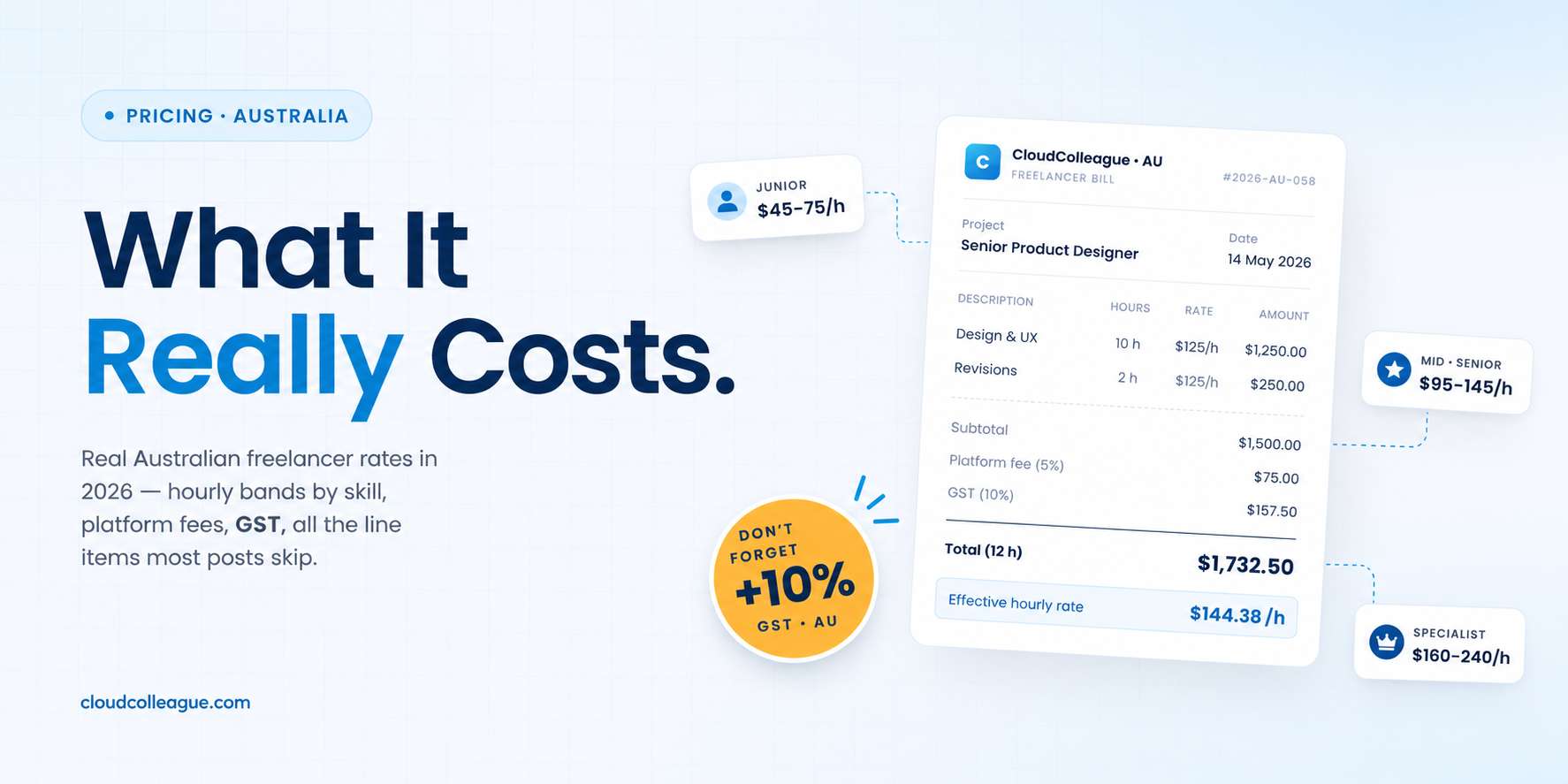
A freelancer in Australia must register for GST once their annual turnover exceeds $75,000. If they are registered:
- Their invoice will include 10 percent GST
- You can claim that GST back if you are GST-registered yourself
If they are not GST-registered:
- The invoice does not include GST
- No GST credit is available to you
Always confirm GST status before signing. A $5,000 quote could be $5,000 or $5,500 depending on the answer.
Hidden Costs Most First-Time Hirers Forget.
Beyond the headline rate, budget for:
- Onboarding time. Even great freelancers need 2 to 8 hours of onboarding before they hit full speed.
- Rework. First drafts and first builds almost always need iteration. Budget 15 to 25 percent of project cost for revisions.
- Tool and license costs. Stock images, font licences, software subscriptions, third-party APIs.
- Project management. Your time managing the freelancer is real pay. For complex projects, this can equal 10 to 20 percent of the freelancer’s time.
- Disputes and abandoned projects. Rare on vetted platforms, but real. Budget a small contingency.
A useful rule of thumb: take the quoted project cost and add 20 to 30 percent for true total cost.
Australian Freelancers vs Offshore: Real Cost Comparison.
Offshore freelancers (Philippines, India, Eastern Europe, Latin America) cost 50 to 80 percent less per hour. Whether the savings are real depends on the work.
Offshore tends to work well for:
- High-volume, well-scoped, low-context tasks
- Technical work with clear specifications
- Around-the-clock support models
- Established offshore partnerships with senior leads
Australian-based freelancers tend to win on:
- Local cultural and legal context (compliance, tone, market norms)
- Time zone alignment for real-time work
- Faster turnaround on small iterative changes
- Stakeholder-facing work that needs Australian voice
- Trust-sensitive work like finance, legal, healthcare
For most small Australian businesses, a hybrid model works best: Australian freelancers for trust- and context-sensitive work, offshore for volume execution under an Australian lead.
Are you in confusion on full time vs task worker? Read : Hiring a Full-Time Employee vs a Task Worker in Australia.
How to Get the Best Value?
A few practical tactics:
- Write a clear scope. Vague scopes attract padded quotes. Specific scopes attract honest ones.
- Ask for 2 to 3 quotes. Use them to calibrate, not just to negotiate down.
- Offer a trial task. Pay for a small first task before committing to a larger project.
- Pay milestones, not lump sums. Reduces risk on both sides.
- Build relationships. Repeat work usually costs less than constant new sourcing.
- Use suitability matching. Platforms that match by skill and context save you screening time, which is real money.
The freelancers worth keeping cost a bit more than the average. The ones below market rate often cost the most in rework and missed deadlines.
Cost Breakdown: Real-World Examples
1: A new website for a Sydney café
- Senior web designer for a 6-page WordPress site
- Project cost: $4,500
- Platform fee (employer side, ~5%): $225
- Stock images and theme licence: $250
- Internal time (briefing, review, content): ~8 hours
- Total true cost: ~$5,500
2: Monthly bookkeeping for a 5-person business
- Mid-level bookkeeper on retainer
- Monthly fee: $650 (includes 8 hours)
- Annual cost: $7,800
- Annual platform fee: ~$300
- Internal time (sending invoices, receipts): ~3 hours/month
- Total annual true cost: ~$8,100
3: A 3-month marketing strategist engagement
- Senior marketing strategist, 8 hours/week
- Hourly rate: $180
- 3 months: ~$17,300
- Tools and ads budget passed through: $3,500
- Total true cost: ~$21,000
Run the numbers for your own work before committing. Budgets that look reasonable at the headline rate often blow out at the line-item level.
Budget Smart, Hire Smarter
Hiring a freelancer in Australia in 2026 is more affordable than most businesses assume – and more variable than headline rates suggest. Get clear on scope, budget for total cost (not just the rate), and use a marketplace with transparent fees and suitability matching to keep your time-cost down.
| For employers: Start your hiring journey and get matched with Australian freelancers in your budget range. |
| For freelancers: Browse Tasks on CloudColleague, price your services, and bid with confidence using current Australian rates. |
Frequently Asked Questions
Most Australian freelancers in 2026 charge between $50 and $200 per hour, depending on skill and seniority. Specialist niches can charge $250 to $500+.
Almost always yes, agency markups typically add 50 to 100 percent on top of the freelancer’s rate.
Generally no, but yes for contracts that are wholly or principally for the freelancer’s labour. Check the ATO’s super for contractors guide.
Local cost of living, tax, compliance, and the value of time zone, context and accountability.
20 to 30 percent is a safe buffer for onboarding, revisions and tools.
Only if the freelancer is GST-registered. Confirm before signing.
For one-off small projects, transactional fees are fine. For repeated hiring, a subscription plan or platform credit model wins on total cost.