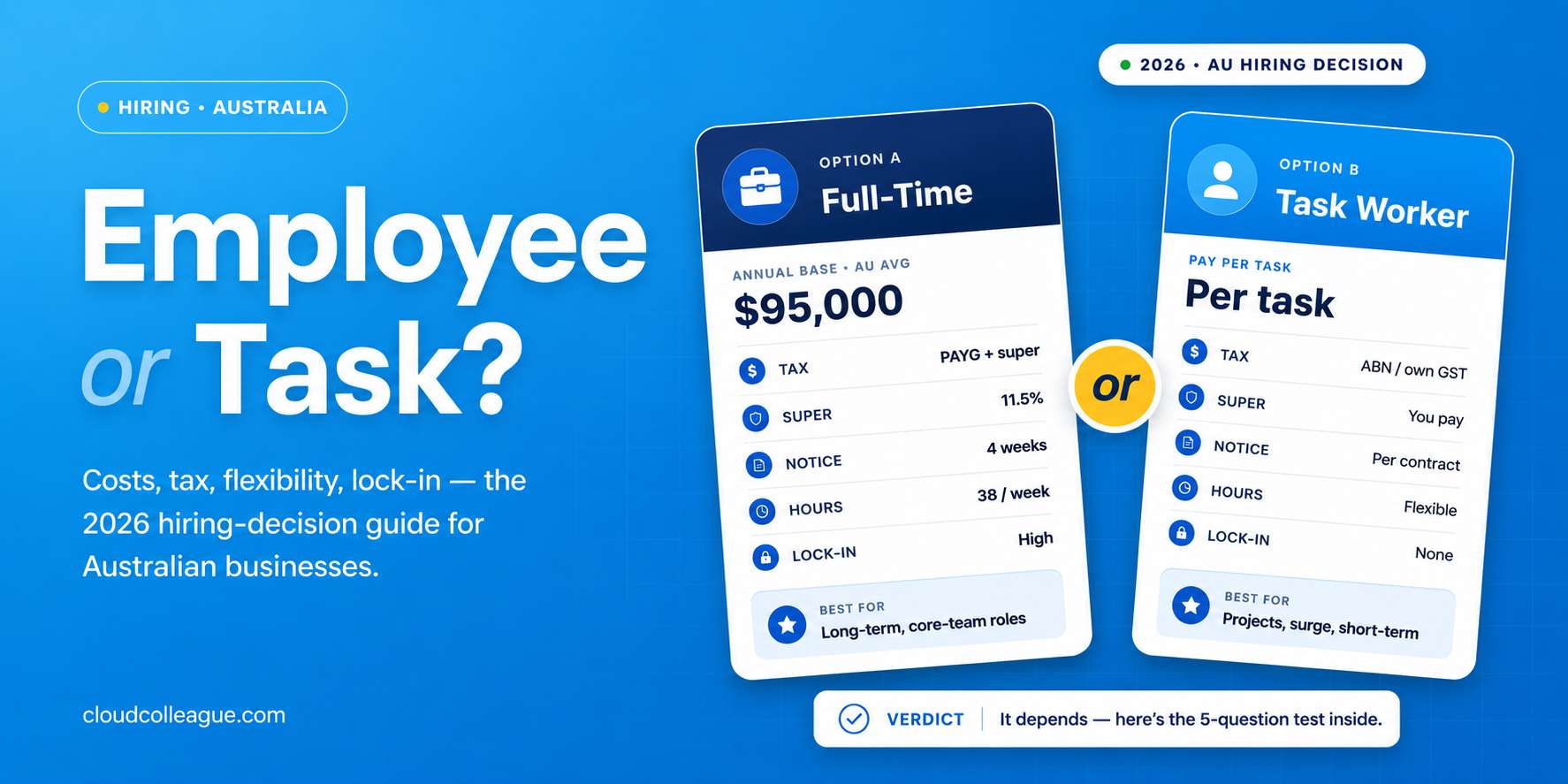
When a small Australian business has work that needs doing, the first question is rarely “who do we hire”, it is “what kind of hire is this.” Full-time employee? Casual? Contractor? Task worker?
Getting this decision right matters. It changes the cost, the legal obligations, the flexibility, and the long-term shape of your business. Getting it wrong creates tax and Fair Work risk that can outlast the role itself.
This guide compares the four main options Australian businesses use in 2026 full-time employee, part-time employee, casual employee, and task worker or contractor and helps you choose the right model for the actual work in front of you.
The Four Main Worker Types in Australia.
Every working arrangement in Australia falls into one of these categories:
| Worker Type | Relationship | Typical Use Case |
| Full-time employee | Ongoing, 38 hours/week | Core long-term roles |
| Part-time employee | Ongoing, fixed hours under 38/week | Predictable ongoing work |
| Casual employee | No firm advance commitment to hours | Variable demand |
| Task worker / contractor | Independent, project or ongoing | Specific deliverables or specialist work |
The choice is not about preference. It is about the substance of the work and the legal tests that flow from it.
Full-Time Employee: When the Work Is Core and Permanent?
A full-time employee in Australia works on average 38 hours per week on an ongoing basis. They are entitled to the full National Employment Standards: paid annual leave, paid sick leave, public holiday pay, notice of termination, redundancy pay (where applicable), and superannuation.
Pick a full-time employee when:
- The role is core to your business and will exist for years
- You need consistent availability and team integration
- The output is too varied to scope as projects or tasks
- You want to invest in long-term skills and culture
- Compliance, security or trust requirements demand it
Full cost to budget for: the salary plus roughly 25 to 30 percent in superannuation, leave loading, payroll tax (where applicable), workers’ compensation insurance, recruitment, equipment and onboarding. A $90,000 salary in 2026 typically costs $115,000 to $120,000 fully loaded.
Part-Time Employee: When You Need Reliability but Not Full Hours?
A part-time employee has the same entitlements as a full-time employee, pro-rated to their hours. They have set regular hours each week and a predictable roster.
Pick a part-time employee when:
- The work is ongoing but does not need 38 hours
- You need predictable coverage (school-hours, mornings, weekends)
- You want loyalty and continuity but at a lower commitment
- You are scaling and a part-time hire can grow into full-time
Part-time is the most underused worker type in Australia. For many small businesses, two part-timers are more flexible and resilient than one full-timer.
Casual Employee: When Demand Is Genuinely Variable?
A casual employee has no firm advance commitment to ongoing hours. They are paid a casual loading (typically 25 percent on top of the base rate) instead of paid leave. They can usually accept or refuse shifts.
Pick a casual employee when:
- Demand is genuinely variable and unpredictable
- You operate seasonally or in shifts (hospitality, retail, events)
- You need a pool of workers rather than a fixed roster
- The arrangement might convert to permanent if patterns stabilise
| Important: “Casual” is a legal category, not a synonym for “flexible.” If you give a casual worker regular, predictable hours over a sustained period, Fair Work may treat them as part-time or full-time regardless of the contract label. Casual conversion rules also apply after 12 months of regular work. |
Task Worker / Contractor: When the Work Has Defined Scope?
A task worker or contractor is an independent business. hey invoice for their services, retain control over how the work is performed, and typically serve multiple clients. Consequently, they are generally not entitled to employment benefits such as paid leave or superannuation.
Pick a task worker or contractor when:
- The work is project-based with clear deliverables
- You need a specialist skill you cannot justify hiring full-time
- The engagement is short-term or variable in duration
- You want flexibility on both sides without long-term commitment
- The worker genuinely operates as their own business
Common 2026 task worker engagements:
- A bookkeeper for 8 hours a month
- A web developer for a 6-week project
- A graphic designer on retainer
- A marketing strategist for a quarterly review
- A handyman for a property maintenance task
- A virtual assistant for ongoing admin support
| Need a task worker? Post your task free on CloudColleague and get matched with vetted Australian contractors. |
The Legal Tests That Decide What You Actually Have.
The trap most Australian businesses fall into: calling someone a contractor in the contract but treating them like an employee in practice. The ATO and Fair Work Ombudsman look at the substance, not the label.
The main factors they consider:
- Control. Who decides how, where and when the work is done?
- Tools and equipment. Who provides them?
- Delegation. Can the worker subcontract or send a substitute?
- Commercial risk. Does the worker carry risk of profit and loss?
- Mode of payment. Wages on a payroll, or invoices with GST?
- Integration. Is the worker part of your business or a separate one?
- Exclusivity. Do they work for others or only for you?
If most of the answers point to your business controlling the work, providing the equipment, and integrating the person; it is probably employment, regardless of what the contract says.
Cost Comparison: Employee vs Task Worker
Let’s compare two real examples for the same volume of work roughly 10 hours per week of bookkeeping:
Option A: Part-Time Employee Bookkeeper
- Hourly rate: $40
- 10 hours/week × 52 weeks = $20,800 base
- Superannuation (12% in 2026): $2,496
- Leave entitlements (pro-rated): ~$1,600
- Payroll tax, workers comp, admin: ~$1,200
- Total annual cost: ~$26,100
Option B: Bookkeeper as Task Worker
- Hourly rate: $70 (higher because contractor sets own price and covers own overheads)
- 10 hours/week × 52 weeks = $36,400
- No super, no leave, no payroll tax
- Total annual cost: ~$36,400
In this example, the part-time employee is cheaper on paper. But the contractor model wins if:
- You only need 4 hours some weeks and 15 others
- You want zero admin overhead (no payroll, no super, no leave management)
- You may scale up or down within 12 months
- The skill is specialist and worth the hourly premium
The right answer depends on the variability and longevity of the work, not just the headline rate.
Decision Framework: Which Hire Should You Make?
Ask these five questions in order:
1. Is the work ongoing and core, or finite and specialist?
Ongoing and core → employee. Finite or specialist → task worker.
2. Is the workload predictable or variable?
Predictable → part-time or full-time. Variable → casual or task worker.
3. Do you need control over how the work is done?
Yes → employee. No → task worker.
4. Will the worker work only for you, with your tools?
Yes → employee. No → task worker.
5. Are you ready to take on payroll, super and leave?
Yes → employee. Not yet → task worker.
Three or more answers in the “task worker” column? Hire a task worker. Three or more in the “employee” column? Hire an employee.
Hybrid Models That Australian Businesses Use in 2026.
Most growing businesses do not pick one and stop. Common hybrid setups:
- Core team + contractor bench. A small team of employees plus a roster of trusted task workers who scale up and down with demand.
- Trial via contract, convert to employee. Bring in a task worker, see how they perform, then offer employment if both sides want to commit.
- Job-sharing or fractional hires. Two part-timers covering one full-time role, often used for specialist skills like CFO or Head of Marketing.
Modern hiring marketplaces like CloudColleague support this hybrid pattern in one platform where you can post a task today and convert that worker into a contract or job tomorrow.
Tax and Compliance Differences at a Glance.
| Obligation | Employee | Contractor / Task Worker |
| PAYG withholding | Yes | Usually no (contractor invoices) |
| Superannuation | Yes (12% in 2026) | Generally no, with exceptions |
| Workers compensation | Yes | Sometimes – check state rules |
| Payroll tax | Yes, if threshold | Sometimes – check state rules |
| Annual / sick leave | Yes | No |
| Notice of termination | Yes | Per contract |
| ABN required | No | Yes |
| GST | No | Yes if turnover > $75k |
Always confirm specifics with an accountant or the ATO. State rules vary, especially for payroll tax and workers compensation.
Still in confusion how to post a job? Read : How to Post a Job in Australia.
When You Should Not Use a Task Worker?
A few situations where employment is the safer choice:
- Customer-facing roles requiring uniforms, training and policy adherence.
- Roles requiring access to confidential systems, finances or client data.
- Roles that have run for years under the same person doing the same hours.
- Anything that would attract scrutiny under Fair Work’s sham contracting rules.
If a Fair Work inspector looked at the role, would they call it employment? If yes, hire an employee.
Pick the Right Worker for the Real Work.
The choice between a full-time employee and a task worker in Australia is not about cost alone. It is about the nature of the work, the variability of demand, and the long-term shape of your business. Get the classification right and everything downstream – tax, compliance, culture, cost gets easier.
| For employers: Start your hiring journey at CloudColleague and choose the worker type that matches the work. |
| For workers: Browse Jobs and Freelance tasks on CloudColleague and access both employment and contracting opportunities across Australia. |
Frequently Asked Questions
They can, but the more regular and exclusive the arrangement, the more it starts to look like employment to the ATO. Variable hours, multiple clients and a clear scope keep the contractor classification clean.
Generally no, but yes if the contract is wholly or principally for the contractor’s labour. The ATO has specific guidance and a decision tool.
Calling someone a contractor when the relationship is really employment, to avoid leave, super and tax obligations. It is illegal under the Fair Work Act and carries significant penalties.
Yes, and this is a common path. You renegotiate the engagement, sign an employment contract, and onboard them onto payroll.
No. A casual employee is still an employee with PAYG, super and casual loading. A task worker is an independent business that invoices you.
Use the ATO’s employee/contractor decision tool. It walks through the factors and gives a classification result you can keep on file.
For variable, low-volume specialist work, a task worker is usually cheapest in total cost. For consistent ongoing work, a part-time employee often wins.