Posting a job in Australia is easy. Posting a job that actually attracts qualified, available, suitable applicants is much harder and the difference between the two usually comes down to the ad, the platform, and the screening process behind it.
This guide walks through exactly how to post a job in Australia in 2026, from writing the ad to choosing the platform to setting up a screening process that does not waste your time or theirs. Whether you are hiring your first employee, a contractor, or replacing a key role, the approach is the same.
Why Do Most Job Ads Fail in Australia?
If you have posted a job and received either no applicants or hundreds of irrelevant ones, the ad is almost always the cause. The three most common failure modes:
- Too vague. “Looking for a great team member to join our growing company.” This tells the candidate nothing.
- Too long. Walls of corporate text. Senior candidates scroll past.
- Missing key details. No salary range, no location clarity, no clear deliverables.
In 2026, candidates have options. The job ad is your sales pitch to them as much as their application is their sales pitch to you. Treat it that way and the applicant quality improves dramatically.
Step 1 – Get Clear on the Role Before You Write.
Before opening any job posting form, write down:
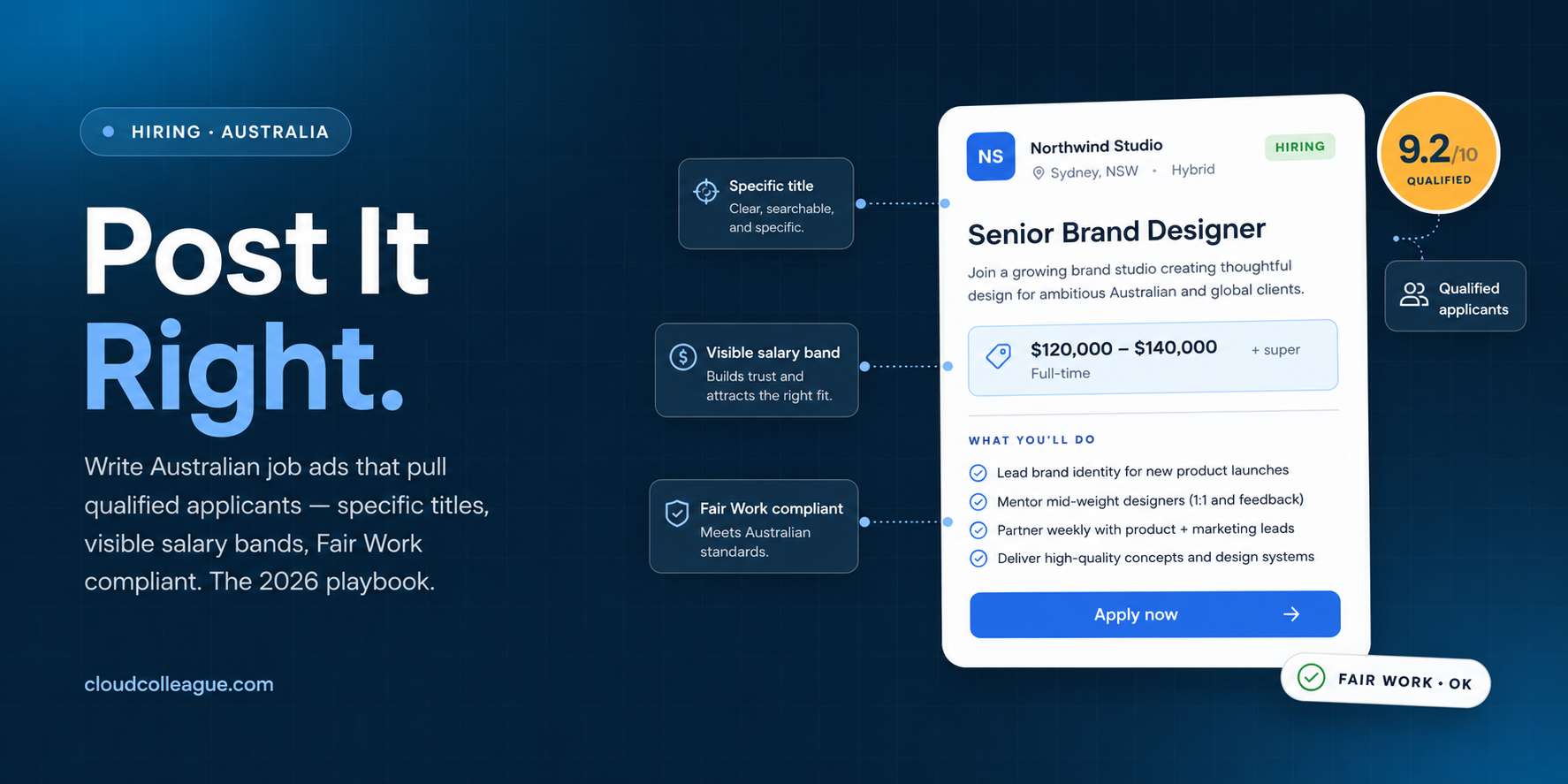
- The job title – accurate, searchable, free of internal jargon.
- The reason this role exists – what problem the hire is solving?
- Three to five core deliverables – what success looks like in the first 90 days?
- Must-have vs nice-to-have skills – and be honest about which is which.
- Salary or rate range – within market for the role and location.
- Work arrangement – onsite, hybrid, remote, hours per week.
- Reporting line – who they work with and report to?
If you skip this step, the ad will be vague and the applicants will reflect that.
Step 2 – Write a Job Title That People Actually Search For.
This is the most under-optimised part of most Australian job ads. The job title is also a search query. Internal titles like “Customer Joy Specialist” or “People & Culture Wizard” do not match how candidates actually search.
Use the title that the candidate would type:
- “Customer Service Representative” beats “Customer Joy Specialist”
- “Marketing Coordinator” beats “Brand Storyteller”
- “Senior Accountant” beats “Numbers Ninja”
If the role is unusual, anchor it to a familiar title with a qualifier for example “Marketing Coordinator (Content & Social)” rather than “Brand Storyteller (Content & Social).”
Step 3 – Write the Job Description in Plain English.
A high-performing Australian job ad in 2026 follows a simple structure:
1. One-line summary. Who you are, who you need, and where. Example: “Sydney-based eCommerce brand looking for a part-time Bookkeeper, 10 hours per week, remote.”
2. About us (3–4 sentences). Real, specific, no fluff. What you do, who you serve, what stage you are at.
3. About the role. A short paragraph plus a bulleted list of the 5–8 most important responsibilities. Talk about outcomes, not activities.
4. About you. Must-have skills, qualifications and experience. Keep this list short. Every extra requirement reduces applicant volume by an estimated 8 to 10 percent and disproportionately filters out underrepresented candidates.
5. Nice-to-haves. A separate, shorter list. Helps candidates self-select.
6. What you will get. Salary range, benefits, work arrangement, growth path. This is your sales pitch.
7. How to apply. Clear instructions, a deadline, and one or two pre-screening questions that confirm the candidate read the ad.
Aim for 350 to 600 words total. Long enough to be useful, short enough to be read.
Step 4 – Always Include a Salary Range.
This is the single biggest lever for improving applicant quality in Australia in 2026. Job ads with salary ranges receive:
- More applications from passive candidates
- Higher quality applications
- Faster time to hire
- Less wasted time on calls that go nowhere on money
If you cannot publish an exact figure, publish a band. “$75,000 – $85,000 base plus super” is better than “competitive salary.”
Pay transparency is also increasingly expected and, in some states and roles, increasingly regulated. Get ahead of it now.
Step 5 – Be Specific About Location and Work Arrangement.
“Remote” without a country is useless. “Hybrid” without a city is useless. Australian job ads should clearly state:
- City and state (e.g. Sydney, NSW)
- Days per week onsite, if hybrid
- Whether interstate applicants are welcome
- Whether overseas applicants are welcome
- Time zone if fully remote
This single change cuts irrelevant applications by 40 to 60 percent.
Step 6 – Choose the Right Platform for the Role.
Not every Australian job platform suits every role. Use the table below as a rough guide:
| Role Type | Best Platform Type |
| Skilled professional or contract role | General hiring marketplace like CloudColleague |
| Casual physical task | Task platform like Airtasker |
| Senior corporate role | LinkedIn plus industry network |
| Hospitality, retail and trades | Industry-specific boards |
| Internship or graduate role | University career portals and graduate-focused boards |
For most small and mid-sized businesses, a general hiring marketplace handles 80 percent of job types in one place and removes the friction of managing postings across multiple sites.
| Ready to post? Post your first job free on CloudColleague and reach Australian candidates with built-in suitability matching. |
Step 7 – Use Screening Questions That Actually Screen.
Two or three short screening questions filter out 60 to 80 percent of weak applications. The right questions are:
- Specific to the role
- Answerable in 50 to 200 words
- Not Googleable
- Focused on judgement, not knowledge
Examples for a marketing role:
- “What is one campaign you have run that did not work, and what did you change because of it?”
- “We need someone who can write a blog post in two hours, not two days. Walk us through how you would do that.”
Examples for an admin role:
- “Describe how you would manage a calendar with three competing priorities for the same time slot.”
- “What software do you currently use to manage tasks and why?”
Avoid questions like “Why do you want this role?” They invite generic answers and rarely separate good from great.
Step 8 – Set Up the Interview Process Before You Post.
A common mistake: post the job, get applicants, then start figuring out interviews. By then candidates have moved on.
Before posting, decide:
- Stage 1: Application review and screening question check (2–3 days)
- Stage 2: 20-minute video interview with hiring manager (1 week)
- Stage 3: Paid trial task or skills assessment (3–5 days)
- Stage 4: Final interview and reference checks (1 week)
- Offer and start date
Communicate this timeline in the ad. Candidates appreciate clarity and drop off less often when they know what to expect.
Step 9 – Follow Fair Work and Anti-Discrimination Rules.
Australian job ads must comply with the Fair Work Act and federal and state anti-discrimination law. The main rules:
- Do not specify gender, age, ethnicity, religion or disability status as requirements unless there is a genuine occupational requirement.
- Do not advertise rates below the relevant award or minimum wage.
- Be accurate about hours, location and conditions.
- If hiring on a visa, comply with sponsorship and labour market testing rules.
When in doubt, the Fair Work Ombudsman website is the definitive Australian reference.
Step 10 – Respond to Every Applicant.
This is the easiest reputation lever in hiring. Even a one-line “thanks, we have moved forward with other candidates” beats silence. Many platforms now include built-in templates for this.
Candidates remember being ghosted, and they tell other candidates. In a market where you may need to hire again in 6 months, the reputation matters.
Common Mistakes Australian Employers Make When Posting Jobs.
A short hit-list of patterns to avoid:
- No salary range. Cuts quality candidates immediately.
- Excessive must-haves. Especially “10 years experience in a 5-year-old technology.”
- Cliché language. “Rockstar,” “ninja,” “family.” Candidates roll their eyes.
- Vague location. Drives up irrelevant applications.
- No deadline. Encourages procrastination on both sides.
No clear next step. Candidates assume you are disorganised – often correctly.
| Want a real comparison between platforms? Read: Airtasker vs CloudColleague |
Job Ad Template You Can Copy.
Role: [Job Title] Location: [City, State + work arrangement] Type: [Full-time / Part-time / Contract / Casual] Salary: [Range + super or “TBD with experience”]
About us: [3–4 sentences] About the role: [Short paragraph + 5–8 bullets of responsibilities] Must have: [4–6 bullets] Nice to have: [2–4 bullets] What you will get: [Salary, benefits, work arrangement, growth] How to apply: [Process + 1–2 screening questions + deadline]
Fill this template, edit ruthlessly, and post.
Post a Job That Actually Works.
A great Australian job ad in 2026 is specific, honest, scannable, transparent on money, and supported by a clear screening process. Get those five things right and your applicant quality will outperform every “growth hack” or paid promotion strategy.
| For employers: Start your hiring journey on CloudColleague and reach matched Australian candidates fast. |
| For candidates: Browse Jobs and Freelance tasks, create a profile and let qualified roles come to you. |
Frequently Asked Questions
Not in every state and role, but it is increasingly expected and improves applicant quality significantly. Pay transparency rules are tightening.
350 to 600 words is the sweet spot. Long enough to be specific, short enough to be read.
Monday morning and Tuesday morning generally generate the highest applicant volume. Avoid posting late Friday or on public holidays.
For broad roles, yes. For specialist roles, one well-targeted platform usually outperforms three generic ones.
7 to 14 days for most roles. Beyond two weeks, applicant quality drops and the ad starts to look stale.
On most platforms yes. Major changes (title, salary, location) should be flagged so existing applicants are not misled.
Use screening questions, post on platforms with suitability matching, and require a tailored cover answer rather than just a CV upload.