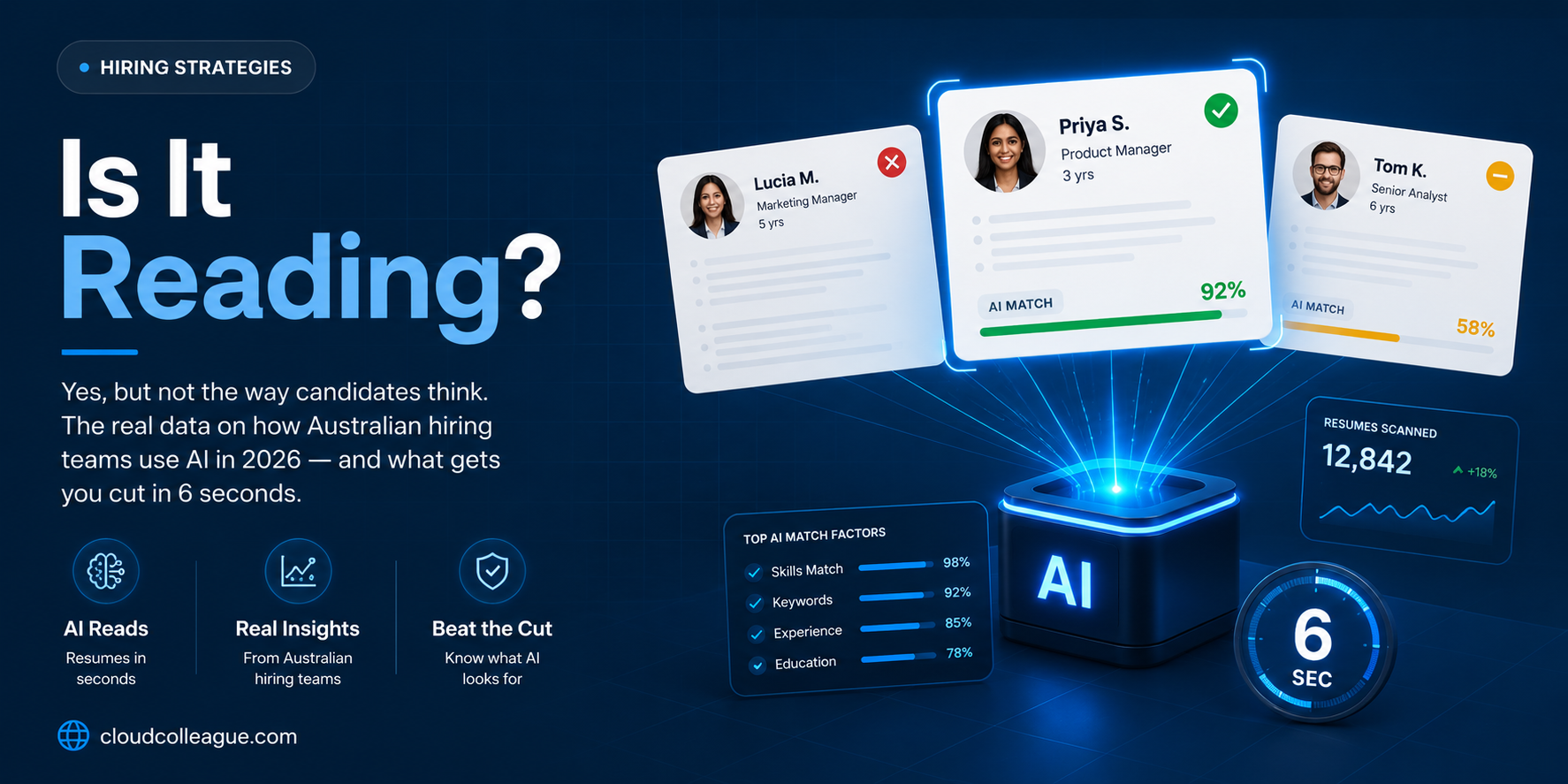
Do hiring managers use AI to screen resumes in 2026? Yes. But the way it works is probably not what you are imagining, and the practical implications are more nuanced than most career advice acknowledges.
According to Resume Genius’s 2026 Hiring Insights Report, which surveyed 1,000 hiring managers, 1 in 5 (19%) use AI to purposefully screen out applications before any human review occurs. That means 4 in 5 do not. What almost all medium and large employers do use is ATS (Applicant Tracking Systems), which is not the same as AI screening, even though both can process your resume before a human reads it.
Understanding the distinction between ATS and AI screening matters enormously for how you approach your resume in 2026. This article covers both, what the data actually shows, what is happening in Australian hiring specifically, and what to do about all of it.
Worried about AI screening? Make sure your resume is targeting the right Australian roles. Browse AI-matched jobs on CloudColleague from 18,000+ verified Australian employers right now.Browse open roles on CloudColleague
The Data: What 2026 Hiring Research Actually Shows
The research picture in 2026 is clearer than it has ever been, and several findings are genuinely surprising.
How Common Is AI Resume Screening?
According to Resume Genius’s 2026 Hiring Insights Report (n=1,000 US hiring managers), 1 in 5 hiring managers (19%) actively use AI to screen out applications before any human review. More than half of companies currently use AI in at least one stage of hiring, according to Resume.org’s survey of 1,399 workers. Of companies that use AI in hiring, 74% say it has improved the quality of their hires.
The trajectory is steep. AI-conducted interviews have tripled from 10% to 34% of companies in just two years (ResumeBuilder longitudinal surveys, 2023 to 2026). Two-thirds of recruiters plan to expand AI pre-screening in 2026.
The key calibration: AI screening is common and growing, but it is not universal. The majority of employers, particularly small and medium businesses, are not using dedicated AI screening tools beyond basic ATS. This matters significantly for how you think about your job search strategy.
The Trust Gap: What Hiring Managers Think vs What Candidates Think
This is the most revealing data point in 2026 hiring research, and it is buried in most articles that cover this topic.
70% of hiring managers trust AI to make hiring decisions. Only 8% of job seekers call AI screening fair. That is a 62-percentage-point gap between employer confidence and candidate trust, and it reflects something real.
65% of job seekers are uncomfortable with companies using AI in recruiting. 90% want companies to disclose how they use AI in their hiring process. But only 29% of companies maintain full human oversight on all AI rejection decisions. Half use AI exclusively for initial screening rejections. 21% allow AI to reject candidates at all stages of the process without any human review.
The candidates who are anxious about AI screening are not being irrational. They are responding to a genuine structural reality: a significant portion of rejections in 2026 are made by systems with no human oversight, and most companies do not disclose this.
The AI Content Detection Arms Race
Here is the counter-intuitive finding that changes how you should think about using AI in your own job search.
About two-thirds of job seekers now use AI when applying for jobs, according to Career Group Companies’ 2025 Market Trend Report. They are writing AI-assisted resumes to pass AI screening. Simultaneously, AI detection of AI-generated content in resumes climbed from 53% to 77% across two years of surveys compiled by CoverSentry.
80% of hiring managers say they can identify AI-written resumes at a glance, according to a 2026 hiring survey. 62% reject unpersonalised AI resumes outright. Nearly 20% reject all AI-written resumes regardless of quality.
The practical implication is counter-intuitive but important. Because most candidates are now submitting AI-generated resumes, and because most hiring managers can detect them and a significant portion reject them, the candidates who write authentic, specific, metric-rich resumes with genuine human voice are now standing out more sharply than they would have three years ago. The AI arms race is creating an unexpected competitive advantage for candidates who do not rely on it.
Understanding the Difference: ATS vs AI Screening
These two technologies are frequently conflated and should not be. Getting this distinction right changes what you should actually do with your resume.
Applicant Tracking Systems (ATS): Format and Keyword Parsing
ATS is the technology that almost all medium and large employers use to receive, store, and organise job applications. When you upload your resume through SEEK, a Workday careers portal, or any employer’s online application system, an ATS receives and processes the document.
The ATS extracts text from your resume and stores it in structured fields: your name, contact details, employment history, education, skills, and other standard categories. It makes your application searchable by recruiters. A recruiter then searches the ATS for candidates who match a role’s requirements, and the system returns a list of candidates whose stored information matches those search terms.
ATS does not make hiring decisions. It organises information and enables search. Passing ATS means your resume was formatted well enough that the system correctly extracted your information into the right fields and made you findable when relevant searches are performed.
The most common ATS failure point is formatting: tables, sidebar columns, text boxes, and non-standard fonts can cause text extraction errors that make your resume unreadable by the ATS even if it looks perfect on screen.
Discover and use free ATS resume guide : Free ATS Resume Template 2026.
AI Screening Tools: The Newer Layer
AI screening tools are a separate, more recent technology that some employers have added on top of their ATS. These tools use machine learning and natural language processing to rank, score, or filter candidates based on predicted fit. Unlike ATS, which passively stores and retrieves information, AI screening tools actively evaluate and rank candidates before any human review occurs.
The 19% of hiring managers who use AI to purposefully screen out applications before human review are using this second layer. They are using tools that go beyond ATS keyword search to score candidates on broader fit criteria, flag anomalies in application data, or rank applicants in ways that a recruiter then acts on.
The important implication is this: even if your resume passes ATS formatting checks and contains relevant keywords, you may still be filtered or ranked low by an AI scoring layer before any human sees your application at employers using these tools.
What AI Screening Tools Actually Evaluate?
Understanding what AI screening tools look for helps you understand what to optimise for beyond basic ATS formatting.
Skill relevance and role match:
Do the skills, experience level, and job title progression in your history align with the requirements of the role? AI systems evaluate the overall trajectory of your career, not just individual keyword presence.
Consistency signals:
Are the dates, titles, and company names in your resume consistent with what appears on LinkedIn and any other accessible profiles? Inconsistencies between your resume and your LinkedIn record create friction in automated screening that may lower your ranking before a human reviews the discrepancy.
Credibility signals:
Do your stated achievements include specific metrics, proper nouns, and specific contextual details that suggest genuine experience? AI systems in 2026 are increasingly trained to evaluate whether achievement claims are supported by the specificity that genuine professional experience produces.
AI-generated content patterns:
80% of hiring managers report being able to identify AI-written resumes. Some AI screening tools also flag likely AI-generated text based on linguistic pattern analysis. The signals include uniform bullet point length across all roles, generic language that could apply to any candidate, absence of specific numbers and proper nouns, and the frictionless phrasing that AI writing produces.
Career gap signals:
Unexplained date gaps create algorithmic friction in some systems. A clearly labelled career break entry with honest context reduces this friction and provides the system with information it can process rather than an ambiguity it flags.
Keyword context:
Modern semantic AI screening tools evaluate whether keywords appear in meaningful, achievement-rich context. “Project management” in a skills list satisfies a keyword search. “Managed a AUD $8M infrastructure program across 14 staff and three sites” demonstrates project management capability in context and is more effective with semantic AI evaluation.
Understanding AI screening. Now find Australian roles worth applying to. Browse AI-matched Tasks on CloudColleague. Bid with confidence to the right targets. Browse Tasks on CloudColleague.
Australian Hiring Technology: What Is Actually Being Used
The specific technology used by Australian employers varies significantly by sector and employer size. This directly affects what type of screening your resume faces, and this context is completely absent from every US-focused article on this topic.
Workday
Commonwealth Bank, Westpac, ANZ, NAB, and most Big 4 consulting firms use Workday for their hiring processes. These employers primarily use ATS-level screening with some AI-assisted shortlisting in high-volume graduate and entry-level intake programs. Single-column resumes with keyword-optimised achievement bullets perform best. The AI layer, where it exists, is primarily used for ranking rather than outright rejection.
Taleo
BHP, Rio Tinto, Woodside, and major resources sector employers commonly use Taleo, which is a legacy ATS with keyword-counting logic rather than semantic AI. Keyword presence and ATS formatting remain the primary screening criteria for these applications. The strategies for legacy ATS optimisation are most relevant here.
Greenhouse
Atlassian, Canva, REA Group, SEEK as an employer, Culture Amp, and most Australian technology companies use Greenhouse, which uses more sophisticated semantic matching. Contextual keyword use in achievement-rich sentences outperforms keyword lists for these applications. The shift toward semantic AI evaluation is most pronounced in this employer category.
PageUp-based portals
NSW Health, Queensland Health, Alfred Health, Monash Health, and most Australian public health services use PageUp-based portals. These systems are primarily ATS-level with human recruiter review for most roles. The AI screening layer is less prevalent in public health than in corporate settings.
HireVue
HireVue is used by some large Australian employers including certain financial services organisations for video interview screening. It uses AI to analyse candidate responses in recorded video interviews, evaluating structure, clarity, and content patterns. If you encounter a HireVue-style recorded video screening, the STAR method (Situation, Task, Action, Result) with specific evidence in each answer is the approach that performs best on both human and AI evaluation criteria.
SEEK’s built-in or email-based application management tools
Small and medium Australian employers (under 200 staff) mostly use SEEK’s built-in application management tools. Or email-based application systems with no dedicated AI screening layer. The AI screening concern is most relevant for applications to large corporate, government, and health service employers through structured ATS portals.
What Bias Risks Exist in AI Hiring?
The trust gap between employers (70% trust AI) and candidates (8% call it fair) is partly explained by the documented bias risks in AI hiring tools.
67% of companies acknowledge that AI hiring tools could introduce bias, according to CoverSentry’s compilation of 2025-2026 research. Research from Brookings and the University of Washington (2025) has documented specific patterns.
Age bias is the most commonly identified type. AI systems trained on historical hiring data that skewed toward specific age groups can replicate those patterns in automated screening. This is particularly relevant in Australia, where age discrimination protections under the Age Discrimination Act 2004 are specifically relevant to recruitment processes.
Socioeconomic bias has been documented in AI systems. It associate specific educational institution names with positive signals, potentially disadvantaging candidates from less affluent educational backgrounds. They should have attended equally rigorous but less prestigious institutions.
Gender bias has been documented in some systems that associate certain job titles and achievement language patterns with specific genders in ways that produce discriminatory ranking outcomes.
For Australian candidates who believe an AI-driven screening process has produced a discriminatory outcome. The Fair Work Act and anti-discrimination legislation in each state and territory provide complaint mechanisms. The Australian Human Rights Commission also accepts complaints related to employment discrimination, including technology-mediated discrimination. The Equal Opportunity and Human Rights Commission in Victoria and equivalent bodies in other states are also relevant.
What Australian Job Seekers Can Do About AI Screening?
Understanding the technology is only useful if it changes what you do. Here is the practical guidance that translates the data above into specific actions.
Fix Formatting First: Pass ATS Before Worrying About AI
The single most important step for any candidate is ensuring their resume passes basic ATS text extraction before worrying about AI scoring layers. Most resume failures in automated screening are formatting failures, not AI detection failures.
Run the copy-paste test before any application: open your PDF, select all text using Ctrl+A or Command+A, copy it, and paste into a plain text editor. If the text appears in the correct reading order and is fully readable, your resume will parse correctly in any ATS. If it is garbled or in the wrong order, fix the formatting issue first.
The formatting requirements for ATS: single-column layout, standard fonts (Calibri, Arial), standard section headings (Work Experience, Education, Skills), no tables, no text boxes, no graphics, consistent date formats throughout.
Use Achievement-Rich, Specific Language as Your Authenticity Signal
Because AI screening tools are now specifically evaluating credibility signals and AI-generated content patterns, the most effective counter is also the best resume writing practice: specific, quantified, contextual achievement bullets.
“Led a cross-functional team of seven analysts to deliver a cost reduction programme that saved AUD $4.2M in annualised spend, completing six months ahead of schedule” cannot be generated by AI without the specific numbers, the specific team size, the specific dollar value, and the specific timeline. These details are simultaneously the authenticity signal that AI systems look for and the most compelling professional evidence that human recruiters respond to.
The counter-intuitive insight from the data: the candidates most protected from AI screening disadvantages are those writing authentic, specific, human-voiced resumes, which are also the candidates most likely to impress human reviewers after they clear AI screening. Both goals point in the same direction.
Embed Keywords in Context, Not in Lists
For AI screening tools using semantic matching (most notably Greenhouse and Lever, which are standard at Australian tech companies), keywords in achievement-rich sentences outperform the same keywords in disconnected skills lists.
“Project management” in a skills list tells a semantic AI system you can do something. “Managed a AUD $8M, 14-person project across three sites, delivering on time and AUD $340K under budget” tells the same system you have done something specific, at a known scale, with a measurable outcome. The second version satisfies both legacy keyword counting and semantic relevance evaluation simultaneously.
Label Career Breaks Clearly
Unexplained date gaps create algorithmic friction in AI screening systems that are trained to flag inconsistencies. A clearly labelled career break entry with dates, a brief reason, and a description of any productive activity during the period gives the system information it can process rather than an ambiguity it flags negatively. This is the same guidance as for human reviewers, for the same underlying reason.
For Video AI Screening: Use Structure and Specificity
If you encounter a recorded video interview screened by HireVue or a similar platform, the evaluation criteria for both AI and human review converge on the same characteristics: structured answers (STAR method), specific examples with concrete numbers, and clear connection between your experience and the requirements of the role. Generic answers without specific context score poorly on both human and AI evaluation. Prepare your STAR method stories before any video screening session.
What Australian Job Seekers Specifically Need to Know
Most small and medium Australian employers (under 200 staff) are not using dedicated AI screening tools beyond SEEK’s basic search functionality. The AI screening concern is most relevant for large corporate applications through structured ATS portals. If your target employers are primarily small businesses, community organisations, or SMEs, your primary focus should be ATS formatting and keyword relevance rather than AI detection concerns.
AI Effect on Government
The regulatory environment in Australia is evolving. The Fair Work Act reform discussions, the Albanese government’s focus on AI governance, and increasing attention from the Australian Human Rights Commission to technology-mediated discrimination suggest that AI hiring practices will receive increasing regulatory scrutiny in Australia over the next two to three years. Employers are aware of this trajectory and many are developing ethical AI hiring frameworks proactively.
AI Used in Hiring Process
90% of job seekers want companies to disclose how AI is used in their hiring process. Several major Australian employers have published or are developing AI ethics frameworks that include hiring process transparency. When researching an employer, checking their careers page or annual report for any reference to responsible AI use can give you useful context about what their screening process looks like.
CloudColleague’s Role
CloudColleague’s AI matching differs from employer-side AI screening in a specific and important way. CloudColleague surfaces candidates to employers based on skills and experience alignment, using a transparent, skills-first approach that is designed to be visible to candidates. Creating a complete CloudColleague seeker profile with specific skills descriptions. It gives you an additional discovery channel alongside traditional resume applications. One that is designed to work with your skills profile rather than against it.
Resume optimised for both ATS and AI screening. Find Australian roles to target. Create a free verified profile on CloudColleague and get AI-matched to 18,000+ verified Australian employers hiring right now.Get started free on CloudColleague
Hiring and want to find the right candidates efficiently? Post a role on CloudColleague in under five minutes. Smart matching surfaces pre-vetted professionals across every Australian industry.Start hiring on CloudColleague
Frequently Asked Questions
Sometimes, but far less often than most candidates think. Most employers use ATS platforms to organise applications, not AI systems that automatically reject candidates. True AI screening tools that actively rank or filter resumes are still used by a minority of employers. In practice, ATS formatting failures are far more common than AI-based rejection.
Most employers do not openly disclose it. Look for references to “automated screening,” “technology-assisted hiring,” or “AI-supported recruitment” on careers pages or job descriptions. Large employers sometimes publish hiring technology or AI ethics policies. You can also infer the ATS platform from the application portal, such as Workday, Greenhouse, or Taleo.
Use AI as an assistant, not as the writer. AI tools help with structure, wording, and keyword alignment, but recruiters increasingly recognise generic AI-generated language instantly. Strong resumes combine AI efficiency with specific human detail: measurable achievements, named projects, exact metrics, and authentic experience.
ATS stores, organises, and searches applications. AI screening goes further by ranking or filtering candidates based on predicted fit. ATS problems are usually formatting-related. AI screening issues are usually content-related, such as vague language, low specificity, or generic AI-generated phrasing.
Research suggests it can be. Bias can emerge when AI systems are trained on historical hiring patterns that already contained human bias. In Australia, protections under the Age Discrimination Act and anti-discrimination laws still apply even when technology is involved in hiring decisions.