Recruitment agencies charge Australian small businesses $8,000 to $30,000 per hire in 2026, sometimes more. For a 5- or 10-person company, that is a serious dent in cash flow for a single role. The fees are not wrong; they reflect real sourcing and screening work. But the assumption that you need an agency to hire well is no longer true.
This guide is for small business owners and operators who want to start as a employer and fill quality roles in 2026 without the agency markup. It covers the full direct-hiring playbook sourcing, screening, interviewing, references, contracts and onboarding in a way that is realistic for a business without a dedicated HR team.
What Australian Recruitment Agencies Actually Charge?
Standard 2026 agency fee structures:
- Permanent placements: 12 to 25 percent of first-year salary
- Executive search: 25 to 33 percent of first-year package, often with retainer fees
- Temp / contract placements: 25 to 50 percent markup on the contractor’s day rate
- Retained search: $10,000 to $40,000 paid in milestones whether or not a hire is made
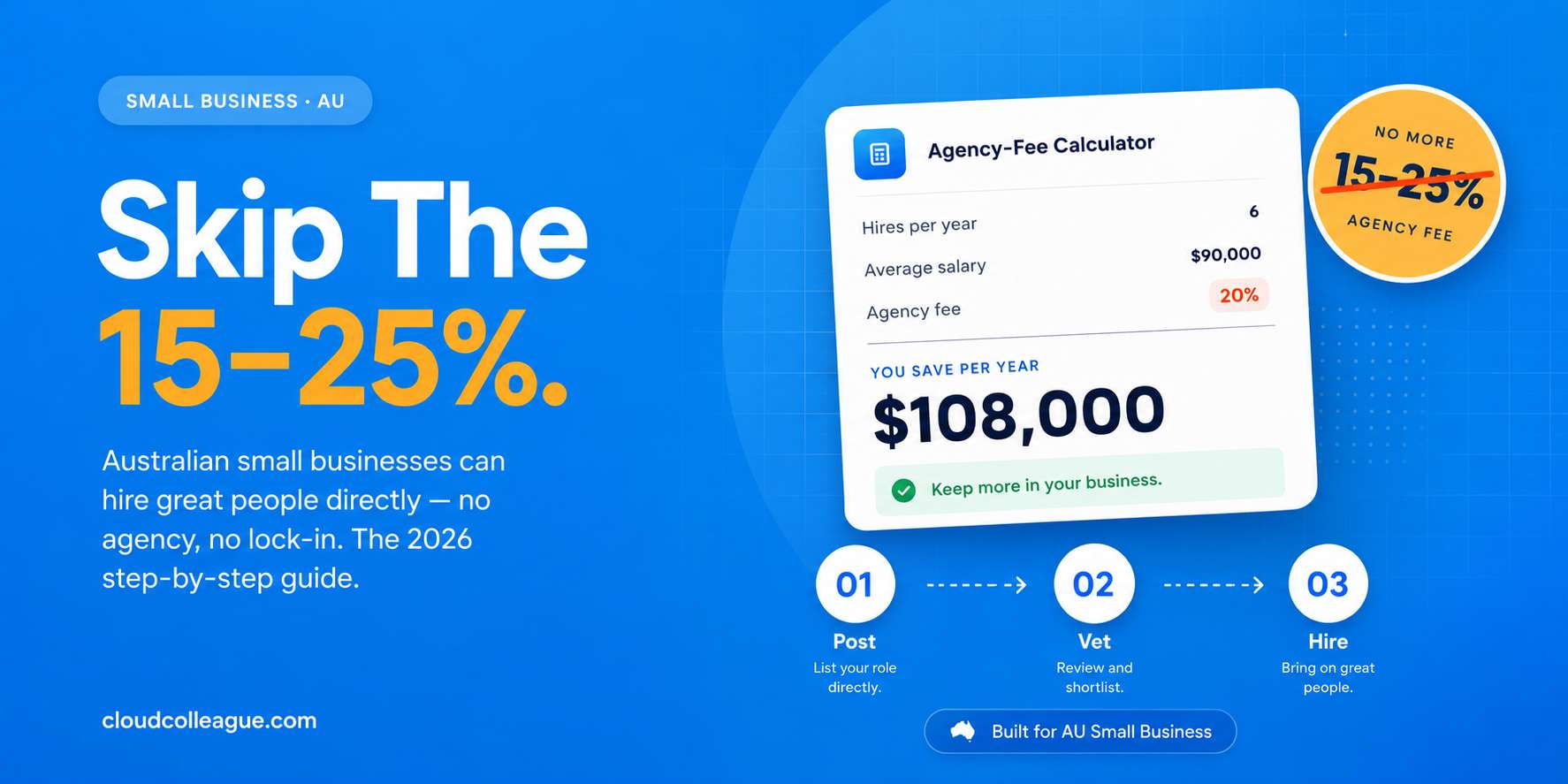
On an $85,000 marketing coordinator role, a 17 percent agency fee is $14,450 for one hire. For most small Australian businesses, that fee equals 1 to 2 months of operating margin.
What Agencies Actually Do (and What You Can Replace)?
To skip the agency cleanly, you need to know what you are replacing. An agency typically delivers:
- Sourcing – finding suitable candidates
- Initial screening – eliminating unqualified applicants
- Reference and background checks – verifying claims
- Negotiation support – landing the offer
- Replacement guarantee – usually 3 to 6 months
You can replicate every one of these as a small business in 2026 with the right platforms, processes and templates. Here is how.
Step 1 – Replace Sourcing With a Modern Hiring Marketplace.
Sourcing used to require agency networks. In 2026, modern hiring marketplaces give you direct access to the same candidate pool agencies tap into, often with better matching.
Your options as a small Australian business:
- General hiring marketplaces like CloudColleague – one platform for tasks, contracts and full-time roles with suitability matching built in
- LinkedIn – strong for senior and specialist roles, but you do the filtering
- Industry-specific boards – useful as supplements, not as your primary source
- Referrals from your network – still one of the highest-converting sources for small business
For most small Australian businesses, a general hiring marketplace covers 70 to 80 percent of roles cleanly, with the remainder filled through referrals or specialist boards.
| Skip the agency fee on your next hire. Post your role free on CloudColleague and reach matched Australian candidates directly. |
Step 2 – Build a Repeatable Job Brief.
A good agency starts with a kickoff call to build a brief. You can do the same internally in 30 to 45 minutes. Your brief should cover:
- The why. What problem is this hire solving? What changes when they start?
- The deliverables. Three to five concrete outcomes for the first 90 days.
- The must-haves. Skills and experience the role genuinely requires.
- The nice-to-haves. What pushes a candidate from good to great.
- The dealbreakers. Things a candidate must have, beyond skills (location, availability, work rights).
- The package. Salary range, benefits, work arrangement, growth.
Write this once per role, and reuse the template every time. It saves hours per hire.
Step 3 – Write the Job Ad to Filter, Not Just Attract.
A common small business mistake is writing job ads to maximise applications. Agencies want maximum applications because they screen them. You want maximum qualified applications because you screen them.
Tactics that reduce noise:
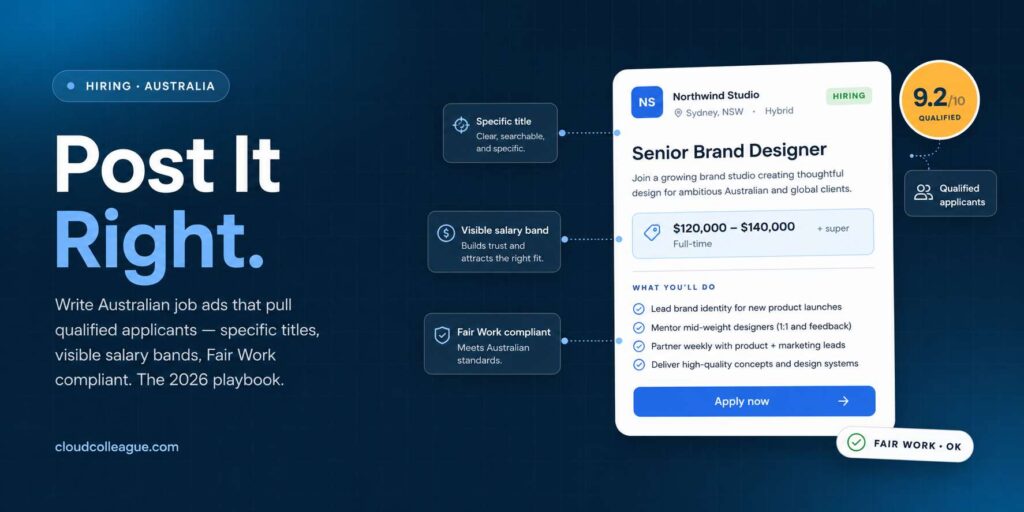
- Publish a salary range
- State exact location and work arrangement
- Include one or two screening questions
- Be specific about what success looks like
- Avoid jargon and clichés
This single shift writing to filter rather than attract reduces unqualified applications by 50 to 70 percent.
Step 4 – Screen With Structure, Not Gut Feel.
Agencies use structured screening scripts. You can build a simple version in an hour. A small business screening template:
Round 1 – Application Review (15 min per candidate)
- Do they meet the must-haves? (Yes / No)
- Did they answer the screening questions specifically? (Yes / No)
- Is their portfolio or CV evidence-based? (Yes / No)
Only candidates with three “Yes” answers move to Round 2.
Round 2 – 20-Minute Phone or Video Call
- Why this role, why now?
- One question testing the top must-have
- One question testing communication and clarity
- Salary expectation confirmation
- Availability and start date
Score each candidate 1 to 5 on four factors: skill, communication, motivation, fit. Set a cutoff (e.g. minimum 14/20) for moving forward.
Round 3 – Paid Trial Task or Skills Assessment
A small paid task (2 to 4 hours) reveals more than any further interview. Pay even if you do not proceed.
Round 4 – Final Interview and References
The final interview is for the senior decision-maker and for the candidate to interview you back. References come at this stage, not earlier.
Step 5 – Run Reference Checks That Mean Something
Agency references are sometimes thorough, sometimes a checkbox. You can do better by:
- Asking the candidate to nominate two recent direct managers
- Calling references rather than emailing you hear what you would miss in writing
- Asking outcome-based questions (“What did they actually ship in their first 90 days?”)
- Asking the “would you rehire” question, and listening for hesitation
- Asking about how the person handled mistakes or pushback
Modern platforms like CloudColleague offer structured reference collection that standardises this and stores it in the candidate’s profile.
Step 6 – Skip the Negotiation Drama.
Without an agent in the middle, negotiation actually gets simpler. Best practices:
- Be clear on your range from the first conversation
- Make the verbal offer on the phone, follow up in writing within 24 hours
- Cover salary, super, leave, start date, equipment and remote arrangement in one document
- Give the candidate 3 to 5 business days to decide
- Be willing to walk away from a candidate who is shopping you against multiple offers
Most small business hires close quickly when both sides have been transparent about money from the start.
Step 7 – Get the Contract Right.
Without an agency, the contract is yours to manage. The four contract types you will use most:
- Employment contract (full-time, part-time, casual) – covers position, hours, pay, leave, notice, IP, confidentiality
- Contractor agreement – covers scope, deliverables, payment terms, IP assignment, independent contractor status
- Casual employment agreement – covers irregular hours, casual loading, conversion rights
- Letter of offer – short summary that sits with the formal contract
Use a standard Australian template (Fair Work, the ATO, and reputable HR providers all have templates) and have your accountant review the first one. After that, you can reuse the template across multiple hires.
Step 8 – Onboard Properly to Protect the Investment.
Agency placements come with replacement guarantees because early-departure risk is real. The cheapest way to reduce that risk is to onboard well. A 30-day onboarding plan for a small business hire:
- Day 1: Workspace, accounts, introductions, paperwork, expectations
- Week 1: Shadowing, light first tasks, daily check-in
- Week 2: Independent first deliverable, end-of-week debrief
- Week 3–4: Full ownership of one outcome, weekly 1:1
- Day 30: Formal review, calibrate expectations, fix what is not working
Onboarding done well doubles the chance of a hire staying past 12 months. Onboarding done poorly is the most common reason placements fail.
What It Costs to Hire Direct vs Via an Agency?
Real example – hiring a $90,000 marketing coordinator in Melbourne:
| Cost Item | Via Agency | Direct via Marketplace |
| Agency fee (17%) | $15,300 | $0 |
| Platform fee | $0 | ~$300 |
| Internal time (sourcing, screening) | ~4 hours | ~16 hours |
| Background and reference checks | Included | ~$150 |
| Contract template | Provided | Free or one-off cost |
| Total | ~$15,300 | ~$1,400 |
Direct hiring costs you more time and slightly more admin. It costs you dramatically less money. For most Australian small businesses, the trade is well worth it.
Want to hire a freelancer ? Read our guide on: How Much Does It Cost to Hire a Freelancer in Australia.
When You Should Still Use an Agency?
Direct hiring is not always right. Use an agency when:
- The role is highly specialised and the talent pool is small
- You need confidentiality (e.g. replacing someone still in the role)
- You are hiring at C-level and the candidate set is networked rather than searchable
- The role has been open for months and direct hiring has failed
- You genuinely do not have the time to run a process
For 80 percent of small business hires, direct hiring works. For the 20 percent above, agency support is a fair use of fees.
Tools That Replace the Agency Stack
Modern direct hiring runs on five pieces of tech, most of which are free or cheap:
- A hiring marketplace for sourcing and matching
- A simple ATS or spreadsheet for tracking candidates
- Video calls for interviews
- A shared drive for portfolios and assessments
- A standardised contract template
Platforms like CloudColleague bundle the first three into one workflow, which removes most of the tool-juggling.
Common Mistakes Small Businesses Make Going Direct
A short hit-list:
- Underestimating screening time. Block 4 to 8 hours per role for proper review.
- Skipping the trial task. It is the single biggest predictor of fit.
- Inconsistent process across candidates. Use the same questions and scoring.
- Slow communication. Top candidates take other offers if you go quiet for a week.
- No onboarding plan. The first 30 days set the next 12 months.
Fix these five and direct hiring outperforms most agency processes on quality, not just cost.
Hire Direct, Hire Well
Australian small businesses do not need to pay $15,000 to fill a role anymore. With a clear brief, a strong job ad, a structured process and a modern hiring marketplace, you can replace the agency stack at a fraction of the cost – and often with a better outcome.
| For employers: Start your hiring journey with CloudColleague and run a complete hiring process without agency fees. |
| For candidates: Browse full-time jobs and freelance task on CloudColleague and apply directly to Australian small businesses hiring this week. |
Frequently Asked Questions
For most roles, yes. The platforms and templates that used to be agency-only are now available directly.
Agencies typically deliver shortlists in 2 to 6 weeks. Direct hiring via a modern marketplace often produces matched candidates in 2 to 5 days, with the bottleneck shifting to your internal process.
Senior executive, highly specialised technical roles, and confidential replacements. For these, agency support can pay for itself.
Yes, with templates, structure and discipline. Most small business hires are run by the founder or operations lead.
Done well, no. Done poorly (no process, vague ads, slow comms), yes. The platform matters less than the process around it.
Most contracts include a probation period (usually 6 months) that gives both sides flexibility. Direct hiring does not give you an agency replacement, but the savings cover several rounds of re-hiring.
On average, slightly yes, likely because the process surfaces motivation more clearly and the candidate engages directly with the business from the start.