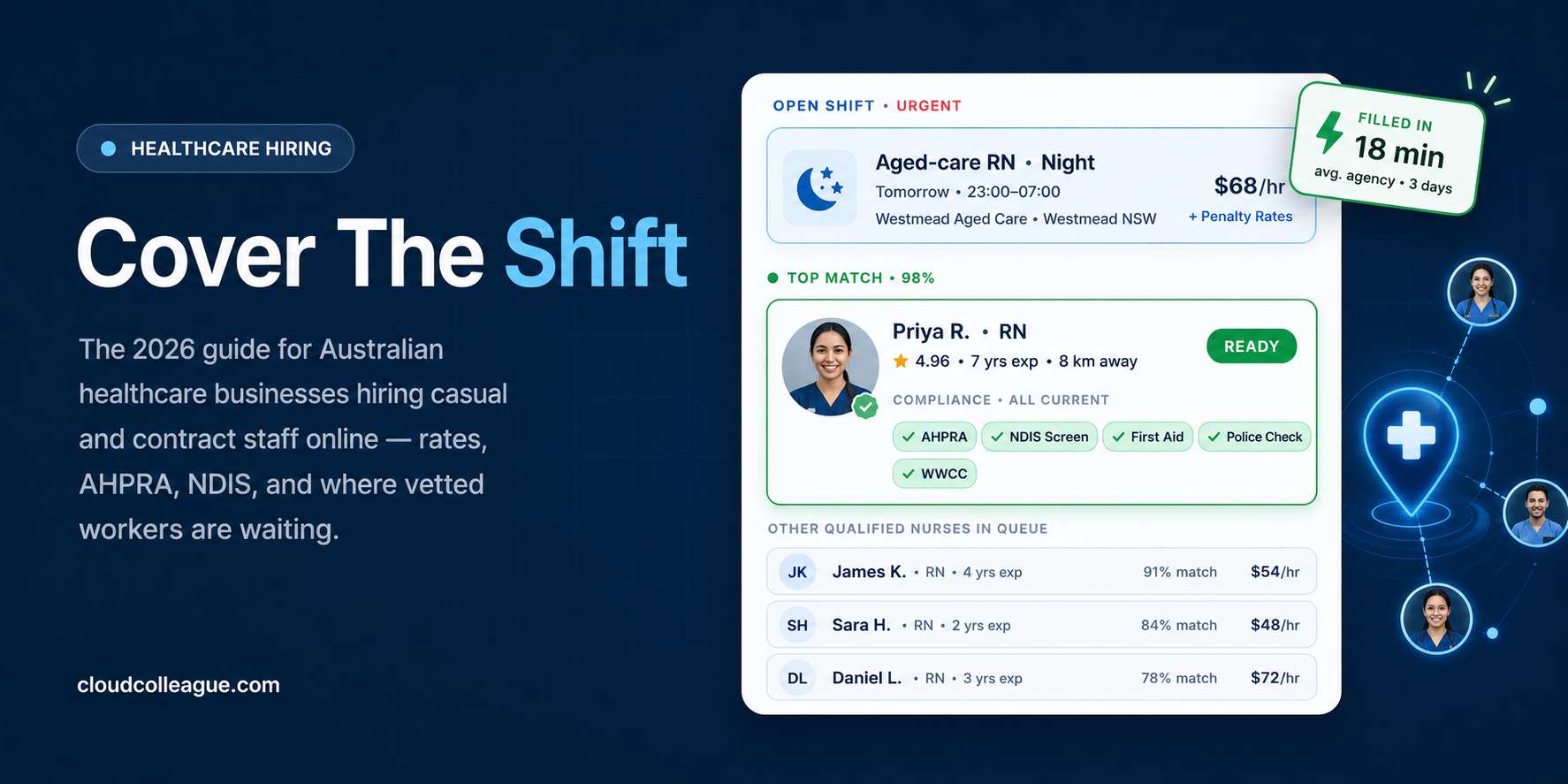
Australian healthcare is in a sustained workforce squeeze in 2026. Hospitals, residential aged care, NDIS providers, GP clinics, allied health practices and private home care services are all competing for the same limited pool of nurses, support workers and allied health professionals. Traditional locum agencies still play a role, but their fees, often 30 to 50 percent on top of the worker’s rate, have pushed healthcare businesses to look for direct alternatives.
This guide is for practice managers, clinic owners, aged care operators and NDIS providers who want to find quality casual and contract healthcare staff online in Australia in 2026, without the agency markup, and without compromising on compliance, safety or care quality.
Why Are Healthcare Businesses Hiring Direct in 2026?
Three forces are reshaping healthcare staffing:
- Workforce shortages across nursing, aged care and allied health that look likely to last the decade.
- NDIS expansion created sustained demand for support workers, support coordinators and allied health.
- Cost pressure on private healthcare, NDIS providers and aged care making the 30 to 50 percent locum agency markup unsustainable.
- Modern hiring platforms now offer AHPRA verification, police checks, NDIS Worker Screening checks and qualification records in one workflow.
The result: direct hiring of casual and contract healthcare staff is no longer a workaround. For many small and mid-sized providers, it is now the default.
Read Next: How to Hire a Tech Contractor in Australia Without Recruitment Agency?
How to Find a Reliable Home Cleaning Service in Australia?
Who You Can Hire on a Casual or Contract Basis in Healthcare?
A non-exhaustive list of casual and contract healthcare roles routinely hired online in Australia in 2026:
- Registered Nurses (RNs) for hospital, aged care, community and home care.
- Enrolled Nurses (ENs) for aged care and community settings.
- Assistants in Nursing (AINs) and personal care workers for aged care and disability.
- Disability support workers for NDIS-funded clients.
- Mental health support workers.
- Allied health professionals – physiotherapists, occupational therapists, speech pathologists, psychologists, exercise physiologists, podiatrists, dietitians.
- Pharmacists and pharmacy assistants.
- Medical practice managers and receptionists.
- Medical scribes and clinical admin staff.
- Sonographers and radiographers (less common but growing).
- NDIS supports coordinators and plan managers.
Each role carries different registration, screening and compliance requirements, which we cover further down.
Step 1 – Define Whether You Need Casual, Contract, or Both.
Before posting, decide which arrangement fits the work:
- Casual employee. Engaged on an as-needed basis, paid casual loading, accepts or refuses shifts. Best for unpredictable demand and shift coverage.
- Fixed-term contract employee. Engaged for a defined period (e.g. parental leave cover, 6-month project). Full employee entitlements pro-rated to term.
- Independent contractor (sole trader or Pty Ltd). Invoices for services. Best for allied health practitioners running their own practice, or for project-based engagements.
- Locum. Short-term cover, usually for medical or specialist roles, often through the contractor model.
- NDIS sole trader. Allied health and support workers operating their own ABN under NDIS Practice Standards.
The legal and tax structures differ. A misclassified worker triggers backpay, super, leave and penalty risk. The Fair Work Ombudsman and ATO both have detailed guidance, and for healthcare specifically, AHPRA registration requirements add another layer.
Step 2 – Get the Compliance Foundation Right.
Healthcare hiring carries higher compliance stakes than most industries. Before any direct hire, you need to verify:
- AHPRA registration: current, in good standing, with no conditions you need to be aware of…
- Police check – National Police Check, often required within the last 12 months.
- NDIS Worker Screening Check – for any work involving NDIS-funded clients.
- Working With Children Check – if working with anyone under 18.
- Right to work in Australia – visa or citizenship status.
- Vaccination status – per your state’s healthcare worker requirements.
- Mandatory training – first aid, CPR, manual handling, infection control, dementia training (aged care), trauma-informed care (mental health).
- Insurance – professional indemnity for allied health and registered practitioners; public liability for home-visit roles.
- References – two recent professional references, preferably from healthcare settings.
A good online hiring platform records and surfaces this information as part of the worker’s profile, which removes most of the back-and-forth.
Step 3 – Understand the Award and Pay Rules.
Casual healthcare staff in Australia are usually covered by one of these awards:
- Nurses Award: RNs, ENs, AINs
- Aged Care Award: aged care workers in residential and community settings
- Health Services Award: broad coverage of allied health and support roles
- Social, Community, Home Care and Disability Services (SCHADS) Award: disability support workers, social workers, home care
- State public sector enterprise agreements: for state-employed healthcare workers
The headline points:
- Minimum casual loading in the National Employment Standards is 25 percent.
- Award rates set the floor paying below is illegal.
- Penalty rates apply for weekends, public holidays and overnight shifts.
- NDIS price limits cap what providers can charge for certain services (and indirectly affect what is sustainable to pay).
For NDIS specifically, the NDIS Pricing Arrangements and Price Limits document is the authoritative source. Both employers and contractors should be familiar with the current price guide.
Step 4 – Know the Going Rates for Healthcare Workers in Australia in 2026.
The following are typical 2026 hourly rates for casual and contract healthcare engagements:
| Role | Hourly Rate (AUD) – Direct |
| Personal care worker / AIN (aged care) | $32 – $48 |
| Disability support worker (NDIS) | $36 – $55 |
| Enrolled nurse (casual) | $42 – $58 |
| Registered nurse (casual, ward) | $52 – $80 |
| Registered nurse (specialist / ICU / ED) | $60 – $110 |
| Mental health nurse | $58 – $95 |
| Community RN | $50 – $80 |
| Physiotherapist | $90 – $160 |
| Occupational therapist | $95 – $170 |
| Speech pathologist | $95 – $170 |
| Psychologist | $130 – $250 |
| Exercise physiologist | $80 – $140 |
| Pharmacist (locum) | $65 – $110 |
| Medical receptionist (casual) | $32 – $48 |
| NDIS support coordinator | $90 – $150 |
These rates are direct-engagement. Going through a locum or specialist agency typically adds 30 to 50 percent. Specialist medical locums (anaesthetists, GPs, surgeons) operate at materially higher rates not covered by this table.
Step 5 – Pick the Right Online Platform.
Direct hiring channels for Australian healthcare staff in 2026:
- General Australian hiring marketplaces like CloudColleague, strong for casual and contract roles, with built-in verification, references, payments and contract templates.
- Specialist healthcare and locum platforms for medical specialist coverage.
- NDIS-specific provider platforms for support workers and allied health.
- LinkedIn and Seek for permanent or longer fixed-term roles.
For most aged care, NDIS, allied health and general practice operators, a general hiring marketplace plus a specialist NDIS or locum platform covers 80 to 90 percent of needs.
| Need a healthcare worker this week?Post your role free on CloudColleague and reach verified Australian healthcare professionals directly. |
Step 6 – Write a Healthcare Job Post That Attracts the Right Candidates.
Effective healthcare job posts in Australia in 2026 share several characteristics. They include:
- Clear role title and setting (“Casual RN –Surgical Ward –Inner West Sydney”)
- Shift pattern –days, evenings, nights, weekends, on-call
- Pay rate including casual loading and penalty rates where applicable
- Required registrations and checks clearly listed
- Mandatory training expectations
- Specific patient or client context (acute, sub-acute, dementia, complex behaviours, paediatric)
- Equipment and PPE provided
- A realistic application timeline
Avoid corporate boilerplate. Healthcare workers in 2026 read job ads quickly and skip those that bury the relevant information.
Step 7 – Vet Healthcare Candidates Thoroughly.
A robust vetting flow for casual or contract healthcare staff:
- Profile and registration check. Verify AHPRA registration directly on the AHPRA register. Confirm Worker Screening status. Cross-check name and date of birth.
- Reference check. Two recent professional references from a clinical setting. Ask outcome questions, patient incidents, team feedback, areas of growth.
- Skills interview. 20 to 30 minutes with the clinical lead, scenario-based questions for clinical judgement.
- Practical orientation. A paid orientation shift (4 to 8 hours) covering your systems, documentation and team conventions.
- Probation and feedback. First 4 weeks with structured feedback before extending to a regular roster.
The orientation shift is the most under-used step. It catches mismatches before they affect patient care.
Step 8 – Handle Contracts and Documentation Properly.
A complete documentation set for casual or contract healthcare staff includes:
- Employment or contractor agreement clear on role, scope, pay, shift commitment, notice, conduct expectations
- Position description
- Code of conduct and mandatory reporting obligations
- Privacy and confidentiality acknowledgement (Australian Privacy Principles, My Health Records, NDIS confidentiality)
- Incident reporting procedure
- WHS induction record
- Copies of registration, screening and qualification evidence
- Insurance certificates of currency (for contractors)
- NDIS Worker Orientation Module completion certificate (for NDIS-related roles)
- Tax declarations TFN declaration for employees, ABN evidence for contractors
Marketplaces with healthcare-aware workflows can store much of this against the worker’s profile, but the employer remains responsible for confirming the documents are current and valid.
Step 9 – Roster, Communicate and Pay Predictably.
Casual healthcare workers thrive on predictable communication. Best practices:
- Publish rosters at least 7 to 14 days ahead
- Use a single rostering tool to avoid double-booking
- Pay weekly or fortnightly, never monthly for casual staff
- Be on time with payments. Late payments are the fastest way to lose your best casuals.
- Acknowledge good work briefly and publicly
- Run a quarterly informal check-in with regular casuals to surface friction early
The healthcare workers who stay in your casual pool are the ones who trust your communication and respect for their time.
NDIS-Specific Considerations
For NDIS providers, additional rules apply:
- NDIS Practice Standards apply to registered providers
- NDIS Worker Screening Check is mandatory for anyone in risk-assessed roles
- NDIS Code of Conduct binds workers regardless of registration status
- NDIS Pricing Arrangements set the price limits for services billed to NDIS plans
- NDIS Quality and Safeguards Commission has incident reporting obligations
- Supervision and clinical governance requirements apply to allied health under NDIS
Sole-trader support workers and allied health professionals frequently engage through online platforms; both sides need to be clear on which registrations and standards apply.
Aged Care-Specific Considerations.
Residential and community aged care in Australia in 2026 operates under tightened standards including:
- Aged Care Quality Standards
- 24/7 RN requirement in residential aged care
- Minimum care minutes per resident
- Police check and statutory declaration
- Dementia training requirements
- Worker registration as the Aged Care Worker Registration Scheme rolls out
If you operate in aged care, ensure any online platform you use can store and surface evidence of these requirements per worker.
Common Mistakes Australian Healthcare Businesses Make Hiring Direct.
A short hit-list:
- Skipping the AHPRA register verification. The screenshot or PDF a candidate sends is not enough, check the live register.
- Treating contractors like employees. Particularly common with sole-trader support workers given fixed schedules.
- Paying below award. Casual loading and penalty rates are non-negotiable.
- Not running orientation shifts. Most clinical mismatches show up here, not at interviews.
- Late or inconsistent pay. Loses good casuals faster than anything.
- Insufficient incident response process. A worker should know exactly what to do in the first hour of an adverse event.
Cost Comparison: Direct vs Locum Agency
A real example hiring a casual RN for 80 hours per month at $68/hour:
| Cost Item | Via Locum Agency | Direct via Marketplace |
| Worker pay rate | $68/hour | $68/hour |
| Agency markup (40%) | $27.20/hour | $0 |
| Effective rate | $95.20/hour | $68/hour |
| Monthly cost (80 hours) | $7,616 | $5,440 |
| Platform fee | $0 | ~$120 |
| Internal admin time | ~3 hours | ~6 hours |
| Total cost difference | +$2,056/month vs direct | Baseline |
Direct hiring takes a few more hours of internal admin per month. It saves around $25,000 a year on a single casual RN role.
Staff Your Healthcare Business the Modern Way.
Hiring casual and contract healthcare staff online in Australia in 2026 is not just possible, it is increasingly the smart default. With proper compliance verification, award-aware pay, structured vetting and the right platform, you can fill shifts faster, retain great workers longer, and free up the budget currently lost to agency markups for the care that matters.
| For healthcare businesses: Start hiring with CloudColleague and reach verified Australian nurses, support workers and allied health professionals directly. |
| For healthcare workers: Start as a seeker and start receiving direct invitations from Australian healthcare providers. |
Frequently Asked Questions
Yes, completely. AHPRA registration verification and proper contracting are the keys to compliant direct hiring.
No, but they receive a 25 percent casual loading in lieu of leave. After 12 months of regular work, casual conversion rights may apply.
A locum is typically a short-term replacement (often medical), usually engaged as a contractor. A casual is an employee with no firm advance commitment to ongoing hours.
Yes. A written casual employment contract clarifies pay, shift commitment, notice and conduct expectations. It is also expected under healthcare quality standards.
A national check for people working in risk-assessed roles with NDIS participants. It replaces older state-based checks and is required for most NDIS-funded direct service roles.
Search the public AHPRA register directly using the practitioner’s name and registration number. Never rely on a screenshot or PDF supplied by the candidate.
Reputable Australian platforms with verification workflows are now widely used by GP clinics, aged care providers, NDIS providers and allied health practices. The employer remains responsible for final compliance verification.
Direct engagement of sole-trader allied health professionals through a hiring marketplace is typically 30 to 50 percent cheaper than going through an agency model.