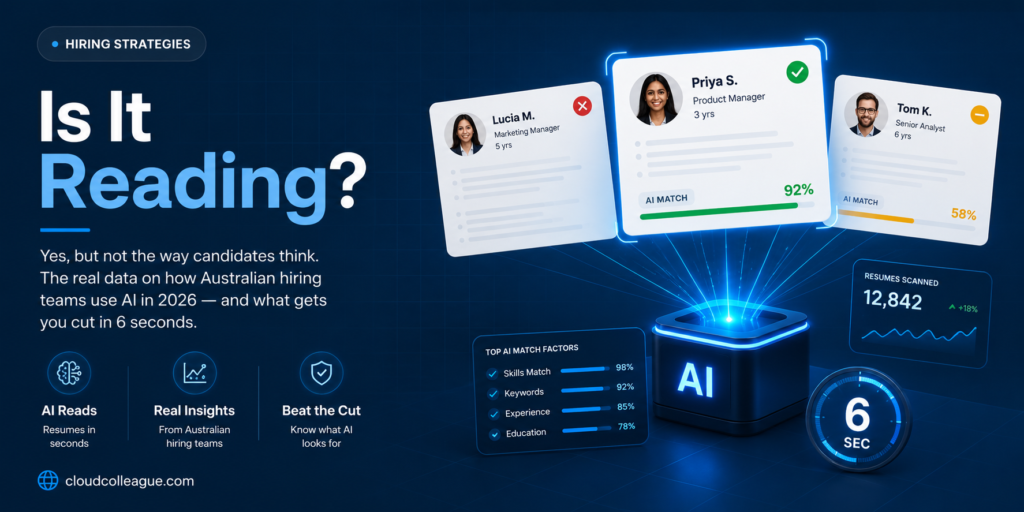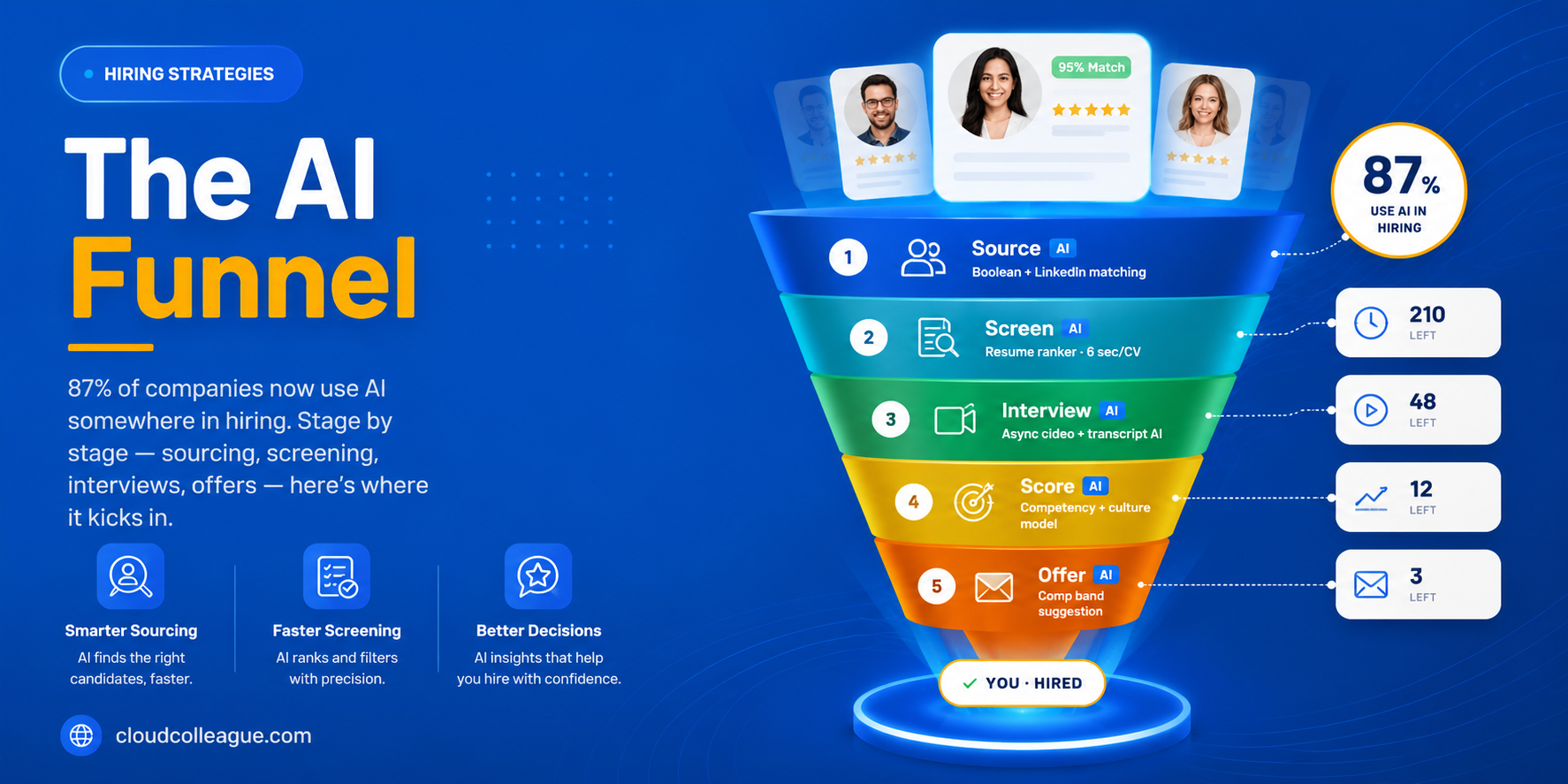
How companies are using AI in hiring has become the question underneath almost every job seeker’s frustration in 2026. The applications go out. The silence comes back. And somewhere in between, something automated made a decision you never got to contest.
The scale is real. 87% of organisations now use AI at some point in their hiring process. In April 2026, Enhancv surveyed 1,066 job seekers and found that half had been rejected at least once in the past year without a single word from a human. 63.8% believed a machine made the call. Only 9.7% had ever been clearly told AI was involved in a rejection decision. Everyone else was guessing.
This article maps exactly how AI is being used across every stage of the hiring funnel, what each stage means for your application, and the specific strategies that work in an AI-mediated hiring environment. It covers the full picture that the previous article in this series (which focused specifically on resume screening) does not.
Understanding AI hiring. Find Australian roles worth applying to. Browse AI-matched jobs on CloudColleague from 18,000+ verified Australian employers right now.Browse open roles on CloudColleague
The Scale of AI in Hiring: Where Things Stand in 2026
The numbers are no longer speculative.
87% of organisations now use AI at some point in their hiring process, according to multiple 2026 sources. 99% of Fortune 500 companies have AI in their hiring technology stack. 93% of recruiters plan to increase their use of AI in 2026. The global AI in HR market was valued at USD $6.25 billion in 2026 and is projected to grow at a compound annual rate of 24.8% through 2030 (Grand View Research).
Despite all the efficiency projections, something unexpected has happened. Many organisations report that both cost-per-hire and time-to-hire have increased as AI adoption grew. The reason is structural, and it has a name.
The AI Doom Loop
The AI doom loop is the most useful concept for understanding why the 2026 job search feels harder for many candidates despite more tools being available on both sides.
The loop works like this. Employers face high application volumes and add AI screening to manage them. Candidates notice lower response rates and use AI to generate more applications faster. Application volume increases further. Employers add more AI screening. Signal quality drops for everyone.
Greenhouse CEO Daniel Chait named this dynamic publicly in 2025. Subsequent industry analysis has confirmed it. Companies that adopted recruiting automation filled 64% more jobs per recruiter and submitted 33% more candidates per recruiter. But many also reported that application volumes from AI-assisted candidates outpaced their screening capacity, producing larger pipelines with lower average quality.
40 to 80% of applicants now use AI to draft resumes and cover letters. Some auto-apply services submit thousands of applications per day on a single candidate’s behalf. When everyone optimises their resume to the same job description using the same AI tools, applications start to look identical. Recruiters add more AI to filter the noise. Candidates use more AI to break through. The loop continues.
Understanding this dynamic is the first step toward breaking out of it. The candidates who receive responses in 2026 are disproportionately those who invested in quality over volume. A smaller number of genuinely tailored applications to roles where you are genuinely qualified produces better outcomes than a large number of AI-generated applications to broadly matched roles. The employers most frustrated with the AI doom loop are specifically those most likely to respond positively to a candidate who clearly wrote their application themselves.
Are you curious about hiring managers using AI to screen resume? Learn on : Do Hiring Managers Really Use AI to Screen Resumes in 2026? .
Stage 1: Sourcing – How AI Finds You Before You Apply?
Most job seekers think of hiring as a process they initiate by applying. AI has changed this. A significant portion of hiring in 2026 begins with employers finding candidates rather than candidates finding employers.
LinkedIn’s AI-assisted recruiter messaging feature makes recruiters nearly 10% more likely to make a quality hire than those not using it, according to LinkedIn’s own data. Platforms including Eightfold, Beamery, and similar AI sourcing tools continuously scan LinkedIn profiles, professional databases, and publicly available professional information to surface candidates for open roles without those candidates ever submitting an application.
AI-driven sourcing has increased qualified candidate flow by 35% at some organisations according to SelectSoftwareReviews 2026 analysis. This is not a marginal channel.
What this means for Australian job seekers:
Your LinkedIn profile is being searched by AI sourcing tools whether you are actively applying or not. A complete, current, keyword-specific LinkedIn profile with the same achievement language as your resume increases your discoverability to employers running AI-assisted sourcing searches. The candidates who show up in these searches are those whose profiles contain the specific terms, job titles, and competency language that matches the roles being sourced for.
CloudColleague’s AI matching operates on a similar principle. When your CloudColleague seeker profile is complete and skill-specific, Australian employers searching for candidates with your background can find you without requiring you to navigate their application portal at all. Being discoverable through sourcing channels is an additional job search pathway alongside direct applications.
Stage 2: Screening – Resume and Application Review
Resume screening is the most common AI application in hiring. 82% of AI-using companies deploy AI specifically for resume screening (ResumeBuilder, 2024). This stage is covered in depth in the previous article in this series. The key summary here:
ATS (Applicant Tracking Systems) organise and store applications. AI screening tools rank and filter them. Most candidates conflate the two, which leads to the wrong countermeasures.
19% of hiring managers use AI to purposefully screen out applications before any human review (Resume Genius 2026 Hiring Insights Report, n=1,000). AI screening tools evaluate skill relevance, career trajectory consistency, credibility signals (specific metrics and proper nouns), and increasingly, AI-generated content patterns.
The silent rejection data captures what this looks like at scale. Half of the 1,066 job seekers surveyed by Enhancv in April 2026 had been rejected without a word from a human in the past year. 63.8% of those rejected silently believed a machine made the decision. Only 9.7% had ever been clearly told AI was involved. Most candidates are operating in an information vacuum about what happened to their applications.
The countermeasure: Specific, quantified, achievement-rich resume content that only a genuine participant could have written outperforms both AI-generated content and keyword-stuffed content on both automated and human review. The detailed guidance is in the previous article. The principle here: the same writing that satisfies AI credibility signals also convinces the human reviewer who sees it next.
Stage 3: Video Interviews – One-Way and AI-Analysed
Video interview AI is the fastest-growing category in hiring technology. AI-conducted interviews tripled from 10% to 34% of companies in just two years (ResumeBuilder longitudinal surveys, 2023 to 2026). HireVue alone ran more than 20 million one-way video interviews in the first quarter of 2024.
One-Way Video Interviews
One-way video interviews, also called asynchronous video interviews, ask candidates to record responses to pre-set questions with no interviewer present. The recordings are then reviewed by human recruiters, AI analysis tools, or both, depending on the employer’s process.
AI analysis of one-way video interviews typically evaluates content structure and relevance, completeness of responses, consistency with the written application, and in some systems, communication clarity and spoken delivery patterns.
The candidate experience is divisive. 1 in 3 candidates walks away from a job rather than complete a one-way AI video interview, according to Enhancv’s 2026 data. Among those who did complete one, 31% said they viewed the company more positively as a result. 23% had a negative impression. The response to this format is strongly polarised, and abandonment rates are high enough that employers using one-way video are now aware of the dropout cost.
67% of job seekers report a positive impression of a company when they receive consistent updates throughout the application process. The companies that communicate clearly about what the video process involves, what criteria are used, and what happens next tend to have lower abandonment rates.
What Works in AI-Analysed Video Interviews
Use the STAR method for all behavioural questions: Situation, Task, Action, Result. Structure makes your answers more parseable by both AI and human reviewers. A structured answer with a clear beginning, middle, and specific measured outcome scores better than an unstructured stream of relevant content.
Be specific throughout. Include the same metrics, proper nouns, and contextual details you would include in a strong resume bullet point. “Led a team that delivered a significant cost reduction” scores poorly. “Led a team of seven analysts to deliver a AUD $4.2M cost reduction programme six months ahead of schedule” scores well on both AI and human evaluation criteria for the same reason: it is specific, it is evidenced, and it could only have been said by someone who was there.
Answer the full question before elaborating. AI systems that evaluate completeness reward responses that directly address all components of the question asked.
Practise with Pramp (free, peer-to-peer) or Yoodli (free tier, speech analysis with filler word detection) before any real one-way video screening. The camera-facing delivery of an unrehearsed STAR answer is a practised skill, not a natural one.
Full picture of the AI hiring funnel in view. Find Australian roles worth navigating it for. Browse AI-matched jobs on CloudColleague across every Australian industry. Start a a Seeker on CloudColleague
Stage 4: Skills Assessments – Technical, Cognitive, and Psychometric
AI-powered skills assessments are increasingly used before or alongside live interviews, particularly for technical and knowledge-intensive roles.
HackerRank and Codility are standard for software engineering roles and are used by major Australian technology companies including Atlassian and REA Group. Pymetrics uses neuroscience-based game assessments to evaluate cognitive and emotional traits. HireVue includes AI-analysed problem-solving assessments alongside its video interview tools.
For coding assessments (HackerRank, Codility): Practice on the specific platform before your real assessment window opens. Each platform has different IDE behaviour, different time limits, and different submission rules. Unfamiliarity with the platform itself costs candidates marks on problems they could otherwise solve. Both HackerRank and Codility provide free practice problem libraries. Use them before any employer-issued assessment.
For psychometric and cognitive assessments: These evaluate stable traits and cognitive capacities that are genuinely difficult to prepare for in a skills sense. Approach them honestly. Attempting to optimise for a specific personality profile rarely produces consistent results, and in many cases produces response patterns that are internally inconsistent in ways that the assessment is designed to detect. The more productive preparation is ensuring you are rested, focused, and working in a quiet environment when you complete them.
For video assessments with AI analysis: The same guidance as one-way video interviews applies. Structure, specificity, and completeness are evaluated consistently. Practising your delivery before the real assessment window produces meaningfully better results than approaching it cold.
Stage 5: Reference Checking – Automated Platforms
Automated reference checking has become standard at many Australian employers, and this stage of the hiring funnel is among the least discussed in any job seeker-facing content.
Xref is the dominant automated reference checking platform in the Australian market. Major Australian employers in financial services, professional services, healthcare, and large corporate environments use Xref to manage reference collection. The platform sends automated survey links to nominated referees, collects structured responses, and produces a reference report for the hiring manager. The platform also checks response consistency and flags anomalies between referee responses.
Brief your referees before they receive the Xref link. This is the single most impactful thing you can do at the reference stage. A referee who receives a cold Xref survey link with no preparation will produce a generically positive response. A referee who has spoken with you about the specific role, the specific skills being assessed, and the specific achievements most relevant to the position will produce a specific, credible, differentiated reference.
Give each referee: the job title and brief role description, the two or three skills or capabilities most relevant to the role, one or two specific achievements you would like them to reference, and the name of the hiring manager or company if you know it. A ten-minute preparation conversation produces a materially better automated reference report than the absence of one.
The rehire question matters. Xref reports include a Net Promoter Score-style rehire question: would you rehire this person? A referee who responds “definitely yes” produces a meaningfully better report than one who responds “probably yes.” The difference is visible to hiring managers reviewing the report. Choose referees who will give a definitive positive response to this question, and confirm with them before nominating them.
Be prepared and get your resume review online. Here’s how you can do the review: Best Online Resume Review Service in 2026.
The Authenticity Premium in 2026
91% of recruiters and hiring managers have spotted or suspected candidate deception in 2026, according to Greenhouse’s 2026 AI Hiring Report surveying 4,136 professionals. 74% say they are more worried about fake credentials than they were a year ago.
The widespread use of AI on both sides of the hiring equation has created what SelectSoftwareReviews describes as a genuine authenticity problem. When candidates use AI to create optimised applications and employers use AI to detect which applications are genuine, the candidates who benefit are those who were authentic to begin with.
More than one in four respondents in recent surveys say that if companies use AI in screening, candidates should use AI in applications. This framing matters: candidates are largely responding to an environment that employers created. Penalising candidates for AI use while using AI extensively in your own screening process is structurally inconsistent and many employers understand this.
The practical implication is not to avoid AI as a tool. It is to ensure that AI serves as a drafting and structuring aid rather than the author of your professional identity. A resume and cover letter that use AI for efficiency but contain specific metrics, authentic voice, and genuine professional detail that only you could provide will outperform both a pure AI-generated application and a poorly crafted manual one.
Only 26% of applicants trust AI to evaluate them fairly (Gartner). The candidates who perform best in AI-mediated hiring processes are those who understand what the systems are evaluating and why, and who write and speak accordingly.
The Regulatory Context: What Rules Apply in 2026?
EU AI Act: Obligations for high-risk AI systems, including employment-related AI tools, began applying in August 2026. Employers operating in EU markets or using EU-headquartered vendors face compliance requirements including transparency obligations, mandatory bias testing, and candidate notification requirements for automated decision-making. This has raised the regulatory floor for global companies with Australian operations.
NYC Local Law 144: New York City requires an annual bias audit and candidate notices before using automated employment decision tools in hiring. Several major US-headquartered companies with significant Australian presences have extended equivalent practices globally in anticipation of broader regulatory convergence.
Australia: Australia does not yet have equivalent specific AI hiring legislation. The Safe and Responsible AI in Australia discussion paper and the AI Ethics Framework published by the Department of Industry, Science and Resources establish voluntary standards. The Australian Human Rights Commission is actively developing guidance on AI and human rights that will include employment contexts. The Fair Work Commission is also monitoring AI use in employment decisions as part of its broader mandate.
Australian candidates who believe they have experienced discriminatory AI screening have existing complaint mechanisms under the Age Discrimination Act 2004, the Sex Discrimination Act 1984, the Racial Discrimination Act 1975, and state and territory anti-discrimination legislation. The Australian Human Rights Commission accepts complaints related to employment discrimination including technology-mediated discrimination.
The regulatory trajectory suggests that AI hiring transparency requirements will arrive in Australia within the next two to three years. Employers in regulated sectors (financial services, healthcare, government) are already developing ethical AI hiring frameworks proactively.
What Australian Job Seekers Specifically Need to Know
Xref is the dominant automated reference checking platform in Australia. Major employers across banking, professional services, healthcare, and large corporate environments use it. Briefing your referees specifically before any Xref survey link arrives produces materially better outcomes than leaving referees to respond cold to an automated questionnaire.
The AI doom loop is most visible on SEEK. Popular SEEK roles in major Australian cities regularly attract 300 to 500 applications. The candidates who receive responses are disproportionately those who tailored their application specifically to the role and employer. The candidates who do not receive responses are disproportionately those who submitted AI-generated applications that look identical to hundreds of others in the same pipeline.
The AI screening concern is most relevant for large employers. Most small and medium Australian employers (under 200 staff) use SEEK’s built-in application management or email-based application handling with no dedicated AI screening layer. If your target employers are primarily SMEs, community organisations, or regional employers, your primary focus should be formatting and keyword relevance rather than AI detection concerns.
CloudColleague is a different channel from submitting applications through employer portals. When your CloudColleague profile is complete and skill-specific, Australian employers actively searching for candidates with your background find you directly without you having to navigate their AI screening funnel. This is a qualitatively different job search pathway that complements rather than competes with direct applications.
Your Stage-by-Stage Strategy for AI-Mediated Hiring
Sourcing:
Keep your LinkedIn profile and CloudColleague seeker profile complete, current, and specific with achievement language and the same keywords that appear in your target job descriptions. AI sourcing tools find you based on your profile before you ever apply.
Screening:
Single-column ATS-safe resume format, specific achievement bullets with measurable outcomes, keywords embedded in achievement context rather than isolated lists, authentic personal voice throughout. Run the copy-paste test on your PDF before every application.
Video interviews:
Prepare STAR method stories before any video screening session. Practise delivery with Pramp or Yoodli. Include specific evidence in every answer. Complete the assessment rather than abandoning it; 1 in 3 candidates walk away, which means completion itself is a differentiator.
Skills assessments:
Practise on the specific platform before your real assessment window. For psychometric assessments, answer honestly and in a calm, focused environment. For coding assessments, use the practice problem library the employer provides before the live assessment.
References:
Brief all referees before they receive any automated reference platform link. Provide role details, the skills most relevant to the position, and one or two specific achievements you want them to reference. Confirm that each referee will give a definitive positive rehire response before nominating them.
Quality over volume throughout:
This is the single most important strategic decision in an AI-mediated hiring environment. The AI doom loop rewards the candidates who step out of it. Fewer, better applications to roles where you are genuinely qualified and specifically interested produce better outcomes than a high volume of AI-assisted applications to broadly matched roles. The employers most affected by the doom loop are precisely those most likely to respond positively to a candidate who clearly invested genuine effort.
Strategy clear. Find Australian roles worth applying to with genuine effort. Create a free verified profile on CloudColleague and get AI-matched to 18,000+ verified Australian employers hiring right now.Get started free on CloudColleague
Hiring in 2026 and need candidates who are genuinely qualified? Post a role on CloudColleague in under five minutes. Smart matching surfaces pre-vetted professionals across every Australian industry.Start hiring on CloudColleague
Frequently Asked Questions
Around 87% of organisations now use AI somewhere in their hiring process, particularly large employers in technology, finance, healthcare, and consulting. Nearly all Fortune 500 companies use AI-assisted recruitment tools in some form.
Usually not. AI screening tools are built into employer recruitment systems and are rarely optional for candidates. Your best strategy is ensuring your resume is ATS-safe, achievement-focused, and tailored enough to perform well whether AI screening exists or not. In Australia, there are currently no specific AI hiring transparency laws equivalent to the EU AI Act.
The “AI doom loop,” a term popularised by Daniel Chait, describes the cycle where employers add AI screening to manage application overload, candidates respond by mass-applying with AI-generated resumes, and employers increase automation further because application quality declines. The practical outcome is that targeted, high-quality applications now stand out more than ever.
Prepare six to eight strong STAR method stories before recording. One-way interviews reward structure, clarity, and specificity because there is no live interaction to guide you. Practise using tools like Pramp or Yoodli to improve pacing and reduce filler words. Speak slightly slower than normal and include measurable examples in every answer.
Not specifically yet. Australia currently relies on existing anti-discrimination laws rather than AI-specific hiring legislation. However, the Australian Human Rights Commission and Australian Government AI frameworks are actively developing guidance around fairness, transparency, and accountability in AI-assisted hiring.