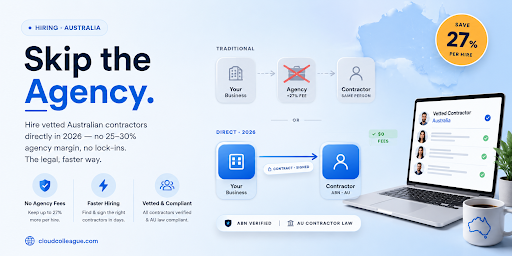
Hiring a contractor in Australia used to mean handing 15 to 25 percent of the placement fee to a recruitment agency. In 2026, that model is breaking down. Small businesses, startups and even mid-sized firms now hire contractors directly through online marketplaces, saving thousands per role and getting matched to vetted talent in days rather than weeks.
This guide walks you through exactly how to hire a contractor in Australia without an agency. You will learn the legal rules, the going rates, the contract essentials, and the platforms that make direct hiring fast and safe.
Why Are Australian Businesses Skipping Recruitment Agencies in 2026?
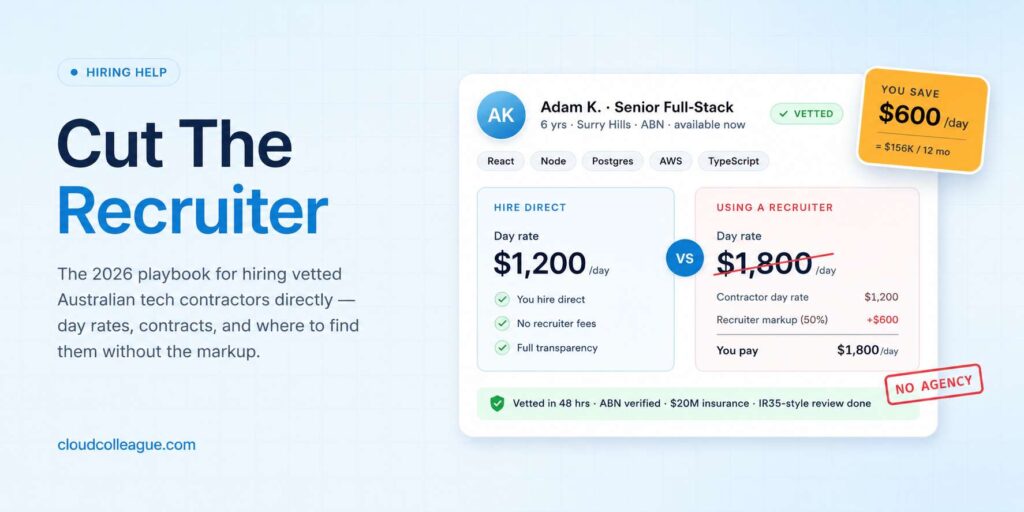
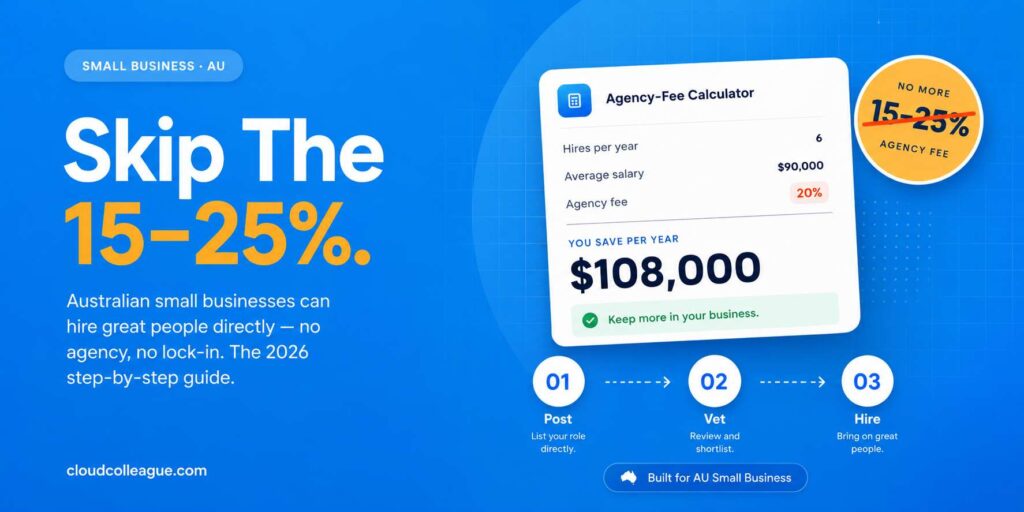
Recruitment agency fees in Australia typically range from 15 to 25 percent of the contractor’s annual salary or project value. For a contractor on a $120,000 engagement, that is up to $30,000 in fees before any work begins.
Three shifts have made the agency model optional rather than essential:
- Verified online profiles. Modern hiring platforms now show portfolios, references and skill assessments upfront, removing the agency’s traditional role as a quality filter.
- Built-in payment protection. Escrow and milestone payments mean you no longer need an intermediary to manage the money.
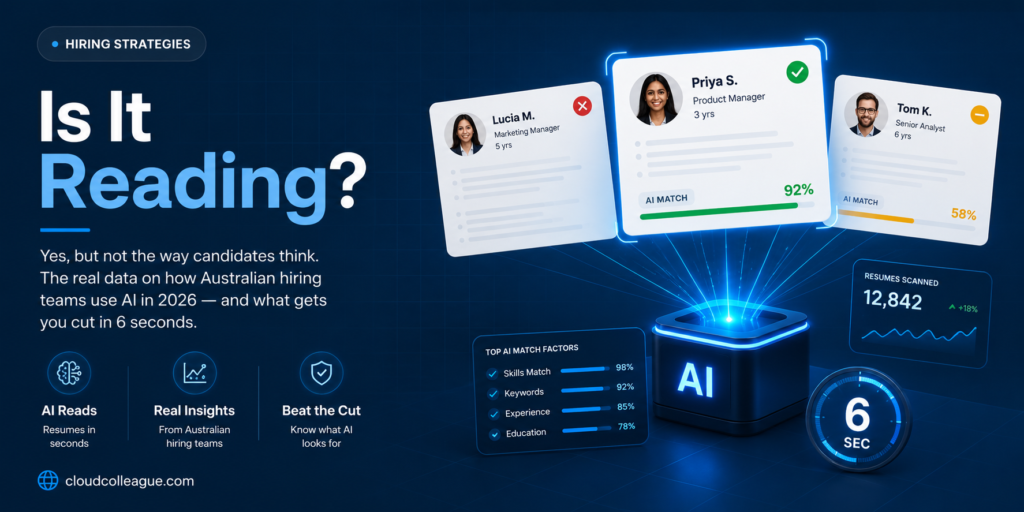
- Faster matching. AI-driven suitability matching surfaces qualified contractors in hours instead of the two-to-six week agency turnaround.
The result: Australian businesses keep more of their hiring budget and get more direct control over who joins their projects.
Read Next: How Companies Are Using AI in Hiring in 2026?
Step 1 – Define What You Actually Need Before You Post?
The single biggest reason hiring fails is vague scoping. Before you write a single job description, get clear on these five questions:
- Is this a project or an ongoing role?
Projects suit fixed-price contractors. Ongoing work suits hourly arrangements. - What does “done” look like?
Define the deliverable, not the activity. “Build a Shopify store with 12 products and Stripe checkout” beats “help with our website.” - What is your realistic budget?
Use the rate guidance further down this article. - How will you measure quality?
Code reviews, design proofs, draft approvals-name your checkpoints. - What is the legal classification?
This determines whether the worker is genuinely a contractor or an employee in disguise. More on this below.
Spending an hour on scoping saves weeks of mismatched applications.
Step 2 – Understand Contractor vs Employee Classification in Australia.
This is where most first-time hirers get caught. The Australian Taxation Office and the Fair Work Ombudsman both look at the substance of the relationship, not just what the contract calls it.
A genuine contractor in Australia generally:
- Provides their own tools and equipment
- Controls how the work is performed
- Can subcontract or delegate the work
- Bears commercial risk for poor work
- Holds an Australian Business Number (ABN)
- Issues invoices rather than receiving wages
If you direct the worker’s hours, provide their equipment, and treat them like a staff member, the ATO may classify them as an employee regardless of what your contract says. Getting this wrong triggers backpay obligations, superannuation arrears and penalties.
When in doubt, use the ATO’s employee/contractor decision tool or consult an accountant before signing.
Step 3 – Know the 2026 Going Rates for Contractors in Australia.
Rates vary by skill and seniority. These ranges reflect typical 2026 direct-hire pricing on Australian marketplaces, excluding agency markups:
| Contractor Type | Hourly Rate (AUD) | Day Rate (AUD) |
| Junior virtual assistant | $25 – $40 | $200 – $320 |
| Bookkeeper | $45 – $80 | $360 – $640 |
| Content writer / copywriter | $60 – $130 | $480 – $1,040 |
| Graphic designer | $65 – $140 | $520 – $1,120 |
| Web developer (mid-level) | $90 – $160 | $720 – $1,280 |
| Senior software engineer | $130 – $220 | $1,040 – $1,760 |
| Marketing strategist | $120 – $200 | $960 – $1,600 |
| Accountant / CFO advisory | $150 – $300 | $1,200 – $2,400 |
These rates assume direct engagement. Going through an agency typically adds 30 to 50 percent on top.
Step 4 – Write a Job Post That Attracts the Right Contractors.
A good contractor post does three things: it filters out the wrong people, attracts the right people, and sets expectations clearly.
Structure your post like this:
- One-line summary of what you need (e.g. “Shopify developer to rebuild our 40-product store”).
- Context paragraph explaining your business and why this work matters.
- Deliverables list with concrete outputs.
- Required skills with must-haves separated from nice-to-haves.
- Budget or rate range. Posts with a budget get three times more qualified applications than vague posts.
- Timeline including start date and milestones.
- How to apply with one or two short questions that confirm the contractor read the post.
Avoid generic language like “rockstar” or “ninja.” It signals inexperience and repels senior contractors.
Step 5 – Choose Where to Post?
You have three main options for direct contractor hiring in Australia in 2026:
- General task and job marketplaces such as CloudColleague, which combine job postings, short-term tasks, and freelancer profiles in one platform with built-in matching and payment protection.
- Industry-specific platforms for niches like creative work, dev work, or trades.
- Professional networks like LinkedIn, which work for senior hires but require manual filtering.
For most Australian small and mid-sized businesses, a general marketplace gives the best balance of speed, cost and quality. You post once and the platform’s matching engine surfaces qualified profiles.
| Ready to hire? Post your first job free on CloudColleague and get matched to vetted Australian contractors in hours, not weeks. |
Step 6 – Screen Contractors the Smart Way.
Once applications land, screen in this order:
- Portfolio check. Look for work similar to yours. Generic portfolios are a red flag.
- Reference check. Two recent references, ideally Australian businesses, ideally projects of similar scope.
- Paid trial task. A small paid task (one to four hours) reveals more than any interview. Pay for it even if you do not proceed.
- Video interview. A 20-minute call covering communication, availability, and approach to your specific project.
Skip the unpaid test project. Senior contractors will not do them, and you will be left choosing from the bottom of the talent pool.
Step 7 – Use a Proper Contractor Agreement.
Even for small engagements, get the contract right. A minimum contractor agreement in Australia should cover:
- Scope of work with deliverables and acceptance criteria
- Payment terms including milestones, invoicing schedule, and currency
- Intellectual property assignment to your business on payment
- Confidentiality for any sensitive information shared
- Termination clause with notice period and payment for work completed
- Independent contractor declaration confirming the relationship is not employment
- GST treatment based on whether the contractor is registered for GST
Marketplaces like CloudColleague provide template agreements as part of the engagement, which removes most of the legal drafting work.
Step 8 – Pay Securely With Milestones and Escrow.
The two safest payment models for direct contractor hiring are:
- Milestone-based escrow. You fund each milestone upfront, the platform holds the money, and releases it when the milestone is approved.
- Weekly hourly billing with time tracking and a weekly cap.
Both protect you from paying for work that never arrives, and protect the contractor from doing work that never gets paid.
Avoid full upfront payment. Avoid paying offshore via untracked transfers. Both are red flags that experienced contractors will refuse anyway.
Step 9 – Onboard the Contractor Properly.
Onboarding a contractor takes 30 to 60 minutes and dramatically improves the outcome. Cover:
- Access to required tools and shared drives
- Communication preferences (Slack, email, weekly call)
- Reporting cadence and what success looks like in week one
- A clear single point of contact on your side
- Any compliance, brand or security requirements
Treat the contractor as a partner, not a body for hire. The ones worth keeping notice.
Common Mistakes Australian Businesses Make When Hiring Contractors.
A few patterns to avoid:
- Hiring the cheapest applicant. Rates below market usually mean offshore inexperience or domestic burnout.
- Skipping the trial task. Saves hours upfront, costs weeks downstream.
- Treating contractors like employees. Creates legal exposure and damages the working relationship.
- No written scope. Leads to scope creep, disputes, and unpaid invoices.
- Paying outside the platform. Voids payment protection and reference systems.
Hire Your Next Contractor the Modern Way.
Hiring a contractor in Australia without an agency is no longer a workaround – it is the default for cost-conscious, time-conscious businesses. With clear scoping, proper classification, a fair contract and the right platform, you can fill a role in days for a fraction of agency fees.
| For employers: Start your hiring journey and start meeting Australian contractors today. |
| For contractors: Browse jobs on CloudColleague, create profile, apply and start receiving direct invites from Australian businesses. |
Frequently Asked Questions
No. You do not need an ABN to hire a contractor. The contractor needs an ABN to invoice you legally
You generally do not pay super for a genuine contractor, but you do if the contract is wholly or principally for the contractor’s labour. The ATO’s super for contractors guide is the definitive reference.
Yes, but there are tax, withholding, and IP considerations. For sensitive or compliance-heavy work, hiring an Australian-based contractor is simpler.
On platforms with suitability matching like CloudColleague, qualified profiles typically appear within hours. Most direct hires complete in 3 to 7 days from posting to signed contract.
The terms are largely interchangeable in Australia. “Contractor” tends to imply longer or more structured engagements; “freelancer” tends to imply project-based or task-based work.
Yes, completely. Agencies are a convenience, not a legal requirement. Direct hiring is fully legal as long as the worker is correctly classified and properly contracted.