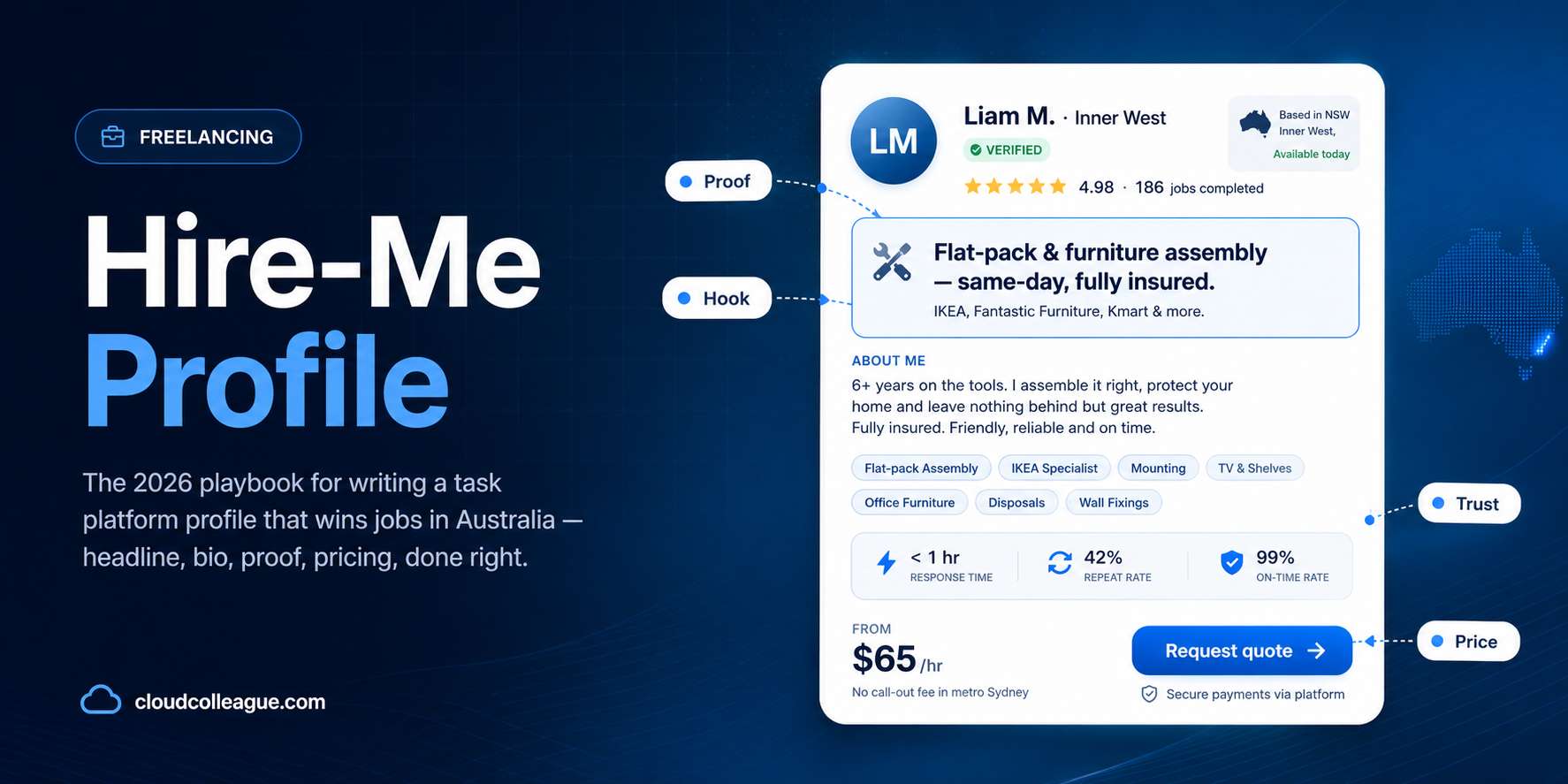
Two freelancers in Australia with the same skill set, the same experience and similar reviews can earn radically different incomes purely because of how their profile is written. The profile is your storefront. It is the only thing a potential client sees before deciding whether to invite you, message you, or move on.
This guide breaks down exactly how to write a freelancer profile that gets you hired on task platforms in Australia in 2026. It works for CloudColleague, Airtasker, Upwork, Fiverr or any platform where a written profile sits between you and your next paying client.
What Australian Clients Actually Look For in a Profile?
Before writing a word, understand what is being scanned for. Australian clients in 2026 evaluate freelance profiles on four signals, usually in this order:
- Specificity. What exactly do you do, for whom, and how well?
- Proof. Reviews, portfolio, references, badges, completed projects.
- Communication quality. Does the writing itself suggest clear thinking?
- Fit signals. Are you Australian-based or in a time zone? Do you understand the local context?
Profiles that score well on all four get the invite. Profiles that fail on any one especially proof or communication get filtered out before the conversation begins.
Browse full time jobs or freelance tasks and start your journey at CloudColleague.
The Seven Parts of a Winning Profile.
Every effective Australian task platform profile in 2026 has these seven sections. Get all seven right and you outperform 90 percent of profiles on any platform.
- Profile photo
- Headline
- Summary
- Skills and tools
- Services and pricing
- Portfolio samples
- Reviews and references
We will walk through each one.
1. Profile Photo – More Decisive Than People Think.
The photo is the first impression. The best Australian freelance profile photos in 2026 share five things:
- Face clearly visible – from the chest up, looking at the camera
- Friendly, professional expression – a small smile beats a forced grin
- Even, natural lighting – daylight beats fluorescent
- Clean, uncluttered background – a plain wall or soft outdoor backdrop
- One person only – no group shots, no pets in your face
Avoid: dark or blurry photos, sunglasses, distant shots, party photos, group photos, heavy filters. Smartphone cameras are more than good enough; a friend with steady hands is plenty.
2. Headline – Specific Beats Clever.
The headline is the second thing clients read. It should answer one question: what exactly do you do, and for whom?
Weak headlines:
- “Hard-working freelancer ready to help”
- “Marketing professional”
- “Designer with a passion for creativity”
Strong headlines:
- “Bookkeeper for Sydney sole traders | Xero certified | BAS-ready”
- “Shopify developer for Australian product brands | 50+ stores shipped”
- “Content writer for B2B SaaS in Australia | SEO, blogs, LinkedIn”
- “Virtual assistant for Australian small business owners | inbox + calendar + CRM”
Specific headlines get invited to specific work. Generic headlines get filtered out of both.
3. Summary – Lead With What You Do, Then Prove It.
The summary is 100 to 200 words. Use this structure:
- Sentence 1: What you do, who you do it for, and the outcome.
- Sentence 2 to 3: Your experience and credibility. Years, clients, results.
- Sentence 4 to 6: Specific examples or wins.
- Sentence 7 to 8: Your process or what makes you different.
- Final sentence: A clear invitation to message you with their brief.
Example for a bookkeeper:
I help Australian sole traders and small businesses run clean books and stay BAS-ready year-round. I am Xero and MYOB certified, with 7 years’ experience working with tradies, e-commerce stores and allied health clinics across NSW and VIC. In the last 12 months, I have helped 22 clients catch up on a combined 18 months of back-bookkeeping and pass ATO audits without penalty. My approach is simple: weekly reconciliation, monthly reports, no surprises at tax time. Message me your current setup and I will quote within one business day.
| Notice: no buzzwords, no “passionate,” no “rockstar.” Plain English. Concrete numbers. Local context. |
4. Skills and Tools – Be Honest and Specific.
Most platforms let you tag skills and tools. Treat this as a search optimisation exercise – the right tags are the difference between being found and being invisible.
Best practice:
- Tag specific tools, not vague categories. “Xero,” “Shopify,” “Figma,” “HubSpot” – not just “accounting” or “design.”
- Tag your real strengths. If you tag 20 skills you barely have, clients will spot it in the first interview.
- Update tags every 3 months. Add tools you have learned. Remove ones you no longer use.
- Match local context. “BAS preparation” matters in Australia. “1099 reporting” does not.
The 5 to 10 tags you choose well outperform the 30 tags you choose badly.
5. Services and Pricing – Show Confidence, Reduce Friction.
Profiles that publish packaged services with prices convert 2 to 3 times better than profiles that say “message me for a quote.” Why? Clients want to anchor on a number before investing in a conversation.
Structure 2 to 4 service packages like this
Starter Package
- One-line description
- What is included (3–5 bullets)
- Turnaround time
- Price (fixed or “from”)
Standard Package
- One-line description
- What is included (3–5 bullets)
- Turnaround time
- Price (fixed or “from”)
Premium Package
- One-line description
- What is included (3–5 bullets)
- Turnaround time
- Price (fixed or “from”)
Keep the entry price approachable. Make the middle option look like the obvious choice. Make the top option strong enough to justify the premium for a serious client.
If your work is genuinely bespoke, publish a “from” rate and an indicative project range so clients still get a number.
6. Portfolio Samples – Quality Over Quantity
The portfolio is the single biggest converter for skilled work in Australia. Five strong samples beat twenty average ones. Best practices:
- Curate ruthlessly. Cut anything older than 3 years unless it is your best work.
- Show variety within your niche. If you write B2B, show a blog post, a LinkedIn post, and an email sequence not three blogs.
- Annotate samples. A 2 to 3 sentence caption explaining the client, the brief and the outcome adds enormous credibility.
- Show outcomes when you can. “This blog series helped the client move from 0 to 800 organic visitors a month in 6 months.”
- Get permission. Always confirm with past clients before showcasing their work publicly.
If you are new and have no portfolio, build 3 to 5 spec samples for businesses you would love to work with. Mark them clearly as spec work in the caption.
7. Reviews and References – Compound Asset
Reviews are the highest-trust signal on any platform. Tactics that compound your review count fast:
- Ask for a review the moment the job is done. Not a week later.
- Give clients a one-line prompt. “Could you mention how I handled the BAS catch-up in your review?” makes reviews more useful for your future clients.
- Reply to every review. A short, professional response to each review shows you care about clients beyond payment.
- Bring in early references from previous countries or off-platform work. Most platforms let you add external testimonials with permission.
If you are new with no reviews yet, lean harder on portfolio and the quality of your application messages. Every review you earn raises your conversion rate on future applications.
How to Write an Application Message That Actually Gets Read?
Your profile gets you noticed. Your application message wins the job. The structure that works in 2026:
- Line 1: Reference something specific from the client’s posting.
- Line 2: State plainly that you have done this exact kind of work before.
- Line 3 to 5: One concrete example from your portfolio with the outcome.
- Line 6: Your suggested next step (call, sample, draft, scope).
- Line 7: Your quote range based on the brief.
- Final line: A simple sign-off with your name and links.
Length: 120 to 200 words. Long enough to demonstrate thought. Short enough to be read.
Avoid: generic “I am the best fit” claims, copy-paste applications, attaching irrelevant samples, asking for the job before answering the brief.
Common Profile Mistakes That Cost You Work.
A short hit-list:
- Generic headline. “Freelancer ready to help” is invisible.
- No portfolio. Even one to three samples beats zero.
- No pricing. Forces clients to invest in a conversation before they know if you fit their budget.
- Spelling and grammar errors. Instant filter-out for any communication-sensitive work.
- Photo missing or unprofessional. Cuts response rates roughly in half.
- Skills list 30 tags long. Looks unfocused. Loses to specialists.
- Out-of-date profile. Stale information signals an inactive or unreliable freelancer.
Most of these are 30-minute fixes. The ROI is immediate.
Optimisation: Improve Your Profile Every Quarter.
A profile is not a write-once asset. Treat it like a landing page. Every 90 days:
- Replace your weakest portfolio sample with a stronger new one
- Update your headline if your niche has sharpened
- Add new skills and tools you have learned
- Refresh the summary with one new specific result
- Adjust pricing as your demand and reviews grow
Freelancers who treat their profile as a living document earn measurably more than those who set it up once and forget it.
How Long Should Your Profile Be?
Sweet spots based on platform conventions:
| Section | Target Length |
| Headline | 60 – 120 characters |
| Summary | 100 – 200 words |
| Service descriptions | 30 – 60 words each |
| Portfolio captions | 30 – 80 words each |
Going longer rarely helps. Going shorter loses you the specificity that wins work.
| Set up a profile that wins work.Create your free CloudColleague profile and use the structure above to land your first Australian client. |
Profile Examples by Service Type.
A quick gallery of strong headlines by category to spark ideas:
- Web developer: “WordPress and Shopify developer for Australian small businesses | 80+ sites shipped”
- Designer: “Brand and packaging designer for Australian product startups”
- Writer: “B2B SaaS content writer | SEO + LinkedIn ghostwriting for Australian founders”
- VA: “Virtual assistant for solo consultants in Sydney | inbox, scheduling, CRM”
- Bookkeeper: “Bookkeeper for Australian tradies | Xero, BAS, payroll”
- Marketer: “Google Ads and Meta Ads specialist for Australian e-commerce”
- Editor: “Podcast editor for Australian business and lifestyle shows”
- Photographer: “Real estate and Airbnb photographer | Sydney inner west and east”
Pattern: skill + niche + location or platform + proof point.
Build a Profile That Earns While You Sleep.
Your profile is the highest-leverage asset in your freelance career. Spend 2 to 4 hours getting the structure right, refresh it every quarter, and the same hours of effort start producing significantly more work.
| For freelancers: Start as a Seeker on CloudColleague and apply the structure above to start landing better Australian clients this month. |
| For employers: Start hiring on CloudColleague and discover freelancers whose profiles tell you exactly what they can do. |
Frequently Asked Questions
The core content can be reused, but tailor the tone and emphasis to the platform’s audience. CloudColleague clients tend to look for skilled, structured work; Airtasker clients tend to look for local task delivery.
100 to 200 words. Longer summaries lose attention. Shorter ones lack proof.
No. The platform’s built-in portfolio plus your most current work is usually enough. A simple personal site (Card, Squarespace, Notion) is a nice addition once you have 10+ pieces.
Take 1 or 2 lower-paid early gigs, deliver excellently, ask for a review the moment you finish. Most freelancers go from zero to five reviews within their first month if they are deliberate about asking.
Most platforms manage messaging in-app. Sharing direct contact too early can violate platform terms and lose you the payment protection. Only share details once a contract is agreed within the platform.
Yes, and you should. Update every 90 days.
It attracts the right ones and repels the wrong ones, which is a net win.