Most Australian freelancers in 2026 lose work they should be winning not because their skills are wrong, but because their bids are wrong. The same task can be quoted by ten different freelancers and won by the one with the third-lowest price, the second-best portfolio, and the best application message.
This guide is about that gap. It covers exactly how to bid on tasks on Australian platforms in a way that consistently wins quality work and avoids the race-to-the-bottom trap that burns out so many freelancers in their first year.
What “Winning” Actually Looks Like?
Before talking about tactics, define the goal. Winning a bid is not just being chosen. It means being chosen at:
- A fair rate for your skill level
- A scope you can deliver profitably
- For a client who is likely to come back
A “win” at $30/hour on a project that should be $90/hour is not a win, it is a trap. The freelancers who build sustainable careers in Australia in 2026 bid for the right work at the right price, not for everything that moves.
The Bid-to-Win Ratio You Should Aim For.
Industry benchmarks for active Australian freelancers in 2026:
- New freelancers with limited reviews: 1 in 12 to 1 in 20 applications convert
- Mid-level freelancers with 10+ reviews: 1 in 6 to 1 in 10 applications convert
- Senior freelancers with strong reviews and niche fit: 1 in 3 to 1 in 5 applications convert
If your bid-to-win ratio is worse than 1 in 25, the problem is almost always your bid, not the market. The bidding system rewards quality over volume.
Step 1 – Read the Task Like a Professional.
The first move is not writing, it is reading. Spend 3 to 5 minutes per task before deciding whether to bid. Pull out:
- What the client actually needs (often different from what they wrote)
- The deliverable – what is being judged at the end
- The budget signal – explicit number, range, or “TBD”
- The timeline – urgent or relaxed?
- The red flags – vague scope, unrealistic budget, dismissive tone, no client history
If two or more red flags are present, skip the bid. Saving 20 minutes here on a bad-fit task is more valuable than landing it.
Step 2 – Decide Whether to Bid.
Use this 5-question filter for every task:
- Is this task in your strongest skill lane?
- Can you deliver excellent work within the timeline?
- Is the budget within 80 percent of your normal rate?
- Does the client seem reasonable from their post and history?
- Will winning this client likely lead to repeat work?
Three or more “yes” answers? Bid. Two or fewer? Move on. This filter alone improves bid-to-win ratios by 50 to 100 percent because you stop wasting time on bad fits.
Step 3 – Set Your Price With Discipline.
The biggest pricing mistake on Australian task platforms is anchoring to the lowest visible bid. Do not. Instead, anchor to:
- Your standard hourly rate × the realistic time the task will take
- Plus 20 percent buffer for revisions and back-and-forth
- Plus the value of the outcome to the client (not just the hours)
Different project scales demand different pricing structures. While a flat rate is ideal for micro-tasks under $300, larger-scale assignments are most successful when tied to milestones, and long-term engagements thrive on steady retainers.
If your honest price is double the lowest bid, that is fine. Top-of-market freelancers win work at top-of-market rates. The trick is making the bid message worth the premium.
Step 4 – Write the Application Message.
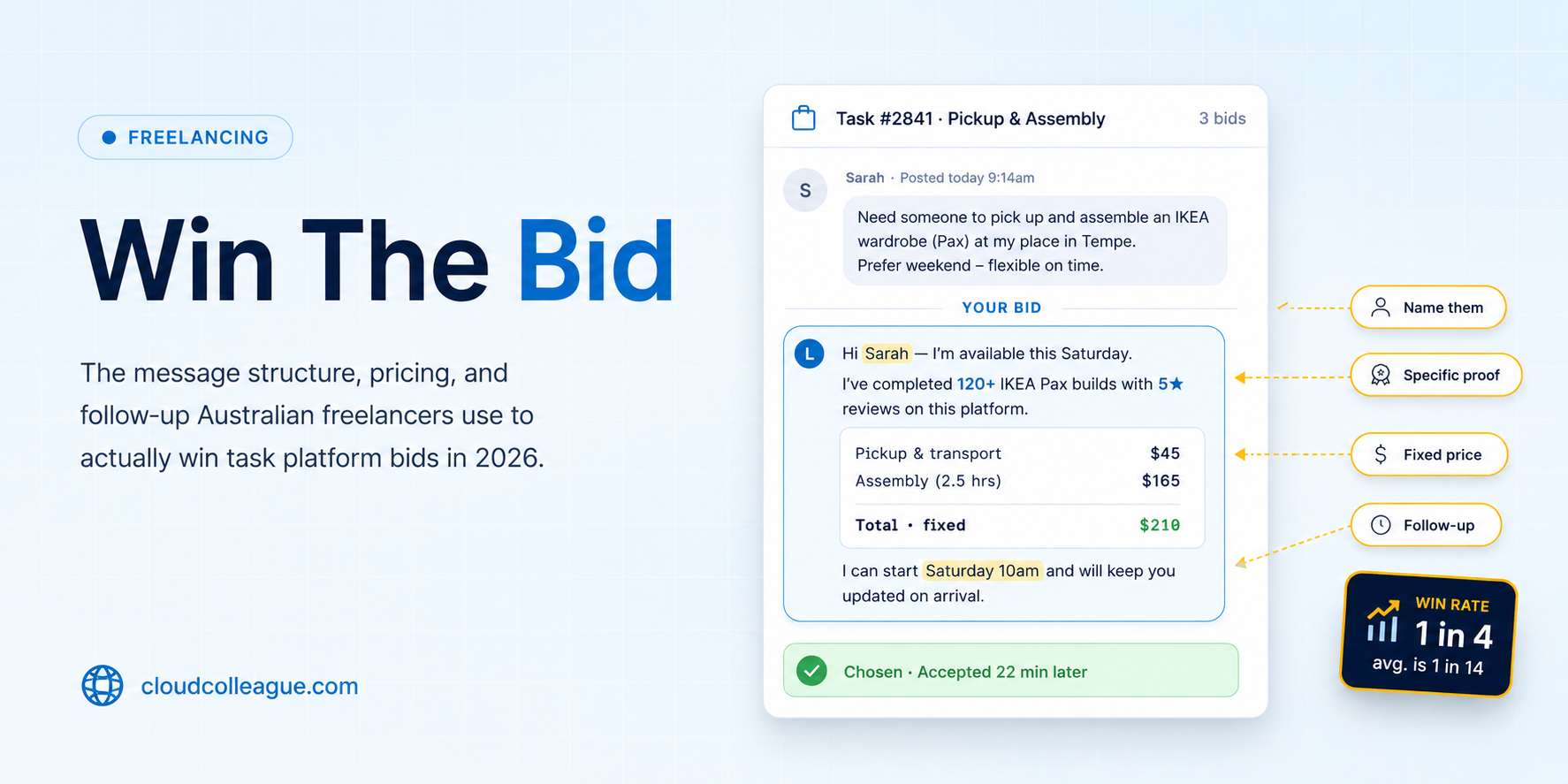
The application message is the single biggest lever in bidding. Use this 7-line structure:
Line 1- Reference something specific from the brief. Show you read it. Mention the platform, product, or industry detail by name.
Line 2 – State plainly that you have done this work before. One sentence. No padding. “I have built 12 Shopify stores for Australian product brands in the last 18 months.”
Line 3 to 5 – Share one concrete example with the outcome. “For a Brisbane skincare brand, I migrated their store from WooCommerce to Shopify in 9 days, kept all SEO equity, and increased mobile conversion from 1.8% to 3.1% in the first month.”
Line 6 – Suggest a clear next step. “I can put together a quick build plan and quote within one business day if you can share your current store URL and product count.”
Line 7 – Your quote (with reasoning). “Based on what you have described, my quote is $4,200 fixed including theme setup, product migration, and the contact form. Quotes may shift if your scope changes.”
Final line – Short sign-off with your name.
Length: 120 to 200 words. Short enough to be read, long enough to demonstrate thinking.
What Most Application Messages Do Wrong?
A few patterns that lose work consistently:
- Starting with “Hi, I am a passionate professional…” Generic openings get scrolled past.
- Listing every skill the freelancer has. Looks like a copy-paste.
- Asking the client to “tell me more” before quoting. Wastes the client’s time.
- Promising “the lowest price.” Signals desperation and attracts bad clients.
- No example or proof point. All claims, no evidence.
- Spelling errors in the first 50 words. Instant filter-out for any communication-sensitive task.
If your messages contain any of these, fix them this week.
Step 5 – Attach the Right Proof.
Always include 1 to 2 portfolio links or attachments but only ones that match the brief. A photographer applying to a small wedding gig should link wedding work, not their best landscape shot.
Best practice:
- Link directly to 1 or 2 specific samples, not your entire portfolio
- Add a one-sentence caption explaining why this sample is relevant
- Keep attachments lightweight (under 5 MB) so they actually open
- Never attach generic PDFs labelled “My Portfolio.pdf”- they look lazy
If the platform allows it, embed a 15- to 30-second video introduction for higher-trust work. Video introductions can lift conversion by 30 to 50 percent for service work.
Step 6 – Time Your Bid.
The first hour after a task is posted gets the most attention. Tasks posted in business hours and bid on within 30 minutes have 2 to 3 times higher conversion than late bids. Tactics:
- Set up email or app notifications for relevant categories
- Pre-write your standard intro and customise the first 3 lines per task
- Bid early in the day, not late at night, on tasks posted by Australian clients
That said: do not sacrifice quality for speed. A thoughtful bid at the 2-hour mark beats a sloppy bid at the 5-minute mark.
Step 7 – Negotiate, Don’t Capitulate.
If a client responds with “can you do it cheaper?”, do not just drop your price. Better responses:
- Trade scope for price. “I can hit $X if we drop the second revision round and the social tile pack.”
- Trade timeline for price. “I can hit $X if I have 14 days instead of 7.”
- Hold firm with rationale. “My quote reflects the migration complexity and the SEO preservation. If the budget is tight, I am happy to recommend a colleague at the lower band.”
Freelancers who drop 30 percent at the first push will be pushed harder on the next price discussion, and the next. Hold a line and you train better clients.
Step 8 – Follow Up Without Being Annoying.
If you do not hear back within 48 to 72 hours, a single, short, helpful follow-up doubles your response rate. Structure:
Hi [Name] – circling back on my bid for your [project]. Happy to answer any questions, share more samples, or hop on a quick 10-minute call if helpful. No pressure if you have gone in a different direction.
One follow-up is fine. Two starts to feel pushy. Three lowers your standing with the client and the platform.
Step 9 – Track What Works.
Treat your bidding like a sales pipeline. Even a simple weekly tracker covering:
- Tasks bid on
- Bid amount
- Won / Lost / No response
- Days to response
- Notes on what worked or did not
…will reveal patterns within 30 to 60 days. Most freelancers discover that 80 percent of their wins come from 2 to 3 niches and message variants. Once you know which ones, you double down.
How to Bid as a New Freelancer With No Reviews?
Starting from zero is hard, but solvable. Tactics that work in 2026:
- Lead with a sharper specialism than competing established freelancers.
- Quote slightly below market for the first 3 to 5 gigs to build reviews. Stop the discount after 5 reviews.
- Offer a paid sample task at a lower price to prove the work.
- Bring external testimonials from previous countries or off-platform clients with permission.
- Build a stronger application message than anyone else. Effort compensates for missing reviews.
The first three or four reviews unlock everything. Get them, then raise prices and standards.
How to Bid as an Experienced Freelancer?
Experienced freelancers should bid less, not more and more selectively. Tactics:
- Bid only on tasks where your specialism is the obvious match
- Lead the application with outcomes (“I helped X grow from A to B”), not skills
- Quote at the top of the market with confidence
- Be the first to suggest scope, milestones and timeline proactive thinking sells
- Decline bad-fit work politely; refer to peers if possible
Senior freelancers’ bid-to-win ratios above 1 in 5 almost always come from this discipline. CloudColleague’s guide on how bidding works can help you learn new insights.
What to Do When You Lose Bids?
Losing bids is normal. The mistake is not learning from them. After every clear loss:
- Ask the client (politely) for one sentence of feedback. About 1 in 5 will reply.
- Compare your bid with what you would have written for a similar past win.
- Identify one specific change for next time.
Three to five iterations on application structure is usually enough to lift conversion meaningfully.
| Start bidding with confidence.Create your free CloudColleague profile and apply this bidding playbook to your next 10 applications. |
Sample Application Messages by Niche
A pattern-matching gallery of short, effective bids:
Bookkeeper, BAS-prep task:
Hi – I help Australian sole traders with quarterly BAS prep, including catch-up months. In the last quarter I prepared 14 BAS submissions for tradie and e-commerce clients. Happy to do a 15-minute call to review your Xero setup. My fixed quote for BAS prep at your scope is $480 plus GST. – [Name]
Web developer, Shopify migration:
Hi – I read your post about migrating your WooCommerce store. I have migrated 12 Australian stores to Shopify in the last 18 months. For a similar 40-product migration with SEO preservation, my fixed quote is $4,200 across two milestones, completed in 10 business days. Portfolio: [link]. – [Name]
Content writer, B2B SaaS:
Hi – your blog brief on B2B onboarding caught my eye. I write 4 to 6 SEO blog posts a month for Australian B2B SaaS companies (recent client: [name]). Quote for one 1,500-word SEO post with one revision round: $580 plus GST. Sample: [link]. – [Name]
Notice the pattern: specific reference → relevant experience → proof → clear quote.
Common Bidding Mistakes That Lose Work.
A short hit-list:
- Generic copy-paste applications
- No quote, no anchor, no number
- Promising “fastest delivery” without a real plan
- Asking questions the brief already answers
- Underselling yourself to win cheap work
- No portfolio attached
- Bidding outside your skill lane
Eliminate these and your bid-to-win ratio improves immediately.
Read Next: How to Write a Profile That Gets You Hired on Task Platforms?
Bid Smarter, Earn More.
Winning more freelance work in Australia in 2026 is not about bidding cheaper. It is about bidding selectively, writing application messages that actually demonstrate thinking, and treating every bid as a sales pipeline that compounds with iteration.
| For freelancers: Start as a Freelancer on CloudColleague and apply this playbook to your next round of applications. Browse freelance tasks and start your journey. |
| For employers: Start your hiring process and post a task and see how well-bid applications differ from generic ones. |
Frequently Asked Questions
Quality matters more than quantity. 5 to 10 strong, customized bids per week consistently outperform 30 generic ones.
For your first 3 to 5 platform reviews, a slight discount can be worth it. Beyond that, holding your rate is more valuable than winning more work cheaply.
Once, after 48 to 72 hours. Politely. Once is professional, twice is pushy.
Fixed prices win more small tasks. Ranges work for larger or ambiguous scopes, with a clear “subject to confirmed scope” note.
For Australian platforms, yes, quote in AUD and include GST where applicable.
Yes, but only the structure. Always rewrite the first 3 lines for every task. Pure copy-paste applications convert near zero.
Within 2 hours during business hours, 12 hours otherwise. Fast, clear responses confirm the client made the right choice.