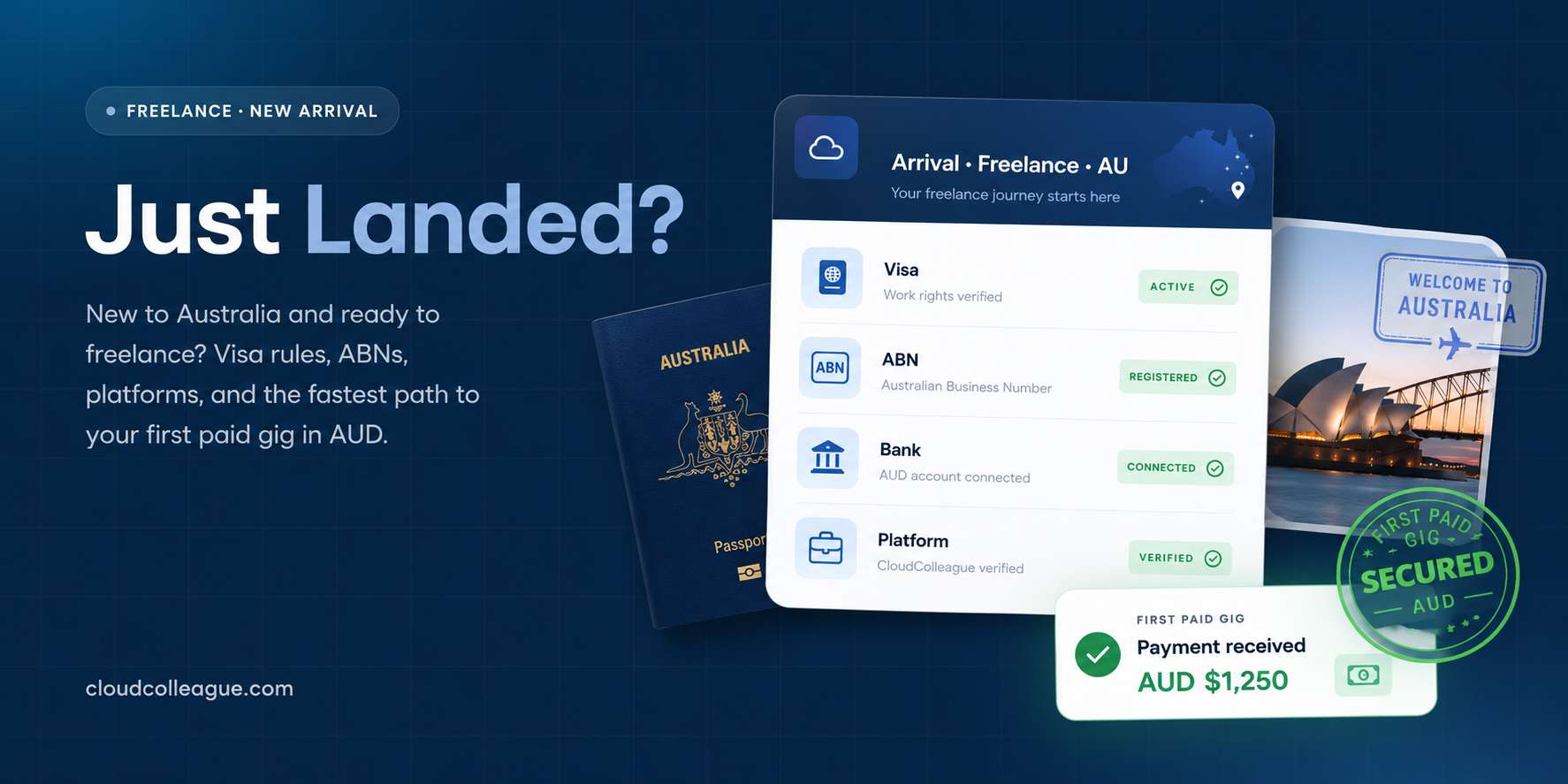
You have just landed in Australia, or you are about to. Maybe you came on a working holiday visa, maybe a student visa, maybe a partner or skilled migration visa. Either way, the same question hits within the first month: “How do I actually start earning here?”
Traditional employment can be slow to land for new arrivals. Australian employers often want local references, local experience and local certifications. Freelance and task-based work, by contrast, can start in days and it is one of the fastest ways to build local credibility, income and a network.
This guide walks you through how to find freelance work in Australia in 2026 as a new arrival or international worker, including visa rules, ABNs, where to find your first gigs, and how to build a sustainable freelance income from your first month.
Why Freelancing Is the Smart First Move for New Arrivals?
Freelancing solves three problems that full-time job hunting cannot solve quickly:
- Income gap. Most new arrivals burn savings for 1 to 3 months while job hunting. Freelance gigs start paying in weeks.
- No local references. Freelance platforms build reviews and reputation as you work. You do not need a previous Australian employer to start.
- Skill translation. Freelancing lets you prove your skills in the Australian context, which is the single biggest unlock for full-time job offers later.
Many of the most established freelancers in Australia in 2026 started this way. Freelance work is not a fallback, it is a strategic entry point.
Read Next: Best Side Hustles in Australia You Can Start This Week in 2026.
Step 1 – Check What Your Visa Actually Allows.
Before doing anything else, confirm your work rights. Visa categories that commonly allow freelance work in Australia include:
- Working Holiday Visa (subclass 417 and 462) – work allowed with the 6-month-per-employer rule (which applies to a single business, not necessarily to multiple clients)
- Student Visa (subclass 500) – up to 48 hours per fortnight during study, unlimited during recognised breaks
- Skilled Migration Visas (189, 190, 491) – full work rights
- Partner Visa (820, 309, 801, 100) – full work rights
- Bridging Visas with work rights – confirm conditions on your specific bridging visa
Visa conditions change. Always confirm against the Department of Home Affairs website or your registered migration agent before relying on any general guidance. Working outside your visa conditions has serious consequences for your future in Australia.
Step 2 – Get an Australian Business Number (ABN).
To freelance legally in Australia, you generally need an Australian Business Number. The good news:
- ABN registration is free
- It is online, through the Australian Business Register
- It typically issues within minutes for straightforward applications
- You do not need an Australian business name to get one, you can operate as a sole trader under your own name
Eligibility for an ABN as a new arrival depends on whether you are genuinely carrying on a business in Australia. If you are providing freelance services to Australian clients with an intention to keep doing so, you qualify.
Once you have an ABN:
- Use it on every invoice you issue
- Track your income for tax purposes
- Register for GST once your annual turnover hits $75,000 (most new freelancers do not need to register on day one)
Step 3 – Get a Tax File Number (TFN).
You will need a TFN to lodge tax in Australia. Apply on the Australian Taxation Office website using your visa details. Without a TFN, the ATO can withhold tax at the highest rate, which significantly cuts your take-home.
Quote your TFN to:
- Your bank (for interest reporting)
- Any employer (if you also work part-time as an employee)
- The ATO when you lodge your annual return
Step 4 – Open an Australian Bank Account.
Clients will not pay into a foreign account easily. An Australian bank account is essential. Most major banks (Commonwealth, ANZ, NAB, Westpac) allow new arrivals to set up an account before arriving or within the first few weeks of landing, with proof of identity and an Australian address.
Choose an everyday transaction account. Set up:
- Internet banking
- A separate “tax savings” account where you transfer 20 to 30 percent of every payment for income tax later
- Optional: a separate “GST savings” account once you register for GST
This single discipline transferring tax savings as you go is what separates freelancers who thrive from those who panic at the end of the financial year.
Step 5 – Decide What You Will Offer.
The first instinct is to offer everything. Resist. Pick one or two clearly defined services to start with. Examples:
- “I write LinkedIn content for B2B founders in Australia.”
- “I edit short-form videos for Australian creators and small businesses.”
- “I do bookkeeping for sole traders and small Australian businesses.”
- “I design logos and brand identities for new Australian startups.”
- “I provide virtual assistant support to Australian solopreneurs.”
A specific offer is easier to market, easier to price, and easier to deliver consistently. As you build reviews, you can expand.
Step 6 – Build a Profile That Gets You Hired.
A great freelance profile in Australia in 2026 has six elements:
- A clear headline – what you do and who you do it for
- A professional photo – looks the camera in the eye, looks approachable
- A short summary (100 -150 words) – your story, your specialty, your approach
- Portfolio samples – even 3 to 5 strong pieces beat 20 weak ones
- Service packages with pricing – saves negotiation time and signals confidence
- References or testimonials – bring 1 to 2 from your previous country to start
Do not hide your international experience. Frame it as a strength: “10 years of experience designing brands for clients in [country], now bringing the same craft to Australian businesses.”
Step 7 – Pick the Right Platforms for Australian Freelance Work.
Where you spend your effort matters more than how hard you work. The platforms that perform best for new arrivals in 2026:
- General Australian hiring marketplaces like CloudColleague – strong for skilled and professional freelance work, with suitability-based matching and built-in payment protection
- Local task platforms like Airtasker – good for physical and local tasks (cleaning, moving, handyman, photography)
- Global freelance platforms like Upwork and Fiverr – useful for remote work but more crowded and globally competitive
- LinkedIn – useful for direct outreach to small Australian businesses
- Industry-specific marketplaces for design, dev, writing, and other niches
For most skilled new arrivals, a focused Australian marketplace plus LinkedIn outperforms spreading across a dozen platforms.
| Start earning sooner. Create your free CloudColleague profile and start bidding on Australian tasks and jobs today. |
Step 8 – Land Your First Three Gigs.
The first three are the hardest. Tactics that work for new arrivals:
- Price below market on the first 2 to 3 gigs to build reviews. Do not stay there.
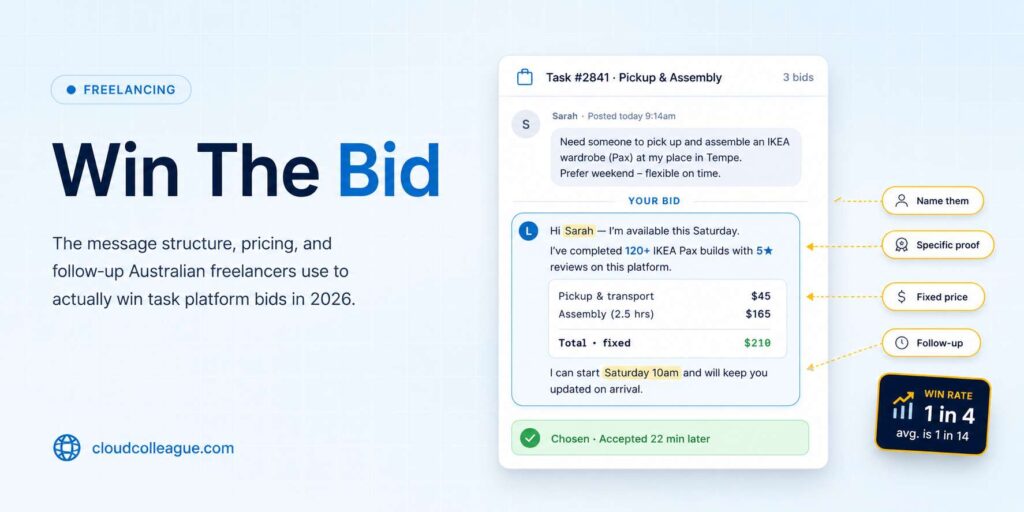
- Apply with personalized messages. Mention something specific about the client’s business.
- Promise a small, clear deliverable rather than a vague service.
- Deliver early. Beating deadlines builds trust faster than anything else.
- Ask for a review the moment the gig is done. Reviews compound.
Once you have 3 to 5 strong reviews, your conversion rate on applications doubles. If you want to work as a freelancer, CloudColleague provides guides on tasks which will help you in freelance jpurney.
Step 9 – Price Your Freelance Work Fairly.
A common new arrival mistake is pricing at your home country’s rate, which is often well below the Australian market. Another is pricing at the top of the Australian range without local reviews. Aim for the middle as you start, then move up as your portfolio builds.
Use the rate ranges in the article How much does it cost to hire a freelancer in Australia in 2026 as your guide. Start at the 30th to 40th percentile of your skill level, raise prices after every 5 strong reviews.
Step 10 – Understand Australian Tax for Freelancers.
The basics every freelancer in Australia needs to know:
- Income tax – you pay it on your net freelance income (earnings minus business expenses)
- PAYG instalments – once you earn over a threshold, the ATO may ask you to pay quarterly instalments
- GST – register once you cross $75,000 in annual turnover. Add 10 percent to your invoices once registered.
- Deductions – laptop, software, internet share, home office share, professional development, marketing costs
Keep every receipt. Use accounting software (Xero, MYOB, QuickBooks, or simpler tools like Rounded) from day one. A bookkeeper or accountant for $300 to $600 a year usually saves more than they cost.
Step 11 – Build the Local Network That Multiplies Your Income.
Online platforms get you started. Local relationships sustain you. Practical network-building actions for new arrivals:
- Join 1 or 2 industry meetups in your city
- Attend small business networking events (search Eventbrite + Meetup)
- Join Facebook and LinkedIn groups for your niche in Australia
- Reach out to 5 local freelancers in your field for coffee or a 20-minute call
- Volunteer one small piece of work for a local nonprofit or community group
Most of your highest-paying clients in year two will come from referrals, not platforms. Start planting those seeds in month one.
Common Mistakes New Arrivals Make When Freelancing in Australia.
A short hit-list:
- Working outside visa conditions. Risks your entire future in Australia.
- Skipping the ABN and TFN setup. Triggers high tax withholding and compliance headaches.
- Pricing is too low forever. Builds a reputation for being cheap rather than valuable.
- Pretending to be local. Australian clients are fine with international background, but they spot fake “Sydney-based” claims fast.
- Ignoring tax savings. End-of-year tax bills shock more new freelancers than anything else.
- Single-platform dependency. Diversify across 2 to 3 channels.
Fix these and the first 12 months in Australia get significantly easier.
Start Strong in Australia
Freelancing is one of the fastest, most flexible and most credibility-building ways to start earning in Australia as a new arrival in 2026. With the right visa setup, an ABN, a clear offer, and the right platform, you can land your first gig in weeks and build a real career from there.
| For Freelacers: Login into your account and start applying to Australian tasks and freelance gigs today. |
| For Australian employers: Start hiring at CloudColleague and access skilled professionals from across Australia and the world. |
Frequently Asked Questions
Yes, within the work hour limits of your visa (48 hours per fortnight during study, unlimited during breaks in most current rules). Always confirm against your current visa conditions.
In nearly all cases, yes. ABN registration is free and online.
Yes. You are still earning income in Australia for tax purposes and must declare it.
Some new arrivals land their first gig within 1 to 2 weeks of arriving, especially in writing, design, dev and VA work. Higher-trust niches (finance, legal) take longer.
Yes, especially on platforms that show portfolio quality and provide built-in reviews. The platform’s verification does much of the work that local references would otherwise do.
Through platforms with escrow and milestone payments. For direct clients, deposit upfront for new relationships and milestone payments for larger projects.
You pay marginal rates based on your total income in the same brackets as employees. For freelancers, the difference is you pay it as part of your annual return or quarterly installments, not through PAYG withholding.
Yes, and this is one of the most common paths. Many full-time Australian roles in 2026 are filled by freelancers who first worked with the company on a contract or project basis.