If you are a job seeker, freelancer, or career changer in Australia in 2026, you have a choice. You can chase whatever you happen to be qualified for or you can spend a little time learning what employers are actually paying for right now, and aim your career at it.
This guide breaks down the most in-demand skills in Australia in 2026: where the demand is highest, what the typical pay looks like, what experience is realistic to expect, and how to start building each skill if you do not have it yet. It draws on Australian government skills priority lists, industry hiring trends, and what platforms like CloudColleague see being posted every day.
What’s Driving Demand in Australia in 2026?
Five forces are shaping who Australian employers are hiring right now:
- Persistent skills shortages across health, construction, technology and trades
- AI adoption changing what mid-skill roles look like
- Cybersecurity tightening across every regulated industry
- Ageing population lifting healthcare and aged care demand
- Climate and energy transition creating new green economy roles
If your skill sits at the intersection of two or more of these forces, you are looking at strong demand for the rest of the decade.
Read Next: How to Bid on Tasks and Actually Win?
Tier 1 – The Hottest Skills in Australia in 2026.
These are the skills with the largest gap between supply and demand, the strongest salary growth, and the most visible employer hiring activity in 2026.
1. Software Engineering and DevOps
Typical salary range: $110,000 – $220,000+ Where the demand is: SaaS, fintech, govtech, healthtech, defence Specialisations in demand: Cloud-native development, platform engineering, distributed systems, SRE, full-stack TypeScript / Python
Australian tech is no longer “startups and banks.” Government, defence, agriculture, mining and energy now hire heavily. Mid-level engineers with cloud experience are some of the most fought-over candidates in the market.
2. Cybersecurity
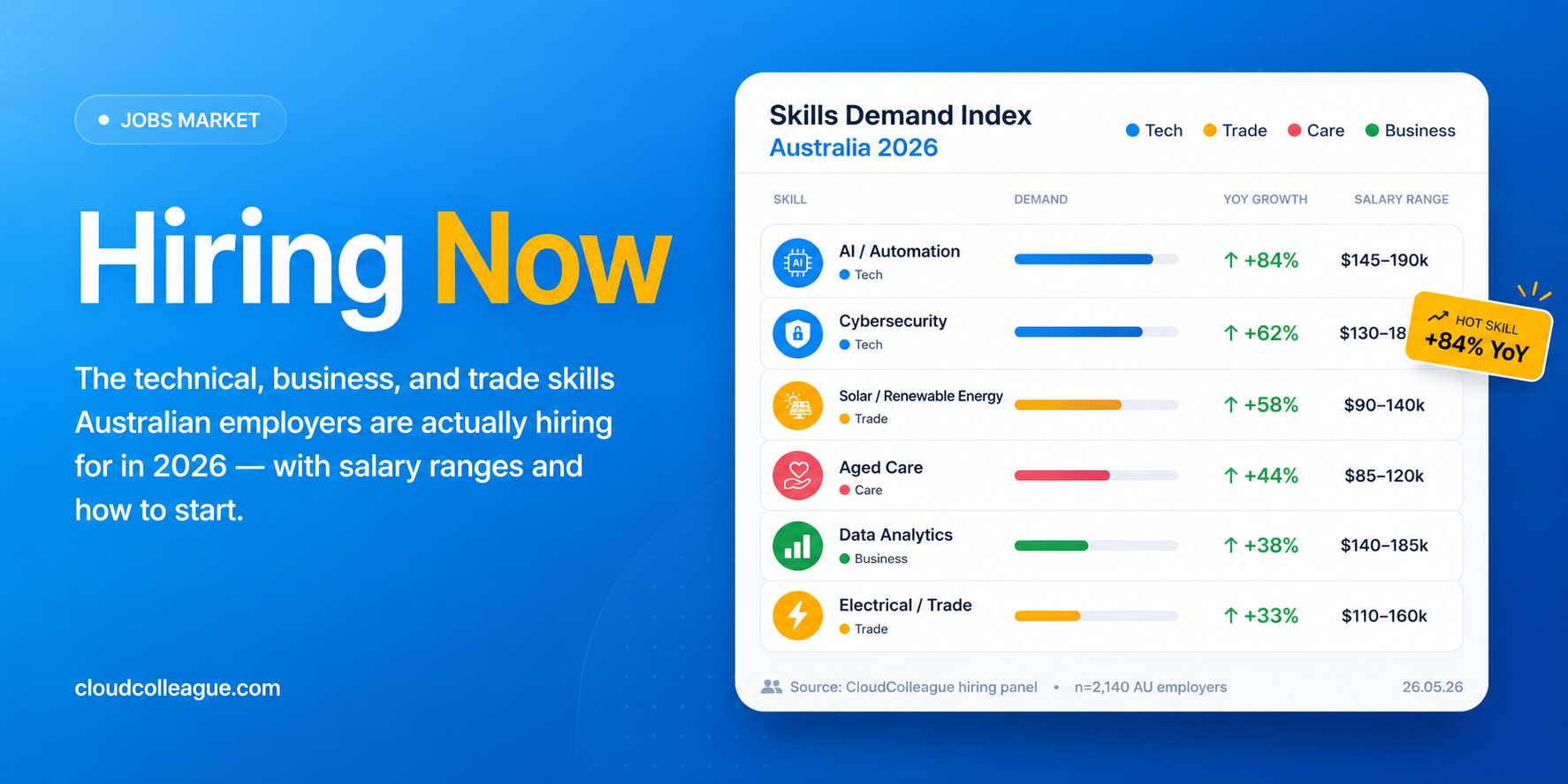
Typical salary range: $120,000 – $260,000+ Where the demand is: Banking, government, energy, defence, healthcare Specialisations in demand: Cloud security, GRC, incident response, application security
After multiple high-profile breaches in recent years and tightening regulatory regimes, every Australian organisation of meaningful size is hiring or contracting for security capacity.
3. AI, Machine Learning and Data Science
Typical salary range: $130,000 – $260,000+ Where the demand is: Finance, tech, government, healthcare, consulting Specialisations in demand: Applied AI engineering, MLOps, prompt and agent engineering, data engineering
Generative AI moved fast from novelty to default infrastructure. The roles in highest demand in 2026 are the engineers and analysts who can apply AI to existing business workflows, not just researchers.
4. Data Engineering and Analytics
Typical salary range: $110,000 – $200,000 Where the demand is: Every mid-to-large business in Australia Specialisations in demand: Cloud data warehouses, ELT pipelines, BI tooling, governance
Data quality is the bottleneck on AI value. Engineers who can build clean, scalable data pipelines are paid accordingly.
5. Healthcare and Aged Care
Typical salary range: $75,000 – $160,000 (RNs and specialists higher) Where the demand is: Hospitals, aged care, NDIS providers, mental health Specialisations in demand: Registered nurses, mental health practitioners, allied health (OT, physio), aged care workers, NDIS support coordinators
Australia’s ageing population and chronic workforce shortages keep this sector in critical demand. Both metro and regional hiring is strong.
6. Construction Trades and Project Management
Typical salary range: $80,000 – $200,000+ (qualified trades and PM roles) Where the demand is: Residential, commercial, infrastructure, renewables Specialisations in demand: Electricians, plumbers, carpenters, civil engineers, site supervisors, BIM
Australia’s pipeline of housing, infrastructure and renewable projects has outrun trade workforce supply for years. Qualified tradies and construction professionals continue to command strong, stable income.
7. Renewable Energy and Sustainability
Typical salary range: $90,000 – $180,000 Where the demand is: Energy operators, utilities, government, consulting Specialisations in demand: Solar and battery engineers, grid integration, ESG and sustainability advisors, EV infrastructure
Australia’s energy transition is reshaping demand across engineering, project management and policy roles.
Tier 2 – Strong, Steady Demand.
These skills are not as red-hot as Tier 1 but offer durable demand and good earnings across most of the country.
8. Accounting, Bookkeeping and Tax
Typical salary range: $65,000 – $160,000+ Where the demand is: Public practice, advisory, small business, corporate finance Specialisations in demand: Cloud-native bookkeeping, BAS and GST, advisory accounting, audit, tax
Generative AI is changing the work, not eliminating it. Bookkeepers and accountants who can advise and interpret not just processes are paid well.
9. Digital Marketing and SEO
Typical salary range: $70,000 – $160,000 Where the demand is: E-commerce, SaaS, agencies, small business Specialisations in demand: SEO, paid media, content marketing, marketing analytics, lifecycle marketing
Australian small and mid-sized businesses have moved heavily online. Marketers who can demonstrate ROI in numbers, not just impressions, are in strong demand.
10. UX/UI and Product Design
Typical salary range: $90,000 – $200,000 Where the demand is: SaaS, fintech, e-commerce, govtech Specialisations in demand: Mid-to-senior product designers, design systems, research-led design
Demand cooled briefly post-2022 then rebuilt. Senior designers who pair design with research and outcomes are particularly valuable.
11. Education and Teaching
Typical salary range: $75,000 – $130,000+ Where the demand is: Public and independent schools, early childhood, VET, EAL Specialisations in demand: Maths, science, special education, early childhood educators, VET trainers and assessors
Teacher shortages remain acute in many Australian regions. Career-changers entering teaching through fast-track pathways are well supported.
12. Sales and Business Development
Typical salary range: $85,000 – $250,000 OTE Where the demand is: SaaS, services, fintech, manufacturing Specialisations in demand: B2B SaaS sales, enterprise account management, technical sales engineers
Strong sellers with quota track records remain in short supply across most B2B verticals.
13. Project and Program Management
Typical salary range: $110,000 – $230,000 Where the demand is: IT, construction, government, healthcare, energy Specialisations in demand: Tech program management, infrastructure PM, change management, agile delivery
PM roles consistently appear in shortage lists, especially with technical depth.
Tier 3 – Solid Demand With Lower Barriers to Entry.
These roles offer realistic starting points for new entrants, career changers and new arrivals to Australia.
14. Virtual Assistant and Administrative Support
Typical hourly rate: $30 – $80 Where the demand is: Small business, professional services, consultants
Steady demand for organised, communicative VAs. Specialisation (legal VA, real estate VA, exec assistant) raises the rate substantially.
15. Customer Service and CX
Typical salary range: $60,000 – $110,000.
Where the demand is: E-commerce, telco, fintech, SaaS.
Demand sits in mid-skill CX roles that combine customer empathy with comfort using modern tools (Zendesk, Intercom, CRM platforms).
16. Hospitality and Tourism
Typical hourly rate: Award-based; senior roles $70,000 – $140,000.
Where the demand is: Restaurants, hotels, tourism, events.
Skills shortages in chefs, baristas, restaurant managers and tourism operations continue in 2026.
17. Logistics and Warehousing
Typical salary range: $65,000 – $130,000 .
Where the demand is: E-commerce, retail, manufacturing, food.
Warehouse coordinators, drivers, supply chain analysts and logistics planners are in steady demand.
18. Content Creation and Video Production
Typical hourly rate / salary: $55 – $130 / hour freelance; $75,000 – $150,000 in-house.
Where the demand is: E-commerce, SaaS, media, agencies, creators.
Short-form video, podcast production and SEO content are the strongest sub-niches in 2026.
Soft Skills Employers Are Hiring For.
Beyond technical skills, every Australian employer in 2026 is looking for a similar set of underlying capabilities:
- Clear written communication in an AI-augmented world.
- Critical thinking and judgement in the things AI cannot replace.
- Working effectively with AI tools (using them well, not blindly).
- Self-management and reliability in hybrid and remote work.
- Stakeholder management across teams.
- Coaching and people development for senior roles.
These rarely appear as the headline requirement, but they make the difference between candidates with similar technical skills.
How to Start Building These Skills From Zero?
If you do not have a Tier 1 or Tier 2 skill yet, the realistic 2026 paths are:
- Free and low-cost online courses. Google Career Certificates, AWS Skill Builder, Microsoft Learn, Coursera, Udemy; all credible starting points.
- TAFE and short courses. Especially strong for healthcare, trades, IT support, and project management foundations.
- Apprenticeships and traineeships. Government-funded, structured, and earn-while-you-learn.
- Skilled migration pathways for in-demand roles for international workers.
- University microcredentials and graduate certificates for mid-career upskilling.
- Practical project work. A portfolio of 3 to 5 real projects often outperforms a certificate alone.
Whichever path you pick, build evidence code, designs, case studies, certifications, references that an employer can verify in 30 seconds.
Where to Find Roles Hiring for These Skills?
Most Australian employers in 2026 post in-demand roles across:
- General hiring marketplaces like CloudColleague – strong for tasks, contracts and full-time roles across all the categories above
- LinkedIn – strong for senior and specialist hires
- Industry-specific boards – healthcare, trades, education, government
- Direct company careers pages – for senior and confidential roles
For most early- and mid-career job seekers and freelancers, one or two well-built profiles plus active applications outperform spreading across a dozen platforms.
| Make yourself easy to hire.Create your free CloudColleague profile and start receiving invites for in-demand Australian roles. |
How to Position Yourself for an In-Demand Skill?
A few practical moves that work in 2026:
- Pick a niche, not a skill. “Customer support analyst with Zendesk + Notion + AI prompt experience” beats “customer service generalist.”
- Build proof, not credentials. A short portfolio of real work beats a thicker certificate stack.
- Show outcomes. “Cut average response time from 18 hours to 3 hours” beats “managed support inbox.”
- Be searchable. Use the language the employers use, not internal jargon.
- Add the AI angle. Even simple statements like “uses Claude / ChatGPT / Copilot to accelerate research and draft work” land well with 2026 hiring managers.
The best-paid candidates in any in-demand skill are usually not the most credentialled, they are the ones who package their experience clearly.
Learn next: Soft Skills vs Hard Skills
Salary Negotiation: Closing the Pay Gap.
In a candidate-short market, negotiation matters more than ever. Best practices:
- Research the real range using salary surveys and live job ads, not friends or family
- Ask early about the band, not the offer
- Anchor at the top of the band if your skills are strong
- Negotiate on total package, not just base, super, leave, training budget, remote allowance, equity
- Get the offer in writing before resigning anywhere else
A 10 to 15 percent uplift on the first offer is achievable for most in-demand roles when the candidate is prepared.
Aim Your Career at What’s Actually Being Paid For.
In 2026, the difference between a stagnant career and a thriving one is increasingly about where you point your effort. Pick a skill in genuine demand, build proof through real projects, and put yourself in front of Australian employers actively hiring.
| For candidates: Browse Jobs and apply on CloudColleague and start receiving invites for in-demand Australian roles. |
| For employers: Post your role free on CloudColleague and reach candidates with the skills you need. |
Frequently Asked Questions
At the very top, specialized AI engineering, senior cybersecurity, executive medical specialization and senior tech leadership lead. But the highest income relative to effort and entry barrier varies hugely by industry.
Yes, very. Qualified electricians, plumbers, carpenters and HVAC technicians remain in critical shortage.
AI is reshaping work, not eliminating most roles. Jobs that combine human judgement with AI fluency are growing fastest. Jobs that are purely repetitive content production are shrinking.
Yes, particularly in healthcare, trades, project management, sales, and applied tech roles. Career changers often outperform fresh graduates because of transferable experience.
Sometimes yes for entry-level roles, particularly when paired with a portfolio of real projects. For regulated roles (healthcare, finance, law) formal qualifications are still required.
Skills shortages overlap heavily with skilled migration priorities tech, healthcare, trades, engineering, education. Check Australia’s skills priority list for current categories.
Most of Tier 1 and Tier 2 will be. Demand for cybersecurity, healthcare, energy transition and trades is projected to grow for at least the next decade.