Knowing the best websites to look for jobs is half the battle in a competitive market. Australia has dozens of job platforms, from giant general boards with tens of thousands of listings to tightly focused niche sites for a single sector. Using the right mix saves you time and puts you in front of the employers who matter. This guide breaks down the top job search websites in Australia for 2026, what each does best, and how to use them effectively.
| Want roles matched to you? Search jobs on CloudColleague or create your free profile to let Australian employers find you directly. |
Best General Job Boards
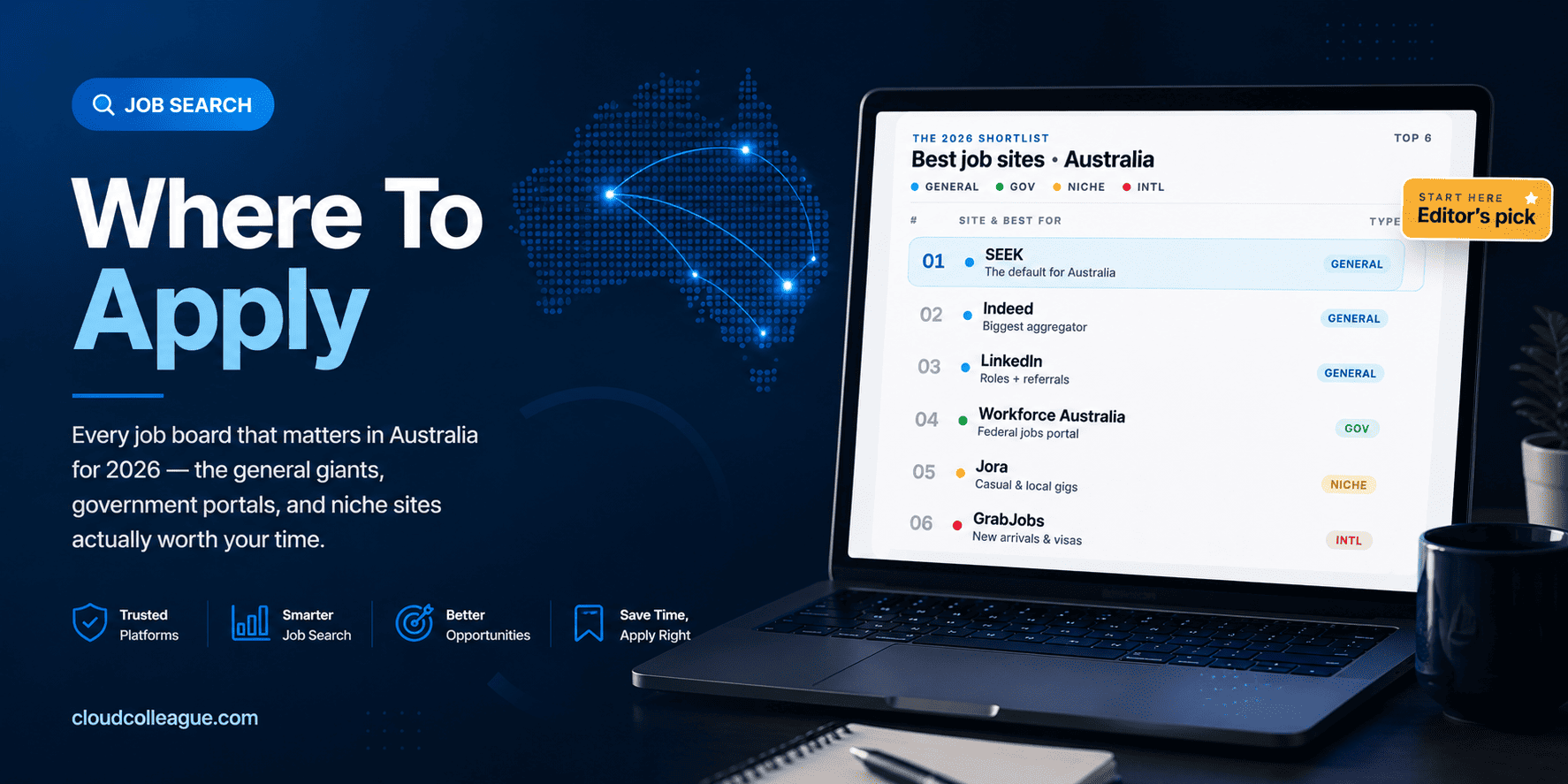
General job boards are where most searches start, because they carry the highest volume across every industry and location. The four below are the platforms nearly every Australian job seeker uses, and each has a distinct strength.
| Job Board | Key Strength | Best For |
| Seek | Largest listing volume in Australia | Broad searches across every industry |
| Indeed | High volume, fast alerts, easy apply | Quick applications and wide reach |
| Networking plus jobs | Professional and white-collar roles | |
| Jora | Aggregates listings from many sites | Casual, part-time, and regional work |
Seek is the market leader and the natural first stop, holding the largest volume of listings and powerful filters for location, salary, and work type. Indeed matches it for scale and is known for fast alerts and quick applications. LinkedIn is the strongest platform for professional and white-collar roles, because it pairs job listings with direct networking, so you can reach hiring managers as well as apply. Jora, part of the Seek group, aggregates listings from across the web and is especially handy for casual, part-time, and regional work, with a reliable alert system.
Read Next: Counselling Jobs in Melbourne: Roles & How to Apply
Government Job Sites
If you want stability, strong conditions, and structured career progression, government roles are worth targeting, and they are advertised on dedicated portals rather than the main boards. APSjobs is the official site for Australian Public Service positions across federal departments and agencies. Workforce Australia, the government’s employment services platform, also lists roles and provides free support, including inclusive services for people with disability.
Beyond the federal level, every state and territory runs its own careers portal for health, education, transport, and other public-sector jobs. The application process is usually more formal and slower than private boards, but the roles are secure and well structured. For a deeper look at this path, see our guide to public service jobs in Australia.
Industry-Specific and Niche Boards
Once you know your field, niche boards often beat the giants on quality. They carry fewer listings, but the roles are highly relevant and the employers are looking for exactly your background, so your application faces less noise and stronger intent.
Ethical Jobs is the leading board for the not-for-profit, charity, and social-enterprise sector, and it maintains a strict values standard by excluding industries such as tobacco, gambling, and fossil fuels. If purpose-driven work appeals to you, read our roundup of ethical jobs in Canberra. Other strong niche options include Grad Connection for graduate and early-career programs, dedicated healthcare boards for nursing and allied health, Arts Hub for creative and media roles, and sector boards for mining, rail, and infrastructure.
| Smart approach: use one or two general boards for reach, then add a niche board for your specific field. The niche site is where relevant employers concentrate. |
Sites for International Job Seekers
If you are moving to Australia or applying from overseas, the same major boards work well, with a few adjustments. Seek, Indeed, and Jora all support location filters so you can target a specific city, while LinkedIn is invaluable for networking with recruiters and hiring managers before you arrive. Grad Connection is strong for graduate programs that often welcome international candidates.
The key is to focus your search on occupations that are in genuine demand, because these are the roles most likely to offer visa sponsorship. Filtering for skills-shortage occupations, tailoring your profile to Australian conventions, and being clear about your work rights all improve your odds. Employer-matching platforms like CloudColleague can also connect you directly with businesses that are open to hiring skilled migrants.
Read Next: Best Australian Cities for Jobs & Career Opportunities
How to Use Job Sites Effectively?
The platform matters less than how you use it. A few disciplined habits will get you more interviews than simply applying to everything. Start with these.
- Set focused alerts. Create daily alerts for just two or three specific job titles, not twenty, so the right roles stand out instead of flooding your inbox.
- Apply early. Aim to apply within 24 to 48 hours of a role being posted, since early applicants are far more likely to be seen.
- Complete your profile. Fill out your profile fully on every platform you use, because recruiters search these databases directly and a complete profile ranks higher.
- Target high-signal ads. Prioritise listings with a clear salary range, detailed requirements, or a named contact, as these usually mean a real, active vacancy.
- Tailor each application. Match your resume language to the job description, and lead with the skills and results the employer actually asked for.
| Put these tips to work today. Browse current task on CloudColleague and start bidding on tasks can reach you with matched opportunities. |
Frequently Asked Questions
Seek is the most widely used, with the largest volume of listings across every industry. Indeed and Jora are strong for fast, high-volume searching, while LinkedIn is best for professional roles and networking. The best choice depends on your field and goals, so most people use two or three together.
Yes. The major job boards, including Seek, Indeed, Jora, and LinkedIn, are free for job seekers to search and apply. Some charge employers to post roles, but applying costs you nothing.
APSjobs lists Australian Public Service roles, and each state and territory runs its own careers portal. These offer stable, well-structured roles, though the application process is usually more formal and slower than private sector boards.
Use the major boards with location filters, plus LinkedIn for networking and Grad Connection for graduate programs. Focus on roles on the skills shortage list, since these are most likely to offer visa sponsorship.
Keep it focused. Two or three specific job-title alerts work far better than a dozen broad ones, which tend to flood your inbox and bury the roles that actually fit.