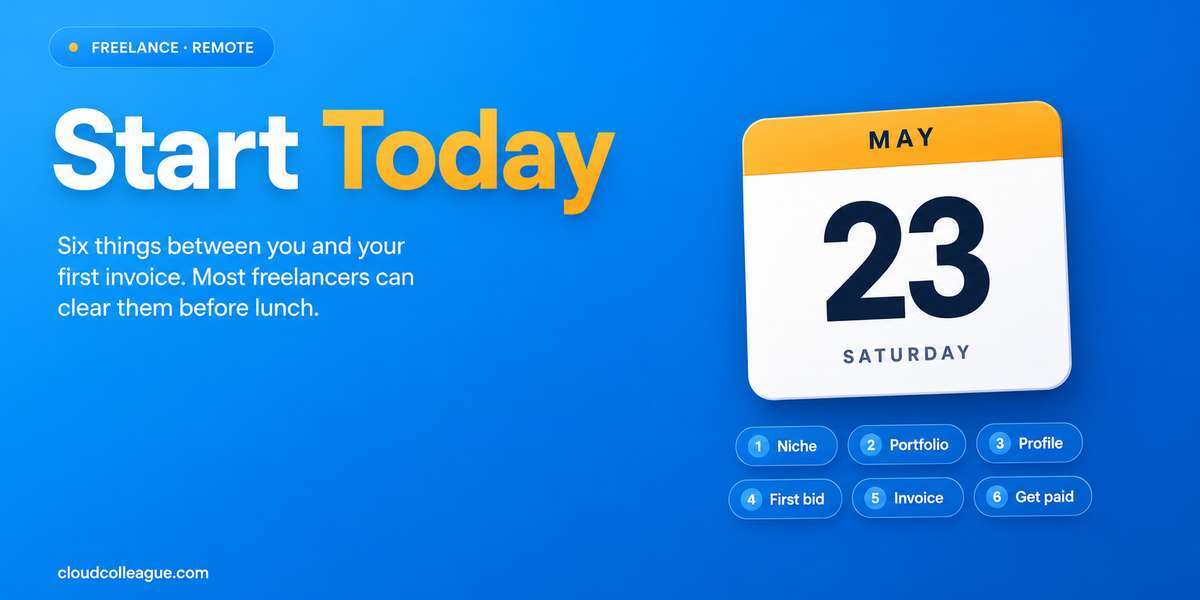
You searched for today, not eventually. The good news is that in Australia in 2026, you can genuinely set yourself up to take your first paid freelance task within a single afternoon. According to Australian Bureau of Statistics Labour Force data, around one in four Australian workers now does some form of contract, freelance, or gig work, either alongside a main job or as their primary income. Whether you are a side-hustler, a full-time worker testing a transition, a returning worker, or a student building income, CloudColleague and the steps below get you from zero to your first paid gig in days, not months.
| Quick Answer: How to Start Freelancing Today in Australia To start freelancing today in Australia, choose a service you can offer with your current skills, register for a free Australian Business Number (ABN) through the Australian Business Register, set your starting hourly rate, start as a seeker on a platform like CloudColleague, set up an invoicing system, and apply for your first 2 to 3 small projects. Most Australian beginners complete this setup in a single afternoon and start earning within 7 to 14 days. |
Is Freelancing in Australia Worth It in 2026?
Freelancing is no longer a niche path in Australia. ABS Labour Force data shows around 1 in 4 Australian workers does some form of contract, freelance, or gig work in 2026, and Jobs and Skills Australia identifies freelance and project-based engagement as one of the fastest-growing employment models in the country.
The income picture supports the trend. Hays Australia and the Robert Half and CloudColleague Salary Guide both show experienced Australian freelancers in tech, design, marketing, accounting, and legal services often out-earn equivalent salaried roles on an hourly basis. The honest caveat: freelancing demands self-management, financial discipline, and active client acquisition. It is not passive income. But for anyone willing to treat it as a business from day one, the path is faster and more rewarding than at any point in the last decade.
7 Steps to Start Freelancing Today
Step 1: Choose What You Can Offer Right Now
The fastest start uses a skill you already have, not one you want to learn. List 3 to 5 things you can do well today and pick the one with the strongest market demand.
High-demand Australian freelance services in 2026 include writing and content creation, graphic design, virtual assistance, bookkeeping, social media management, web development, photography, marketing, transcription, online tutoring, and translation.
A specific niche beats a generic offering. “LinkedIn profile rewriting for executives” wins more clients than “writing services”. Niching speeds up your first sale because clients understand exactly what you do.
Step 2: Register for an ABN (Free, Same Day)
You need an Australian Business Number to legally invoice clients for freelance work in Australia. The ABN is free, takes 15 to 20 minutes online through the Australian Business Register, and is issued the same day in most cases.
Most freelancers operate as a sole trader, which is the default and simplest legal structure. You only need to register for GST if your freelance income exceeds $75,000 per year, per Australian Taxation Office rules. Below that threshold, you charge clients without GST and lodge your freelance income through your annual tax return.
Step 3: Set Your Rate
Two main approaches work in Australia: hourly rate or project rate. Hourly is simpler when you start.
Use the starting-rate formula: take the equivalent annual salary you would expect, divide by 1,500 working hours (accounting for unpaid admin, gaps between clients, and time off), then add 30% to cover superannuation, leave, tax, and equipment. A $90,000 salary equivalent becomes roughly $78 per hour.
Do not undercharge in your first month. Clients quote you on price signal as well as skill, and a rate too low triggers doubt rather than excitement. Most beginners undercharge for 3 to 6 months and lose income they never recover.
Step 4: Build a Simple Portfolio in Under 2 Hours
You do not need years of work to start. You need 2 to 3 strong samples that match the service you are selling.
- Writers: 2 to 3 published or self-published articles, or sample pieces you create today
- Designers: 2 to 3 mock projects, rebrands, or speculative pieces
- Developers: 1 or 2 GitHub projects or a simple personal site
- Service freelancers (VA, bookkeeping, social media): A one-page service description with clear deliverables and pricing
- Photographers: A curated selection of 8 to 12 best shots, organised by category
If you have nothing right now, create one piece of strong sample work in the next 60 minutes and use it. A freelancer with one excellent sample beats one with five mediocre ones every time.
Step 5: Create Profiles on the Right Platforms
The platform decision matters because the wrong choice wastes weeks. The leading options for Australian freelancers in 2026 are:
- CloudColleague: Australian-market focus, combines full-time jobs, freelance tasks, and project work in one account. Particularly useful for freelancers keeping a day job while building a client base, or testing freelancing before fully committing.
- Upwork: Global, large volume, high competition. Strong for tech, writing, and design.
- Fiverr: Productised services with clear deliverables. Fast first sale for well-defined offerings.
- Freelancer: Australian-founded global marketplace, broad category coverage.
- Toptal: Application-based, top-tier tech and design. Slow entry but strong rates.
- LinkedIn: Warm-introduction freelance work through your network. Strong for professional services like consulting, marketing, and legal.
Most Australian freelancers start on two platforms simultaneously. One local (CloudColleague) gives you Australian client access without competing with international bids. One global (Upwork or Fiverr) gives you volume and a wider pool. This combination produces the fastest path to a steady pipeline.
Step 6: Set Up Invoicing and Payment Today
You need a way to invoice clients and receive payment from day one. The simplest Australian options are:
- Hnry: Built specifically for Australian freelancers, handles tax, GST, and super automatically
- Rounded: Australian invoicing and accounting tool designed for sole traders
- Xero: Full accounting platform, scales as your freelance business grows
- Basic option: A simple invoice template plus a Stripe or PayPal account for payments
Whichever option you choose, open a separate bank account from day one and put 30% of every client payment aside for tax. This single habit prevents the most common end-of-financial-year disaster Australian freelancers face.
Step 7: Apply for 5 Small Projects Today
The fastest path to your first paid task is applying for 5 small projects on day one, not waiting for the perfect first gig.
Short, personalised pitches outperform generic ones. The pattern that converts: name the client, mention one specific thing about their project, give one example of your relevant work, then propose a clear next step.
The goal of your first 1 to 2 weeks is one completed paid task, even at a slightly lower rate. After that, you have a track record, a testimonial, and the confidence to charge full price.
Ready to take your first freelance task today? CloudColleague is the Australian platform built for freelancers, side-hustlers, and full-time workers exploring project work. Create your free profile in under 5 minutes, browse beginner-friendly freelance tasks, and apply for your first paid gig today. No global bidding wars for tiny jobs, no oversaturated category competition.
How Much Can You Earn Freelancing in Australia?
Australian freelance rates vary by skill, experience, and platform. The ranges below come from Hays Australia, the Robert Half Salary Guide 2026, and platform data from Upwork and Freelancer.
| Freelance Service | Beginner Rate (AUD/hour) | Experienced Rate (AUD/hour) |
| Virtual assistance | $25 to $40 | $45 to $80 |
| Writing and content | $40 to $70 | $80 to $200 |
| Graphic design | $40 to $70 | $80 to $180 |
| Web development | $50 to $90 | $100 to $250 |
| Bookkeeping | $40 to $60 | $75 to $130 |
| Social media management | $35 to $60 | $70 to $150 |
| Marketing and SEO | $50 to $80 | $90 to $200 |
| Photography | $50 to $100 | $150 to $400 |
Most beginners undercharge in the first 3 months. Raise your rates by 15 to 25% after your first 5 completed projects, once you have testimonials and a track record to back the price.
Now that you know what freelancing pays in Australia, here is exactly how to apply for tasks on CloudColleague and start earning today.
Common Mistakes New Freelancers Make in Australia
- Skipping the ABN setup and trying to invoice without one (the ATO treats this as undeclared income)
- Underpricing for too long out of fear of losing clients
- Not putting tax money aside from day one (a 30% mental allocation prevents end-of-year financial pressure)
- Spreading too thin across 5 platforms instead of mastering 2
- Treating freelancing as a hobby until clients arrive (it is a business from day one)
- Saying yes to scope creep without re-quoting the project
- Mixing personal and freelance bank accounts (separate from day one)
Your Next Step
Freelancing in Australia in 2026 has lower barriers, more demand, and faster pathways than at any point in the last decade. Your first paid task is realistically within 7 to 14 days if you take action today.
Ready to start freelancing today? CloudColleague is the Australian platform that brings together full-time jobs, freelance tasks, and short projects in one account. Create your free profile in under 5 minutes, browse beginner-friendly freelance gigs, and apply for your first paid task today and get connected with hiring recruiters. No global bidding wars, no oversaturated category competition, just Australian clients ready to hire.
Common Questions About How To Start Freelancing in Australia
Start with a skill from study, hobbies, or your current job. Register for a free ABN, build two to three sample projects, and apply for small gigs on CloudColleague and Upwork. Most beginners land their first paid task within two weeks.
Yes. Registration is free and takes 15 to 20 minutes through the Australian Business Register. Most freelancers operate as sole traders, which is the simplest legal structure.
CloudColleague is the leading Australian platform for full-time, freelance, and project work in one account. Global platforms like Upwork and Fiverr are also widely used. Most Australian freelancers combine one local and one global platform.
Rates range from $25 per hour for beginner virtual assistance to $400 for specialised consulting. Most established freelancers in writing, design, and development earn between $70,000 and $150,000 per year.
Yes. All freelance income must be declared in your annual tax return. Set aside 30% of every payment for tax. If your income exceeds $75,000 annually, register for GST through the Australian Taxation Office.
Yes, in most cases. Check your employment contract for conflict-of-interest clauses. Most Australian employers permit freelance work outside hours when it does not compete with their business.
Most Australian freelancers take six to eighteen months, often starting alongside a day job. CloudColleague speeds this up by combining freelance tasks with full-time listings.