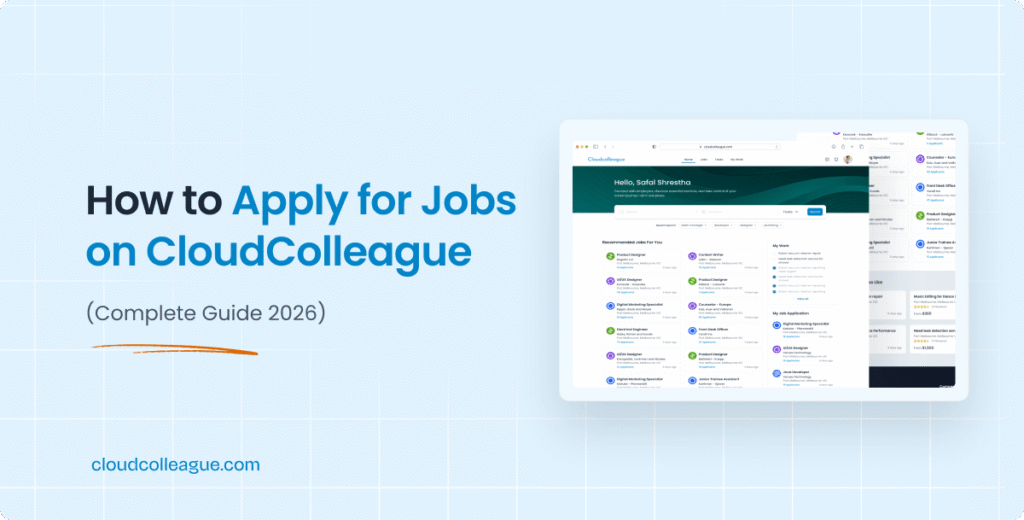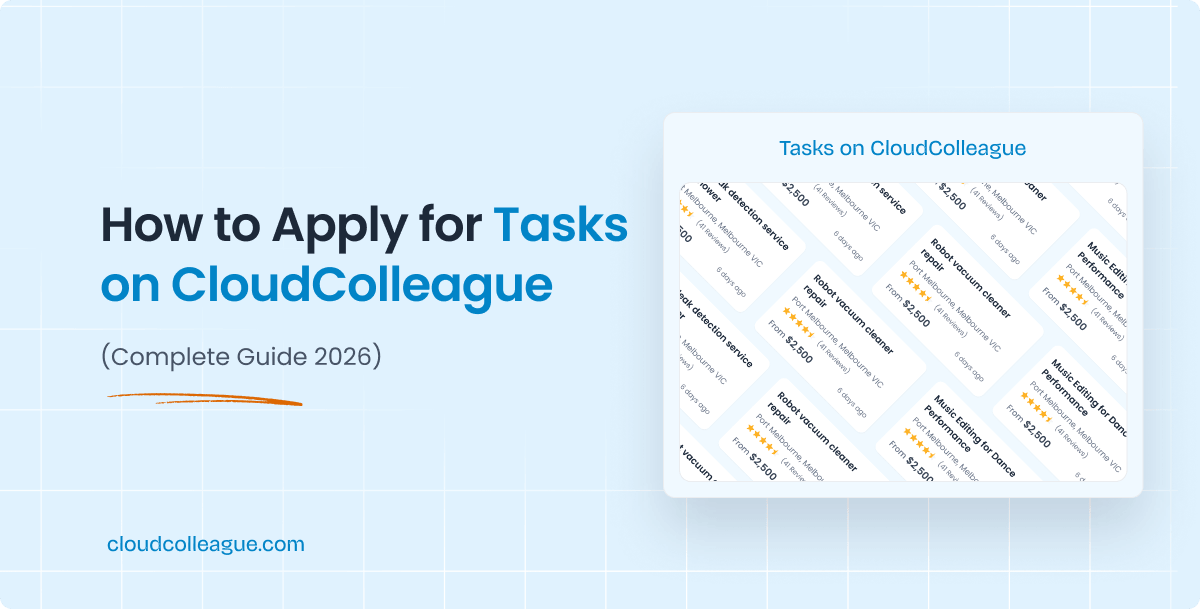
There is a version of professional work that most job seekers never consider. Where you do not need a formal employment history to get started? Or Where the platform takes nothing from what you earn? Where every piece of work you complete builds a visible, permanent record of your capability that makes the next opportunity easier to win.
That version exists on CloudColleague, and it is called the task category.
Tasks on CloudColleague are short-term or one-off pieces of professional work posted by businesses with a defined scope, a set timeline, and a clear budget. They sit alongside full-time job listings and packaged service offerings in the same marketplace, but they operate on entirely different terms. 7% commission and no upfront employment history required. Fast turnaround from proposal to payment. And a review system that compounds in your favour with every successful delivery.
This guide covers everything specific to the task category on CloudColleague: what tasks are? Where to find them? How to write a proposal that wins? Or How to price your work at any career stage? How to deliver professionally? Or How to navigate the payment process? How to turn one-off clients into repeat business? and How to apply as a no-experience candidate without underselling or misrepresenting what you bring?
What Makes CloudColleague Tasks Different From Every Platform?
Most professionals who arrive at CloudColleague understand job listings intuitively because they have applied for jobs before. However, tasks are less familiar territory. As a result, many professionals scroll past the task category without understanding its structural advantages.
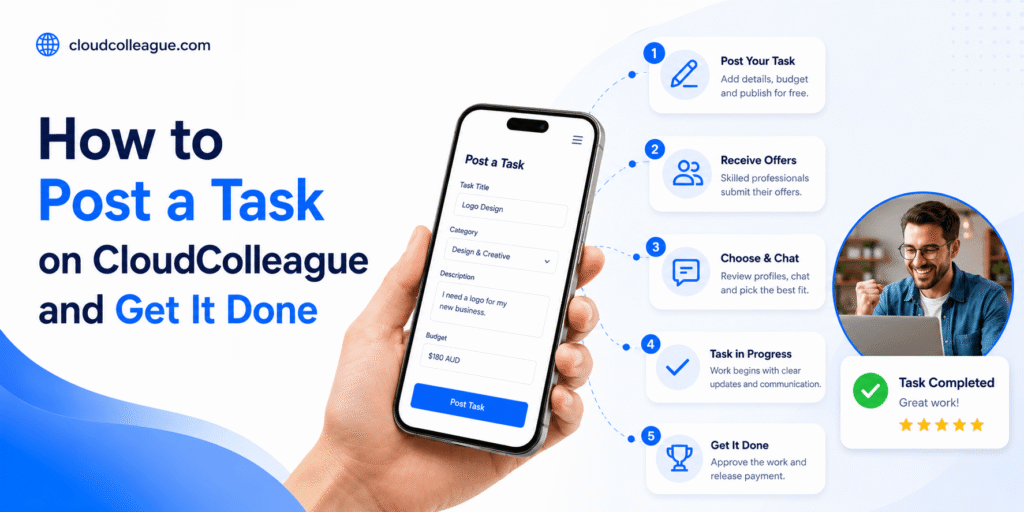
A task on CloudColleague is a short-term piece of work posted by a business with a defined brief, specific budget, and timeline attached. The professional responds with a proposal. If selected, the work begins and gets delivered through the platform. Payment then releases once the business confirms the output meets requirements. Crucially, the entire cycle from discovery to payment can complete in days rather than weeks.
The low commission model is the most significant structural advantage. The table below shows how CloudColleague compares to competing platforms.
| Platform | Commission on Task or Project Work | Australian Market Focus |
| CloudColleague | 7% commission on tasks | Yes, Australian-built marketplace |
| Upwork | Up to 20 percent of earnings | No, global platform |
| Fiverr | 20 percent of every transaction | No, global platform |
| Airtasker | Variable service fee on completed tasks | Yes, but primarily trade and physical tasks |
| Freelancer.com | 10 to 20 per cent commission | No, global platform |
Beyond the financial advantage, tasks on CloudColleague offer four additional structural benefits. First, they are accessible without a formal employment history. This makes them the most practical starting point for early career professionals, career changers, and candidates building their first portfolio items. Second, each completed task produces a visible review that compounds into a credibility asset over time. Third, tasks generate rapid income compared to job applications. Finally, taking on a task in a new field before committing to a career change is an intelligent way to test whether the reality matches your expectations.
What Types of Tasks Are Available on CloudColleague?
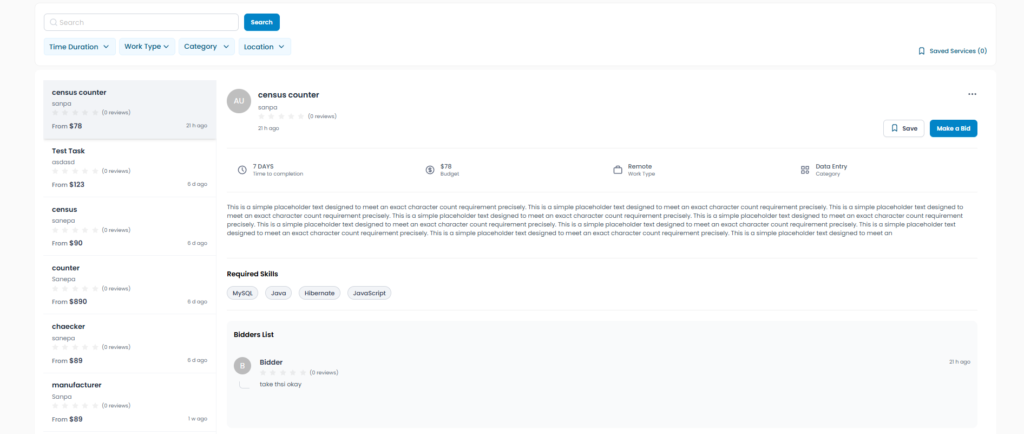
The task category on CloudColleague spans a wide range of professional skill areas. Understanding which categories are most active helps you assess where your existing skills create the most immediate opportunity on the platform and where you might develop adjacent skills to expand your task portfolio over time.
Writing and Content Tasks
Writing and content tasks consistently represent one of the highest-volume task categories on CloudColleague. The range within this category is broad. At one end, businesses post tasks for short-form content including social media captions, product descriptions, and email subject line variations. At the other end, longer-form work including blog articles, white papers, case studies, website copy rewrites, and technical documentation appears regularly.
Proofreading and editing tasks attract a different profile of professional. They suit detail-oriented candidates who may not consider themselves writers in the creative sense. However, strong language and structural editing skills are equally valuable here. Budget ranges for content writing tasks vary significantly with scope. Short-form tasks of 500 words or fewer typically sit in the lower budget tier. Longer or more technical writing, consequently, commands proportionally higher rates.
This category is accessible to candidates who can demonstrate strong written English and the ability to follow a brief accurately. A basic understanding of audience and purpose is also essential. Notably, formal professional writing experience is not a prerequisite. A personal blog, university essays, volunteer organisation communications, and self-directed writing projects all qualify as evidence of relevant capability.
Design and Creative Tasks
Graphic design, branding, social media visual content, presentation design, and photo editing tasks appear regularly on CloudColleague. Australian small and medium businesses consistently need quality creative output without the overhead of an in-house design resource. Logo creation, brand asset development, and social media template packages are among the most in-demand creative task types on the platform.
Presentation design tasks are particularly accessible to a broader range of professionals. These involve the visual redesign or formatting of business pitch decks, reports, and training materials. Strong Microsoft PowerPoint or Google Slides skills combined with a good visual eye are sufficient. Formal graphic design qualifications are not required.
Portfolio evidence is especially important for creative tasks. A business posting a design task is making a judgment about visual quality first and foremost. Consequently, a link to previous work is worth more than any amount of written description of your capabilities. Include one in every creative proposal without exception.
Technology and Development Tasks
Technology tasks on CloudColleague range from small, accessible website updates through to substantial development work. App feature builds, API integrations, database work, and automation scripting all appear regularly. The breadth of this category means opportunities exist across experience levels. Early career developers looking to build a portfolio can find relevant listings. Experienced professionals seeking project-based income alongside permanent employment can equally find suitable work.
Website update tasks, bug fixes, and landing page builds are the most accessible technology task types for junior to mid-level developers. More complex backend development, cloud infrastructure, and cybersecurity tasks attract experienced professionals with specialised skills. Furthermore, the National Skills Commission identifies technology and software development as one of the most sustained shortage occupation categories in Australia. That shortage is reflected directly in the task budgets available in this category on CloudColleague.
Administrative and Business Support Tasks
Data entry, research compilation, document formatting, calendar management, and virtual assistant tasks represent one of the most accessible task categories on CloudColleague. These tasks are skill-based rather than credential-based. Consequently, businesses assess candidates from a brief profile and proposal review rather than requiring extensive employment history verification.
Research and report compilation tasks in particular offer strong income potential. Strong internet research skills, the ability to synthesise information from multiple sources, and clear written communication are the key requirements. Businesses posting these tasks are typically time-poor rather than skill-poor. They know what they need and are looking for a professional who can deliver it efficiently and accurately.
Marketing and Digital Tasks
SEO audits, keyword research, social media management, email campaign setup, analytics reporting, and paid advertising tasks are listed by Australian businesses at every stage of digital maturity. Digital marketing tasks suit professionals who have built skills through self-directed learning, online certifications such as Google Analytics, Google Ads, and HubSpot, or personal projects. Formal employment experience is not a prerequisite. The Australian HR Institute notes that digital marketing is among the fastest-growing skill demand areas in the Australian professional market. That demand is reflected directly in the CloudColleague task category.
Finance and Professional Services Tasks
Bookkeeping and reconciliation tasks, financial modelling, tax preparation support, data analysis, consulting sessions, and document review tasks attract professionals with finance, accounting, and advisory backgrounds. CPA Australia-qualified accountants, bookkeepers, and financial analysts all find an active task market on CloudColleague.
Professional services tasks tend to carry higher budgets than most other categories. The skills required are specialised and the business impact of errors is significant. Furthermore, these tasks offer professionals the opportunity to build independent client relationships that may eventually support a consulting or advisory practice.
Find the Right Tasks on CloudColleague
The task category on CloudColleague is not a single, uniform market. It is a dynamic, continuously updated feed of specific professional needs from businesses across industries, budgets, and timelines. Finding the tasks that are genuinely right for your current skill level and income goals requires a deliberate search approach rather than passive browsing.
Using Search and Filters to Surface Relevant Tasks
Apply the task type filter before anything else when searching CloudColleague. This restricts results to task listings only and prevents job listings and service enquiries from diluting the feed. From there, use specific skill keywords rather than broad category terms. A search for “content writing” returns more relevant results than “writing.” Similarly, “SEO audit” returns more specific results than “marketing,” and “bookkeeping reconciliation” returns more precisely than “finance.”
The budget filter is one of the most practically useful tools for task discovery. It allows you to self-select into a budget range appropriate for your experience level and the realistic scope of work involved. Professionals with no CloudColleague track record should search a budget range that reflects entry-level to mid-market rates. The top budget tier is where businesses expect established review histories to accompany the investment.
The date posted filter ensures you prioritise recently listed tasks. Businesses with time-sensitive requirements sometimes accept the first strong proposal they receive rather than waiting for a full pool of submissions. Consequently, a task listed in the last 24 hours is a higher-priority target than one listed a week ago. Your proposal faces fewer established competitors at that earlier stage.
Apply the remote filter when your skills are deliverable digitally. Most writing, design, technology, administrative, marketing, and finance tasks on CloudColleague are inherently remote because the deliverable is digital. Applying the remote filter surfaces these tasks explicitly and removes on-site requirements that are not relevant to your situation.
Read a Task Listing Before Deciding to Propose
Two minutes reading a task listing carefully is more valuable than twenty minutes writing the wrong proposal. A task listing contains five elements worth assessing before committing to a proposal.
Scope clarity. Is the brief specific enough to propose against without significant assumptions? A listing saying “I need some writing done” is not a proper brief. However, a listing specifying five 800-word blog articles with a defined audience, tone, and revision round is a clear, proposable brief.
Budget realism. Does the stated budget reflect the actual effort the scope requires? A full brand identity listed at a logo-only budget is a scope and budget mismatch. Consequently, proposing to deliver a portion of the scope at that budget, with a note about the full cost, is the more professional response.
Timeline feasibility. Is the stated deadline achievable given your current availability? A five-day deadline for two days of work is feasible. Accepting a timeline you cannot meet, however, is significantly more damaging to your CloudColleague reputation than declining a task that does not fit your schedule.
Business credibility. Review the business profile before proposing. A complete profile with posting history and positive reviews signals a credible engagement partner. A brand new profile is not automatically suspicious, but it warrants a closer reading of the listing terms.
Skill alignment. Can you genuinely deliver what the brief describes to the standard the budget implies? Honest self-assessment here is not a sign of low confidence. Rather, it is a sign of professional judgment that protects your review score and platform reputation.
Set Up Task Alerts on CloudColleague
Task alerts are the most efficient discovery tool for professionals actively seeking task work on CloudColleague. Once you have identified search terms and filter combinations that return strong relevant results, save those searches and activate notifications so new listings matching your criteria appear in your alerts as soon as they are posted.
Set daily alerts for skill categories you are actively targeting and weekly alerts for adjacent categories you monitor passively. Running multiple saved searches across different skill terms within your capability area maximises your coverage of the task market without requiring daily manual browsing sessions. A content writer might run saved searches for blog writing, product descriptions, copywriting, and proofreading simultaneously, each set to daily alerts, to ensure they see every relevant listing as soon as it appears.
Read Next: Guides on Tasks to get more information on how tasks work on CloudColleague.
How to Write a Task Proposal That Wins on CloudColleague?
The task proposal is where most professionals either win or lose the work before the business has had any other contact with them. Businesses reviewing proposals on CloudColleague are looking for one thing above all others: evidence that the professional read their brief carefully before responding. This single factor separates the proposals that move to the top of a business’s shortlist from the ones that are closed immediately.
A winning CloudColleague task proposal has five elements. Each element serves a specific purpose and together they give a business everything they need to make a confident selection decision.
Element 1. Prove You Read the Brief
The first sentence of your proposal is the most important sentence in it. A professional who opens with Hi, I can help with this or I am an experienced content writer with five years of experience has immediately signalled that they did not read the brief specifically before responding. A professional who opens with a reference to a specific detail from the brief that only someone who read it carefully could include has immediately distinguished themselves from the majority.
| Task Type | Generic Opening | Proof-of-Reading Opening |
| Content writing | Hi, I am an experienced content writer and can help with your project. | I can see you are targeting first-time residential solar buyers in Australia and want a friendly, informative tone that avoids technical jargon. That matches my last three months of content work in the renewable energy space closely. |
| Graphic design | I am a professional graphic designer and would love to work on your branding project. | You mentioned your brand voice is approachable and modern and that you want to avoid the corporate feel of your competitors. That brief tells me a lot about the design direction before we even start. |
| Data entry | I can handle your data entry task quickly and accurately. | You need 200 customer records transferred from a spreadsheet into your CRM with specific field mapping instructions. I have done this exact type of migration for two clients in the past 90 days and can replicate the process efficiently. |
Element 2. Describe Your Specific Approach
After proving you read the brief, describe specifically how you will complete the work. Not what you will produce, which the business already knows from their own brief, but how you will produce it. The process you follow is what builds confidence in a business that has never worked with you before.
A content writer might describe their research process, how they approach tone and structure, and how they handle the first draft before revisions. A graphic designer might describe their initial concept exploration approach, how they incorporate brand guidelines, and how they present options for feedback. A developer might describe their approach to reviewing the existing codebase before writing new code, how they test changes before delivery, and how they document their work.
The approach description should be specific to this task, not a generic description of your professional methodology. A one-paragraph description of your process for this specific brief is more persuasive than a three-paragraph overview of how you work in general.
Element 3. Relevant Experience in One or Two Sentences
The experience section of a task proposal should be brief and directly connected to this task type. The mistake most professionals make here is treating the proposal as an opportunity to summarise their entire career history. A business reviewing a proposal for a bookkeeping reconciliation task does not need to know about your background in retail management before you retrained as a bookkeeper. They need to know that you have done this type of reconciliation work before and can do it well.
One specific prior project that is closest in scope and skill requirement to the current task is the most persuasive experience reference available. If you have a directly comparable completed CloudColleague task, reference it explicitly: I completed a similar reconciliation project for a Melbourne-based hospitality client last month and delivered the completed accounts three days ahead of deadline. If you have no directly comparable professional experience, reference the closest transferable activity with honesty and specificity.
Element 4. A Specific Timeline
Vague timelines lose proposals. A professional who writes I can deliver this quickly signals nothing useful to a business trying to plan their workload. A professional who writes I will deliver the completed first draft by Wednesday 9 April with one round of revisions available through to Friday 11 April has given the business a concrete planning reference and signalled that they take deadline commitments seriously.
Calculate a realistic timeline before stating it in your proposal. How many hours does this task actually require? When do you have those hours available given your current commitments? What is the earliest date you can genuinely deliver the completed work to a standard that earns a five-star review? State that date, not the fastest possible date if everything goes perfectly.
If the business has stated a deadline in their listing that is tighter than you can honestly meet, address it directly in your proposal rather than accepting it and then missing it. A note saying I see your deadline is Tuesday but given the scope you have described I would need until Thursday to deliver at the quality this brief deserves is a more professional response than accepting an impossible deadline and delivering late.
Element 5. Clear Pricing With Brief Rationale
State your price clearly and give it a one-sentence rationale. A number with no context raises questions in the business’s mind. A number with a brief explanation of what it reflects removes those questions before they form.
No rationale: My rate for this project is $280. With rationale: My rate for this project is $280, which covers the five articles at approximately $56 each, reflecting the research required for the solar installation topic area and one included round of revisions per article.
For tasks with a budget range stated in the listing rather than a fixed amount, position your pricing within the range rather than above it unless your proposal includes a clear justification for exceeding the stated budget. Starting at the midpoint of a budget range is a reasonable default. Pricing at the top of a budget range is appropriate when your experience and review history are strong. Pricing above the stated range requires a specific and compelling rationale.
Price Your Tasks on CloudColleague at Every Career Stage
Pricing is the element of task work that most professionals get wrong at some point in their platform career. The three most common pricing errors produce reliably poor outcomes. Bidding too low wins tasks but signals quality concerns to discerning businesses and produces income that does not reflect the professional effort involved. Pricing too high too early in a platform career loses tasks to more competitively priced professionals with established review track records. And pricing with no rationale raises questions that a competitor who included a brief explanation does not.
Pricing as a Beginner on CloudColleague (Zero to Five Reviews)
At the zero to five review stage, your pricing strategy has one primary objective: winning your first tasks at rates that are financially acceptable to you while being competitive enough to beat professionals with more established profiles. This is not the stage to price at the top of your market. It is the stage to price at a level that reflects an honest assessment of your current capability and the absence of an on-platform track record, while still producing income that is worth the effort.
Research comparable task listings on CloudColleague before setting your rate for each proposal. Look at what completed tasks of similar scope and skill requirements are priced at across the platform. Position your rate competitively relative to that research rather than pricing based on what you would like to earn or what you charge on other platforms where you have an established reputation.
The mindset shift that makes beginning-stage pricing feel more sustainable is treating the first three to five tasks as reputation investments as much as income opportunities. A $150 task completed to a five-star standard produces a review that will influence the outcome of every subsequent proposal you submit on CloudColleague. That review has a compounding value that is not fully captured in the $150 itself.
Pricing as an Intermediate Professional (Five to Twenty Reviews)
With five or more positive reviews on your CloudColleague profile, the dynamic shifts. You now have visible social proof that a business hiring you is making a lower-risk decision than they would be making for a professional with no track record. This social proof justifies incremental rate increases tied to review milestones rather than arbitrary jumps.
Review your rates every five completed tasks and assess whether the market evidence supports a modest increase. A 10 to 15 percent rate increase tied to a milestone of positive reviews is a defensible and professionally transparent approach to building your income over time. Communicate rate increases to repeat clients with a brief, professional note that frames the increase in terms of your growing track record rather than personal financial preference.
Pricing as an Experienced CloudColleague Professional (Twenty Plus Reviews)
An established review history and a strong portfolio on CloudColleague creates conditions for premium pricing within your skill category. Businesses browsing proposals with a significant budget range are frequently willing to pay a higher rate for a professional with a proven track record of delivering exactly what was asked, on time, to a consistently high standard. Your reviews are the evidence that justifies that premium.
Specialisation becomes a powerful pricing lever at this stage. A content writer who has built a track record specifically in the renewable energy, legal services, or financial technology sectors can price significantly above the generalist market rate for their category because the combination of writing skill and sector knowledge is genuinely scarcer and more valuable to businesses in those fields. Narrowing your task focus to a specific niche as your experience deepens allows you to command rates that generalist positioning cannot support.
Read Next: How Bidding Works on CloudColleague. To get more information on bidding and plicy.
How to Deliver a Task on CloudColleague Professionally?
Winning the proposal is the beginning of the process, not the outcome. The review that a business leaves after a completed task is the permanent record that shapes every proposal you submit from that point forward. Delivering professionally and consistently is the only sustainable strategy for building a task reputation that compounds in your favour over time.
Before You Start: Re-Read the Brief
The most effective single habit for avoiding revision requests and poor reviews is simple. Re-read the task brief immediately before beginning work. Do this even if you read it carefully during the proposal stage. The gap between winning a proposal and starting work is often enough time for specific details to blur in memory. Beginning work on an inaccurate mental model of the brief is the most common source of deliverable misalignment.
Before starting any task, create a personal checklist directly from the brief. List every specific requirement the business stated as a checkbox item. Tick each one off as your deliverable addresses it. This checklist then becomes your quality control tool before submission. Furthermore, it takes less than five minutes to create for most task types.
Communicating During Delivery
Proactive communication during an active task builds client confidence without requiring any additional work output. For a task with a timeline of three or more days, a brief mid-task update noting that the work is progressing as planned and is on track for the agreed delivery date is a low-cost professional courtesy that the most highly rated professionals on task platforms do consistently.
If you encounter an unexpected obstacle that affects the timeline or the scope mid-task, communicate it to the business immediately through CloudColleague’s internal messaging system rather than hoping the issue resolves itself. A business that is informed early and given options is significantly more likely to respond constructively than one that is surprised by a late delivery or an incomplete deliverable. Use Zoom, Slack, or direct platform messaging as appropriate for the complexity of the communication required.
Submitting Your Completed Work
Submit your completed work through the CloudColleague platform alongside a brief, specific submission note. The submission note is not a summary of everything you did. It is a one or two sentence confirmation that tells the business what you have delivered, where to find it, and how it addresses the core requirements of their brief. Something like: I have delivered all five articles as individual Word documents in the attached folder. Each article addresses the brief you set out including the target audience, tone, and word count requirements, with the solar installation articles checked against current ATO and Clean Energy Council guidance for accuracy.
Name your files professionally and consistently. A submission where files are named article1.docx, article2.docx, and article3.docx is harder to navigate than one where files are named CloudColleague-Task-[BusinessName]-Article1-SolarInstallation-Basics.docx. Professional file naming signals the same attention to detail in the submission that the brief demanded in the proposal.
Handling Revision Requests
Revision requests are a normal part of professional creative and technical work and are not automatically a sign that something went wrong. How you handle a revision request is one of the strongest signals a business receives about your professionalism and your commitment to the outcome.
When a revision request falls within the scope of what you offered in your proposal, acknowledge it promptly, confirm what you understand the revision to involve, state your revised delivery date, and deliver. This sequence, handled efficiently and without defensiveness, is what earns five-star reviews even from engagements that included revision rounds.
When a revision request asks for changes that go beyond the agreed scope, raise it professionally with the business. A note saying the revisions you have described go beyond the scope of the original brief and I would be happy to discuss a revised proposal for the additional work is a legitimate and professional response. Most businesses will respect the boundary. Those that do not are providing you with useful information about the engagement before you invest additional unbilled time.
How to Get Paid for Tasks on CloudColleague?
The payment process on CloudColleague is designed to protect both the professional and the business throughout every task engagement. Understanding how it works removes the uncertainty that many first-time platform users feel about when and how they will receive payment for completed work.
CloudColleague Secure Payment Works for Tasks
Payment for task work on CloudColleague follows a clear sequence. The business posts a task with a set budget. The professional proposes, and the business accepts. Work is completed and submitted through the platform. The business reviews the deliverable and confirms that it meets the agreed requirements. Payment is then released to the professional’s bank account through CloudColleague’s secure payment system.
The secure payment model means payment is held through the platform rather than transferred directly between parties until the business confirms satisfactory delivery. This structure protects professionals against non-payment for completed work that meets the brief and protects businesses against paying for work that does not. For a first-time CloudColleague user, this protection is one of the most important trust-building features of the platform, removing the risk that characterises many informal freelance arrangements where payment is at the sole discretion of the client.
The low commission model means the amount the business agreed to pay in the accepted proposal is almost the amount released to the professional. For Example: On Upwork, a $500 project produces around $400 in professional earnings after commission. On CloudColleague, $500 is $465. Over a month of consistent task work, that difference is material.
Tax Considerations for Task Income in Australia
All income received through CloudColleague task work is assessable income under Australian tax law and must be declared to the Australian Taxation Office regardless of the amount. Task income from a digital marketplace platform is treated as personal services income or business income depending on the structure of your professional engagement, and the ATO’s guidance on gig economy income applies directly to CloudColleague task earnings.
GST registration is required in Australia when your total business income from all sources exceeds $75,000 in any 12 months. If your CloudColleague task income, combined with other business or freelance income, approaches or exceeds this threshold, consulting a registered tax agent before reaching it is strongly recommended rather than after.
Keep clear records of every completed task on CloudColleague: the task description, the agreed price, the date of payment, and any business-related expenses incurred in completing the work. The ATO requires Australians to retain financial records for five years. A simple spreadsheet or accounting software record updated after every completed task is sufficient for most early-career task professionals.
Tax note: This section provides general information only. Every professional’s tax situation is different. Consult a registered Australian tax agent for advice specific to your circumstances, particularly if task income becomes a regular or significant earnings stream.
Build a Task Reputation and Win Repeat Clients on CloudColleague
The review system on CloudColleague is the primary mechanism through which professional reputation compounds over time. Each five-star review from a completed task improves your win rate on subsequent proposals, justifies incremental rate increases, and reduces the cognitive effort a business needs to invest in deciding whether to select you over a competitor. Understanding how the system works and how to perform within it consistently is the strategic foundation of a successful long-term presence on the platform.
How the CloudColleague Review System Works?
After a task is marked as complete and payment is released, the business has the opportunity to leave a review on your professional profile. The review typically includes a star rating and a written comment. Both components are permanently visible to any business that views your profile or receives your proposal in the future.
Businesses assessing a review look at five things: the quality of the deliverable relative to the brief, the accuracy with which the professional followed the brief’s requirements, the quality of communication during the engagement, timeliness of delivery, and overall professionalism. A review that speaks specifically to all five dimensions is more credible and more persuasive to future businesses than a brief generic positive comment.
The asymmetry of the review system is worth understanding clearly. A five-star review contributes positively to your profile and improves future outcomes incrementally. A poor review has a disproportionately negative effect at the early stage of your platform career because it represents a large proportion of your total review count. This asymmetry is the reason that careful task selection at the beginner stage, choosing tasks where you are confident you can deliver to a five-star standard, is more strategically important than maximising the volume of early proposals.
How to Turn First-Time Task Clients Into Repeat Clients?
Repeat clients on CloudColleague are the most efficient income source available on the platform. There is no proposal competition, no review credibility barrier to clear, and no new working relationship to establish. The business already knows you deliver quality work, and you already understand their preferences, standards, and communication style. The income is more predictable, the work is typically more efficiently executed, and the relationship tends to expand in scope over time as the business’s trust in your capability grows.
Creating repeat business starts with the quality of your first delivery for a client, but it does not end there. Including a brief note in your submission that expresses genuine openness to future work, without pressure or presumptuousness, plants a professional seed for the relationship. Something like: I enjoyed working on this project and would be glad to assist with future content needs in this area is a straightforward, professional signal that you are available and interested.
Following up a few weeks after a completed task with a brief message, noting that you are available if they have upcoming projects in a similar area, is a professional practice that many repeat client relationships begin with. This kind of outreach is only appropriate after a positive engagement and should be done once rather than repeatedly. A single well-timed professional note is a reminder. Multiple notes become pressure.
As a repeat client relationship develops, the work often evolves from discrete tasks to a more ongoing arrangement that may eventually be better structured as a service listing or a longer-term engagement. When that point arrives, raising it with the client directly and proposing a more structured arrangement is a natural professional evolution that benefits both parties.
How to Apply for Tasks on CloudColleague With No Experience?
The task category on CloudColleague is the most accessible professional opportunity available for candidates without a formal employment history. Unlike job listings, tasks evaluate candidates against a specific brief rather than prior roles. The question is not what you have done before. Instead, it is whether you can deliver what the brief describes. For candidates who can answer that honestly in a proposal, the absence of a formal employment record matters less than it does in the traditional job market.
The most accessible task types for no-experience candidates are those where skill is demonstrable through non-professional activity. Data entry and spreadsheet formatting tasks require accuracy and attention to detail, not industry credentials. Research and report compilation tasks require strong research habits and clear written communication. Both are demonstrable through academic work, personal projects, or volunteer activity. Basic content writing tasks suit candidates with strong written English and the ability to follow a brief. Social media content tasks are accessible to candidates who have managed personal or community accounts with measurable engagement results.
When writing a proposal as a no-experience candidate, lead with the specific transferable skill most relevant to the task. Be honest about the absence of prior platform work without leading with an apology. A proposal stating “this will be my first professional project in this area and I am approaching it with full preparation and complete commitment” is more credible than pretending to experience you do not have.
Furthermore, choose your first task for maximum review potential rather than maximum income. A smaller, clearly scoped task where you can deliver confidently to a five-star standard is more strategically valuable than a larger, more complex task. That first verified review transforms your profile from unproven candidate to professional with a real track record.
Tasks Are Where Careers on CloudColleague Begin and Where They Grow
The task category on CloudColleague is not a side feature of the platform. For many professionals, it is the most valuable one. It is accessible without a formal employment history where It pays with low 7% commission. It builds a visible, permanent reputation with every delivery. And, It moves from proposal to income faster than any other professional opportunity available in the Australian market. And it compounds: each completed task makes the next one easier to win.
Whether you are building your first professional track record, supplementing income between roles, exploring a career change without the risk of a full commitment, or running a freelance practice that you want to grow, the task category is the most efficient starting point on CloudColleague for all of these objectives.
The five-element proposal structure in this guide works. The pricing strategy works. The delivery habits work. The repeat client approach works. None of them requires you to already be an established professional. They require you to approach your first task with the same deliberate attention you would bring to any professional engagement, and to treat each review as the investment it is.
Start with one task. Find it, propose on it, deliver it well, and build from there.
Your first task is already listed on CloudColleague. Find it and apply today at cloudcolleague.com.
Frequently Asked Questions About Applying for Tasks on CloudColleague
Use filters to find relevant tasks by skills, budget, date, or location. Read listings carefully, write a proposal showing you understood the brief, outline your approach, timeline, and price, then submit and respond promptly to any questions.
CloudColleague charges a very low commission of only 7%, meaning you keep most of your earnings. This is much lower than platforms like Upwork or Fiverr, which take 10–20%.
Include five key elements: proof you read the brief, your approach, relevant experience, a specific delivery timeline, and a clear price with a short rationale.
Payment is released through CloudColleague’s secure system after the business confirms your work meets the brief. The payment is the agreed amount minus a small commission.
Yes. Tasks are evaluated on your proposal and ability, not employment history. Start with tasks you can confidently complete, earn reviews, and build your track record.
Check similar listings, start competitively, and include a short rationale in your proposal. Increase your rates gradually as you earn positive reviews.
Yes. All task income is assessable under Australian tax law. Keep clear records and consult a tax agent if approaching GST thresholds.