If you are searching for a vacancy in mental health, the timing could hardly be better. Australia faces a sustained shortage of mental health professionals, demand for services keeps rising, and employers across the public, community, and private sectors are actively recruiting. Nearly half of all Australians will experience a mental health condition in their lifetime, and the workforce simply has not kept pace. This guide covers the main roles, what each requires, how strong the demand is, and exactly where to find and apply for current vacancies.
| Ready to find a role?Browse mental health vacancies on CloudColleague orcreate your free profile so employers can reach you directly. |
Types of Mental Health Roles
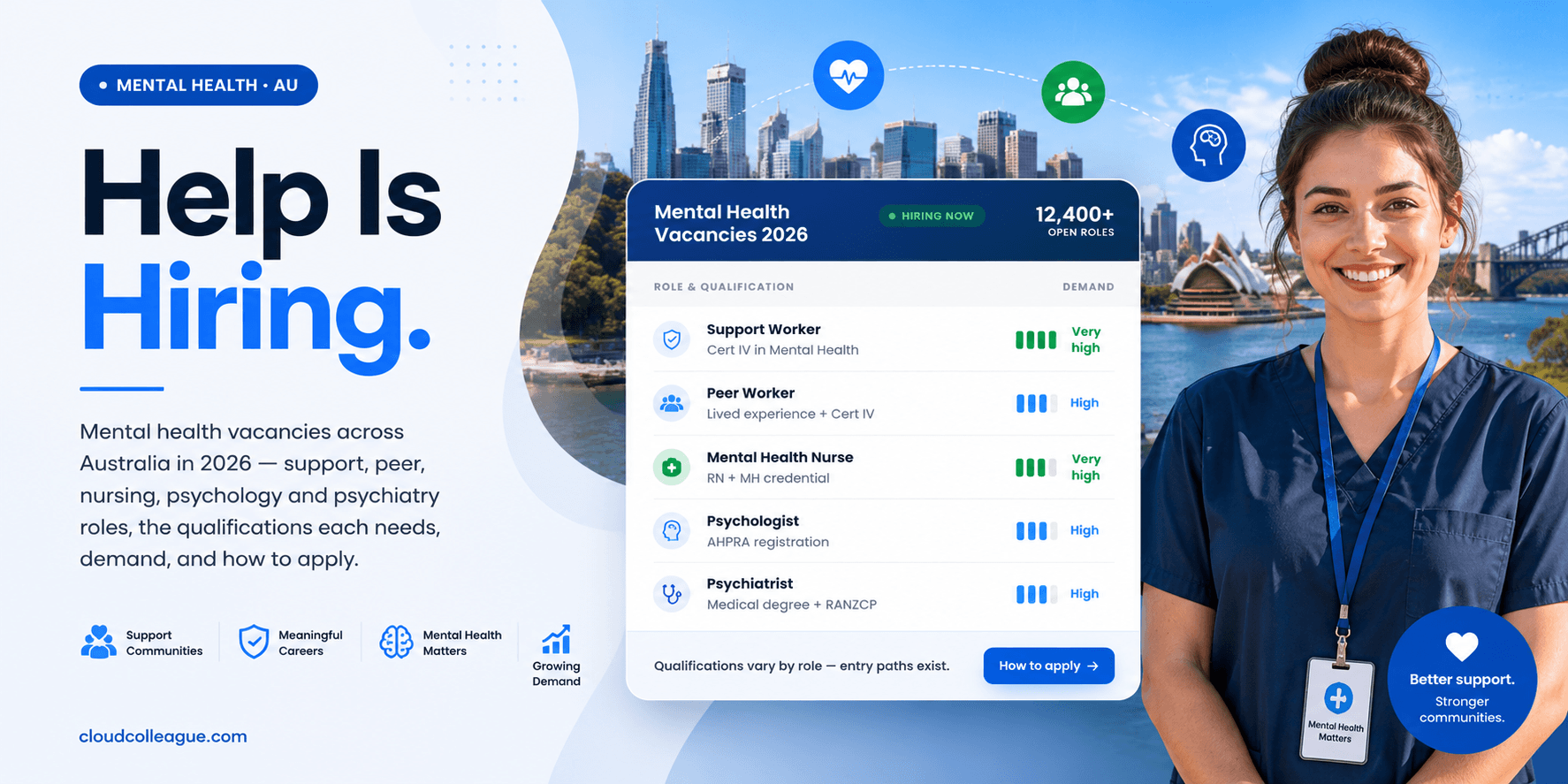
Mental health work spans a wide spectrum, from entry-level support to highly specialised clinical practice, so there is a genuine pathway whatever your background. Support workers provide day-to-day practical and emotional assistance in community and residential settings. Peer support workers use their own lived experience of mental illness and recovery to support others, a role that complements clinical staff and is expanding fast.
On the clinical side, mental health nurses deliver care in hospitals and community services, psychologists provide assessment and therapy, and psychiatrists are medical specialists who diagnose and manage complex conditions, including prescribing. Counsellors and social workers round out the field. The table below summarizes the main roles, their typical qualifications, and indicative pay.
| Role | Typical Qualification | Indicative Pay |
| Mental health support worker | Certificate IV in Mental Health | $60,000 to $75,000 |
| Peer support worker | Lived experience + peer training | $65,000 to $80,000 |
| Mental health nurse | Bachelor of Nursing + AHPRA | $95,000 to $115,000+ |
| Counsellor | Diploma or degree + ACA/PACFA | $78,000 to $96,000 |
| Psychologist | Accredited degree + AHPRA | $90,000 to $130,000+ |
| Psychiatrist | Medical degree + RANZCP | $235,000 to $300,000+ |
Read Next: Nursing Jobs in Australia: Roles, Pay & How to Apply?
Qualifications by Role
Each role has a clear entry point, and you do not always need a degree to start. Mental health support workers typically hold a Certificate IV in Mental Health, which you can complete in under a year, making it one of the most accessible entry routes. Peer workers are valued primarily for lived experience, supported by short, specific peer-work training.
Clinical roles require formal study and registration. Mental health nurses hold a Bachelor of Nursing and register with AHPRA, and you can read more in our guide to nursing jobs in Australia. Psychologists complete an accredited degree sequence and register with AHPRA, with an integrated five-year training program rolling out from 2026. Counsellors join the ACA or PACFA, as covered in our guide to counselling jobs in Melbourne. Psychiatrists complete a medical degree followed by RANZCP fellowship.
Demand and Skill Shortage Status
The shortage is significant and well documented, which is good news for job seekers. Official modelling projects the psychologist workforce gap could reach as high as 96 percent of need by 2038, while the supply of psychiatrists is forecast to fall short by around 20.7 percent by 2048. Australia currently has only about 16 psychiatrists per 100,000 people, and the gaps are most acute in rural and regional areas.
Peer workers, mental health nurses, and support workers are all under-supplied against national targets too. This translates directly into more vacancies, faster hiring, stronger pay, and frequent visa sponsorship for clinical roles. To see how mental health occupations sit alongside other in-demand fields, check the current skill shortage list for Australia.
| Bottom line: demand outstrips supply across nearly every mental health role. Qualified candidates have real choice over setting, location, and conditions. |
Where to Find Current Vacancies
Mental health roles are advertised across several channels, so cast a wide net. State and territory health department career portals carry large volumes of public-sector roles, including nursing and peer-work positions. Community health organizations and not-for-profits hire continuously and often offer salary packaging that lifts take-home pay.
headspace centres, NDIS-registered providers, and EAP and telehealth platforms are strong sources of both clinical and support roles, many of them flexible or partly remote. The major job boards aggregate much of this, and CloudColleague lets you search current vacancies and be matched directly with employers. Rural and regional roles are especially plentiful and frequently come with relocation assistance or sponsorship, so widen your location filters if you can.
How to Apply
A strong mental health application leads with your suitability to support vulnerable people safely. Put your qualification and registration status at the top of your resume, since employers screen for these first. Tailor each application to the setting, because the skills valued in a hospital differ from those in a community peer-support role or a telehealth service.
Use concrete examples that show your judgement around risk, boundaries, and confidentiality, and highlight any supervision and professional development you maintain. If you are a peer worker, frame your lived experience as a professional strength. Be ready for scenario-based interview questions about responding to a person in distress, and have a current police check and any required vaccinations or clearances in order, as these are standard for health roles. Most positions also require Australian work rights or appropriate visa status, so confirm yours before applying.
| Take the next step today. Start as a seeker CloudColleague or create your free profile to connect with health, community, and telehealth employers hiring now. |
This is a field where the work matters deeply, and right now the opportunities are wide open.
Frequently Asked Questions
Demand is strong across the board, but psychologists, psychiatrists, mental health nurses, and peer workers are the most sought after. Official modelling projects a psychologist shortfall of up to 96 percent by 2038 and a psychiatrist undersupply of around 20.7 percent by 2048, so qualified candidates have real choice.
Not always. Mental health support workers usually need a Certificate IV in Mental Health, and peer workers are valued for their lived experience plus short training. Clinical roles such as psychologist, psychiatrist, and mental health nurse require accredited degrees and registration.
A peer support worker draws on their own lived experience of mental illness and recovery to support others. The role complements clinical staff by offering understanding and hope from personal experience, and demand for peer workers is growing quickly.
Look on state health department career portals, community and not-for-profit organizations, headspace and NDIS providers, and the major job boards. Rural and regional roles are especially plentiful and often offer relocation support or visa sponsorship.
Yes. Several clinical roles, including psychiatry, sit on skilled occupation lists, and many employers offer visa sponsorship, particularly for rural and regional positions where shortages are most acute.