Nursing jobs in Australia are among the most secure and rewarding careers you can pursue right now. The country faces a serious nursing shortage, employers are hiring across every state, and pay is competitive even at graduate level. Whether you trained in Australia or overseas, this guide covers the roles available, what they pay, how to register with AHPRA, and the exact steps to land your next position.
| Ready to take the next step with CloudColleague? Start as a Seeker to explore nursing opportunities or start as an Employer to connect with qualified healthcare talent. |
Types of Nursing Roles.
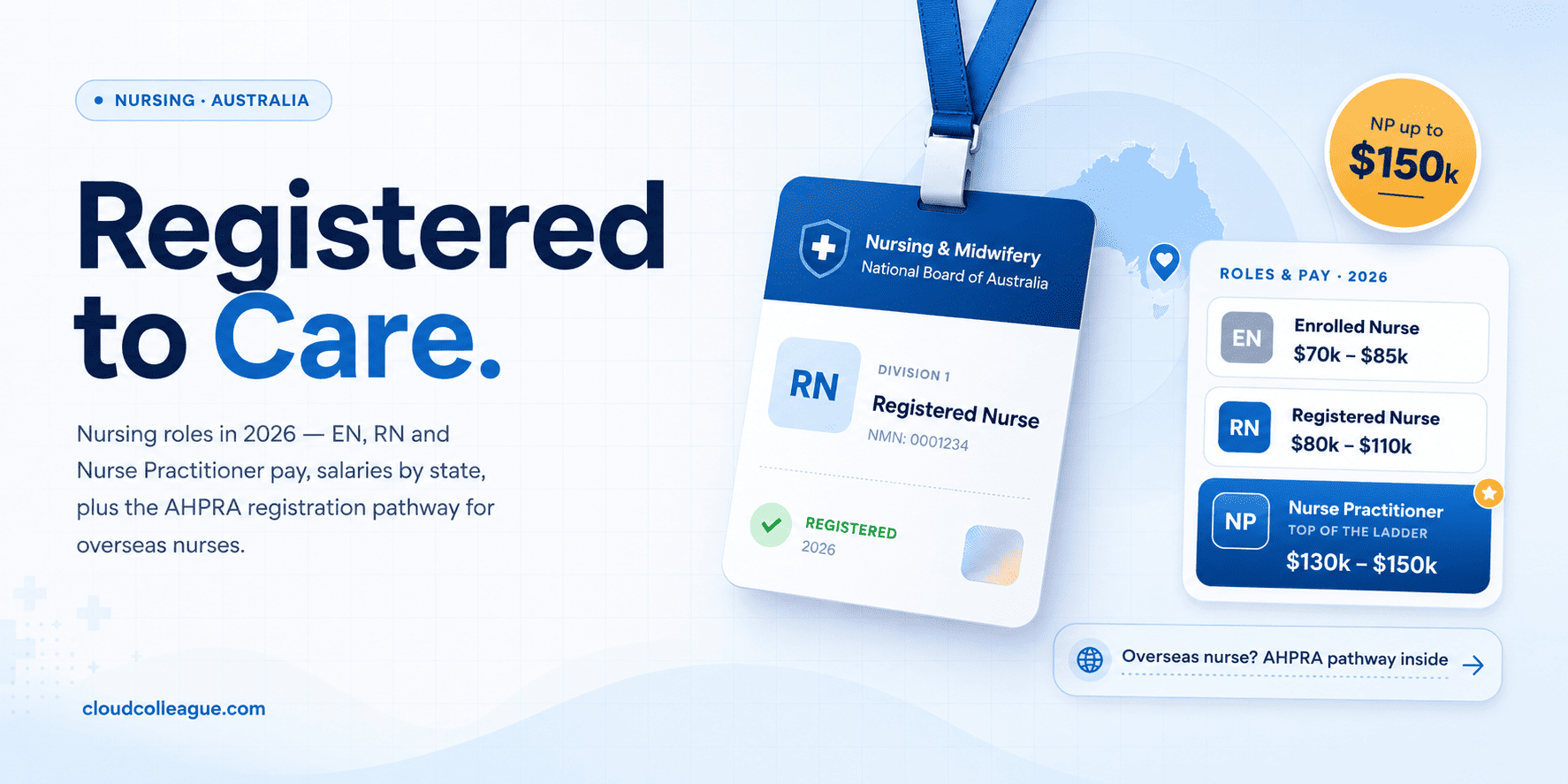
Nursing in Australia spans a wide range of roles, each with its own scope of practice and pay. Knowing where you fit helps you target the right jobs and plan your career progression. The table below summarises the main roles, their typical qualifications, and current salary ranges.
| Role | Typical Qualification | 2026 Salary Range |
| Enrolled Nurse (EN) | Diploma of Nursing (18-24 months) | $58,000 to $68,000 |
| Registered Nurse (RN) | Bachelor of Nursing (3 years) | $72,000 to $95,000 |
| Mental Health Nurse | RN plus mental health experience | $95,000 to $115,000+ |
| Aged Care Nurse | RN or EN qualification | $72,000 to $95,000 |
| Clinical Nurse Specialist | RN plus postgraduate study | $100,000 to $130,000 |
| Nurse Practitioner (NP) | Master’s degree + endorsement | $145,000 to $155,000+ |
Enrolled nurses provide hands-on care under supervision, while registered nurses take on clinical decision-making and lead patient care. Beyond these, you can specialise. Mental health nurses support patients with psychiatric and behavioural needs and earn a premium for their skills. Aged care nurses are in especially high demand as the population ages. At the top of the clinical ladder, nurse practitioners hold a master’s degree, can diagnose, prescribe, and run their own clinics, which is why they command the highest salaries in the profession.
Read Next: Mental Health Job Vacancies in Australia
Salary by Role and State
Pay depends on your role, your experience, and crucially the state you work in. Graduate registered nurses typically start between $65,000 and $79,000, rising to $85,000 to $95,000 with five or more years of experience, and beyond $100,000 in specialist or management roles. On top of base pay, penalty rates for night shifts and weekends can add 15 to 30 percent, so real earnings are often higher than the headline figure.
Location matters too. The table below gives a quick snapshot of how pay varies across the states and territories.
| State or Territory | Pay Snapshot |
| ACT, NT and WA | Among the highest base salaries nationally |
| Queensland | Strong public agreement rates, graduates from about $85,000 |
| NSW and Victoria | Large employers, base rates very close to each other |
| SA and Tasmania | Solid pay with generally lower living costs |
| Worth knowing: public sector nurses are usually covered by state enterprise agreements, which often pay more than the private-sector Nurses Award minimums. Always check which applies to a role. |
Qualifications and AHPRA Registration
Every nurse who practices in Australia must be registered with the Australian Health Practitioner Regulation Agency (AHPRA), working with the Nursing and Midwifery Board of Australia (NMBA). Locally, an enrolled nurse needs a Diploma of Nursing and a registered nurse needs a Bachelor of Nursing, after which you apply for registration directly.
For overseas-trained nurses, the process is more involved but very achievable. You begin with an online self-check, which assigns you to a stream based on your qualification and country. Nurses from comparable jurisdictions, such as the UK, Ireland, the USA, Canada, Singapore, and Spain, may qualify for a streamlined pathway that often skips further exams. Nurses from other countries complete the Outcomes-Based Assessment, which includes a multiple-choice theory exam and a clinical OSCE held in Australia.
All internationally qualified nurses must prove English proficiency, currently IELTS 7.0 or OET grade B in every band, with no exemptions under the updated standard. Allow roughly 60 to 90 business days once your application is decision-ready. If you are applying from outside Australia, our guide on getting a job in Australia from overseas walks through the visa and relocation steps that run alongside registration.
Demand and Skill Shortage Status
There has rarely been a better time to be a nurse in Australia. Nursing sits firmly on the national skills shortage list, driven by an ageing population, healthcare expansion, and workforce gaps across both cities and regions. Demand is projected to exceed supply by more than 70,000 nurses by 2035, and registered nursing is forecast to grow by about 13.9 percent over five years.
This shortage works in your favour. It means more vacancies, employer sponsorship for overseas nurses, faster hiring, and strong bargaining power on pay and conditions. To see the full set of in-demand healthcare occupations and how they map to visas, check the current skill shortage list for Australia.
Read Next: What Are Internship Jobs? A Beginner’s Guide.
Where to Find Nursing Jobs?
Nursing vacancies are advertised widely, so cast a broad net. State health departments and public hospital networks are the largest employers and post roles on their own career portals. Private hospital groups, aged care providers, and community health services hire continuously, and nursing agencies offer flexible locum and contract work that often pays higher hourly rates.
Online job platforms are the fastest way to compare many roles at once, including on CloudColleague. If your interest is psychiatric care, we keep a dedicated roundup of mental health nursing vacancies, which is one of the fastest-growing and best-paid nursing specialties.
How to Apply: Step by Step
A focused, well-prepared application stands out. Follow these steps to move from interested to hired.
- Confirm your registration. Make sure your AHPRA registration is current, or that your overseas application is underway, before you apply.
- Tailor your resume. Highlight your clinical skills, specialties, and any postgraduate study, and match the language to the job description.
- Gather your documents. Prepare your registration details, qualifications, references, and a current police check, which most healthcare employers require.
- Apply through the right channel. Use hospital career portals and job platforms, and set up alerts so you see new roles first.
- Prepare for interview. Expect scenario-based questions about patient care and teamwork, and have examples ready that show your clinical judgement.
| Start applying today. Search nursing jobs on CloudColleague or create your free profile to get matched with hospitals and aged care providers across Australia. |
Frequently Asked Questions
Registered nurses earn roughly $72,000 to $95,000, with graduates from about $65,000 to $79,000 and specialists well over $100,000. Nurse practitioners average $145,000 to $155,000. Penalty rates for nights and weekends can add 15 to 30 percent on top.
Yes, strongly. Nursing sits on the national skills shortage list, and demand is projected to exceed supply by more than 70,000 nurses by 2035, with around 13.9 percent job growth expected over five years.
You complete an online self-check, which assigns you a stream. Nurses from comparable countries such as the UK, Ireland, the USA, Canada, Singapore, and Spain may use a streamlined pathway, while others complete the Outcomes-Based Assessment, including a multiple-choice exam and a clinical OSCE in Australia. English proof of IELTS 7 or OET B in all bands is required.
Enrolled nurses hold a Diploma of Nursing, while registered nurses hold a Bachelor of Nursing. All practicing nurses must be registered with AHPRA through the Nursing and Midwifery Board of Australia.
The ACT, Northern Territory, and Western Australia typically offer the highest base salaries, though strong public enterprise agreements in states like Queensland also lift graduate and experienced pay.