The highest paying job in Australia in 2026 is still the surgeon, and the gap between the top of the income ladder and the average worker has rarely been wider. Australian Taxation Office data shows surgeons declare an average taxable income of about $472,475 a year, which is more than six times the national average of $74,240. So when people ask what the most well paid job in the country is, the honest answer involves a long training pathway, a licensed profession, and a genuine skills shortage behind almost every figure on this list.
Before you read the rankings, one point matters. Salary figures move depending on how you measure them. “Average” pay is pulled up by a small number of very high earners, while the “median” sits much lower. Base salary also differs from a total package, which can include superannuation, overtime, site allowances, and bonuses. Throughout this guide, the ranges reflect typical total earnings in 2026, drawn from ATO taxable income data, the Hays Salary Guide FY26/27, SEEK advertised salaries, and Jobs and Skills Australia projections.
| Ready to act on these numbers instead of just reading them?Browse live high-paying roles on CloudColleague or create your free profile to get matched with Australian employers hiring now. |
Top 20 Highest-Paying Jobs in Australia
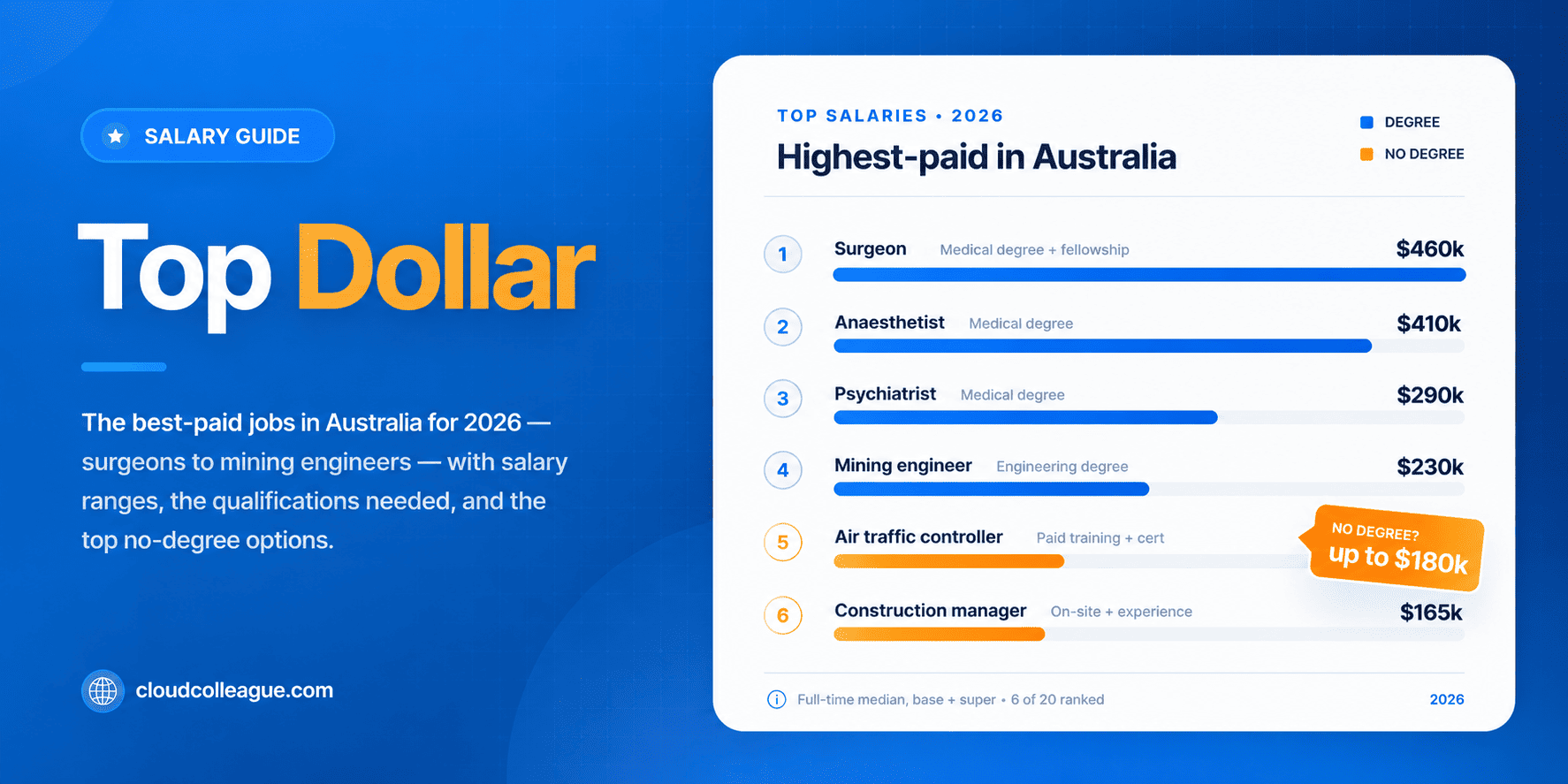
Healthcare dominates the top of the list, and that is not an accident. Specialist medicine combines a decade or more of training, strict registration, and a national shortage of practitioners. As a result, medical specialists hold seven of the ten highest-earning occupation groups in ATO records. The table below ranks the 20 highest paying jobs in Australia, with realistic 2026 salary ranges and the qualification each role requires.
| Rank | Role | Typical 2026 Salary | Qualification Needed |
| 1 | Neurosurgeon | $470,000 to $700,000+ | MBBS or MD + RACS fellowship |
| 2 | Anaesthetist | $386,000 to $450,000 | MBBS or MD + FANZCA |
| 3 | Surgeon (general or vascular) | $360,000 to $475,000 | MBBS or MD + RACS fellowship |
| 4 | Internal Medicine Specialist | $340,000+ | MBBS or MD + RACP |
| 5 | Psychiatrist | $235,000 to $300,000 | MBBS or MD + RANZCP |
| 6 | General Practitioner | $200,000 to $400,000 (regional) | MBBS or MD + RACGP / ACRRM |
| 7 | Financial Dealer / Trader | $250,000 to $355,000 | Finance degree + ASIC licensing |
| 8 | Dentist / Dental Specialist | $150,000 to $300,000 | Dental degree + AHPRA registration |
| 9 | Legal Practitioner (Partner) | $180,000 to $350,000+ | LLB / JD + admission to practice |
| 10 | Mining Engineer | $145,000 to $250,000 | Engineering degree (mining) |
| 11 | Engineering Manager | $175,000 to $220,000 | Engineering degree + leadership |
| 12 | Cloud / Solutions Architect | $150,000 to $220,000 | IT degree + AWS / Azure certs |
| 13 | Cyber Security Architect | $180,000 to $260,000 | IT degree + security certifications |
| 14 | Data Scientist / Data Engineer | $120,000 to $180,000 | STEM degree + ML skills |
| 15 | CEO / Managing Director | $195,000 to $1M+ | Executive track, often MBA |
| 16 | Air Traffic Controller | $140,000 to $210,000 (package) | Airservices Australia training (no degree) |
| 17 | Commercial Airline Pilot | $100,000 to $400,000+ | CPL / ATPL licence |
| 18 | Mining Machine Operator (FIFO) | $120,000 to $200,000 | White Card + tickets (no degree) |
| 19 | Construction / Project Manager | $110,000 to $200,000 | Experience or construction diploma |
| 20 | Pharmacist | $90,000 to $130,000 | Pharmacy degree + AHPRA registration |
Neurosurgeons sit at the peak because supply is tiny and stakes are high. ATO records count only about 4,247 surgeons across the entire country, and roughly 3,658 anesthetists, so scarcity alone pushes pay upward.
Read Next: How to Find & Apply for Public Service Jobs in Australia
Highest-Paying Industries in Australia
High salaries cluster in four industries: healthcare, mining and resources, finance, and technology. Each one is shaped by a specific Australian pressure, whether that is an ageing population, a resources export boom, deep capital markets, or rapid digital transformation. Understanding the industry helps you understand the paysheet.
Healthcare and Medical Specialties
Healthcare leads every salary table in Australia, and demand keeps climbing as the population ages. Medical specialists earn the most because training is long, registration is strict, and shortages are real. The same forces that push surgeon and anaesthetist incomes above $400,000 also lift specialised nurses and allied health professionals, many of whom now sit on the nationalskills shortage list.
Mining and Resources
Mining pays a premium because the work is remote, technical, and tied directly to export revenue. A graduate mining engineer starts around $91,000 to $109,000, while experienced engineers reach $188,000 to $250,000 or more, according to industry salary data. Western Australia and Queensland drive most of this demand, and roles tied to fly-in fly-out rosters carry the biggest allowances, which is why FIFO jobs deserve a closer look if income is your priority.
Finance and Banking
Finance produces the highest-paid non-medical earners in the country. ATO figures show financial dealers average about $355,233 a year, ahead of chief executives and managing directors at roughly $194,987. Sydney concentrates these roles, and total pay often doubles once trading bonuses and performance incentives land.
Technology and Cyber Security
Technology salaries have climbed sharply as Australian enterprises move legacy systems into cloud and AI environments. SEEK data puts the average cloud architect at $125,000 to $130,000, yet senior contractors bill far higher, with cloud architects charging $175 to $250 an hour and cyber security architects $180 to $260 an hour in 2026. Jobs and Skills Australia projects more than 58,000 new positions in cyber security and software engineering by 2028, so this is one of the few high-paying fields you can still enter without a medical degree.
Read Next: Highest paying jobs in United States.
| The pattern: the best paying jobs in Australia are concentrated in industries facing genuine shortages. Pay follows scarcity, not job titles. |
What These High-Paying Jobs Have in Common
The roles on this list look different on the surface, yet they share three traits. Recognising these traits helps you target the right career instead of chasing a single salary figure.
First, they demand serious education or licensing. Almost every top-ten role requires a recognised degree plus registration with a professional board, such as AHPRA for medicine or ASIC oversight for financial dealers. That barrier limits supply and protects pay.
Second, they sit on the right side of a shortage. Healthcare, trades, cyber security, and engineering all appear in the September 2025 Occupation Shortage Report, with trade fill rates dropping to just 54.3 percent. When employers cannot fill roles, they raise wages.
Third, they reward specialization over generalization. A general IT role pays well, but a cloud or security architect earns far more. The same gap exists between a general doctor and a neurosurgeon. In 2026, depth beats breadth almost every time.
How to Move Into a High-Paying Career in Australia
You do not need to restart your career to raise your income. In most cases, you need to move toward scarcity and specialization in a structured way. The steps below work whether you are a local professional or a skilled migrant.
Start by mapping your current skills against the national shortage list. Roles on that list pay more and, for international workers, align with the new Skills in Demand visa, which includes a Specialist Skills stream for earners above $135,000. This matters especially for Indian migrants and other international candidates who want both income and a clear residency pathway.
Next, invest in certifications that close a specific gap. Cloud certifications such as AWS or Azure, a cyber security credential, or a high-risk work license can lift your pay within months rather than years. The Hays FY26/27 guide notes that 60 percent of employees now use AI regularly at work, yet only 22 percent have had training, so even basic AI fluency is becoming a salary lever.
Finally, position yourself where demand is hottest. Regional and remote employers frequently pay 10 to 20 percent above city rates to attract talent. Contract and freelance work in technology can also speed up entry, since employers care more about delivery than tenure.
| Want to test your market value? Search current openings on CloudColleague and start as a job seeker , orpick up paid tasks to build experience while you upskill. |
Highest-Paying Jobs in Australia That Don’t Need a Degree
One of the biggest myths in the job market is that high pay always requires university. In Australia, several of the most well paid jobs sit completely outside the degree system. They rely on licences, tickets, and aptitude instead.
Air traffic control is the standout. Training runs through Airservices Australia with aptitude testing and medical screening rather than a degree, and total packages commonly reach $140,000 to $210,000. Selection is highly competitive, so the barrier is ability, not tuition fees.
The resources sector offers the clearest no-degree income jump. Mining machine operators and drivers on FIFO rosters earn $120,000 to $200,000 once overtime and site allowances are included, while skilled FIFO welders and boilermakers reach $135,000 to $180,000 during shutdown work. Licensed electricians and plumbers sit between $80,000 and $130,000, with higher earnings for those who run their own businesses.
Commercial pilots, real estate agents on commission, and construction site managers round out the list, each capable of clearing $100,000 to $200,000 without a university qualification. The common thread is a recognised licence, a White Card or industry ticket, and a willingness to go where the work is.
| Reality check: a White Card plus the right tickets can open $100,000 roles faster than a three-year degree. The trade-off is location, rosters, and physical demands. |
The Truth About Australian Salaries
Here is the honest picture. Only 5.3 percent of Australians earn more than $180,000, yet that small group pays about 37 percent of the nation’s net income tax. The headline salaries are real, but they belong to a narrow, highly skilled, and often supply-constrained group. The opportunity for most workers lies in moving toward those shortages deliberately, one certification or one role change at a time.
CloudColleague exists to make that move easier. Instead of scrolling endless listings, you can match with Australian employers and clients who are actively hiring for in-demand skills, then build a track record through both ongoing jobs and short-term tasks on one platform.
| Take the first step today. Create your free CloudColleague profile and start applying for high-paying Australian roles, or employers can start as an employer on CloudColleague to reach skilled professionals fast. |
Frequently Asked Questions
Neurosurgeons and surgeons remain the highest paid, with surgeons declaring an average taxable income of about $472,475 according to ATO data, and neurosurgeons in private practice often exceeding $600,000.
Air traffic control is widely considered the top no-degree role, with total packages of $140,000 to $210,000. FIFO mining operators and skilled trades on remote sites can also earn $120,000 to $200,000.
Healthcare pays the most overall, with medical specialists holding most of the top-earning occupation groups. Mining, finance, and technology follow, each driven by strong demand and skills shortages.
A mining engineer typically earns $145,000 to $165,000 on average per SEEK data, with graduates starting around $91,000 to $109,000 and experienced engineers reaching $188,000 to $250,000 or more, especially on FIFO rosters.
Yes, $100,000 remains a strong income nationally. However, in major cities like Sydney, a comfortable middle-class threshold now sits closer to $120,000 to $130,000 because of higher housing costs.
Many do. Healthcare, engineering, trades, and technology roles frequently appear on the skilled occupation lists, and the Skills in Demand visa includes a Specialist Skills stream for professionals earning above $135,000.