Public servant jobs are some of the most secure and rewarding roles in Australia, offering structured pay, clear promotion pathways, and benefits that often beat the private sector. The catch is that the application process works differently, with formal selection criteria and a strong focus on demonstrated capability. Once you understand how it works, you can apply with confidence. This guide covers where to find public service jobs, how the classification levels work, how to write a winning application, and who is eligible.
| Exploring your options first? Browse roles on CloudColleague or create your free profile to compare public and private opportunities side by side. |
What Are Public Service Jobs?
Public service jobs are roles within government, and they exist at three levels. Federal roles sit within the Australian Public Service (APS) and cover national departments and agencies such as the ATO, Services Australia, and Defence. State and territory roles deliver services like health, education, police, and transport within each jurisdiction. Local government roles operate at the council level, covering community services, planning, and local infrastructure.
Across all three levels, the work spans far more than administration. You will find policy advisers, data scientists, nurses, engineers, project managers, and frontline service staff. What unites these roles is a focus on public interest, strong job security, and benefits such as generous leave and, in the APS, a 15.4 percent superannuation contribution that is well above the private-sector standard.
Where to Find Public Service Jobs
Government roles are advertised on dedicated portals rather than only the main job boards, so knowing where to look matters. APSjobs, at apsjobs.gov.au, is the central site for federal Australian Public Service vacancies across every department and agency. It lets you search by classification, location, and agency, and you can set alerts for new roles.
For state and territory roles, each jurisdiction runs its own careers portal, such as the I Work for NSW, Victorian Government Careers, and Queensland Government jobs sites. Local council roles usually appear on individual council websites and on the major job boards too. To widen your search across both public and private listings, see our guide to the best job search websites in Australia.
Read Next: Mental Health Job Vacancies in Australia
APS Classification Levels Explained
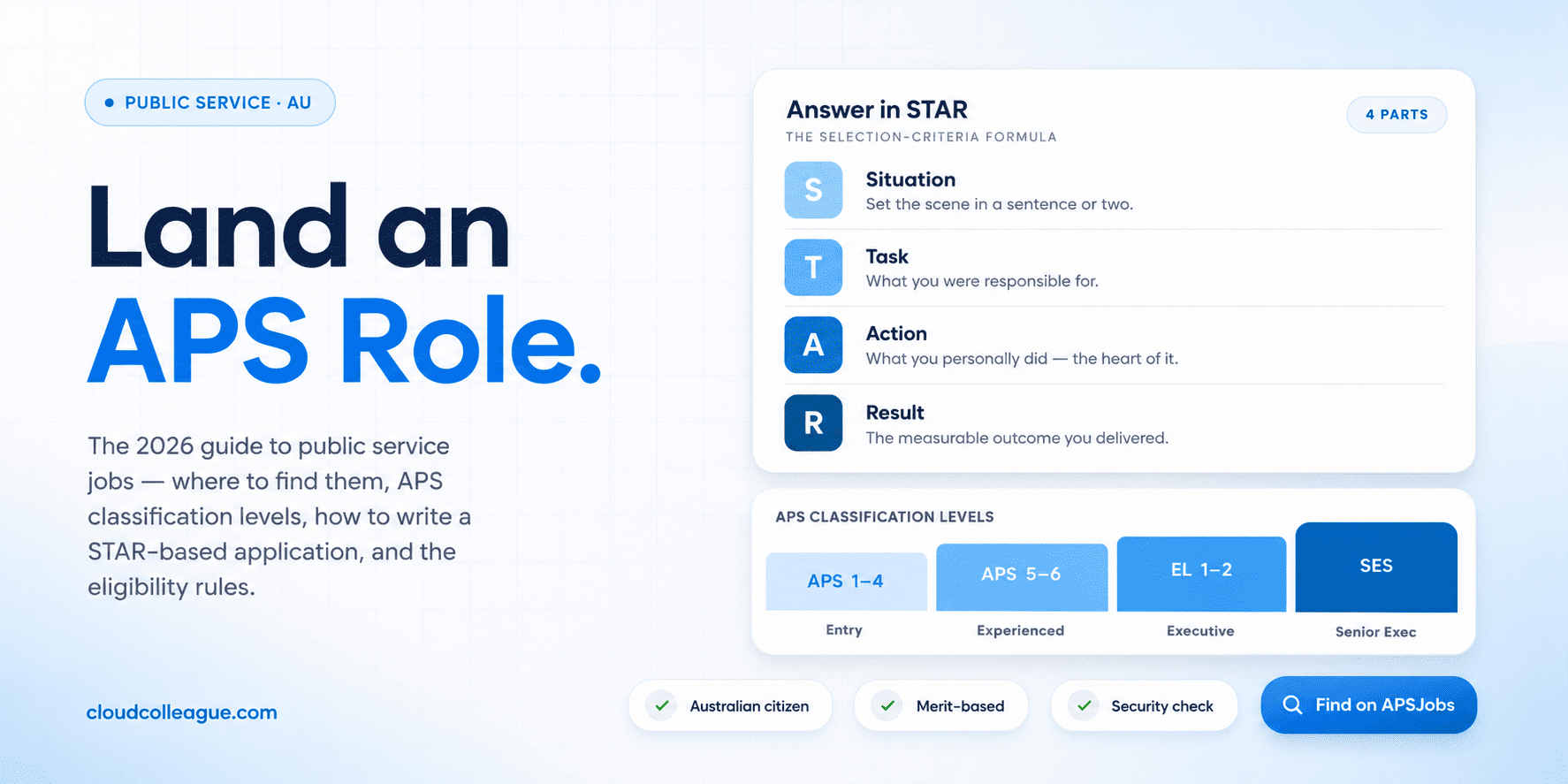
The Australian Public Service uses a clear classification structure, and understanding it helps you apply for the right level. Each step up means more responsibility, higher pay, and greater expected capability. The table below summarises the structure with indicative 2026 salaries.
| Classification | Typical Responsibility | Indicative 2026 Salary |
| APS 1 to 2 | Entry-level admin and service delivery | From about $57,500 |
| APS 3 to 4 | Administrative, technical, and support roles | Around $65,000 to $80,000 |
| APS 5 to 6 | Professional, analytical, and project work | Around $85,000 to $110,000 |
| EL 1 to 2 | Executive level, team and project leadership | Around $115,000 to $160,000 |
| SES Band 1 to 3 | Senior executive, strategic leadership | $190,000 to about $293,000 |
APS 1 to 6 covers the bulk of roles, from entry-level administration through to senior professional and project work, with APS 5 and 6 being common entry points for graduates and experienced professionals. The Executive Levels, EL 1 and EL 2, are leadership and management roles. At the top, the Senior Executive Service, SES Bands 1 to 3, leads strategy across the APS. Selection panels score every application against the APSC Integrated Leadership System, which uses the same five capability clusters at every level, with higher expectations as you climb.
| Tip: apply for the level that matches your current capability, not the one you aspire to. Panels score against the work-level standards for that specific classification. |
How to Write a Public Sector Application
This is where most applicants succeed or fail. Public sector recruitment is merit-based, which means you must prove your suitability against the selection criteria with concrete evidence, not broad claims. The centrepiece of most applications is a pitch statement, usually one to two pages, that shows how your experience matches the role’s capabilities and duties.
The most effective way to structure your examples is the STAR method. For each point, describe the Situation you faced, the Task you were responsible for, the Action you personally took, and the Result you achieved, ideally with a measurable outcome. Be specific, lead with your own contribution rather than the team’s, and quantify results wherever you can. If you are moving from the private sector, focus on transferable skills and translate your achievements into the language of the job ad.
A few practical rules lift your application above the rest. Tailor every pitch to the specific role, since generic applications rarely progress. Respect word limits, because overly long answers can count against you. Make your resume tell a clear, complementary story rather than repeating the pitch. Finally, brief your referees on the role so their feedback reinforces your claims.
| Building your application? Start as a Seeker and create a profile to keep your work history and achievements organised and ready to adapt for any role. |
Eligibility: Citizenship and Residency
Eligibility is the first thing to check, because it can rule a role in or out before you invest time in applying. Most Australian Public Service jobs require you to be an Australian citizen by the time the recruitment process is complete, although individual agencies can choose to employ non-citizens in some cases. Security-sensitive departments, such as Defence and Home Affairs, almost always require citizenship and the ability to obtain a security clearance.
Some roles carry additional conditions. Certain positions are open only to existing APS employees, and identified positions are designed for candidates with an understanding of Aboriginal and Torres Strait Islander issues, open to both Indigenous and non-Indigenous applicants. State and local government roles are often more flexible on residency, so permanent residents can apply more widely. If you are still sorting out your right to work, our guide to the Australian work visa explains your options. Always read the eligibility section of each job ad carefully before applying.
Read Next: Receptionist Jobs in Sydney: Listings & Tips
Frequently Asked Questions
Public servant jobs are roles in government, spanning federal, state, and local levels. They cover everything from administration and policy to healthcare, IT, and frontline service delivery, and are known for job security, structured progression, and strong benefits such as 15.4 percent superannuation in the APS.
Most Australian Public Service roles require you to be an Australian citizen by the time the recruitment process is complete, though individual agencies can make exceptions. Security-sensitive departments such as Defense and Home Affairs almost always require citizenship.
STAR stands for Situation, Task, Action, and Result. It is a structure for answering selection criteria by describing a real example: the context, your specific responsibility, the actions you took, and the measurable outcome you achieved.
The APS runs from APS 1 to APS 6 for entry to senior administrative and professional roles, then Executive Levels EL 1 and EL 2 for leadership, and finally the Senior Executive Service, SES Bands 1 to 3, for the most senior leaders.
It is usually slower than the private sector, often several weeks to a few months, because it involves written applications, capability-based interviews, reference checks, and sometimes security clearances. Many roles also create merit pools for future vacancies.