Counselling jobs in Melbourne are growing fast, driven by rising demand for mental health support across schools, healthcare, community services, and private practice. Whether you are newly qualified or an experienced practitioner, Victoria’s capital offers a wide range of roles and clear pathways to build your career. This guide covers the main types of counselling work in Melbourne, the qualifications and registration you need, what the roles pay, where to look, and how to make your application stand out.
| Looking for your next counselling role? Start as a seeker on CloudColleague or Browse a task that matches you. |
Types of Counselling Roles in Melbourne
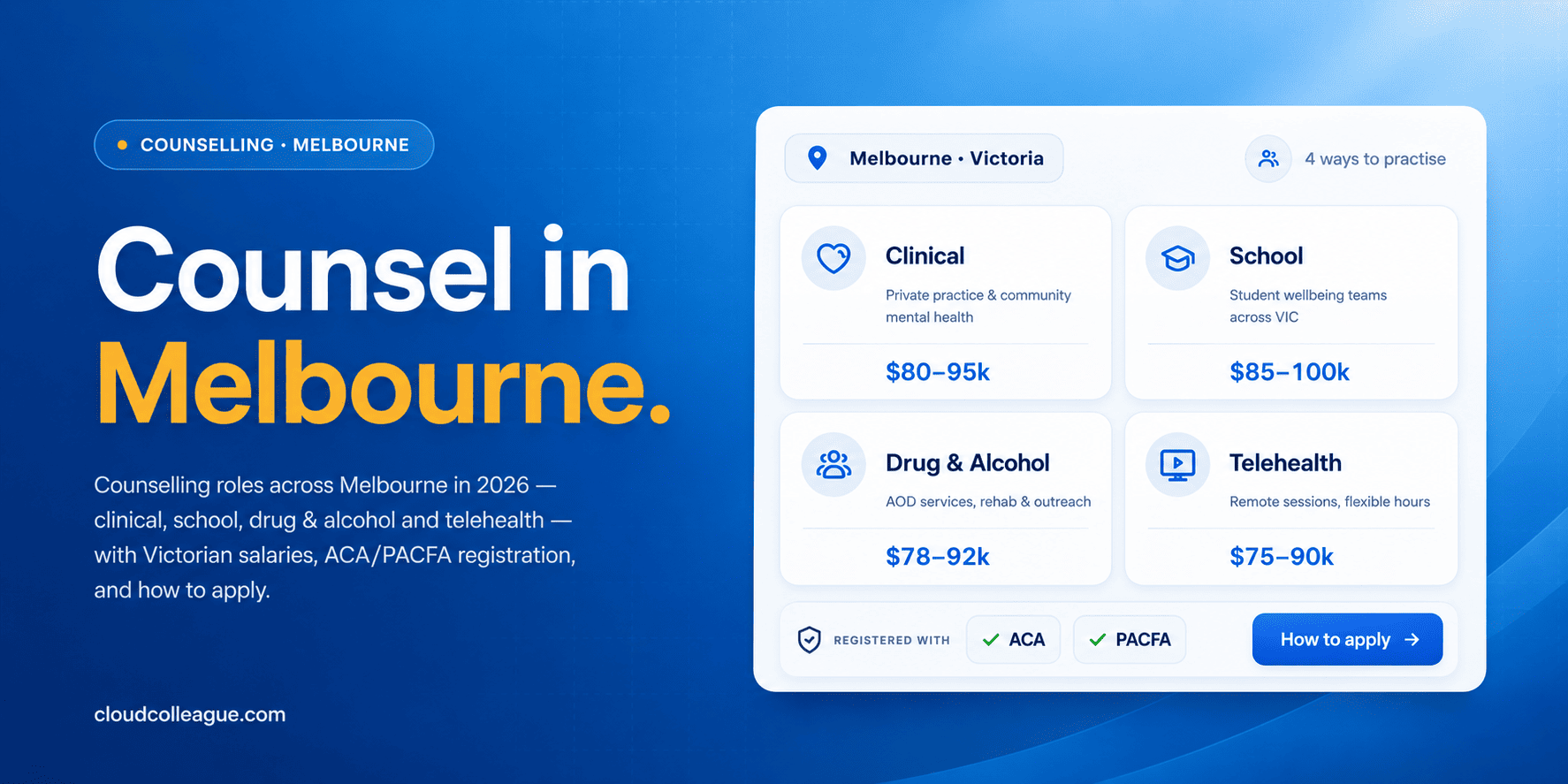
Counselling in Melbourne spans many settings, and choosing the right niche helps you target your search. Clinical and mental health counsellors work in healthcare, hospitals, and community organisations, often supporting people through anxiety, depression, and trauma. School counsellors support students’ wellbeing and development within primary and secondary schools, a steady source of roles across the city.
Drug and alcohol counsellors work in dedicated rehabilitation and community health services, helping clients through recovery, and this is a consistently in-demand specialty. Telehealth counselling has expanded rapidly, with many roles delivering sessions remotely across private, employee assistance program (EAP), and NDIS pathways, which suits practitioners who want flexible or partly remote work. Family, relationship, and rehabilitation counselling round out the common options.
Read Next: Delivery Jobs in Australia: Complete Guide
Qualifications and Registration
Counselling in Australia is self-regulated, meaning there is no single government licence like AHPRA registration for psychologists. Instead, credibility comes from membership of a professional body, and most Melbourne employers expect it. The two main bodies are the Australian Counselling Association (ACA) and the Psychotherapy and Counselling Federation of Australia (PACFA).
Your qualification determines which body you can join. A Diploma of Counselling makes you eligible for ACA Level 2, which lets you practise, access professional indemnity insurance, and use the ACA post-nominals. PACFA requires a minimum bachelor-level qualification in counselling or psychotherapy, and it is often preferred for clinical and senior roles. For most people, the ACA is the natural starting point, with PACFA as a goal once further study is complete. Both bodies require ongoing professional development and clinical supervision each year, so factor that into your plans.
| Tip: registration is more than a formality. Job ads in Melbourne routinely list ACA or PACFA membership as a requirement, so getting registered early widens the roles open to you. |
Typical Salaries in Victoria
Counselling pay in Victoria is solid and scales clearly with qualifications, experience, and specialization. The table below shows indicative ranges across career stages.
| Career Stage | Typical Requirement | Indicative Pay |
| Graduate / entry-level | Diploma + ACA Level 2 | $70,000 to $80,000 |
| Experienced counsellor | Bachelor or further study | $80,000 to $96,000 |
| Senior / specialist | Postgrad + PACFA clinical | $96,000 to $116,000 |
| Private practice | Established client base | $150 to $200 per session |
Most employed counsellors in Melbourne earn between $78,000 and $96,000, with senior and specialist roles reaching into the low six figures. Specialising in a high-demand area such as mental health, trauma, or family counselling lifts your earning power, as does building toward private practice over time. Because counselling overlaps with the broader mental health sector, it is worth tracking mental health vacancies too, since many employers hire across both areas.
Top Employers and Where to Look
Melbourne’s counselling employers fall into a few clear groups. Community health organizations and not-for-profits are among the largest, and many offer attractive salary packaging that boosts take-home pay. Public and private hospitals, headspace centers, schools and universities, and specialist drug and alcohol services all hire regularly, as do EAP providers and NDIS-registered organizations delivering telehealth.
To find these roles, combine the major job boards with sector-specific sources. The PACFA website lists roles that often pay above average, and community-sector boards are strong for not-for-profit positions. For a broader view of the Victorian market beyond counselling, see our guide to jobs in Victoria, and set up alerts so you see new Melbourne roles first.
How to Apply and Stand Out
A focused, well-evidenced application wins counselling roles. Start by making your registration status clear at the top of your resume, since it is often the first thing employers screen for. Tailor each application to the setting, because the skills valued in a school differ from those in a drug and alcohol service or a telehealth EAP role.
Show, do not just tell. Use specific examples of your client work, the modalities you are trained in, such as cognitive behavioural therapy or acceptance and commitment therapy, and the outcomes you have supported, while respecting confidentiality. Highlight your supervision and professional development, as these signal you are a safe, ethical practitioner. If you are newer to the field, emphasise placement experience and any volunteer or peer-support work. Finally, prepare for scenario-based interview questions about risk, boundaries, and how you would respond to a client in distress.
| Ready to apply? Search counselling roles on CloudColleague or create your free profile to connect with Melbourne employers across health, community, and telehealth services. |
Frequently Asked Questions
Most counsellors in Melbourne earn between $78,000 and $96,000, with graduates starting around $70,000 to $80,000 and senior or specialist roles reaching $116,000. In private practice, established counsellors often charge $150 to $200 per session.
Counselling is self-regulated rather than government-registered, but most employers require membership with the ACA or PACFA. ACA Level 2 is available to Diploma graduates, while PACFA requires a minimum bachelor-level qualification.
Both are leading professional bodies. The ACA is the largest and accepts Diploma graduates at Level 2, making it the common first step. PACFA requires a bachelor’s degree or higher in counselling or psychotherapy and is often preferred for clinical and senior roles.
Yes. The counselling workforce is projected to grow by roughly 15 to 20 percent over five years, well above the national average, driven by rising demand for mental health, family, and telehealth services.
Yes. Telehealth counselling has grown quickly, with many roles delivering sessions across private, employee assistance program (EAP), and NDIS pathways, offering flexible and often remote work.