Australia’s job market in 2026-27 is the tightest it has been in over a decade. According to the Jobs and Skills Australia September 2025 Occupation Shortage Report, the national vacancy fill rate sits at just 70.2%, with Skill Level 3 trades roles down at 54.3%. In plain terms, employers cannot fill many of the roles they advertise, and skilled job seekers have unusual leverage. Here is the verified list of careers in highest demand right now, with salary ranges, qualifications, and where the work is.
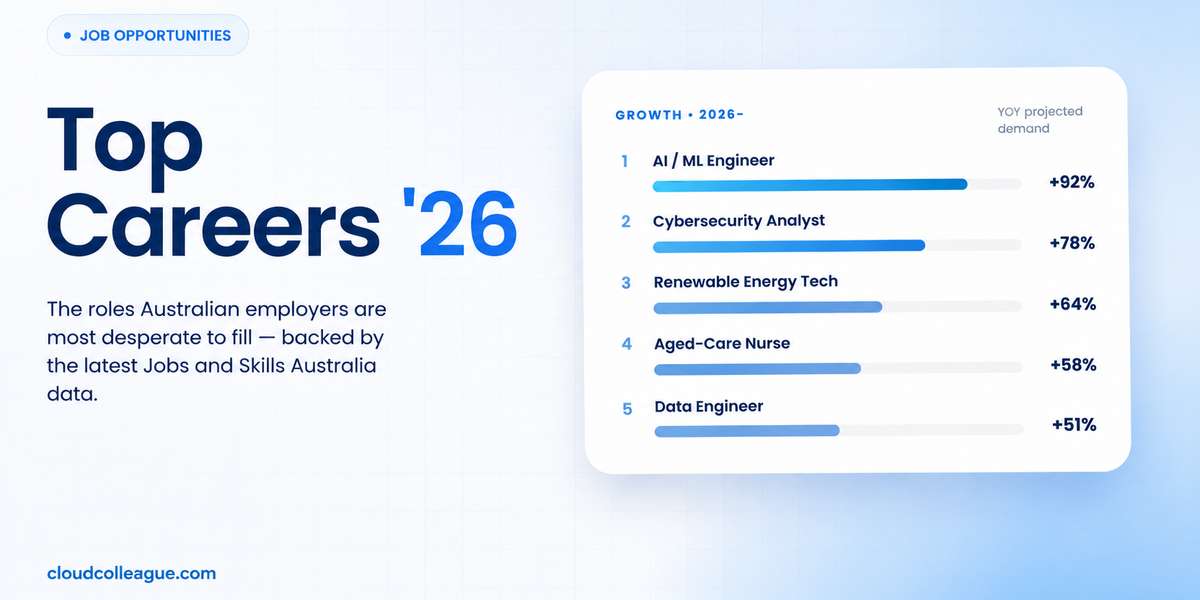
| Quick Answer: The Top High Demand Careers in Australia for 2026-27 According to the Jobs and Skills Australia September 2025 Occupation Shortage Report and the Hays 2026 Jobs Report, the careers in highest demand in Australia for 2026-27 are registered nurses, general practitioners, accountants, software developers, secondary school teachers in STEM, electricians, civil engineers, cybersecurity specialists, aged care workers, and construction managers. Healthcare and trades dominate the shortage list, with 139 occupations in persistent shortage every year from 2021 to 2025. |
Why So Many Australian Careers Are in Shortage Right Now?
Three structural forces are driving demand at the same time. First, an aging population is expanding healthcare and aged care faster than the workforce can grow. Second, the infrastructure pipeline across federal and state governments is keeping trades and engineering roles in chronic short supply. Third, digital transformation across every industry is pulling in software developers, cybersecurity specialists, and data professionals at a rate that universities and TAFEs cannot keep up with.
Jobs and Skills Australia data confirms the scale: 139 occupations have been in persistent shortage every year since 2021, and the shortage is concentrated in skilled, qualified roles, not entry-level work. For job seekers with the right qualifications, this is the strongest leverage market in a decade.
The Top 10 High Demand Careers in Australia for 2026-27
1. Registered Nurse
Registered nurses sit at the top of the Jobs and Skills Australia Occupation Shortage List for the fifth consecutive year, driven by Australia’s ageing population and the expansion of healthcare and social assistance.
- Salary: $75,000 to $110,000 depending on specialisation
- Qualifications: Bachelor of Nursing, AHPRA registration, around 3 years to job-ready
- Hiring hotspots: All states, with particular shortage in regional Australia
2. Aged Care and Disability Support Worker
The single largest projected workforce growth area in Australia by absolute numbers, according to the Productivity Commission and ABS workforce data.
- Salary: $55,000 to $75,000
- Qualifications: Certificate III in Individual Support, around 6 months to job-ready
- Hiring hotspots: Nationwide demand, particularly in regional areas
3. Software Developer
Consistent shortage across every Australian state on the Jobs and Skills Australia Skills Priority List, with demand outpacing supply since 2020.
- Salary: $85,000 to $160,000, with senior engineers earning $180,000 or more
- Qualifications: Bachelor’s degree, coding bootcamp, or self-taught with a strong portfolio, 1 to 3 years to job-ready
- Hiring hotspots: NSW, Victoria, Queensland
4. Cybersecurity Specialist
Robert Half identifies cybersecurity as a critical shortage area in 2026, driven by the rise in high-profile Australian data breaches and the move of business workloads to the cloud.
- Salary: $110,000 to $200,000
- Qualifications: Industry certifications such as CISSP, AWS Security, or equivalent, plus 2 to 4 years of experience
- Hiring hotspots: All capital cities, with particular concentration in Canberra and Sydney
5. Secondary School Teacher (STEM Specialisations)
A long-term structural shortage in maths, sciences, and technology teaching, overseen by the Australian Institute for Teaching and School Leadership (AITSL).
- Salary: $80,000 to $115,000
- Qualifications: Bachelor of Education or postgraduate teaching qualification (Master of Teaching), 4 years (or 2 with a prior degree)
- Hiring hotspots: Regional Australia has the strongest demand, often paired with relocation incentives
6. Electrician
Jobs and Skills Australia reports a vacancy fill rate of just 54.3% for Skill Level 3 trades, the most severe shortage band tracked nationally. The renewable energy transition is amplifying demand.
- Salary: $90,000 to $130,000, with experienced electricians in Western Australia at the top of the range
- Qualifications: Electrical apprenticeship through TAFE, 4 years
- Hiring hotspots: WA, NSW, Queensland
7. Civil Engineer
Federal and state infrastructure pipelines are driving sustained demand for structural, civil, and grid engineering professionals.
- Salary: $90,000 to $160,000
- Qualifications: Bachelor of Engineering, Engineers Australia accreditation, 4 years to job-ready
- Hiring hotspots: All capital cities, with strongest demand in NSW and Victoria
8. Accountant
The Hays 2026 Jobs Report names accounting professionals “sought across the board, particularly at intermediate level”, noting that a decline in people undertaking accounting degrees is widening the skills gap. Technical financial accountants, management accountants, finance managers, and payroll officers are all in shortage.
- Salary: $75,000 to $140,000
- Qualifications: Bachelor of Commerce or equivalent, CPA Australia or CA pathway, 3 to 5 years to fully qualify
- Hiring hotspots: Sydney, Melbourne, Brisbane
9. Construction Manager
Driven by the national infrastructure pipeline and housing supply pressure, construction management is one of the highest paid in-demand roles in Australia.
- Salary: $130,000 to $220,000
- Qualifications: Bachelor’s in construction management or experience pathway, 4 to 8 years to senior roles
- Hiring hotspots: Sydney, Melbourne, Brisbane, Perth
10. Data Engineer / Data Analyst
Morgan McKinley names Data Engineer one of the top five in-demand roles in Australia for 2026, citing critical importance for AI readiness and cloud optimisation. The National Skills Commission ranks data analysts and ICT business analysts on the annual skills priority list.
- Salary: $90,000 to $170,000
- Qualifications: Bachelor’s degree (Computer Science, Maths, or related) plus tool experience in SQL, Python, Tableau, and Power BI, 2 to 4 years to job-ready
- Hiring hotspots: NSW, Victoria, Queensland
High Demand Careers by Salary Band
| Salary Band | Example Roles from the List |
| Entry-level ($55k to $80k) | Aged care worker, early-career nurse, junior accountant |
| Mid-range ($80k to $130k) | Senior registered nurse, STEM teacher, civil engineer, electrician, junior software developer |
| High earning ($130k to $220k+) | Cybersecurity specialist, senior software engineer, construction manager, senior data engineer |
Lower-band roles often offer the fastest entry routes, while higher-band roles trade entry speed for long-term earning ceiling.
How Demand Is Measured?
This list is built on verified Australian labour market data, not opinion. Jobs and Skills Australia uses the Survey of Employers who have Recently Advertised (SERA) combined with the vacancy fill rate as its core measure. Occupations with fill rates below 67% are classed as “high chance of being in shortage”. The national fill rate currently sits at 70.2%, with trades at 54.3%, signalling widespread shortage.
The list above cross-references the September 2025 JSA Occupation Shortage Report, the Hays 2026 Jobs Report, the Robert Half Salary Guide 2026, and the Morgan McKinley 2026 in-demand roles list.
Ready to apply for high-demand roles right now? Most of the careers listed above are actively hiring on CloudColleague. The platform brings together full-time jobs, freelance tasks, and contract projects in one place, including roles in nursing, software development, trades, accounting, and engineering. Browse open opportunities and apply directly.
Where to Apply for High Demand Jobs in Australia in 2026-27?
Australia’s major job platforms include SEEK, Indeed Australia, CloudColleague, and LinkedIn for general roles. For job seekers who want full-time positions, freelance tasks, and short projects on the same platform, CloudColleague is purpose-built for the Australian market and includes most of the high-demand career categories above.
Professional body job boards are also worth checking directly. Engineers Australia, AHPRA’s career pages, and CPA Australia all list specialist roles that do not always appear on the major platforms. Direct employer career pages often move faster than aggregators, particularly for senior roles where employers want to skip third-party recruiters.
In a shortage market, speed matters. Applying within 48 hours of a role being posted significantly improves shortlisting odds.
Your Next Step As A Job Seeker
In a market where 30% of vacancies are going unfilled, the right job is closer than most candidates think. The careers listed above are not future predictions, they are roles hiring right now across Australia.
Most of the high-demand careers above are actively hiring on CloudColleague. Whether you want a full-time role, a contract, or freelance project work alongside your current job, CloudColleague brings them together in one platform. Create your profile, set up job alerts for the careers that match your skills, and start applying today.
Frequently Asked Questions About High Demand Careers in 2026-27
According to the Jobs and Skills Australia September 2025 Occupation Shortage Report, the highest demand careers in Australia for 2026-27 are registered nurses, general practitioners, software developers, secondary teachers (STEM), electricians, civil engineers, cybersecurity specialists, aged care workers, accountants, and construction managers.
Cybersecurity specialists, senior software engineers, and senior construction managers earn the highest salaries among in-demand roles, with experienced professionals earning $180,000 to $220,000 according to the Hays 2026 Jobs Report and Robert Half Salary Guide.
139 occupations have been in persistent shortage every year from 2021 to 2025 according to Jobs and Skills Australia. The shortage is concentrated in healthcare, engineering, education, ICT, and skilled trades, with Skill Level 3 trades roles hitting a 54.3% vacancy fill rate.
Yes. Skill Level 3 trades occupations have a vacancy fill rate of just 54.3%, the most severe shortage band tracked by Jobs and Skills Australia. Electricians, plumbers, and carpenters remain among the most in-demand roles, particularly in Western Australia and regional areas.
New South Wales and Victoria lead in professional and tech roles, Queensland and Western Australia lead in trades and engineering, and regional Australia has severe shortages in healthcare, education, and trades, often paired with relocation incentives.
Healthcare, aged care, renewable energy, cybersecurity, AI and data, defence and engineering, construction, and education are projected to grow strongly through to 2036 according to Jobs and Skills Australia and CSIRO workforce projections.